Awaji

Awaji, Kongo-ryu utaibon

On May 12th I’m going to sing in the chorus for the maibayashi (dance and music excerpt) from the Noh Awaji at the Ninomaru Castle Takigi Noh in Matsuyama (Ehime pref.). This time the shite is going to be Higaki Takafumi, while Udaka Michishige is going to lead the chorus.

It is the first time for me to study Awaji, a first category (god Noh) celebratory piece which is not performed as often as other plays from the same groups such as Takasago. In fact the utaibon libretto is only available in the kyūhon ‘old book’ format, with kuzushi-ji cursive characters and hentaigana alternative phonetic writing, making it rather hard to read even for Japanese native speakers. I have recently purchased a lot of these old books, which reminds me that I should soon or later write a post comparing new and old utaibon writing and notation style.

As for Awaji, it follows the typical first category structure: imperial officers are on their way to visit Awaji, thought to be the first island to be created when the godly couple Izanami and Izanagi stirred the primordial sea with a spear. The brine dropping from the spear hardened into islands, thus creating the Japanese archipelago. The officers meet an old man cultivating a rice field attached to a shrine and discuss with him the name Ni-no-miya shrine, an appellation that suggests the two gods Izanami and Izanagi, representing the actions of sowing and reaping. Quoting from ancient poems, the old man chants the fertility of the Japanese soil. Soon the old and mysterious man disappears, only to re-enter in the second half of the play as the male god Izanagi, dancing and bestowing long life and happiness to the land.

Shochiku Kabuki X Uniqlo = Iemoto Noh X Nothing?

150212-kabuki-img01

Popular Japanese apparel company Uniqlo has teamed up with Kabuki management company Shochiku to produce a series of t-shirts, trousers and accessories using Kabuki costume pattern designs as well as well as kumadori make-up impression known as oshiguma. It makes a lot of sense to me: Kabuki costumes have great designs that look very ‘cool’ to the contemporary eye. So do Noh costumes, which served as models for Kabuki costumes in the early days. I hope that the Kabuki establishment will benefit from this mutual form of promotion, but I also ask myself why Noh is not doing this. It’s a rhetorical question: regardless of the more or less awkward attempts to popularise it, Noh remains an art for the elite. Its political system is elitarian, and so is the image it projects to the public. Uniqlo is a cheap fashion brand with a ‘pop’ international image. The two brands do not seem to go together. Most Noh people will agree with this, and rejoice in their elitarianism, leaving the cheap and pop stuff to Kabuki people. However some (a minority) Noh actors, especially the young generations, might disagree. This is the generation that will still be here in 30 years, and will experience the consequences of the current conservative policy enforced by the oligarchy of elders. What is more important? Maintain the elite as it is, or try to find new ways to get more people come to the half-empty Noh theatres?

The fourth Ryumon no Kai – Toru (Jusandan-no-mai)

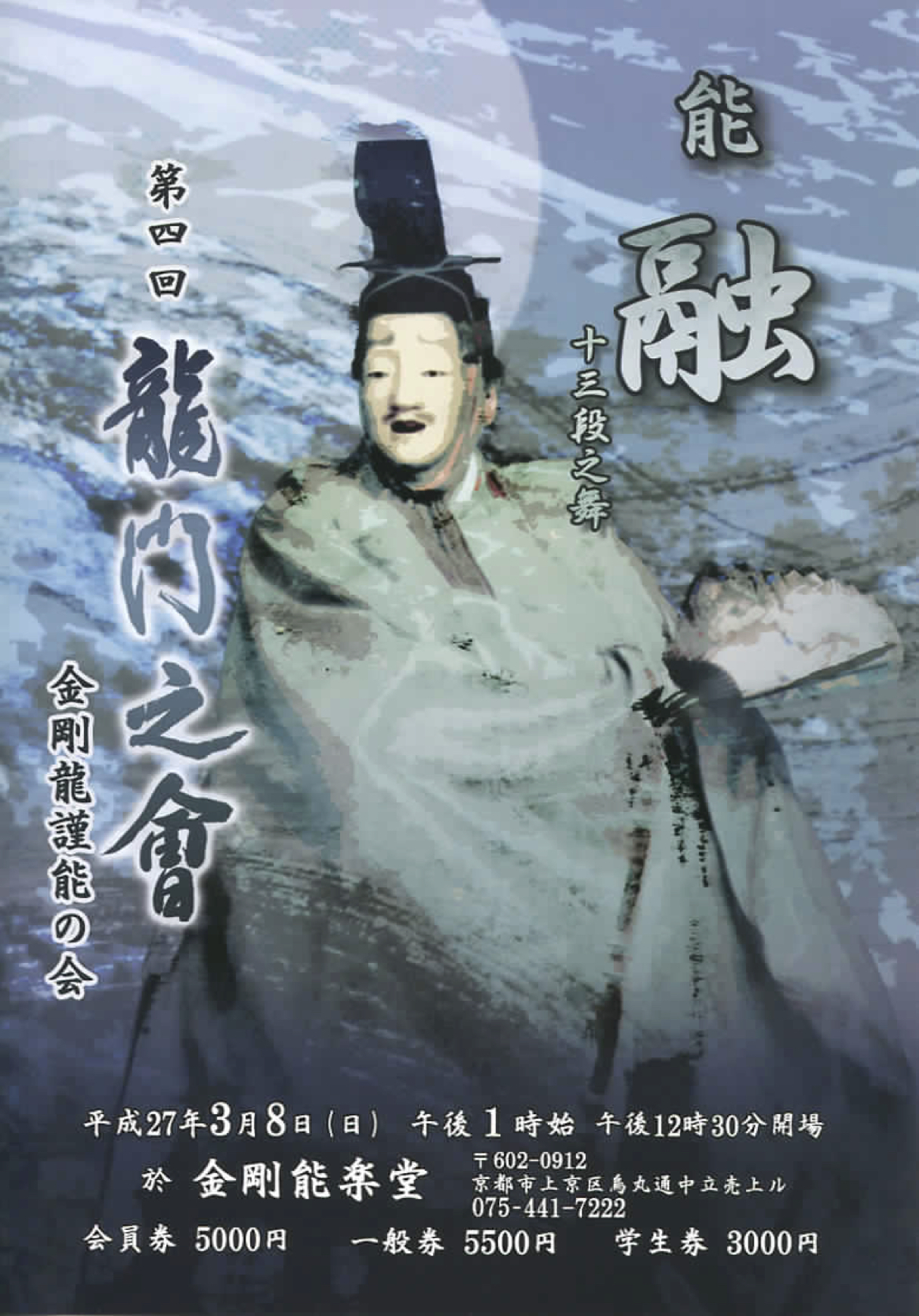
On Sunday 8th March 2015 at the Kongo Nogakudo, on the occasion of the fourth Ryumon no kai event, Kongo Tatsunori, son of the Iemoto Kongo Hisanori is going to perform the Noh Toru in the special variation Jusandan-no-mai.

The Minister Minamoto-no-Toru, son of Emperor Saga, who built a magnificent villa in Kyoto called Kawara-no-in where he created a replica of the salt kilns of Shiogama in present day Miyagi prefecture. Toru is a highly evocative and dramatic Noh with a noble dance in the Jusandan-no-mai, Dance in Thirteen Movements variation, at the end of the Noh, in which the standard five movement dance is repeated in the Banshiki mode related to the element water, closing with three movements of the Kyu-no-mai, Rapid Dance.

The 4th Ryumon-no-kai

Time: Sunday 8th March 2015 from 13:00 (doors open at 12:30)

Place: The Kongo Noh Theatre Nakadachiuri-agaru, Karasuma-dori, Kamigyo-ku, Kyoto. 602-0912. Subway Karasuma-Imadegawa (K06), South Exit (n.6). Walk South 300m. MAP >>

Tickets: regular admission 5,500yen, students 3,000yen

Program:

Shimai: Naniwa, Futari Shizuka, Yoroboshi.

Kyogen: Hagi Daimyo Shigeyama Shime

Shimai: Sesshoseki – Kongo HIsanori

Noh: Toru (Jusandan-no-mai) Kongo Tatsunori

龍門之会(表) 龍門之会(裏)

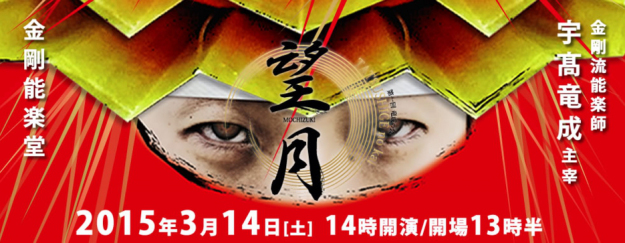
The first Tatsushige no kai: “Mochizuki” 14 March 2015

Young actor Tatsushige Udaka makes his debut in the vendetta play Mochizuki. I bet you never thought that Noh could be so AMAZING. Come see for yourself on March 14th.

inikyoto's avatarThe International Noh Institute

Udaka Tatsushige (Photo: Stephane Barbery)

On 14 March 2015 Udaka Tatsushige (first son of the INI founder Udaka Michishige) will hold the first Tatsushige no Kai, an annual Noh performance event he is producing, featuring high-caliber actors and musicians. Each year Tatsushige is going to take the main role in a particularly challenging play from the Kongo school repertoire. On the occasion of this first Tatsushige no Kai, Kongo Hisanori, grand-master of the Kongo School, has chosen for him the virtuoso Noh play Mochizuki. Family tickets and ‘next generation’ tickets for students and Noh theatre beginners are available!  Check out the full program in English here!


Mochizuki: March 14th 2015, 14:00-17:00 – Kongo Noh Theatre, Kyoto

tatsukai_ja_001

Mochizuki: the story

Mochizuki tells a story of revenge, celebrated in classical Japanese literature as an example of loyalty and selflessness in the face of injustice. Lord Tomoharu was assassinated…

View original post 766 more words

Noh/Kyogen performers – Call for applications


IMG_1830

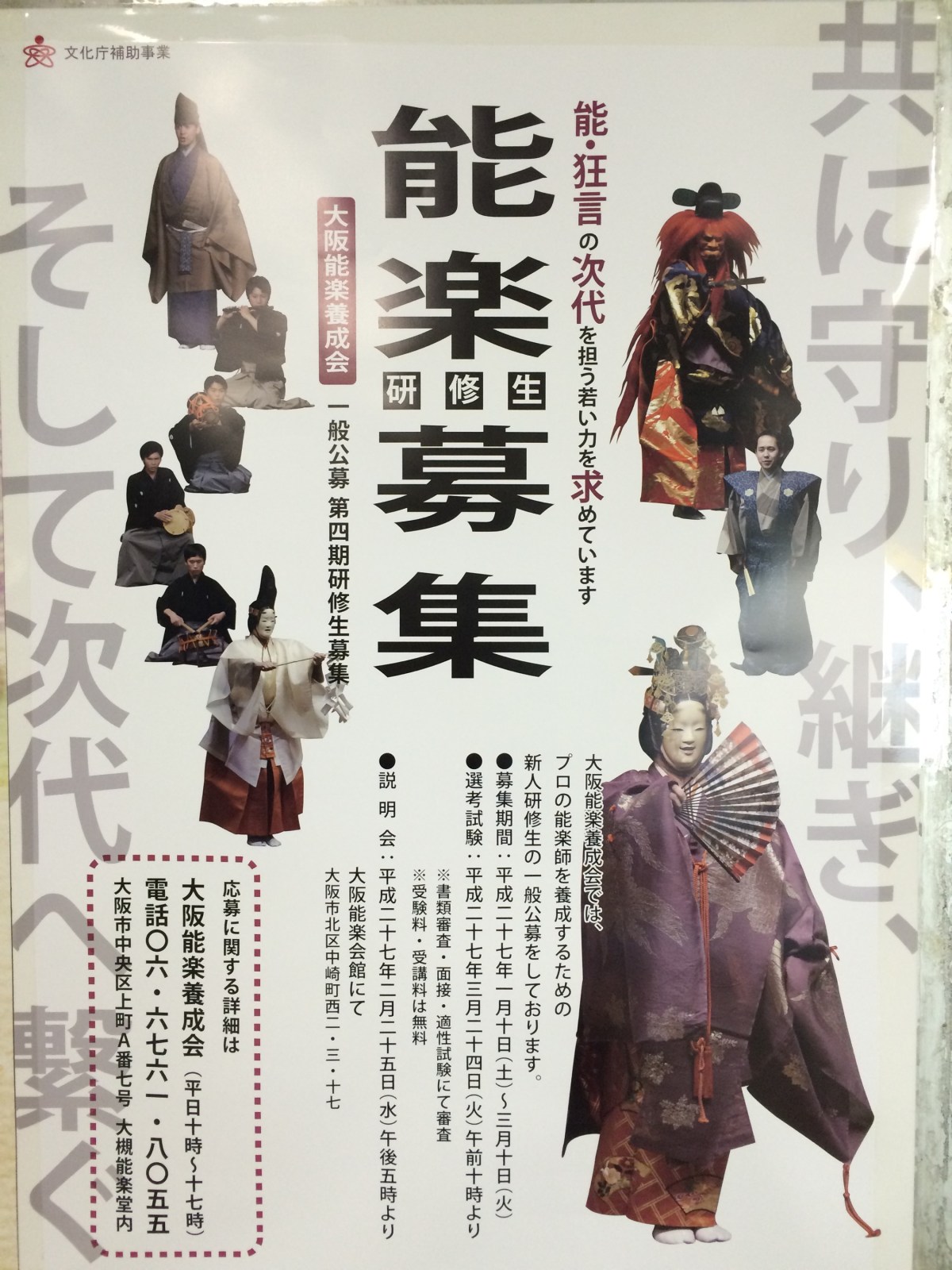
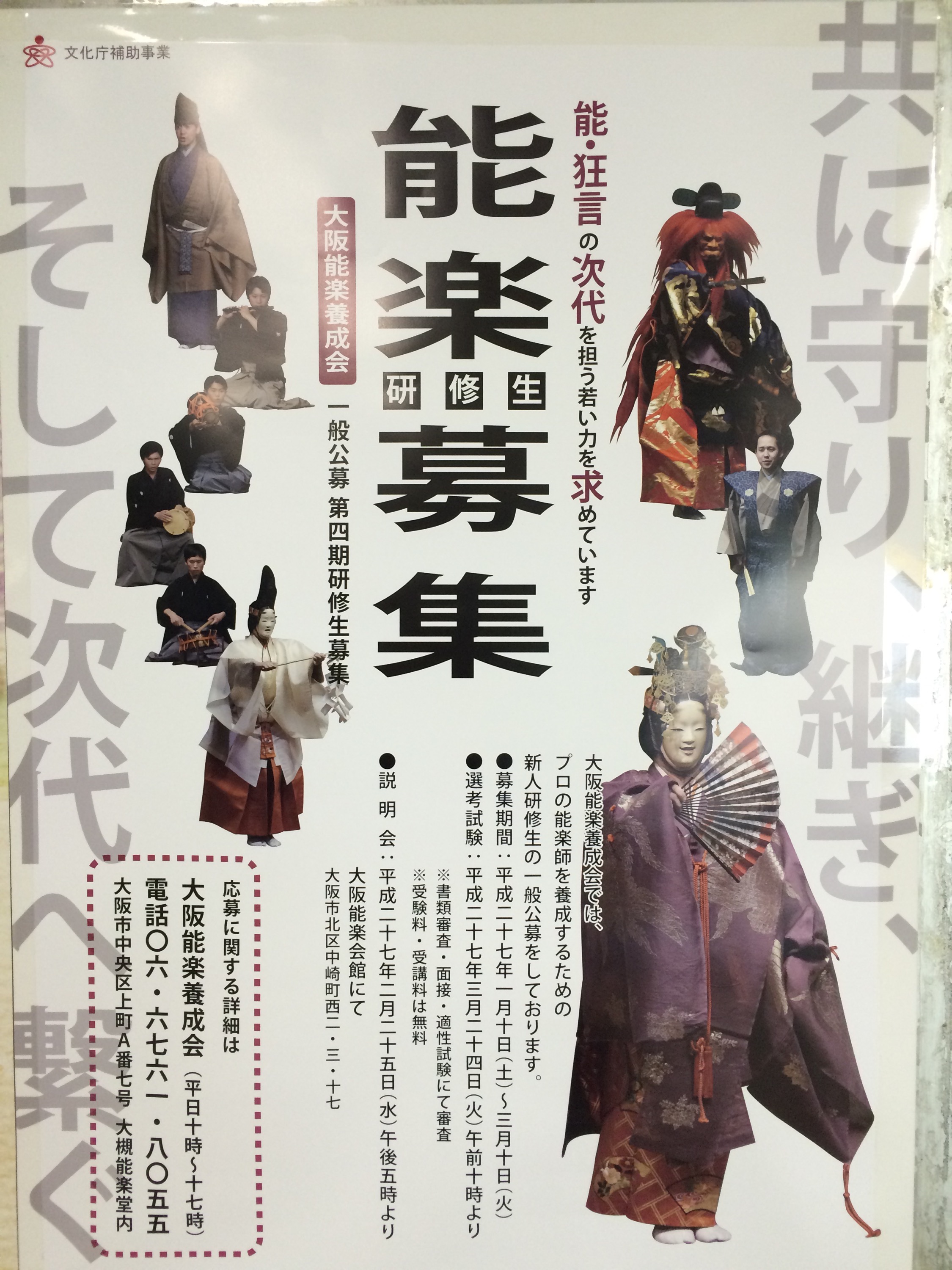
I spotted this on a wall in a subway the other day.


The Osaka Yosei-kai (Performers Training Association) has issued its annual performers call for applications. If you wish become a Noh or Kyogen professional, but you were not born within a family of professionals, you can apply to one of the courses the Yosei associations active in different areas of Japan offer. In order to apply you have to be a healthy individual between 15 and 23. There are two type of courses: one is reserved to those who can solely concentrate on practice, another to those who must also attend school, or have a day job. The Yosei-kai is one of the few Noh activities sponsored by the Japanese government via the Agency for Cultural Affairs.


Gallery

Close-up photographs of INI members’ Noh masks

inikyoto's avatarThe International Noh Institute

This year’s Men-no-kai Noh mask carving exhibition took place at the Kyoto Prefectural Center for Arts and Culture 28th-30th November. Among others three INI members, INI Senior Director Rebecca Teele Ogamo (USA), Kim Hea-Kyoung (South Korea), and Elaine Czech (USA) exhibited their latest works.

Czech carved a Ko-omote, one of the most popular Noh masks outside. It is also the first Noh masks that is carved by beginners. Despite its apparent simplicity, the Ko-omote is a very difficult mask to carve, and mask carvers often come back to it later in their mastery. Ko-omote (lit. ‘small face’) is used for main or secondary roles when the character is a young girl or, in some cases, a supernatural being. The face of Ko-omote is inspired by the aesthetic canons of the Heian period (794-1185), regarded as a golden-age of cultural sophistication and refinement. The face is painted in white, eyebrows…

View original post 225 more words