L’International Noh Institute – sezione Italia, è lieta di annunciare che nei giorni 9 e 10 ottobre la maestra Monique Arnaud terrà due lezioni di prova aperte al pubblico sulla recitazione ed il canto del teatro Noh presso lo spazio Continuum di Via Stendhal, 43 a Milano, ingresso libero dalle ore 15:00 alle ore 19:30. Sarà un’occasione di incontro e di riflessione per approfondire la propria conoscenza e la propria cultura del mondo Giapponese … Read More
Training
Exercises of Memory – Makura-Jido at Hourinji
On Friday, 10th September I joined Udaka Michishige’s performance of the Noh Makura-jido (枕慈童) at Hourinji temple (法輪寺) in the Arashiyama area. Another student of Sensei, Hanna McGaughey, has posted on this performance a couple of years ago. I served as a member of the ji-utai chorus, reason why I have been spending the week before the performance trying to learn the text: this exercise of memory has led to some reflections I would like to share. Memorising a Noh text is not an easy task first of all because of the 6-century old language used, rich in rare alternate readings and special pronunciations. Secondly, the lyrics do not always follow a narrative progression, but consist of more or less abstract associations of images and overlapping of textual layers. It is very hard to ‘make logical sense’ out of the lyrics in order to remember them as one remembers a dialogue with its causes and consequences. This does not mean a Noh text is completely deprived of logical sense, but that if one plans to rely only on ‘meaning’ in order to remember, he or she will face a very hard time.
The other night, at okeiko, while talking about this with Ogamo Rebecca Teele, international coordinator of the Udaka-kai and International Noh Institute, and first foreigner to become Noh professional in the history of Noh, I realised my difficulties are shared by many practitioners. We found out that one common way to approach the memorisation is to re-write the utai on separate sheets. This is not a mere ‘verbal’ exercise: as Japanese is an ideographic language, one does not write the ‘sounds’ of the lyrics, rather he paints the text, that slowly takes the form of a matrix of sounds and images. While singing, one visualises the ideograms that have a strong pictorial, hence evocative, component. Of course, the most common and effective way of memorising is listening to the lesson recording and repeating, repeating, repeating … ad libitum.
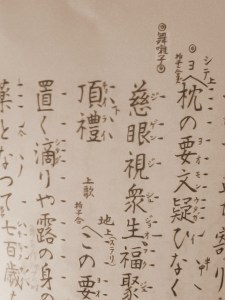
However, even in the repetition one might distinguish between learning by heart or learning by understanding. There is no time here but to make some superficial comments on this distinction. Where the first is a rather mechanical activity, in which one mostly focuses on the sounds, the second focuses on the meaning of the verses and relies on the logical or grammatical flow of the text in order to recall the words. As one might imagine, both methods are necessary combinable. What I found interesting is that the more my language proficiency grows, the more I naturally tend to rely on the memory of the meaning of the lyrics, immediately understandable, rather than on the sounds, which require time and repetition. However, relying on the meaning means that my brain needs to be in continuous conscious activity, focusing on what comes next in what I would describe as an ‘active’ recalling of the words. When I sing using this technique, I can hardly do anything else. If my minds get distracted by something else, the flow of meaning is interrupted, and I will skip some syllables trying to catch up with the delay. If, instead, I memorise by sound, which would at first appear as a rather ‘dull’ form of learning, I can easily multitask, as my brain is not ‘actively’ involved in thinking about the story, what came before and what comes next. Words come out automatically or instinctively.
I am not sure what sort of conclusion I want to draw after this but I would just want to encourage those who cannot understand Japanese. Memorising the sounds without the meaning is an excellent (the best) start in the training of utai. Focus on the breathing, on the emission, on the rhythm instead – those are the qualities that the audience will appreciate, rather than your understanding. First come the image, then the meaning – this is very close to another famous say by Zeami.
I feel thankful toward Udaka-sensei who allowed me to take part in the performance (I wonder how many foreigners had the privilege to be singing for a Noh professional actor of his caliber in a public performance) and I hope this chances will become more and more frequent as I refine my singing skills.
Dimenticando la mente comprendete il Nō: dimostrazione e laboratorio allo Shōbōzan Fudenji di Salsomaggiore (via International Noh Institute – Italy)
A Noh theatre workshop organised by the Italian branch of the INI – International Noh Institute, led by Shihan Monique Arnaud, the only licensed Noh instructor in Europe. Please click on the image below to be re-directed to the event page.

Cleaning up
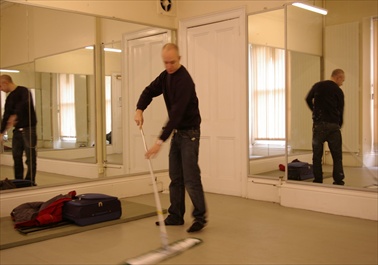
Studying Noh theatre requires a little bit of housekeeping before you start. Cleaning means preparing a space for someone or for something to come and getting ready to receive it. As a host prepares to receive a guest, the body and the mind of the trainee (and here we could argue on the distinction made) get rid of layers of dust that have been unconsciously covered floor and furniture and open the windows, letting fresh air come in.
‘The trainee needs to be like an empty cup’, says Udaka Michishige, my Noh teacher. Although it is utopic to talk in terms of ‘neutrality’, the trainee needs to get as close as possible to a condition in which he is not influenced by his pre-existent knowledge, experience, existence. Or at least it has to remain confined to an unconscious, unexplicit level. Without the will to put your former ‘I’ aside, the master will not be able to transmit a knowledge which is handed over in a one-to-one training process. I now wonder if the adjective 素直 (sunao – meek) doesn’t have any connection with the quasi-homophone verb 砂下ろし (sunaosuru – purify one’s stomach)…
 The Noh Diaries