17th Kongo Iwao II Memorial Performance

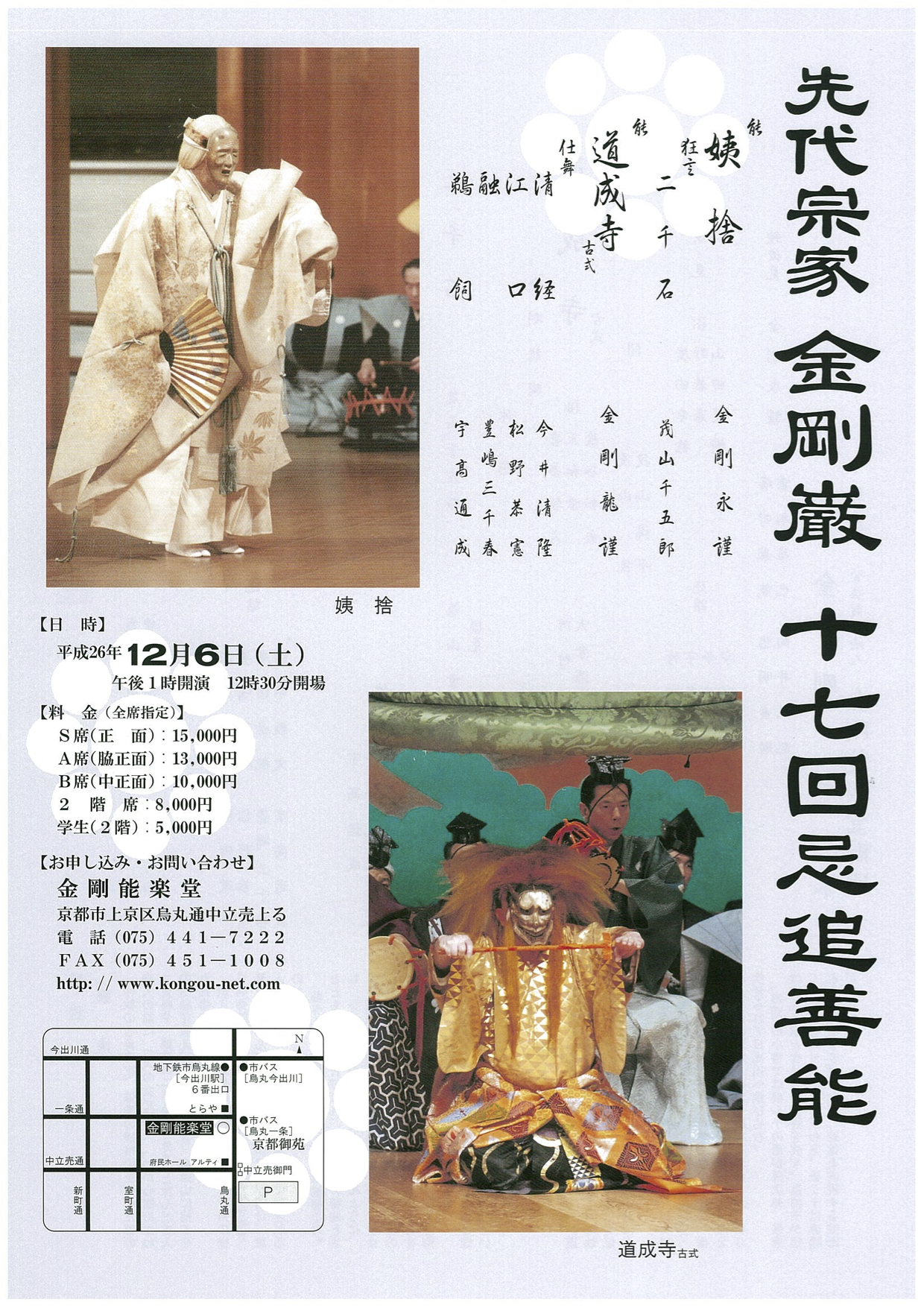
On Saturday 6th December 2014 from 13:00 to 17:00 the 17th Memorial Performance commemorating the late Iemoto (Head Master) Kongo Iwao II will take place at the Kongō Noh Theatre in Kyoto. This exceptional event will feature two special plays: Obasute, starring the current Iemoto, Kongō Hisanori, and Dōjō-ji (koshiki version) starring his son, Kongō Tatsunori. (See full program below. If you are interested in purchasing a ticket, contact me here).
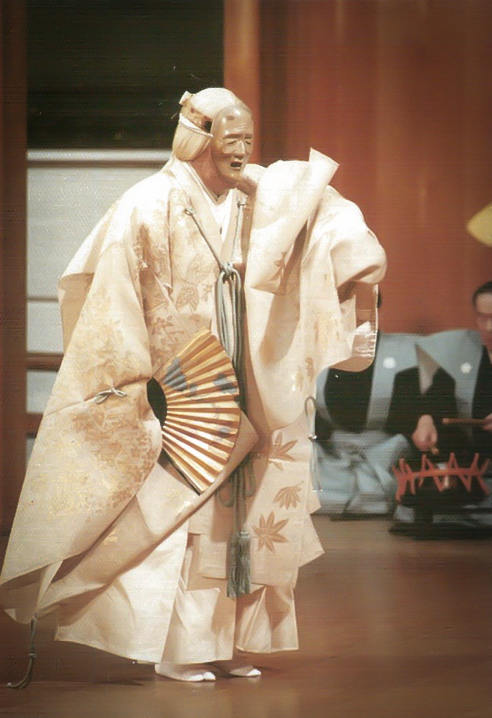
Obasute
Obasute

Obasute, by Zeami Motokiyo is one of the highest ranking plays in the Noh repertoire, and is based on the ancient Japanese legend of obasute-yama, a mountain where the elderly were abandoned by their own relatives, and left there to die. The legend of obasute-yama has been popularised by the famous film The Ballad of Narayama by Kinoshita Keisuke (1958 remade by Imamura Shōhei in 1983). In the Noh play Obasute, the spirit of a woman who was abandoned on Obasute-yama appears to a traveller who is visiting the area, and describes how her loneliness prevent her to break away from her attachments to this world and reach enlightenment. The play is pervaded by the imagery of the full moon, a buddhist symbol of enlightenment, also associated to the Seishi-bosatsu, Bodhisattva of Wisdom and companion of Buddha Amida.
Kongo Dōjōji koshiki

The story of Dōjō-ji is well known in Japan, also because of its Kabuki rendition. The play tells the story of a young woman whose impossible love for a monk transforms her into a deadly monster. After having learned about the girl’s feelings, the man finds refuge in a temple, where monks hide him under the bell. Realising his hiding spot, the woman, now transfigured into a monstrous snake, wraps herself around the bell. As her own snake-body burns with deadly passion, the bell melts along with the man hiding underneath. Years after this accident, a ceremony is held to celebrate a the rising of a new bell. The Abbot has prohibited women to enter the temple precincts, but a young and attractive girl comes knocking at the gates… This

17th Kongo Iwao II Memorial Performance

Time: Saturday 6th December 2014 – 13:00 to 17:00. Doors open at 12:30.

Place: Kongō Noh Theatre, Kyoto.

Noh: Obasute. Shite: Kongō Hisanori; Waki: Hōshō Kan; Flute: Sugi Ichikazu; Shoulder drum: Sowa Hiroshi; Hip drum: Kamei Tadao;  Stick drum: Maekawa Mitsunaga.

Kyōgen: Jisenseki. Shite: Shigeyama Sengorō: Ado: Shigeyama Dōji.

Noh: Dōjō-ji (koshiki) Shite: Kongō Tatsunori. Waki: Fukuō Kazuyuki; Flute: Takeichi Manabu; Shoulder drum: Okura Genjirō; Hip Drum: Kawamura Masaru; Stick drum: Maekawa Mitsunori.

Seating: S seats stage front 15,000¥; A seats stage side 13,000¥; B seats stage middle 10,000¥; balcony 8,000¥; students 5,000¥
17th Kongo Iwao II Memorial Performance

17th Kongo Iwao II Memorial Performance

[Video] Tatsushige no Kai – Mochizuki 2015

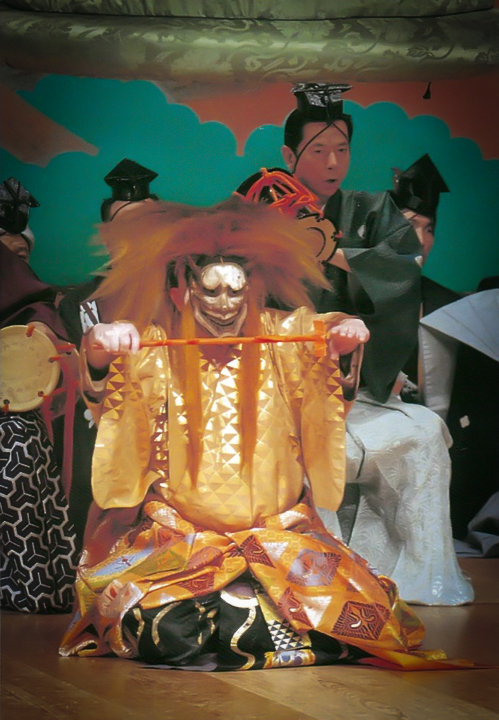
Udaka Tatsushige, son of the INI leader Michishige, will perform the virtuoso Noh Mochizuki on March 14th 2015 on the occasion of the first Tatsushige-no-kai series performance event. Mochizuki is a dramatic vendetta story featuring the famous lion dance, normally associated with the Noh Shakkyō, here performed by a man wearing a lion wig, golden fangs symbolising the lion’s jaws, and a red cloth to cover his face. You can watch here the promotional video of the event below.

Speaking of Mochizuki, this is a Meiji-period colour photograph of an actor dressed for the role of Kozawa no Gyōbu Tomofusa, the main character of the play, part of Albert Kahn’s Archives of the Planet.

Mochizuki - Albert Kahn

Basic questions

question-mark-440x440

The other day a Noh scholar asked me if I didn’t feel uncomfortable with Asian actors taking roles in opera productions. The question implied the fact that it is normal for the Japanese to be uncomfortable with non-Japanese taking roles in Noh theatre, and was supposed to merit a positive answer. My answer was simply ‘of course not’, as I didn’t really know where to start explaining why the answer could not be anything but ‘OF COURSE not’. When I am asked about foreigners in Noh I often use opera as a comparison, as I take for granted that most people accept that ‘European classical music’ is now an artistic patrimony of many countries in the world. I assume that no one is shocked to see a Korean soprano or a Japanese tenor singing arias written in 19th century Italy, for example. European classical music (I apologise for the awkward appellation) is part of the educational curricula of all Japanese schools. However, I realise that this should not be taken for granted, especially in environments as conservatives as that of Noh theatre. We really have a long way to go…

Present and Future of Noh seminar series

Today I am going to speak at the Fall Seminar series entitled Present and Future of Noh, organized by the Hosei University Noh Research Institute in Kyoto. I am honored to have been invited to talk about the International Noh Institute and Udaka Michishige. Today I will be presenting along with shite actor Kanze Yoshimasa and Kyogen actor Nomura Manzō. I am looking forward to the talk and I will be posting again after the event.

頑張ります!IMG_1113.JPG

30th Matsuyama Shimin Noh 2014 – Midare

I am privileged to be in the jiutai chorus for Midare (find me under my stage name, 高谷大悟). I will also be dancing the shimai from the Noh Kantan in the recital before the main event, and will also be singing in the small chorus for a cluster of shimai. Short, maybe, but actually very challenging!

inikyoto's avatarThe International Noh Institute

This year the Matsuyama Shimin Noh celebrates its 30th anniversary! On November 3rd 2014 Udaka Tatsushige, Michishige’s elder son, will perform the Noh Midare, a special variation (kogaki) of the Noh Shōjō. Udaka Norishige, his younger brother, will perform the maibayashi (chant and dance excerpt with instrumental dance) from the Noh Takasago.

From 10:00 to 14:30 students of Udaka Michishige will perform dance and chant excerpts. INI members will also participate with the following shimai: Rebecca Teele Ogamo (小鴨梨辺華): Ochiba, Diego Pellecchia (高谷大悟): Kantan, Elaine Czech: Ukon. The performance of Takasago and Midare will begin at 15:00.

matsuyama_14_final

30th Matsuyama Shimin-Noh performance

3 November 2014 Matsuyama (Ehime prefecture) Dogo Yamatoya Nohgakudo 10:00 – 17:00

Part I (10:00 – 14:30)
Student recital of chant and dance – free of charge

Part II (15:00 – 17:00)
Maibayashi: Takasago. Shite: Udaka Norishige
Noh:  Midare. Shite: Udaka Tatsushige

Tickets: General…

View original post 418 more words

Featuring Via

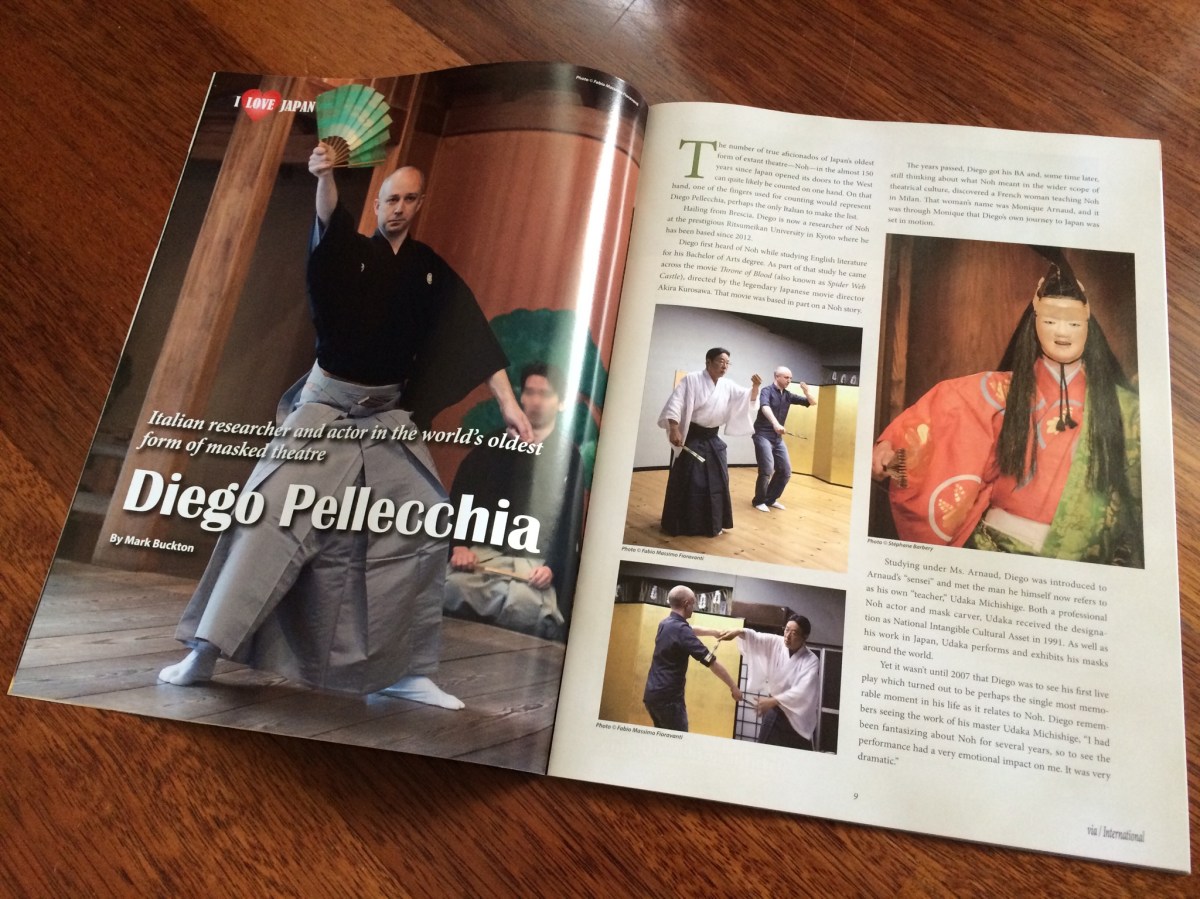
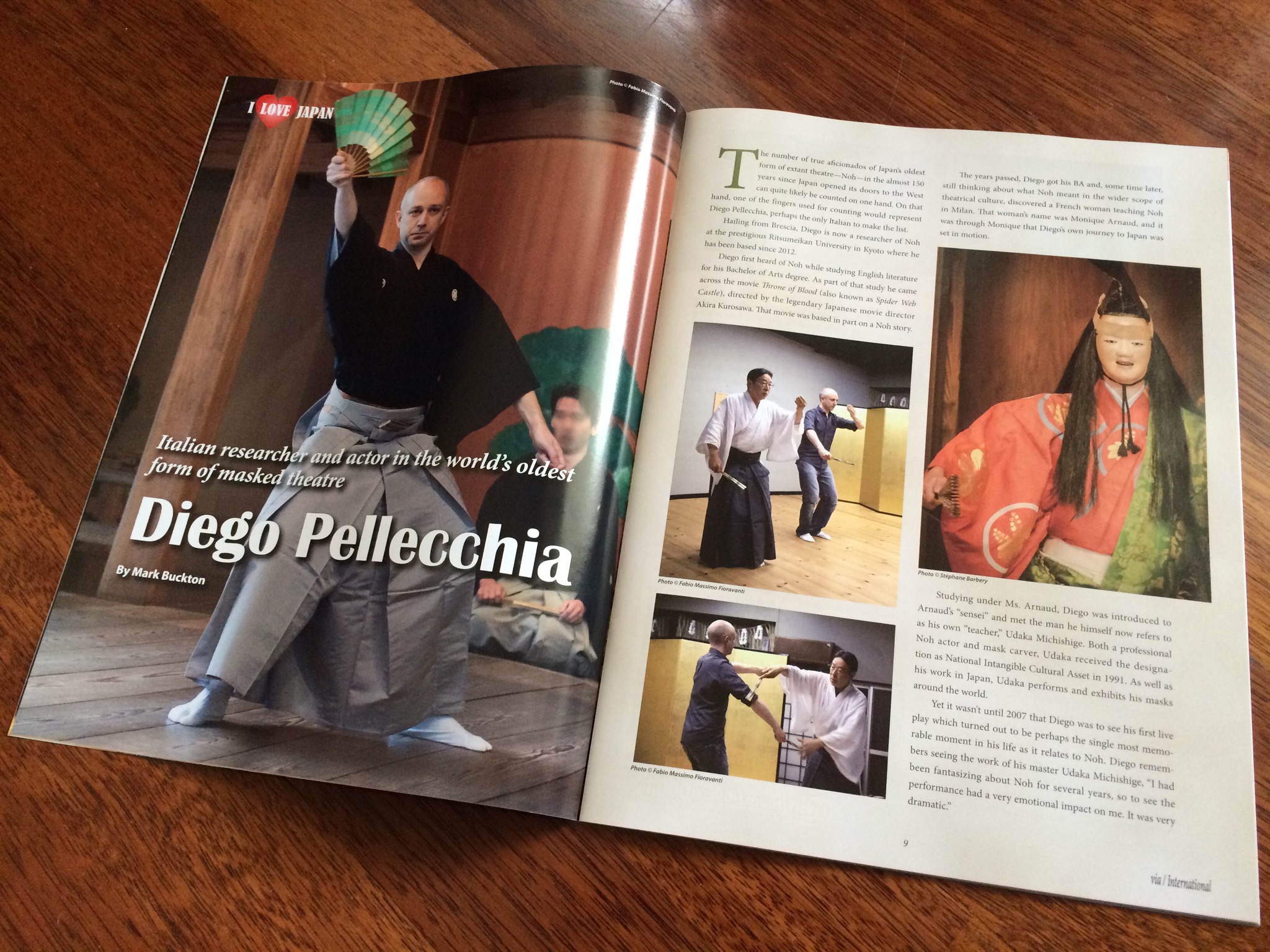
Tokyo-based journalist Mark Buckton has interviewed me for an article featuring this month’s issue of Via, a magazine that is distributed at airports and limousine buses in Tokyo. I’m privileged to have many photographer friends who have taken great pictures of my performances and training.

IMG_1100-0.JPG

Learn Noh mask carving from a professional Noh actor

inikyoto's avatarThe International Noh Institute

Autumn is finally here! The leaves are turning to beautiful shades of red and gold in the crisp autumn air, and we are getting ready to admire the gorgeous foliage on the hills that surround Kyoto, the ancient capital. In this wonderful and refreshing atmosphere we renew our invitation to visit Udaka Michishige’s Noh mask carving atelier.

Udaka Michishige is unique in being both a Noh actor and a mask carver. Students in his mask carving classes in Kyoto, Nagoya and Tokyo learn to sculpt masks of a high quality that can be used on stage. Every two years a group mask exhibition is held in Kyoto to show the latest results of students efforts. These mask exhibitions include free-standing displays of some masks, performance pictures, costumes and lecture-demonstrations to promote a deeper understanding of the place of the Noh mask in the world of Noh.

Contact us to arrange a visit of…

View original post 13 more words

Noh Photography #1 – Irwin Wong

inikyoto's avatarThe International Noh Institute

This is the first of a series of posts on photographers who have worked with the INI and with Udaka Michishige.

Irwin Wong is a professional photographer based in Tokyo. A few months ago he contacted the INI as he was looking to arrange a photo shoot commissioned by camera maker Hasselblad for the advertising campaign of their new model. We arranged to meet at Iori, a machiya, or traditional house in downtown Kyoto: Michishige brought his costumes and the masks he carves, and his sons Tatsushige and Norishige helped him with the complex dressing process. Irwin brought his camera and lighting equipment, while his collaborator Kondō Keiichi filmed the behind-the-scenes that you can watch in the video below. It was very productive day and Irwin’s pictures are just stunning: make sure to check out his post on the photo session, which also includes technical information about the cameras and the lights.

View original post 196 more words

The 15th Udaka Seiran Noh: Hagoromo, Ataka

SPECIAL PROMOTION! The INI is offering 5 ‘buy one, get one free’ tickets to the 15th Udaka Seiran Noh on September 14th (Sun). The promotion applies to general admission mid-center seats (5,000 yen). Available until Sept. 1st. Contact the INI to apply.

inikyoto's avatarThe International Noh Institute

This year the annual Udaka Seiran Noh performance will feature the Noh Ataka with the very special kogaki (performance variations) ennen takinagashi, kai-tsuke kai-date. Udaka Michishige will take the leading shite role, while his sons Tatsushige and Norishige will take the tsure supporting roles as disguised yamabushi priests. Michishige’s eldest son Tatsushige will also perform his first Noh with a kogaki: Hagoromo (banshiki variation).

Minamoto no Yoshitsune, one of Japan’s tragic heros, is known as a talented and charismatic general, and as the lover of shirabyoshi dancer Shizuka Gozen. The relatiohship between Yoshitsune and his retainer, the warrior-monk Musashibo Benkei, is particularly celebrated in the Noh plays Hashi-Benkei, Funa-Benkei, and Ataka. In all of these Noh the role of Yoshitsune is played by a ko-kata, or child actor. In Ataka the role of Musashibo Benkei is taken by the shite, or main player.

In Ataka

View original post 285 more words

Noh theatre and adaptation

9781408184721Theatre and Adaptation: Return, Rewrite, Repeat (Bloomsbury Methuen), edited by Margherita Laera, is out today! I have contributed to the book with the interview ‘Conservative Adaptation in Japanese Noh: Udaka Michishige in Conversation with Diego Pellecchia’. Instead of looking at adaptations of Noh plays by other theatre genres, or adaptations of other plays through the Noh techniques, I have reflected on what ‘adaptation’ means within the Noh tradition by looking at Udaka Michishige‘s shinsaku (newly written) Noh plays. “How does the notion of ‘adaptation’ apply to a classical theatre genre where language, dramatic structure, music, and mise-en-scene are prescribed by a canon? Can this English word be used invariably to describe works belonging to any cultural area? “

About the book (from the publisher website):

“Contemporary theatrical productions as diverse in form as experimental performance, new writing, West End drama, musicals and live art demonstrate a recurring fascination with adapting existing works by other artists, writers, filmmakers and stage practitioners. Featuring seventeen interviews with internationally-renowned theatre and performance artists, Theatre and Adaptation provides an exceptionally rich study of the variety of work developed in recent years. First-hand accounts illuminate a diverse range of approaches to stage adaptation, ranging from playwriting to directing, Javanese puppetry to British children’s theatre, and feminist performance to Japanese Noh”. 

The book is available for purchase in paperback or eBook on the usual internet vendor websites.