From: 善知鳥神社website http://www.actv.ne.jp/~utou/utou.html


この善知鳥舞は善知鳥神社正遷座 1180年祭(昭和62年斎行)を記念し、当時の伊勢の神宮 慶光院俊 大宮司の特別な計らいにより、神宮楽部が、この青森の永久の安寧を願い、うとう鳥の親子の情愛を表現し創作したものです。
又、各ご家庭や会社、お店等の繁栄を祈念すべく、特別参拝時にはこの善知鳥舞を奉納することも出来ます 。
From: 善知鳥神社website http://www.actv.ne.jp/~utou/utou.html
この善知鳥舞は善知鳥神社正遷座 1180年祭(昭和62年斎行)を記念し、当時の伊勢の神宮 慶光院俊 大宮司の特別な計らいにより、神宮楽部が、この青森の永久の安寧を願い、うとう鳥の親子の情愛を表現し創作したものです。
又、各ご家庭や会社、お店等の繁栄を祈念すべく、特別参拝時にはこの善知鳥舞を奉納することも出来ます 。
I found this interesting comment by a rather famous Japanese anime voice actress, Ikezawa Haruna.
‘It began with an email from my father. “Do you want to go see Noh?”
If I think back, the first time I saw Noh and Kyōgen was as an elementary-school pupil when we went to see it as part of a Social Studies class. It was also the last time I’d seen it.
Kabuki and Bunraku, on the other hand, I’d been to see many times. I’d go to see Kabuki with a friend who liked it and would took me along. And Bunraku I’d gone to see with my father back in grade school. We’d take a lunch and watch the whole thing straight through.
Both of them were interesting and the memories and pictures of those times are still strong in my mind. But, I have no memory of Noh. Perhaps, Noh was, for me as a grade-school pupil, just a bit too stoic. Things would unfold on this mysterious stage. Mysterious people would talk of mysterious tales. In my young mind the only thing I took away from it was thinking, “This kind of world exists as well, but I don’t understand it very much.”
After that I never went to see Noh or Kyōgen of my own accord. I think that’s the case with the majority of Japanese of my generation….’
Find the full text on the-noh.com.
Copyright© 2010 the-NOH.com All right reserved.
 Though Claudel is not really my cup of tea – I find his work rather heavy, excessively ornate, and vaguely orientalist – I have to admit some of his passages on the Noh are astoundingly beautiful, and particularly efficacious in describing the inner and outer spectacle of the Noh performance.
From L’Oiseau noir dans le soleil levant, 1929.
‘C’est la vie telle que, ramenée du pays des ombres, elle se peint à nous dans le regard de le méditation: nous nous dressons devant nous-mêmes, dans l’amer mouvement de notre désir, de notre douleur et de notre folie. Nous voyons chacun de nos actes à l’état d’immobilité, et du mouvement il ne reste plus que la signification. A la manière d’un maître qui reprend et qui explique, quelcu’un lentement devant nous reproduit ce que nous avons reproduit ce que nous avons fait afin que nous comprenions de quelle attitude éternelle chacun des nos pauvres gestes au hazard était l’imitation inconsciente et improvisée’.
The National Noh Theatre, Tokyo 1:30~4:10 p.m. (doors open at 12:30)
Kyogen: SORA UDE – OKURA Yataro, OKURA Motonari
Noh: UTOH (Kumiotoshi) – UDAKA Michishige


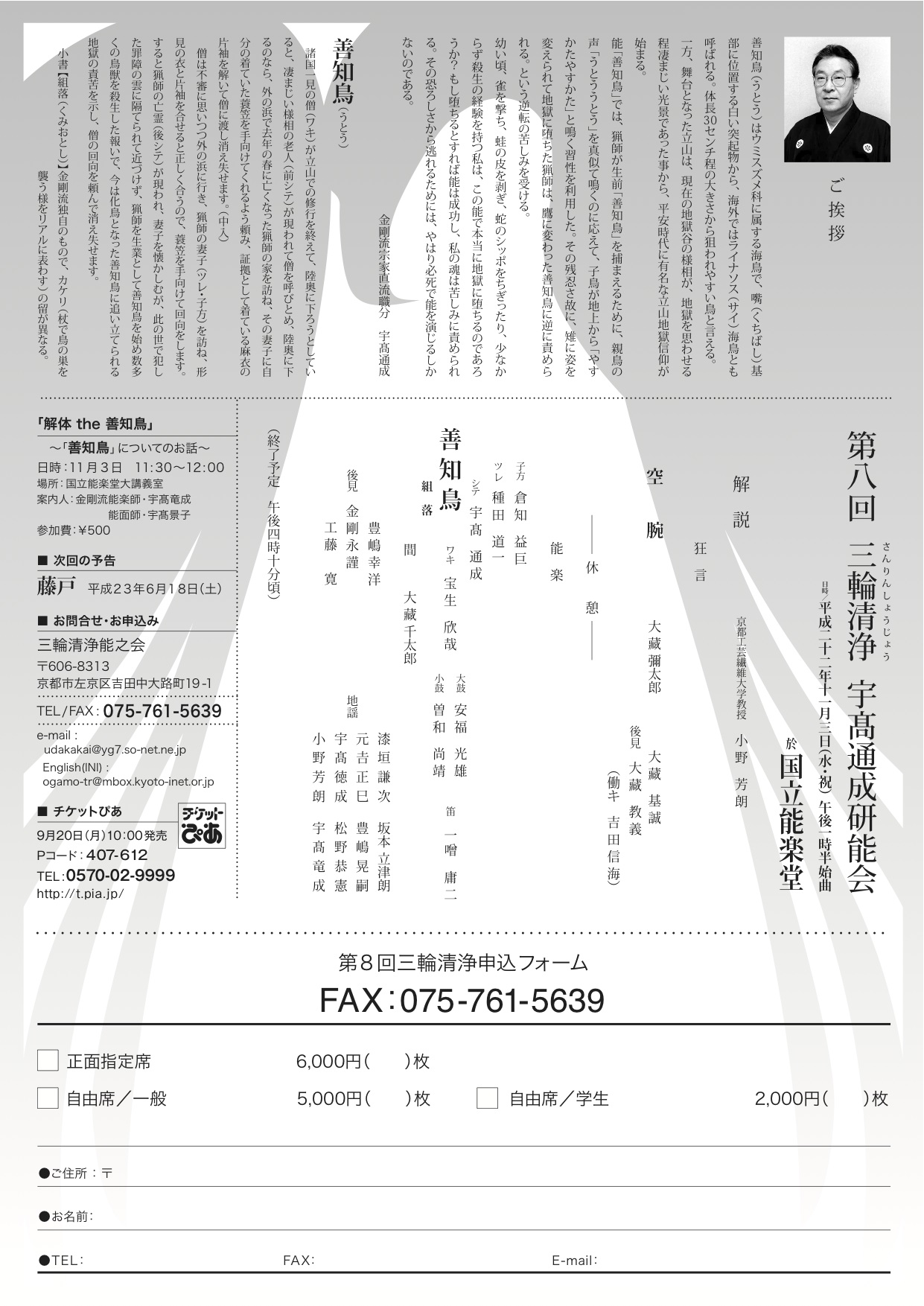

Tickets: Reserved (stage front): 6,000 yen General admission: 5,000 yen, Student: 2,000 yen
For tickets or further information contact: ogamo-tr@mbox.kyoto-inet.or.jp
Information about the plays will be available in English, French, German, and Italian
This is how the butterfly dance of the bugaku repertoire must have looked like. The Noh version is much less ‘realistic’: apart from the headpiece, the costume does not necessarily remind of the wings of a butterfly. I wonder if, in the past, the dance of the Noh Kocho was influenced by the bugaku version.

I have already posted something on unconventional/ironic ways of using Noh theatre, but I think this goes beyond what I have encountered so far. I am unsure I understand the process that led to the creation of the video below; I don’t even know whether the Noh utai amateur pizza-ossan was a victim of this or if the pizza delivery-utai that you hear is actually his own creation. If so, well… hats off.
Hey wait a second… now that I think of it.. I should be the one doing this!!
On Friday, 10th September I joined Udaka Michishige’s performance of the Noh Makura-jido (枕慈童) at Hourinji temple (法輪寺) in the Arashiyama area. Another student of Sensei, Hanna McGaughey, has posted on this performance a couple of years ago. I served as a member of the ji-utai chorus, reason why I have been spending the week before the performance trying to learn the text: this exercise of memory has led to some reflections I would like to share. Memorising a Noh text is not an easy task first of all because of the 6-century old language used, rich in rare alternate readings and special pronunciations. Secondly, the lyrics do not always follow a narrative progression, but consist of more or less abstract associations of images and overlapping of textual layers. It is very hard to ‘make logical sense’ out of the lyrics in order to remember them as one remembers a dialogue with its causes and consequences. This does not mean a Noh text is completely deprived of logical sense, but that if one plans to rely only on ‘meaning’ in order to remember, he or she will face a very hard time.
The other night, at okeiko, while talking about this with Ogamo Rebecca Teele, international coordinator of the Udaka-kai and International Noh Institute, and first foreigner to become Noh professional in the history of Noh, I realised my difficulties are shared by many practitioners. We found out that one common way to approach the memorisation is to re-write the utai on separate sheets. This is not a mere ‘verbal’ exercise: as Japanese is an ideographic language, one does not write the ‘sounds’ of the lyrics, rather he paints the text, that slowly takes the form of a matrix of sounds and images. While singing, one visualises the ideograms that have a strong pictorial, hence evocative, component. Of course, the most common and effective way of memorising is listening to the lesson recording and repeating, repeating, repeating … ad libitum.
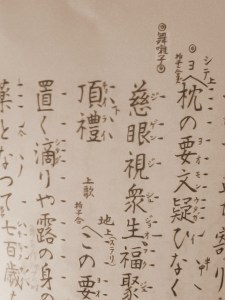
However, even in the repetition one might distinguish between learning by heart or learning by understanding. There is no time here but to make some superficial comments on this distinction. Where the first is a rather mechanical activity, in which one mostly focuses on the sounds, the second focuses on the meaning of the verses and relies on the logical or grammatical flow of the text in order to recall the words. As one might imagine, both methods are necessary combinable. What I found interesting is that the more my language proficiency grows, the more I naturally tend to rely on the memory of the meaning of the lyrics, immediately understandable, rather than on the sounds, which require time and repetition. However, relying on the meaning means that my brain needs to be in continuous conscious activity, focusing on what comes next in what I would describe as an ‘active’ recalling of the words. When I sing using this technique, I can hardly do anything else. If my minds get distracted by something else, the flow of meaning is interrupted, and I will skip some syllables trying to catch up with the delay. If, instead, I memorise by sound, which would at first appear as a rather ‘dull’ form of learning, I can easily multitask, as my brain is not ‘actively’ involved in thinking about the story, what came before and what comes next. Words come out automatically or instinctively.
I am not sure what sort of conclusion I want to draw after this but I would just want to encourage those who cannot understand Japanese. Memorising the sounds without the meaning is an excellent (the best) start in the training of utai. Focus on the breathing, on the emission, on the rhythm instead – those are the qualities that the audience will appreciate, rather than your understanding. First come the image, then the meaning – this is very close to another famous say by Zeami.
I feel thankful toward Udaka-sensei who allowed me to take part in the performance (I wonder how many foreigners had the privilege to be singing for a Noh professional actor of his caliber in a public performance) and I hope this chances will become more and more frequent as I refine my singing skills.
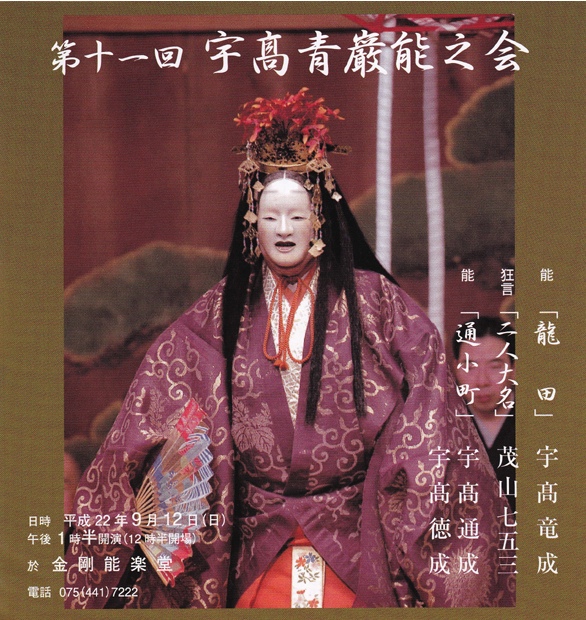
Kongo Noh Theatre, Kyoto 1:30~5:00 p.m. (doors open at 12:30)
Noh: TATSUTA Shite: UDAKA Tatsushige
Kyogen: FUTARI DAIMYO Shite: SHIGEYAMA Shime
Ado: SHIGEYAMA Doji
Koado: SHIGEYAMA Akira
Noh: “KAYOI KOMACHI The Nightly Courting of Komachi ” Shite: UDAKA Michishige
Tsure: UDAKA Norishige
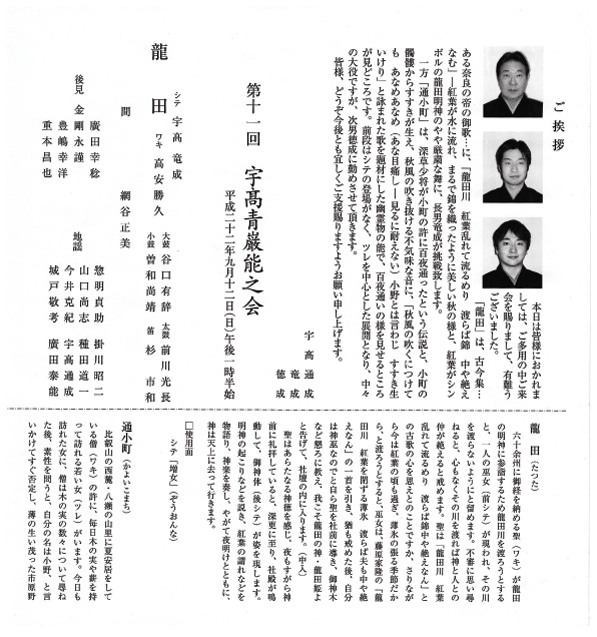

Tickets: General admission advance ¥5,000
(At the door ¥6,000) all non-reserved seating
Student ¥2,500
Information about the plays will be available in English, French,
German, and Italian.
The Udaka Michishige-no-kai Office
(For questions or reservations.)
TEL: +81 (075) 701-1055
FAX :+81 (075) 701-1058
Email: ogamo-tr@mbox.kyoto-inet.or.jp
 A few weeks ago I had the privilege to participate to the Mushiboshi (虫干) of the Shinonome Shinto shrine (東雲神社) in Matsuyama, Shikoku, where the ancestors of my Master, Udaka Michishige, used to live and perform under the patronage of the aristocrats settled in Matsuyama castle. Mushiboshi (lit. ‘drying insects’) is a periodical cleaning and refreshing of artifacts usually stored in closed compartments – items are removed from their usual storage location and exposed to fresh air. In Japan temples, shrines, museums and private collections have their own mushiboshi once or twice a year. In this case, the Shinonome collection comprised of a number of Noh masks and costumes which still have not been fully catalogued and dated, though they could range from the early Edo period until today. This collection had been used by professional actors until the Meiji restoration, when Noh theatre underwent hard times as a consequence of the loss of its former patrons. From this moment onwards masks and costumes from Shinonome Jinja has been probably used both by amateurs and low-level professionals. This was noticeable from the poor condition in which the items were found and the signs of bad handling and storing after use were evident. While many masks were covered with dust and simply left sitting on shelves, costumes and wigs were just thrown into boxes without proper cleaning and folding. Although several masks and costumes had already been taken care of and displayed in one of the halls of the jinja, the majority of masks (around 250) and costumes were still to be cleaned and re-stored – it has been a two-day intensive session, but an extremely interesting one! Not only I could closely observe different Noh costumes but also I could learn folding techniques and storage methods. As always, Udaka-sensei put together such a great, hard-working group coming from some of the different locations where he teaches in Japan (in this case Kyoto, Tokyo and Matsuyama) – although it has been intense I have to say thanks to Sensei for this unforgettable experience.
 This was not just an archeological expedition – Udaka Michishige is reconnecting his present and future activities with an equally important past. During the tumultuous years of the Meiji restoration the nobles patronising the Udaka family lost their powers and the Noh troupe was disbanded. Many of the most precious items in the Shinonome collection were sold to big companies and museums in Tokyo. However, many great costumes and masks were still hidden in the storage room, sleeping there but asking for someone to rescue them! Now that so many of them have been taken care of and catalogued, it will be possible to use them in performance in the future. Finally their uneasy sleep has been awaken by summer winds!
P.S.: I apologise for not posting better pictures or not providing better explanations but I am unsure of how much both Shinonome Jinja and Udaka Michishige would want this material to be public in an informal (blog-like) way. It is my intention to write more about this topic through more official channels.
Those who would like to know more about this activity, or purchase a small catalogue of the Shinonome-Jinja collection are encouraged to refer to Udaka Michishige’s official website.

 The Noh Diaries