The dangers of the world outside

OMG! Foreign viruses!

As a post-scriptum to my previous post, commenting on the difficulty encountered by the condition of ‘otherness’ of the foreign scholar operating within the Japanese field, I wanted to share something that popped up on my laptop screen right after I closed the WordPress window.

It’s an anti-virus advertisement showing up when visiting websites hosted outside Japan. The heading reads: ‘Hey you, browsing foreign websties! Have you taken the appropriate security measures?’ while the worried girl, depicted in the typical bikkuri pose (a mixture of surprise and innocence) is thinking ‘Really? Are foreign websites that dangerous?’

The ad campaign is founded on the Japanese stereotype of the ‘world beyond the seas’ (kaigai) as receptacle of impurities. The risk of visiting the alien territory is obviously that of contracting some  unknown disease. I know for sure that Japan pullulates with indigenous internet crap (spam, viruses, malware of all sorts) and it was explained to me that one of the reasons why Japanese people of all ages have such ridiculously long mobile email addresses (ie sl33py-OxO-rabu666@whatever.ne.jp) is to prevent spam attacks. Nonetheless, advertising the risk of not being ready to face the unknown dangers of the outside world is certainly a great way to convince users to purchase an anti-virus and feel safe, who will nod at each other on the dangers of something they ignore, and, I am afraid, will continue to ignore for a long time. Sure, Japan is not the only ‘xenophobe’ (excuse my language) country in the world, but they way it does it is so, so peculiar.

Tora no o wo fumu otoko

Like treading on the tiger’s tail, such is the condition of the ‘foreign’ researcher studying anything related to the Japanese culture. Sure, our non-Japanese opinions are kept in high regard, as the gaze of the ‘other’ is fundamental in the constitution of identity in every society, and all the more so in the Japanese society. The foreign opinion is considered, sure, but considered as the ‘foreign opinion’, not as an opinion with a value in itself. It exists in virtue of its cultural otherness. Listened to, then packed into a box, and put somewhere safe, where it will not disturb or divert the ‘natural flow’ of the Japanese ‘way’. This typically Japanese attitude has been criticised for decades now, sometimes even ridiculed because of its inadequacy to the post-modern society many thought we were living in. However. In a world reverting from utopian dreams of interculturalism to new nationalisms and post-traditionalisms, will Japan end up being right about its conservative attitude?

As I approach a new project in which I will discuss aspects of Japanese conservatism in relation to history and tradition, I am once more faced with my incompetence, in the literal meaning of ‘something that does not compete with me’, outside my jurisdiction, a concept close to that of the literal meaning of gaijin. This form of incompetence, which is evidently not technical, is intrinsic to my condition of foreigner. While this thought might appear obvious in an every-day life context – anybody living in or dealing with Japan know what I am talking about, and many got over it (while others never will) – it is not so obvious when it comes to academic research and scholarship, which is the matter I am engaged with. Until when will ‘foreign’ scholarship continue to be ignored as something that adds luster to the ‘things Japanese’, but that eventually does not belong there?

PS: The title of the post is inspired by an early Akira Kurosawa film, The Men Who Tread on the Tiger’s Tail, recounting the famous episode, also depicted in the Noh Ataka and in the Kabuki Kanjincho, describing Minamoto Yoshitsune and his bodyguard Musashibo Benkei crossing the barrier of Ataka disguised as yamabushi priests.

10/4~9 Mask Exhibition of the Nagoya Branch of the “UDAKA Michishige Men-no-Kai” Mask Carving Group

October 4 (Tuesday) ~ 9 (Sunday) 9:30 a.m.~6:00 p.m.

“NOH: a ONE POINT Lecture” 8th (Saturday) from 1:30 p.m.

7th Floor 3rd Exhibition Room
Nagoya City Nakaku-Shimin Gallery–Sakae
Supported by:

the Aichi Prefectural Board of Education, the Nagoya City Board of Education, Chunichi Shimbun

名古屋面展
Photo: “IZUTSU” at National Noh Theater; Mask: Magojiro;
performance and mask by UDAKA Michishige
名古屋面展地図

Nakakuyakusho Asahi Seimei Bldg. 7th Fl.
By Subway: Higashiyama Line or Meitetsu Line Sakae Station
one minute’s walk East from Exit 12
By Bus: 5 minute walk from the Sakae Bus Stop

Documentary on Keiko Fukuda, Judo’s Only Female 10th Degree (via What can I do with a B.A. in Japanese Studies?)

A beautiful example for all women involved in the often sexist world of Japanese traditional arts.

“The belt ranks for women were very old fashioned and sexist. There was nothing above 5th degree for women.” -Keiko Fukuda A trailer for Yuriko Gamo Romer’s documentary Be Strong, Be Gentle, Be Beautiful: The Story of Keiko Fukuda, Grand Mistress of Judo, which will be released in 2012 by Flying Carp Productions. The last surviving student of Kanō Jigorō, the founder of judo … Read More

via What can I do with a B.A. in Japanese Studies?

The American Who Couldn’t Say Noh

Just when you think you heard all the possible idiotic puns on Noh, that is when a new onecomes up (usually from an American publication). I have already explored the topic in a previous post, but this time I give you.. The American Who Couldn’t Say Noh, by Charles Danziger.

I haven’t read the book – I kind of feel I have enough from the title – but will welcome reviews by anyone who already endeavoured to… I know a lot of people find these puns very amusing and trust me, I would like to find them amusing too, so that I would be more natural in my reactions when talking to such people. But I can’t help thinking they are simply very lame…

A life of dedication to Noh

I re-post here the article that appeared today on Japan Times online. I consider the work of Rebecca Ogamo Teele as a model for all those who would like to pursue the study of Noh in a serious way. I wish Rebecca-sensei all best for her next performance.  

Saturday, June 18, 2011  

American woman pours self into noh

By JANE SINGER

Special to The Japan Times

According to Rebecca Ogamo Teele, an American instructor, performer and mask carver for noh, falling asleep is a perfectly respectable response to attending such plays.

In fact, she would almost recommend it.

A noh performance can be likened to a meditative state, with a rhythm forged from drum calls and breath-based vocalizations, she explains. This dreamlike world harkens back to the womb, pulsing with the mother’s heartbeat.

“The rhythms of noh can draw you into a trance state,” Teele says. “You may sleep, but at some point there will be a change in the tension, and you’ll wake naturally.”

Teele, 62, speaks about noh with familiarity born of 39 years of study, including three decades as an instructor of the classical dramatic and musical art. Her longtime teacher, Michishige Udaka, is a master actor and mask carver in the Kyoto-based Kongo school, one of the largest of the five major noh schools.

Teele’s first exposure to noh was as a child in Kobe, where her father, an educational missionary and scholar of contemporary literature, taught at Kwansei Gakuin University during two stints in Japan totaling nine years that began in 1950.

“My father studied utai (noh chanting) and often brought our family to classical art performances. I can remember when I was very young waking up at noh performances and feeling transported by the otherworldly sounds and the unexpected sight of masked actors,” she says.

After returning to the United States in 1960, Teele fueled her interest in Japanese arts with a fine arts major at Bennington College in Vermont. She returned to Japan in 1971, settling to Kyoto, to learn more about classical theater arts.

She first studied with a mask carver but desired a stronger connection to the plays themselves. Intrigued by Udaka’s insistence on carving the masks for his noh roles himself and his rare openness to teaching women and foreigners, she began to study at the Kongo school.

“Udaka-sensei felt that noh is universal; that if someone trains and has the necessary commitment, they can interpret a role, no matter where they’re from,” she says.

Teele began studying dramatic roles right away, along with daily stretching and vocalization exercises. “In the Kongo School you learn to read notation by parroting the teacher. You start with the simplest, most abstract movements and you learn to listen to and to later interpret the text.”

She gradually mastered the performer’s gliding walk, in which the feet never leave the floor, the elbows are held out and to the side, and fingers are folded in a fist. She demonstrates by gliding across the carpet, with posture held erect but the torso set at a low center of gravity and legs bent. In noh, she says, movement is controlled and usually slow, but it can sometimes unfold explosively fast.

“This posture creates a larger sounding board for your voice and nicely sets off the costume, which often features sleeves twice as long as your arms. Holding your arms this way is physically demanding, calling on stamina and strength,” she explains. The performer typically holds a fan to amplify gestures or mime movements, such as drinking or holding a shield.

“Kabuki has a wonderful flamboyance, but I was attracted by the depth of noh,” she says. “In noh the audience is a kind of witness, called on to participate in the performance. Rather than passively having things laid out for them, they must create something by listening to the chorus and watching the abstract movements, which assume meaning when attached to a text.”

In noh, costumes, dance, utai and poetry help to express overwhelming emotions, such as rage or sorrow, with stories often based on famous historical scenes or Buddhist themes. The main character, the shite, is assisted by an on-stage chorus and a wakikata, or secondary character, who acts as the foil for the shite.

A noh performance typically includes several plays as well as a farcicalkyogen performance.

Over the years, as Teele improved as a noh performer, she began to conceive of a role for herself, she said, “in facilitating communication and understanding among performers and learners.” After nine years of study she became certified as a shihan, or instructor, one of the three foreign instructors whom Udaka has trained. In 1996 she was accepted into the Noh Association under her noh name, Rebecca Ogamo (a play on words, since “kamo” means duck, and a “teal” is a small dabbling duck).

Most noh plays are performed wearing masks, although not all. When performing without a mask the face remains completely emotionless. For the Western actor, the face is the greatest medium of expression, but the use of a mask in noh, rather than serving as a handicap, allows for greater expression of creative energy, Teele says.

“Because the audience is not distracted by the face, you become more aware of the performer’s body and voice. It seems that it would be limiting, but it allows you to access greater powers of expression,” she says. “The mask is the focusing lens for the actor’s energy, and that can be quite transporting.”

She displays a lacquered mask she has carved herself from lightweight Japanese cypress, with straps and linen backing attached. Most masks are carved for specific roles or character types; this one is for Lady Rakujo, the betrayed wife of Prince Genji in the play “Aoi no ue.” The horns and the savage, tooth-bared grimace symbolize a woman transformed by resentment, grief and disillusionment into a demonic spirit, Teele says.

It takes up to a year for Teele to complete a mask like this. “The finest masks have an intense immediacy and can express love, devotion, or grief,” she says. “With an accomplished performer, the mask should seemingly come alive, with the expression changing as the viewing angle changes.”

Teele provides information on noh and teaches both foreign and Japanese students as associate director of the International Noh Institute, a Kyoto-based network of instructors and students affiliated with Michishige Udaka. She says Japanese have no problem accepting a foreign teacher: “Sometimes Japanese prefer a foreigner, since they can ask questions and admit their ignorance of noh without embarrassment.”

Much of the appeal of noh is in the texts, which are often very short narratives but with compressed layers of meaning. Although many of the most famous noh plays, like “Hagoromo” and “Dojoji,” date back more than five centuries, new plays are being written and performed regularly, many to address contemporary issues.

After the Sept. 11, 2001, terrorist attacks in the U.S., Udaka pondered the fate of the souls of those who died instantly in mass carnage, leading him to write a play about Hiroshima atomic bomb victims. In the play, “Inori” (“Prayer”), a mother follows the voice of her missing child to the underworld, where a guide escorts her to a site where victims of nuclear and terror attacks reside. Teele accompanied Udaka on a tour of the play to Paris, Dresden and Berlin in 2007, where it was met with enthusiastic, focused audiences, she says.

Teele has appeared on NHK TV, and has lectured and led workshops about noh in Latin America, Europe and New Zealand. In 2003 the Kyoto Prefectural Government recognized her dedication to the dance form by awarding her the Akebono Prize, for women who have contributed greatly to their fields.

She believes that she is the only foreigner to be accepted into the Noh Association, which recognizes professional performers.

She is currently working on a compilation of translated noh plays intended for a general readership, and she has embarked on a project to create smaller-proportioned masks specifically designed for female performers. Last June, she performed as the shitekata, or central character, of the play “Yuki” at the Kongo Noh Theater, a highly abstract role in which, as the spirit of the snow, she materializes before a lost priest and seeks his intercession for finding enlightenment.

“The character is essentially an accumulation of our memories, attachments and illusions,” she says. “In noh, plays like this allow us to experience an awakening of awareness of both the dangers of attachment and the importance of the living things on Earth.”

Performing what does not belong

On Monday 28th March I attended Dr. Matthew Cohen‘s performance A Dalang in Search of Wayang at the Centre for Creative Collaboration in London. Besides his many achievements as an academic, Matthew is a trained dalang or puppeteer of the wayang kulit tradition of Java. Matthew’s piece is a fascinating act between puppetry, stand-up (in this case ‘sit-down’) comedy, and philosophic research, in which Matthew as dalang, in a semi-schizophrenic dialogue with his own puppets, and with the audience, questions himself about the how, the why, and the what it is to perform a tradition of a far-away place to an audience that does not belong to the same cultural territory of that tradition.

Matthew’s performance is certainly inspiring for people like myself, who live this condition of cultural displacement as feature of their everyday life. The questions that the performance raised are indeed pointing straight to the meaning of our lives as performers and scholars across the borders. Rather than discussing themes of universality and interculturality in general terms, Matthew’s endeavour is an intimate, but frank reflection not just on the effectiveness or possibility, but on the very meaning of performing an ‘other’ performance tradition abroad.

Matthew’s questions are something I can very much sympathise with. Many times I found myself confronting audiences that knew nothing of Japan (let alone of Noh) besides geishas and sushi. The frustration of incommunicability, and a slight sense of superiority that derives from the thought of how much your efforts would be appreciated somewhere else, are sometimes difficult to bear. An audience that cannot understand the language, the symbolism, the dramatic devices of performance is an element of extraordinary resistance to what the performers tries to do. It needs to be instructed, nurtured, taken care of. By doing this, I sometimes wonder if we are not trying to transform this audience into something familiar to us, bringing it with our sphere of confidence. What does this mean, then? Is this an act of covert manipulation of the audience’s identity? Are we trying to create a bush league of our beloved and indulging original audience? Or, conversely, do we not realise that this ‘ignorant’ audience is the most indulging one, while informed ‘authentic’ audience would just kick our asses because or our poor skills?

There are profound ethical questions embedded in the reflection that Matthew put in the form of a much enjoyable comic act. To what extent can we call the tradition we are dedicating our life to ‘ours’? How can we then pretend to be ‘cultural ambassadors’ of something which does not really belong us, and why in the world should we fight against the resistance of an audience that can sometimes hardly hear us, if what we fight for does not belong us? Much intercultural scholarship has attested that we ‘Westerners’ cannot appropriate ‘Asian’ art and expect it to be ours, and I think this is fair enough, especially when one sees this concept in a larger scale political and economic frame. However, I would lie if I said that Noh ‘does not belong to me’, or that I am just ‘borrowing it for a couple of hours’ for my little demonstration. I’m sorry – I don’t sell post-cards.

There are ways to be more or less transparent in the way we undertake this act of moving culture across borders. What I was particularly pleased with in Matthew’s piece was the honesty of his presence. Dressed in a traditional cloth as a skirt, but wearing a trunk shirt on the top, Matthew did not pretend to hide what cannot be hidden (his not being a son of the land that gave birth to the tales he tells through wayang), and went about his performance in a constant dialogue with himself, and with the others who were watching him, without exposing the exoticism of Java. Rather than stating, Matthew was asking. One of the dangers of tradition is immobility, petrification of the form as petrification of the mind. It is thanks to unorthodoxy and disturbance that tradition can find stimuli for renovation. And yet there are ways to poke the boundaries of tradition without necessarily destroying it, or subverting its order – as long as questions like Matthew’s keep on being asked, and our many ‘others’ keep on listening.

Repost: Interview with Ogamo Rebecca Teele

Ogamo Rebecca Teele is a Noh actress, mask carver, translator and scholar; she is the coordinator of the International Noh Institute, led by Noh Master-Actor Udaka Michishige. It is also thanks to Rebecca-sensei’s efforts to pursue the way of Noh that I have been able to begin my journey through this art.

I am copying here the full text of the interview that appeared on the Yomiuri Shimbun (Feb. 6, 2011).

Wedded to her art, noh two ways about it.
Yoshihiro Kitaura / Yomiuri Shimbun Staff Writer

KYOTO–Face-to-face at a rehearsal hall at the foot of Mt. Hiei in Kyoto, the elder U.S. teacher and her Australian pupil bowed and engaged in a traditional “Yoroshiku onegaishimasu” (thank you for your support).

The teacher, noh actress Ribekka Ogamo, then began demonstrating a model performance, moving and lowering her center of gravity as if skating across some ice. She then coaxed her student into dancing more slowly and expressively.

Ogamo, 61, whose real name is Rebecca Teele, has described noh as having ongoing inspiration on her life. She has been learning noh for 39 years under the tutelage of Master-Actor Michishige Udaka, 63, a professional noh actor of the Kongo school. Udaka has much praise for Teele, saying, “She is good at noh chants and her performance is also solid.”

Born in Michigan, Teele first encountered noh as a child in Japan, at a performance she went to with her father who was then teaching at a university in Kansai.

Teele was mesmerized by the scene facing her when she woke from a nap. Orotund noh chants, emotive noh masks and the subtle rustling of long skirts all contributed to a profound atmosphere on stage that left an indelible impression on the young girl.

Teele, who later returned to the United States and graduated from high school there, majored in theater at a U.S. university. She thought while Western theater called on actors to possess certain physical charms, including a modicum of attractiveness, the noh she knew from Japan instead emphasized people’s spirituality. She thought she would be able to explore this theatrical expression, which she felt lacking in Western theater, by performing noh.

As her obsession grew, she again visited Japan and observed many noh performances. Fascinated with the beauty of the works staged by the Kongo school, Teele decided in 1972 to become Udaka’s pupil, as he had previously accepted foreign students.

===

Becoming Udaka’s pupil

Despite being accepted into the Udaka school, Teele faced much difficulty. First, she had to practice sitting seiza-style on her heels. She had no difficulty speaking conversational Japanese but it was a challenge to understand the noh chants written in classical Japanese.

Yet Teele was determined to succeed. Consulting her dictionary, she slowly made her way through many noh works. She also practiced the requisite chants in a loud voice at a riverside in the neighborhood.

Meanwhile, swimming helped Teele developed a physique better suited to the art form and she eventually conquered movements such as how to shuffle properly. She was making her living working at an English conversation school and translating, but Teele was completely devoted to noh.

Teele’s journey to become a noh master took nine years. Upon being admitted to join the Nohgaku Kyokai association–itself an unusual move–she identified herself as noh actor Ribekka Ogamo.

“[Teele’s membership] has inspired Japanese disciples,” Udaka said.

Teele, who also serves as secretariat chief of the International Noh Institute, a body comprising of overseas noh students among others, now herself teaches foreign students, her efforts a testament of her devotion to the art form.

The work is not without its challenges. The quality of a noh performance depends not only on the actors’ expertise in traditional dances and chants but also how the noh masks are displayed to the audience.

The significance of these principles is not always understood among beginner pupils hailing from overseas. According to Teele, she was once asked by a non-Japanese student whether it was acceptable to make small changes to the basic style of noh dancing.

Teele also recalled a pupil from South America unable to imagine snow. On such occasions, Teele would advise the students to visit temples and shrines in Kyoto and look at pictures on display depicting the four seasons.

In spite of the fact that many foreigners visit Japan to learn noh just like she did many years ago, Teele is disappointed their Japanese peers seem uninterested in learning the traditional art.

In June last year, Teele took part in a performance to celebrate the 50th anniversary of Udaka’s stage career. She played the main role in the program “Yuki” (snow), a snow spirit that dances in the moonlight for about one hour.

The performance was even more remarkable as Teele danced while enduring severe pain in her left knee. She had fallen down some station stairs six months earlier and injured the knee, which had already been broken once before. The accident prevented Teele from rehearsing enough before the performance.

“You should improve your dancing so that the noh mask becomes more expressive,” Udaka commented following her performance. His uncompromising attitude toward the art made Teele even more determined.

Teele has one unrealized dream: To perform noh in the United States. She hopes to fulfill this by almost any means possible, her will unchanged from when she first decided years ago to devote herself to noh.

(Feb. 6, 2011)

Continue reading

Noh thriller movie – 天河伝説殺人事件

Back from Japan and heavily jet-lagged as usual, I was wandering the many Noh-related blog pages when I bumped into 天河伝説殺人事件 (Tenkawa Densetsu Satsujin Jiken) a 1991 thriller by Ichikawa Kon, the director of The Burmese Harp, Tokyo Olympiad and many other legendary films. 天河伝説殺人事件 looks like a standard 80s old-school detective story with the surprising twist of being centred upon homicides related to Noh theatre. I haven’t seen the movie myself but I am about to make an order to Amazon.jp where they seem to have DVD copies of it. It just looks very cool – the retro-sound score, the ossan hat of the protagonist, the terrible オーバー acting technique of the actors… and on top of it, it’s Ichikawa! The review of the All Movie Guide has been published on the New York Times here. Googling a bit I found the trailer uploaded on YouTube.

Grilled Utai

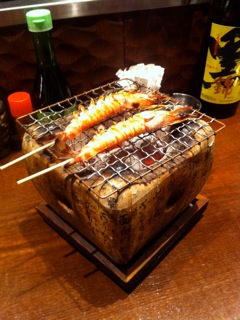
The other day I’ve been to this place in Kyoto where you
can eat all sorts of grilled food. Apart from the smoke and the
smell of barbecue that will oblige you to wash everything you wore
on that day, the food is pretty good and the staff nice and
friendly. I had scallop, squid and pumpkin – all grilled with real
wood fire. You have a choice of having whatever you order grilled
by the chef or to grill it yourself on small bracers with burning
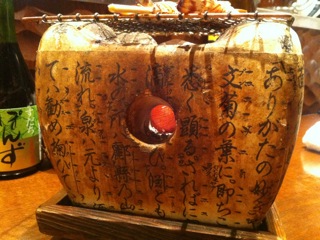
embers inside. This is where the
surprise came. The bracers are decorated with paper taken from Noh
utaibon (謡本), or Noh chant libretti. Mine had
Makurajido (枕慈童, aka 菊慈童) on. I was lucky
enough to be given an utai I already practiced, which was easy to
recognise. However, I realised
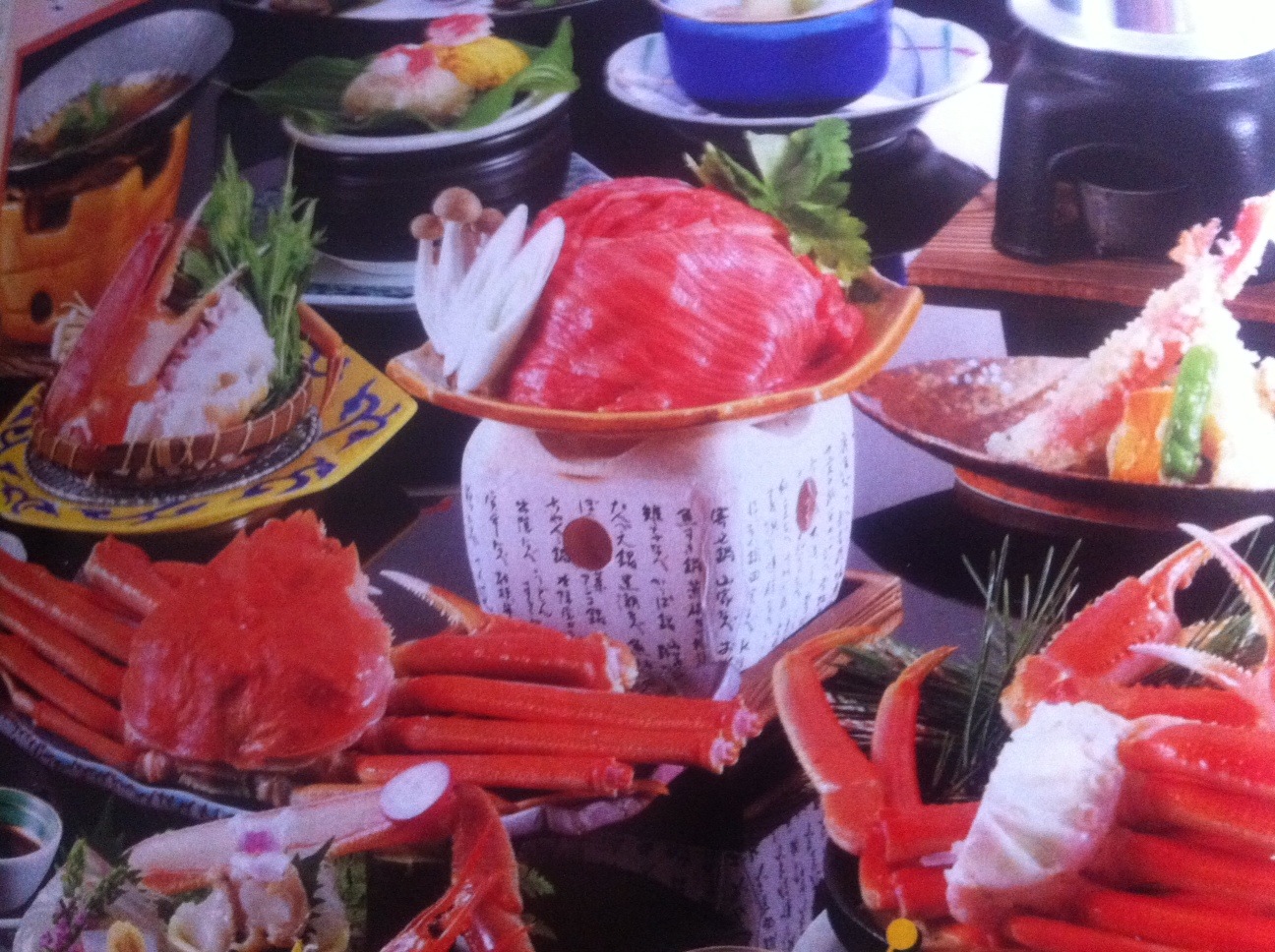
it is common practice to use paper from various traditional books
(with printed handwriting) on bracers. This is from the
advertisement of one of the many restaurants specialised in crab.

I find this custom rather interesting,
although a bit inappropriate, maybe.