One thing I have learned from the Kei’un-kai Memorial performance 2014

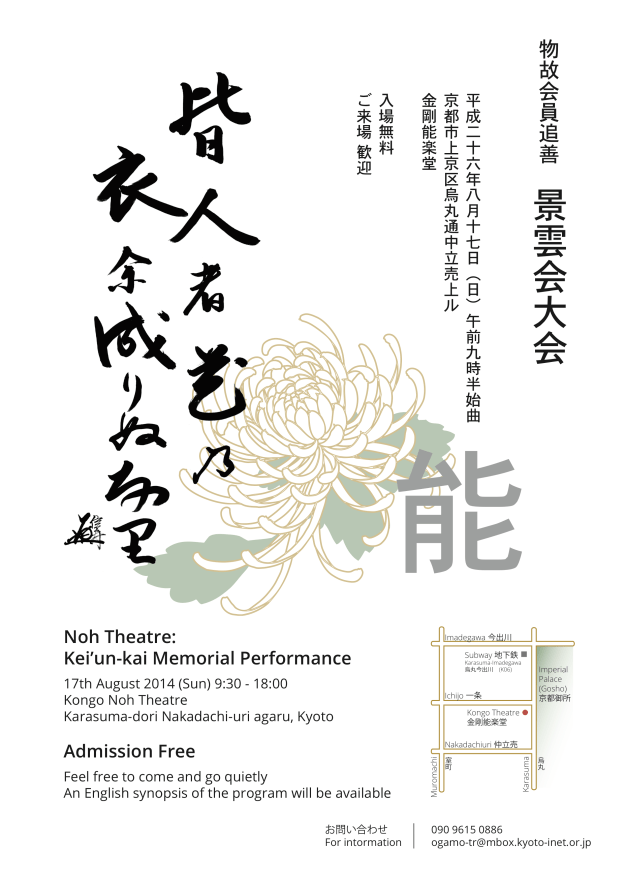
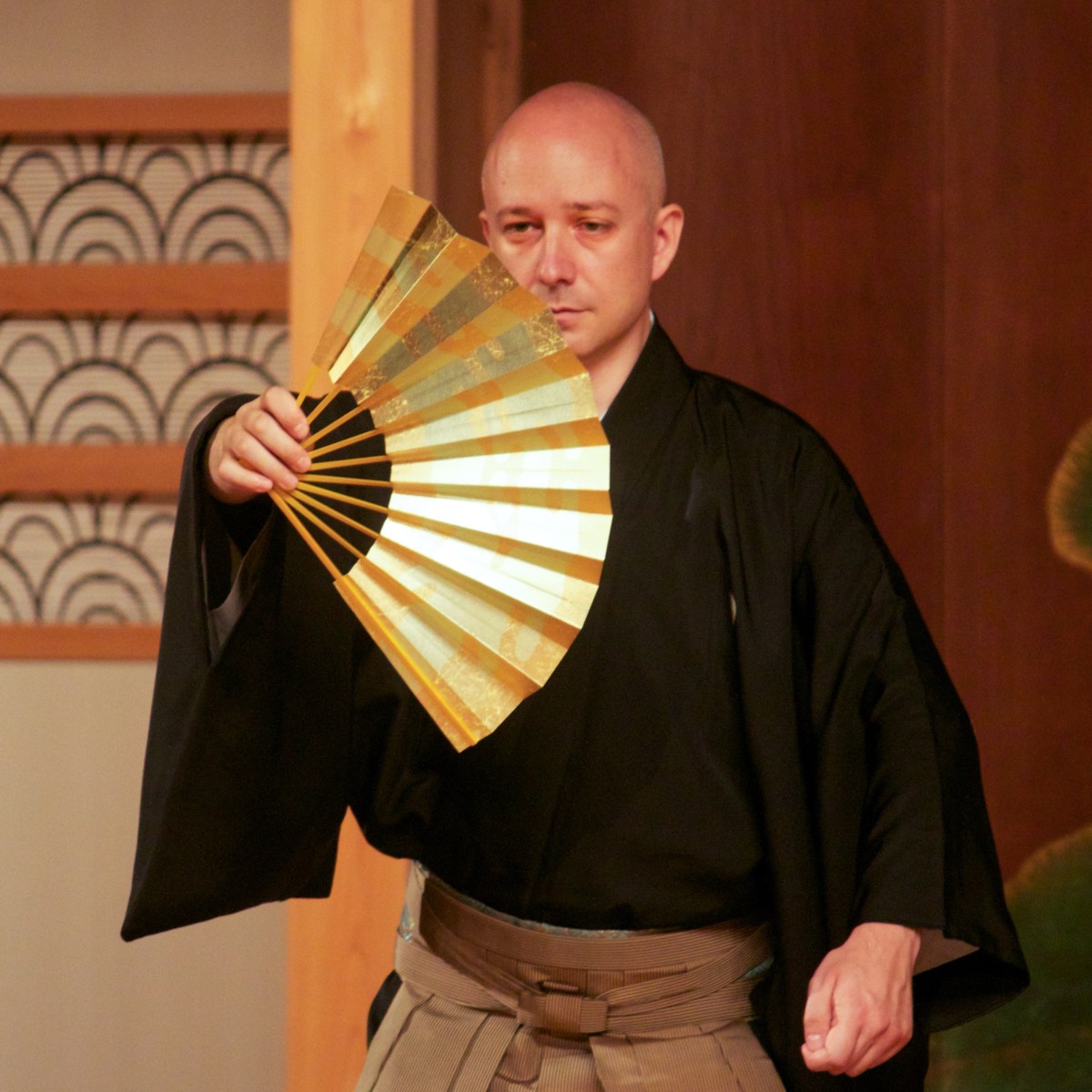
On Sunday 17 August I took part in the 2014 Kei’un-kai, INI Memorial Taikai performance, a collective recital in which a great number of Udaka Michishige’s students performed dance and chant excepts, as well as full Noh plays. This year’s highlights were the Noh Atsumori and Funa-benkei. As for me, I danced the maibayashi from the Noh Tōru, featuring a godan-hayamai, an instrumental dance in five parts. I enjoyed performing in an environment that is becoming increasingly more familiar to me. Everyone has been extremely supportive during the preparation and on the day of the performance.
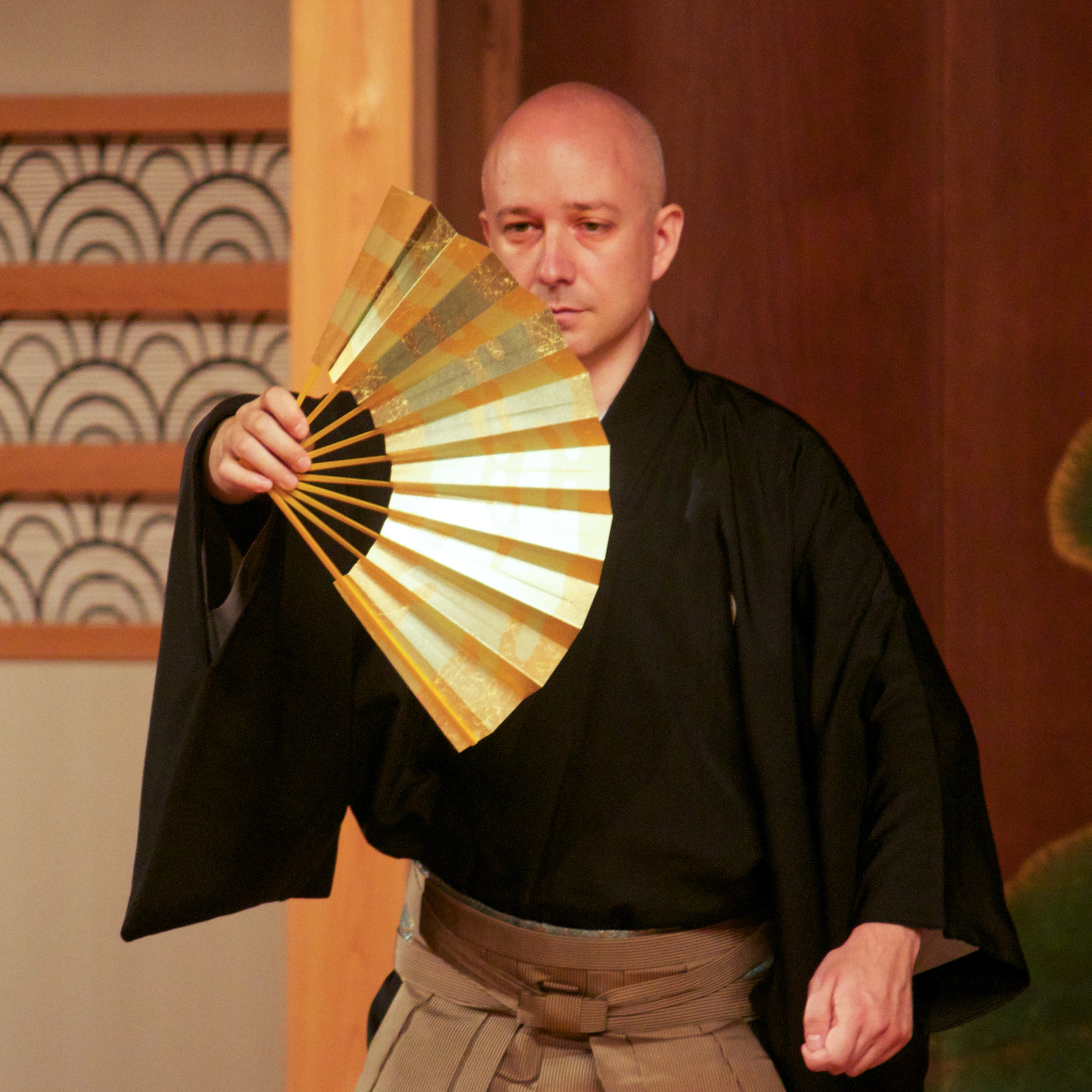
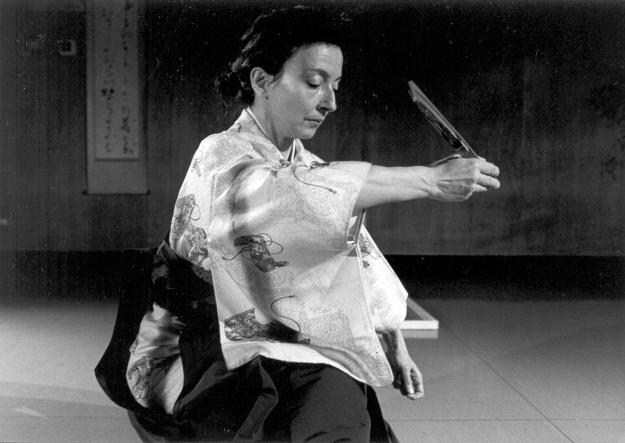
Maibayashi: Toru. Shite:Diego Pellecchia

Oddly enough though, the most difficult performance of the day was singing in the jiutai for a cluster of seven shimai (dance excerpts at the accompaniment of a chorus of four). They were all basic pieces (Tsunemasa kuse, Yashima, Momiji-gari, Kochō, Yuki kuse-kiri, Hagoromo kuse, Kakitsubata kiri), but this was my first time in such a formal situation. In the case of a shimai, four jiutai singers are sitting at the back of the stage, facing the front. I was in the lowest ranking position (A in the drawing), butai jiutaiupstage right, which is coincidentally the most difficult to be in: it is the furthest from the jigashira (chorus leader, sitting in position C in the drawing), and the closest to the waki-shōmen side of the stage, where the audience is sitting and can hear your voice clearly: not a comfortable place for a beginner. In addition, the way jiutai is sung for shimai is different from the way it is performed for a maibayashi or for a full Noh. It is not easy to explain all differences, but generally speaking a jiutai for shimai is ‘lighter’, often quicker because it is not forced to respect the extension of syllables regulated by the rhythm of the drums, and all pauses (ma) between verses. This is particularly evident in hiranori chant type, in which twelve syllables match an 8 beat rhythmical pattern. It is less evident in chūnori and ōnori, where the syllables subdivision is more regular and a certain set rhythm has to be maintain.

The way jiutai chant for shimai is performed does not depend on the jigashira’s extemporaneous feeling. It maintains a rhythm that all four chanters have to follow, but should not be sung ‘as if’ drums were there, or it would result in a boring, predictable recitation. Chorus of sole amateurs or novices often end up singing this way.  In a professional shimai jiutai, notes are often shortened, and the speed is generally faster, but it maintains a certain  jo/ha/kyuTalking about this with Udaka-sensei the other day, he confirmed that in order to sing well in a shimai jiutai, I would first need to master utai with the percussions, then I will be able to understand better the utai for shimai, which definitely stands at a higher level of expertise.

Here I was sitting
Here I was sitting

Now that I have learned my first godan dance, I will continue to research progressively challenging mai (instrumental dances). My next assignment is the maibayashi from the Noh Kantan, a beautiful piece featuring the gaku, a stately dance characterised by many hyoshi or feet stamps. At the same time, I will continue studying various ji-utai for Noh that other people will perform as shite. It will be important for me not only to learn how to sing, but also to deepen my understanding of rhythm.

Gallery

Thoughts on the Kei’un-kai Memorial Performance 2014

inikyoto's avatarThe International Noh Institute

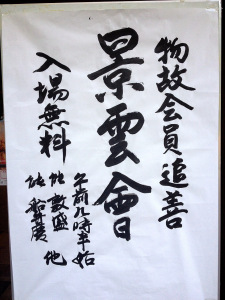
The program board outside the theatre

On August 17th 2014 The Kei’un-kai Memorial Performance, including INI members, took place at the Kongo Noh Theatre in Kyoto. It was a long day, with shimai, rengin, maibayashi and full Noh plays performed  from dawn to dusk.  This year’s performance took place at the end of the o-bon period in Japan, during which people remember and honour the dead. It was an occasion for us performers and for the audience to express their gratitude to those who are not with us anymore.

For this purpose, Udaka Michishige has chosen a poem by Henjo (816-890), quoted in the Noh Sumizome-zakura, ‘The Ink-dyed Cherry Tree’. “Everyone is wearing colourful robes, while my mossy sleeves (a monk’s robes) are yet to dry.” Henjo became a priest after the death of Emperor Nimmyo, and the poem expresses the poet’s grief and his reluctance to return to colourful robes…

View original post 154 more words

To teach, to learn

As preparations for our Sunday 17th recital are becoming more and more intense, Udaka-sensei has asked me to work as ‘sparring partner’ with some of his more mature students, as well as coach younger students. This is a conventional practice in traditional Japanese arts, where people who can help take responsibility for training those in need. Most of this activity consists in offering one’s knowledge, but also one’s ‘external’ point of view, always keeping in mind that it cannot be a substitute to the teacher’s training, but only an additional and limited support. Recently I have done quite a bit of this coaching, probably for the first time since I am in Japan, and I have enjoyed it immensely.

As I was sharing my knowledge with others, I felt compelled to reflect on what I have learned so far in a more analytical way. My okeiko (lessons) with Udaka-sensei are often more ‘holistic’ than ‘scientific’, meaning that I am provided with lots of information by means of metaphors and images, rather than being shown step-by-step choreography. This is, I think, because I am now at a stage where I am supposed to observe his teaching and do my own analysis, without him breaking down everything as he would do with an absolute beginner. This is form of learning is done by imitation and embodiment of a model, rather than rational dissection and reassembling.

However, a Noh choreography still depends on sets of rules and conventions that need to be understood in detail in order to master (and also enjoy) a dance. Therefore, coaching others is a great chance for me to reconsider movement sequences that I have learned through the ‘holistic’ method, and observe them through a more ‘scientific’ method. Thanks to this teaching, I am realising lots of things that I was taken for granted… in fact I am learning a lot! At the end of our training session yesterday I felt a sense of completion, as if something had come full circle. This kind of feeling is common to most of those who, one way or the other, have realised how instructive an activity teaching can be.

This reminded me of Victor Turner, who in From Ritual to Theatre draws on the philosophy of Wilhelm Dilthey to describe experience as ‘never truly complete until it is ‘expressed’, that is, until it is communicated in terms of intelligible to others, linguistic or otherwise’. This certainly applies to what I have experienced in the past few days. It also connects to the way Noh is transmitted within a community of practitioners who create two-way, diagonal ties among them, instead of solely depend on the vertical transmission from the teacher.

I feel very grateful to be part of the Kei’un-kai, and of the International Noh Institute, and to explore the richness of various kinds of knowledge it can offer.

A stack of utaibon chant books on my desk - let it grow, let it grow!
A stack of utaibon chant books on my desk – let it grow, let it grow!

Kei’un-kai Memorial Performance 17 August 2014

I am going to perform  the maibayashi from the Noh “Toru” on August 17th. I will be glad to see you there!

Tsuizen Taikai 2014

inikyoto's avatarThe International Noh Institute

On 17 August 2014 from 9:30am the Kei’un-kai (the group Udaka Michishige’s students, incuding the International Noh Institute) will hold a Memorial Performance at the Kongō Noh Theatre in Kyoto. The performance will begin with two bangai shimai or special feature dance excerpts by masters Taneda Michikazu (Eguchi) and Udaka Michishige (Fujitō), followed by a recitation of an excerpt from the Noh Seigan-ji by Udaka Michishige’s sons, Tatsushige and Norishige. Student performances will begin at 9:50 and will feature a number of shimai, maibayashi and two full Noh plays (from 13:00 Atsumori, Shite: Nagao Atsushi; from 17:00 Funa Benkei, Shite: Higaki Takafumi).

ADMISSION FREE: feel free to come and go quietly. An English synopsis of the program will be available. Download here the full program (Japanese only).

Members of the International Noh Institute will perform the following dances:

Elaine Czech (イレーイン・チェック) shimai:

View original post 29 more words

Hosho X Kongo 2014

Interesting performance today at the Kongō Nōgakudō: the young Iemoto of the Hōshō school, Hōshō Kazufusa (27) and the future Iemoto of the Kongō school, Kongō Tatsunori (25) performed in the same event that brings together the current/future leaders of their respective stylistic schools. Hōshō Kazufusa performed Makiginu (sōkagura version), and it was very interesting for me to observe the Hōshō-style staging of a play I am rather familiar with, since I took part in it as tsure in 2010, and compare it with the Kongō rendition. Kongō Tatsunori performed Kokaji (hakutō version), a variation for which the Kongō is renown, featuring the stunning white and gold costume, white wig, and ō-tobide golden mask.

The event celebrates a long lasting relationship between the Hōshō and the Kongō school, but also acknowledges the efforts and achievements of two young protagonists of the contemporary Noh scene. The event will take place again in Tokyo at the Hōshō Nōgakudō on November 8th.

tumblr_inline_n1yj1p5yzI1snfoss

Noh conference, demonstration and workshop in Italy

Don’t miss this Noh workshop if you are in Italy!

inikyoto's avatarThe International Noh Institute

Kongo-ryu Shihan Monique Arnaud Kongo-ryu Shihan Monique Arnaud

Monique Arnaud and Cristina Picelli from the Italian branch of the International Noh Institute will join the Nipponbashi Festival in Treviso, Italy on Saturday 12th July. The event  features an open lecture on Noh theatre by Prof. Bonaventura Ruperti (Ca’ Foscari University – Venice) from 18:00 to 20:00, followed by a chant and dance from 21:30 to 22:30. This is a wonderful opportunity for those in the area to attend an introduction to Noh by Monique Arnaud (IUAV University – Venice), the only licensed Noh instructor currently resident in Europe.

On Sunday 13th from 10:00 to 18:00 visitors of the festival will be able to participate to a Noh theatre workshop. If you are interested in the participating contact nohitalia@gmail.com

Find the full program of the event here (Italian).

View original post

Toru: shaku-no-mai (酌之舞) variation

Today I went to the second Sōichirō-no-kai performance, organised by young Kanze school shite actor Hayashi Sōichirō. The main performance was Matsukaze, performed by Sōichirō and Sakaguchi Takanobu. The Kanze Iemoto, Kanze Kiyokazu (whose name is written 清河寿 and not 清和 starting this year) was the chorus leader, but also performed the maibayashi Tōru, shaku-no-mai kogaki (staging variation) before Matsukaze. Since I will perform the maibayashi from the Noh Tōru next August I thought I would go and watch this performance.

What an interesting performance! The normal version of Tōru features a haya-mai rapid tempo dance in 5 dan or sections. The Kongō school usually stages it as banshiki haya-mai, where banshiki indicates a shift in the flute mode during the second section (shodan). Among the variations in the Kongō repertoire is also the extremely demanding jū-san-dan no mai, or 13 movements dance, which Udaka Michishige danced last year at the National Noh Theatre in Tokyo.

Scan 5 Jul 2014 19.48-page1

The shaku-no-mai (酌之舞) kogaki, exclusive of the Kanze school, begins with a special tachimawari circling of the stage, followed by a shortened version of the hayamai, filled with special movements (for example the tappai position that signals the beginning of the dance is unusually performed while kneeling at jō-za, in front of the taiko player). What makes this kogaki particularly special is that the initial tachimawari is actually derived from the okina-no-mai dance in the ritual Okina. The shite goes to sumi (downstage right) and waki-za (downstage left) and stands still facing front while the flute plays one long, piercing note. In the context of Tōru I interpreted this as the spirit of the minister Minamoto no Toru contemplating the scenery of his villa in Kyoto (and the scenery of Matsushima and Michinoku that the villa itself reflects), his heart filled with nostalgia. It is a rather intense moment. Then the shite stamps exactly like in Okina, before completing the tachimawari and getting ready for the beginning of the actual hayamai.

Scan 5 Jul 2014 19.32-page1
Konparu school actor Sakurama Kintaro

Another interesting thing is the name of this kogaki. The Kanze school performs the 酌之舞, where 酌 (shaku) is the act of pouring beverages, in this case rice wine. In the play,  the spirit of the minister Minamoto no Tōru observes the full moon reflected on a cup of rice wine, as he used to let cups flow on the surface of the artificial sea he created within his Kyoto residence, Kawara-no-in, during the banquets he used to hold there. However, Konparu, Kita and Hōshō schools perform the 笏之舞, where 笏 shaku is the wooden rod that was part of the formal gear of high ranking aristocrats such as Minamoto no Tōru, and that nowadays only shinto priests use. In this variation the shite uses an actual wooden shaku instead of the fan.

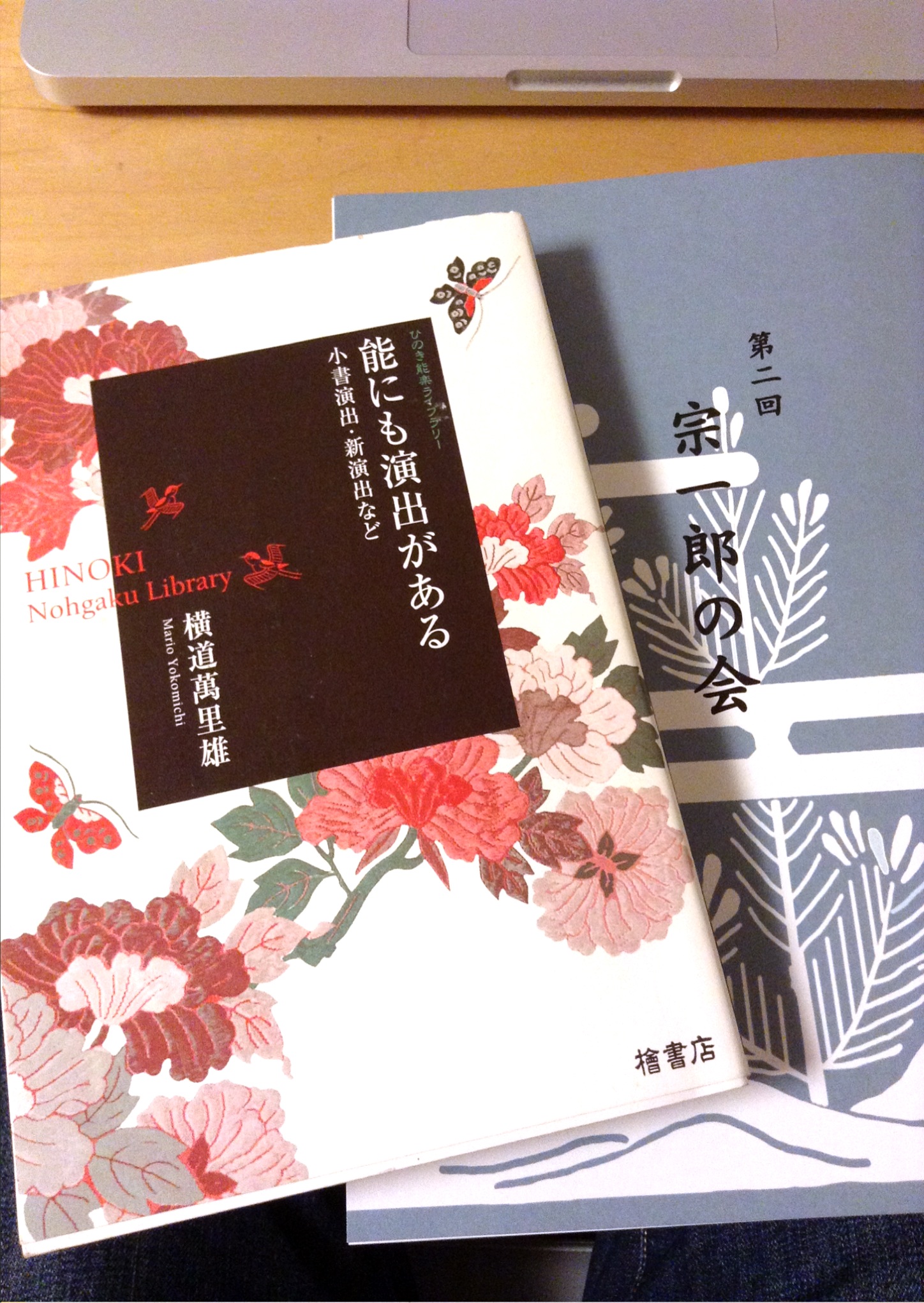
PS: Yokomichi Mario’s book on kogaki Nō ni mo enshutsu ga aru (Hinoki 2007) comes in very handy for checking variations of many Noh plays.

Noh and Kyogen: Lessons For School Teachers

Teaching Noh and Kyogen at elementary, middle, and high schools is part of a larger plan to educate the Japanese youth in the Japanese classic performing arts introduced by the ministry of education in recent years. This sounds like a good idea, as one of the biggest problems the contemporary world of Noh is facing is its inability to attract young audiences. If kids received more exposure to Noh and Kyogen, they could grow an interest in it, or at least it would not feel as alien as it does to most young Japanese. Teaching Noh at school sounds good… but how? Critics of this educational plan pointed out how school teachers, many of whom are ignorant of the classic arts in general, are in fact the reason why kids don’t get to like Noh and Kyogen. Adding plays to textbooks is not sufficient: teachers need to know what they are talking about in order to make the topic meaningful and engaging.

DSCF0993
Kongo School Noh workshop at Uji Shiritsu Nanbu Elementary School

In order to address this important issue the Nōgaku Kyōkai (Noh Professionals Association) has organised educational activities in which Noh professionals visit schools and give workshops both to students and teachers. Last year I attended one of these at the Uji Shiritsu Nanbu Elementary School. The workshop was led by Udaka Tatsushige, who is one of the performers in charge of such activities for the Kyoto area. It was an interesting experience, and he students responded very well to the various activities offered.

DSCF0977
Kongo School Noh workshop at Uji Shiritsu Nanbu Elementary School

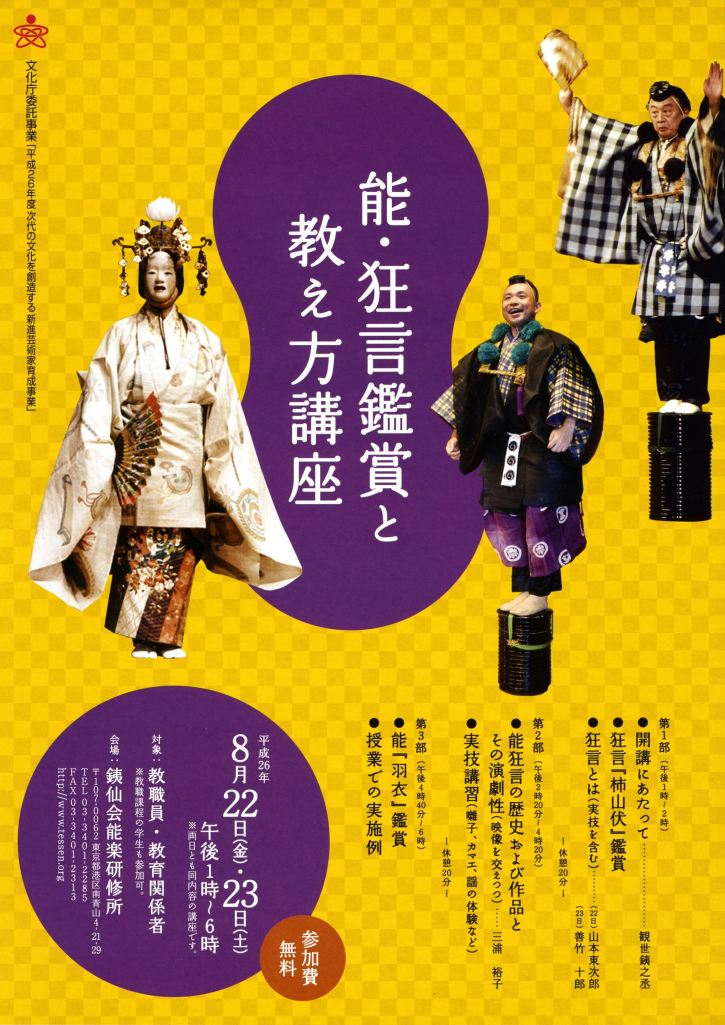
However, sporadic visits to schools will not yield outstanding results: some Noh groups such as the Katayama family in Kyoto and the Tessen-kai in Tokyo are providing more extensive and regular teaching sessions, specifically aimed at instructing the teachers, who will then be able to lecture on Noh and Kyogen even without the need of specialists. One of these sessions, commissioned by the Agency for Cultural Affaires and organised by Tessen-kai, will take place at the Tessen-kai research office in Tokyo on August 22nd and 23rd from 13:00 to 18:00. This event targets school teachers and educators, who will be able attend the performance of the Kyogen Kaki Yamabushi (‘Persimmon Yamabushi’) and the Noh Hagoromo (‘The Robe of Feathers’), plays that feature current school textbooks. Participants will also join practical sessions on performance techniques, as well as lectures on the dramaturgy and history of Noh and Kyogen. The event is free of charge.

lecture_osiekata2014

On Noh chant and responsibility

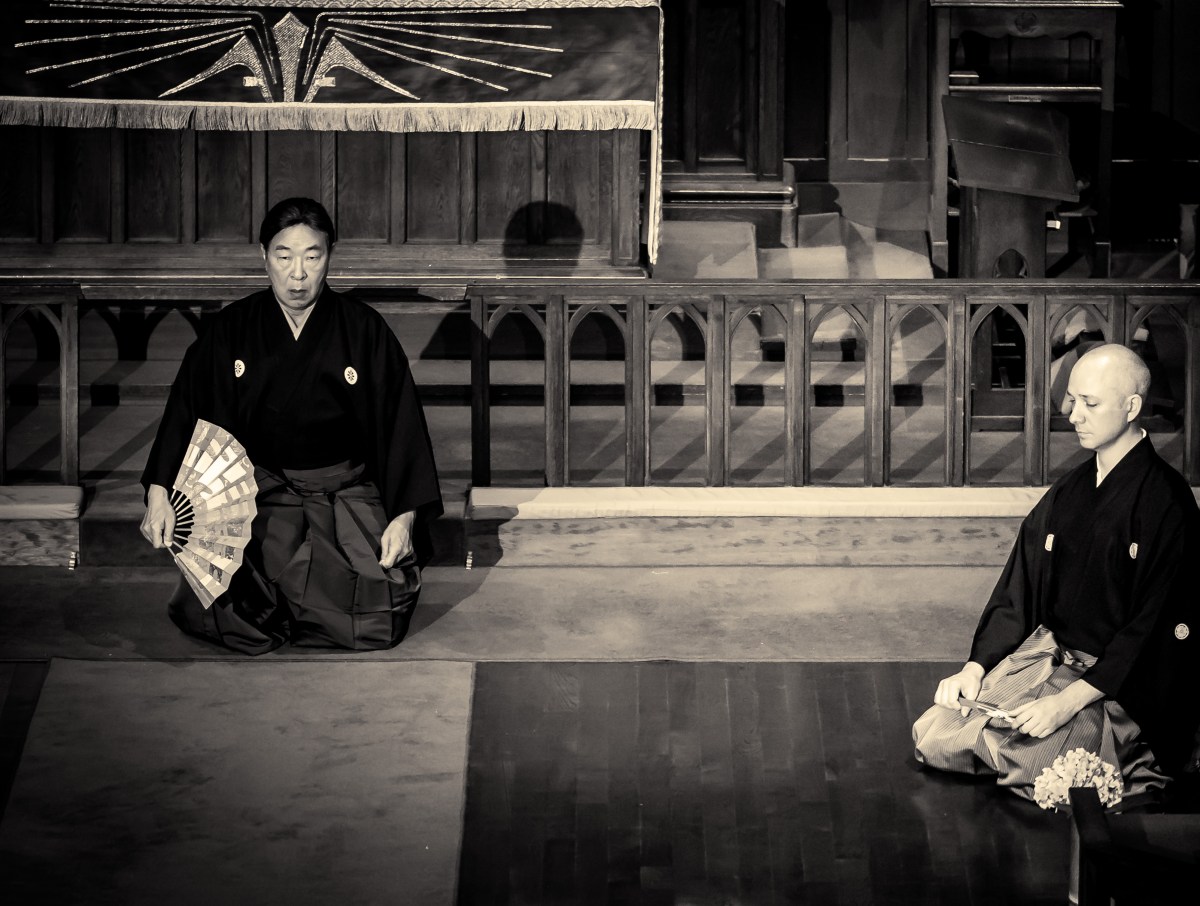
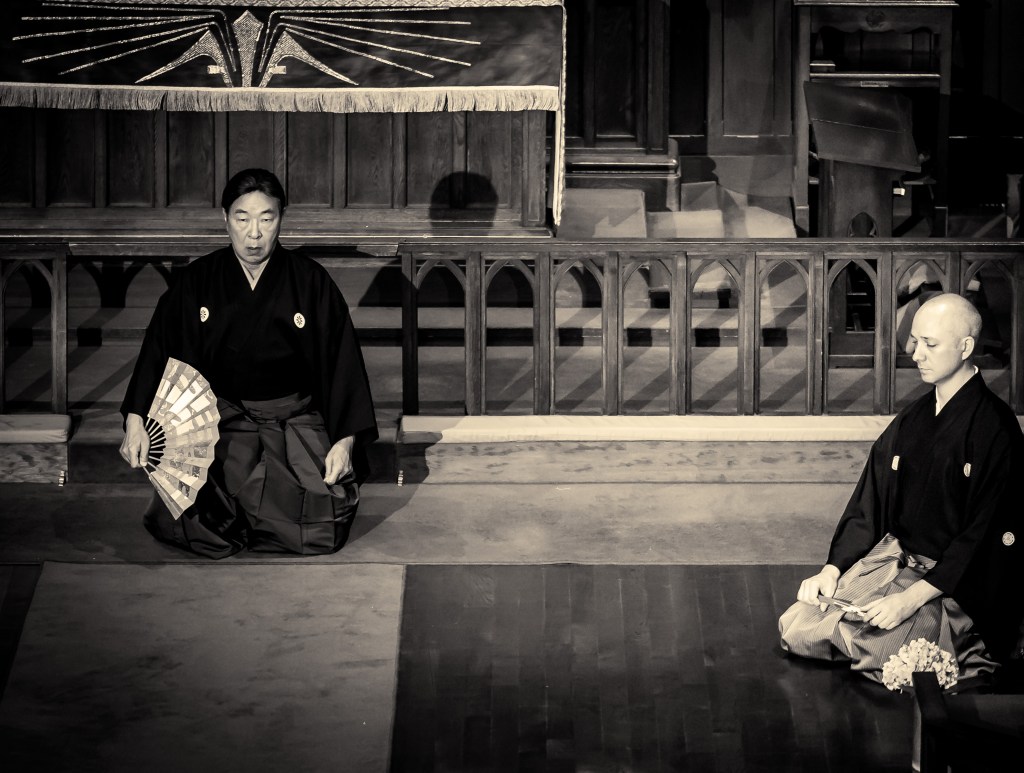
On Wednesday 25 June 2014 I took part to the event  Wayō no Saikai, which I have blogged about here. In the original plan Udaka Tatsushige, my teacher’s eldest son, was supposed to sing and dance Noh excerpts, as representative of the Japanese classical repertoire. Unfortunately Tatsushige-sensei was unable to make it to the performance so his father, Michishige-sensei, took his place. I took part in various Noh pieces that were performed during the evening, but what I was concerned the most with was the shimai dance excerpt from the Noh Yamamba, for which I was supposed to sing as the only jiutai chorus singer.

和洋の再会 2014 - 03
Shimai: ‘Yamamba’. Shite: Udaka Michishige. Photo: Stéphane Barbery.

Until now I have only sung in jiutai with other chanters – from a minimum of 2-3 to a maximum of 8, depending on the situation. This has been the first time for me to be the only singer in a shimai dance. When singing in a jiutai the most important thing is memorise the text and make sure that you follow the chorus leader. Ideally you should memorise the text and score perfectly, and sing with confidence while continuously paying attention to the chorus leader. However, if you are a beginner you will probably be told that the most important thing is not to get into other people’s way. In other words, don’t sing too loud, pay extra care to fit into the pauses, etc.

Things will start to change when as your understanding of rhythm, pauses, and fushi embellishments improves. Now you know enough to sing full force, which means that people are actually going to hear you! You won’t be able to hide behind a wall of other voices anymore. This stage is the beginning of a new phase which I feel I have now entered. Maturity means will and capability to be responsible for your own voice: you have to follow the leader but be able to continue singing even if someone makes a mistake. You have to be independent while harmonising with the others.

When I learned that Tatsushige-sensei could not make it to the performance, and that Michishige-sensei, my direct teacher, would stand in his place, I was rather worried: in a usual setting a junior/student like myself would dance, while the senior/teacher would sing. In addition, singing in a solo jiutai means that there is literally nowhere to hide, no one helping in case of emergency. It also means that (obviously) there is no leader to follow. This might have been my only chance in this life to sing as a soloist for Udaka-sensei. So I did it, and it went well. Udaka-sensei’s dance was easy to accompany even if Yamamba is a piece I had only rehearsed twice before the actual performance.

The other day I received the provisional programme for our forthcoming Gala Performance on August 17th (more news to come about this) and I spotted my Japanese name (高谷大悟 – Takaya Daigo) among the four jiutai chanters for a bulk of shimai that other students will dance. This is a position that, in our school, only professional take. A good sign, I think.

‘Musica Sacra East and West’ 25 June 2014

0625和洋の再会-thumb-290xauto-56

The Kamigata seiyō kogaku ensōkai presents Wayō no Saikai, a musical event featuring pieces from the European tradition (gregorian chant, renaissance music, early baroque music) and Noh flute, chant, and dance. The representatives of the Noh tradition will be flute player Saco Yasujiro (Morita school) and  Udaka Tatsushige (Kongō school, my teacher’s eldest son). I will have the privilege to sing for Tatsushige-sensei’s shimai (Yamamba kiri) and rengin (Kane no dan), from the Noh Miidera. Tatsushige-sensei carefully chose pieces that would suit the theme of the event: the kiri section of Yamamba is a dialogue between actor and chorus, close to the format of some ancient European sacred music, while Kane no dan describes how listening to the sound of the (Buddhist) temple bells helps achieving enlightenment.

Kamigata Seiyō kogaku ensōkai.

Wayō no Saikai – A meeting of classical Japanese and Western musical traditions

Time: 25 June 2014 from 19:00

Place: Nihon Seikōkai Kawaguchi Kirisuto Kyōkai, Osaka-shi, Nishi-ku Kawaguchi 1-3-8 〒550-0021 Subway Chuo line Awaza station (exit n. 7)

Tickets: 3,500yen (at the door) 3,000 (pre-sale)

For enquiries: 090-8147-4861