A Noh theatre workshop organised by the Italian branch of the INI – International Noh Institute, led by Shihan Monique Arnaud, the only licensed Noh instructor in Europe. Please click on the image below to be re-directed to the event page.
Author: Diego Pellecchia

Hiroshima’s Prayer for Peace
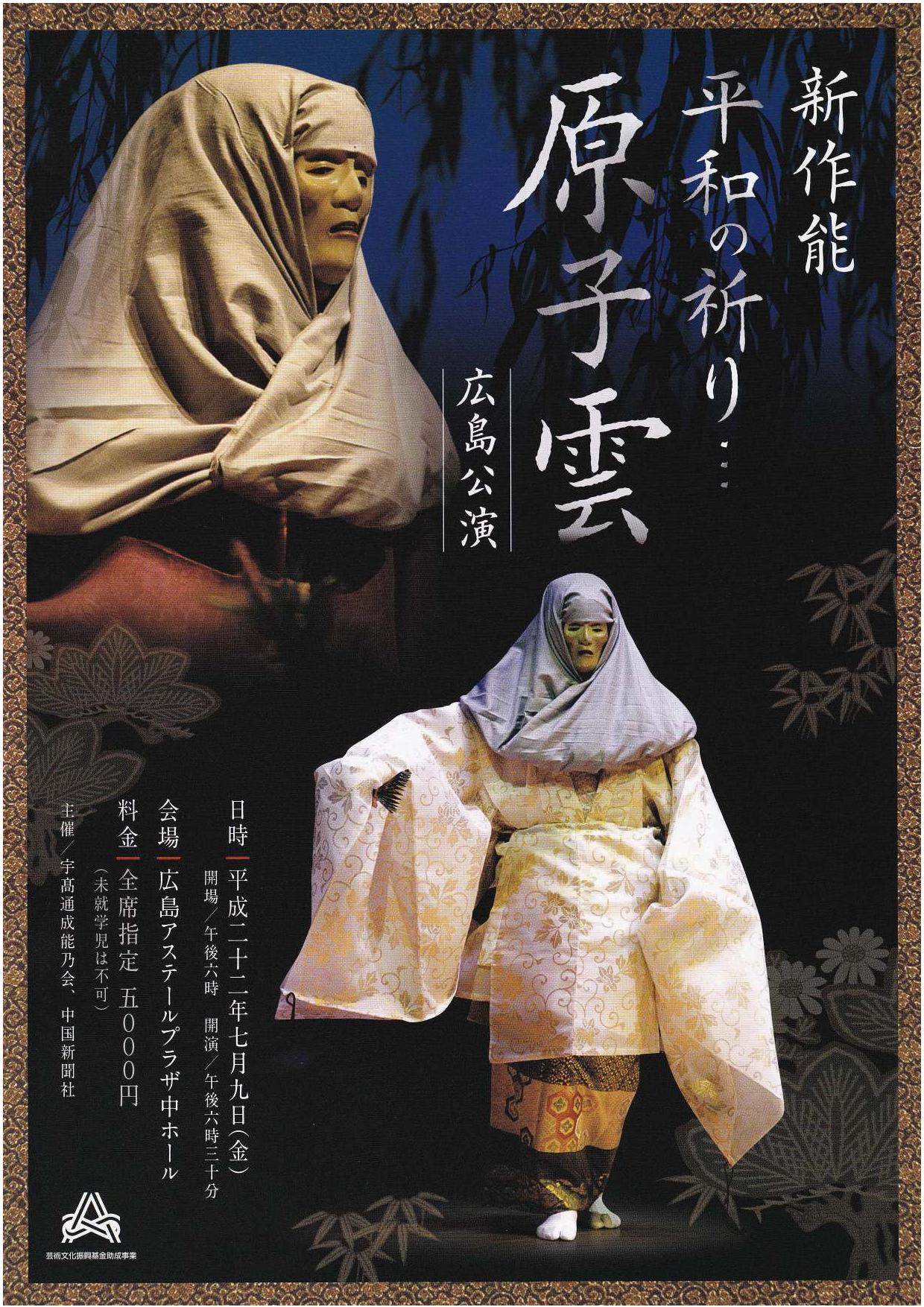
Yesterday (July 9th 2010) Udaka Michishige‘s Genshigumo (原子雲, a newly-written Noh play on the atomic bombing of Hiroshima and Nagasaki) was performed in Hiroshima for the first time. I had the chance to follow Udaka-Sensei, and take part in the introductory speeches of the performance, reading messages from members of the International Noh Institute around the world, and from the William J. Clinton Foundation.
The night before the performance, sitting in the lobby of a hotel near the Peace Memorial Park, Udaka was giving an interview for a documentary on Genshigumo. While confessing the state of excitement for finally being able to perform this play in Hiroshima, Udaka described his experience of meeting with the spirits of the casualties of the bombs who, victim of a sudden and unreasonable death, cannot be released from this existential plane and be reborn. In the play, a Mother is on a journey through memory, looking for her missing daughter who died in the bombing. After the hellish scenes of the bombings are recounted, the Mother finally finds her daughter reborn as a willow tree.
Yesterday night I observed the audience watching this play for the first time. I felt the atmosphere was very tense, and the gazes of the spectators revealed that while observing the performance on stage, their thoughts were wandering elsewhere, leaving the hall and reaching out above the sky over Hiroshima. As in the classic Noh style, when the narration of the events reaches its culmination, emotions also reach the limit of verbal explicability: it is the moment when words give way to music and dance. The haya-mai dance symbolises the complex feelings of grief and happiness of the Mother who is finally reunited with her daughter, now reborn as a willow tree. While until this point the spectators where plunged into a tense atmosphere, attentively listening to the narrative part, when the jo-no-mai dance started, only a few could restrain from letting go of their emotions. I think this passage was the peak of the performance and made me wonder if in order to express such a deep message, with all its individual and universal resonances, words were not superfluous, after all.
Genshigumo is not a historical play, aimed at re-enacting those tragic events in a narrative style. Following the tradition of the pieces of the classic repertory, Genshigumo is rather a requiem for the victims of the bombs, and an invitation to the audience to take part in this prayer for peace. Noh theatre has been transmitting the ethos of Japan (its literature, its philosophy and history) throughout six centuries: it is therefore natural that even recent events such as World War II and its tragic epilogue are incorporated in the tradition of Noh. I wish this new play will eventually become part of the official canon of Noh, and will be performed by other actors in the future. Some might wonder how it is possible to render the horrors of war through the subtle beauty of Noh. How can we ‘enjoy’ the horror? While watching Genshigumo I realised how its beauty (and the beauty of Noh as an artistic means of expression) transcends earthly pleasures (the mere aisthesia) and allows the spectator to reach out to a higher level of meaning. Genshigumo is, more than anything else, a prayer offered to those suffering spirits trapped between this and the other world. At the same time, it is a ritual, a vehicle to transmit the memory of the bombings, and a chance for us and for the generations to come to reflect on the absurdity of war.
Hiroshima, July 9th 2010. A Prayer for Peace: “GENSHIGUMO” The Atomic Cloud

July 9 (Friday), 2010 6:30 p.m. ~ 8:30 p.m.
Venue: The Hiroshima Aster Plaza Noh Theater
4-17 Kakomachi, Naka-ku, Hiroshima 730-0812
Genshigumo (‘The Atomic Cloud’), Udaka Michishige’s third newly-written noh play (新作能), composed as requiem for the victims of the atomic bombs, will be performed in Hiroshima for the first time. I had the pleasure to attend performances of Genshigumo in Paris, Dresden and Berlin in 2007, when the Udaka-kai was touring Europe. The experience of watching a Noh play performed in the traditional style based on such recent historical facts is particularly strong, and inspired several reflections. While watching the different characters of the play recounting the tragic events of the bombing of Hiroshima in highly poetic language and beautifully stylised movements, I realised how much Noh theatre’s aesthetic conventions are suitable to portray a story of such historical but also emotional relevance. The austere style of Noh, which does not indulge in easy heart-tearing devices, plunges the audience in the solemn atmosphere of a requiem, while maintaining the detachment necessary in order to consciously reflect on what war and its casualties mean.
I am looking forward to joining in this prayer.
>>>For further information and reservation, please visit the Udaka-Kai website<<<
Asian Performing Arts Forum (via Asianperformingartsforum’s Blog)
A Visit to the Worlds of Noh (via 茶有の者 – A Man with Tea)
A synthetic, yet touching account of a close encounter with Noh theatre. Thank you Travis.
Taikai 2010 – the aftermath
This year’s INI International Noh Institute – Keiunkai Taikai, in celebration of 50 years of stage life of Master Actor Udaka Michishige, has come to a close. It is difficult to draw all the impressions on such a special event in one single post. There are so many aspects and viewpoints it would be necessary to include and, in the attempt to include everything (and everyone) I would end up not doing justice to all of them. I will maintain the very personal take that has been the line of this blog so far.

On the occasion of this Kai I could for the first time take part of the full production of a Noh play, Makiginu, in the role of the tsure. As in a dream, my memories of the performance are blurred and spotty. I stand behind the omaku curtain, in the kagami no ma mirror room, I can appreciate the quality of the lights coming from the stage, through the five colours of the curtain. The lights, and the cries of the hayashi call for my entrance. Although that of the tsure is a subsidiary role, its rather long initial chant substantially contributes to set the mood of the play. I felt invested of this responsibility while treading on the hashigakari for the first time. Slowly pivoting on my feet to face the matsubame pine on the backdrop of the stage, the beats of the drums give room to my chant, as I begin my long trip to Mikumano…
Taking part of a full Noh is a privilege that only a very few foreigners had in the century-old Noh tradition. Infinite gratefulness and deep respect go to those who are teaching me this way: Master-Actor Udaka Michishige, Shihan Rebecca Ogamo-Teele and Monique Arnaud, whose relentless efforts to transmit Noh theatre to foreigners is, I believe, the greatest, unconditional expression of love for the art of Noh.
INI – International Noh Institute Gala Recital
This year’s INI – International Noh Institute Gala Recital celebrates 50 years of stage life of its founder, Master-Actor Udaka Michishige (Kongo School).
Noh: Yuki (‘The Snow’)
Makiginu (‘The Rolls of Silk’)
The program will also include a variety of chant and dance excerpts. Foreign and Japanese students of Udaka Michishige will perform on stage. Information material will be available in English and Japanese.
Place: Kongo Noh Theatre, Kyoto. Subway Karasuma line: get off at Karasuma-Imadegawa (K06), South Exit 6, walk South 300m and find the theatre on the right.
Time: 12 June 2010 (Sat) 1:00pm – 5:30pm.
Fee: Free of charge. The audience is free to come and go quietly.
A reception will follow from 6:30pm (fee: 1000 yen). Come share your impressions on Noh theatre and to talk to the teacher and the performers! Meet us at ‘Tenshokan’(天正館)2nd Fl., Mukadeya-cho 380, Shinmachidori Nishiki-koji-agaru Subway Karasuma-Shijo, Exit 24, walk West, then North at Shijo-Shinmachi (about 5 minutes). Click here for a directions from the Kongo Theatre to Tenshokan.
Map for the Kongo Nogakudo (金剛能楽堂)
来日
 Tomorrow I am embarking on a new journey to Japan. After I began to practice Noh theatre I went back to Japan almost every spring in order to undertake training with Udaka Michishige in Kyoto. For someone like me, coming from a non-Japanese studies background, it is rather hard to find opportunities to go to Japan and study there. So far I always managed with travel grants and research funding. This year will be my first experience as ‘official’ exchange student at Ritsumeikan University in Kyoto. Among the choices were Waseda and Keio – with all due respect, the exchange programme committee was a bit surprised to see that my first choice was Rits. However Kyoto is the city I love and the headquarters of Udaka-sensei’s International Noh Institute. I am going to stay there until September, entering then my 4th and final PhD year at Royal Holloway.
This time in Kyoto is going to be very special. On 12 June 2010 I will take my first role as actor in a full Noh theatre performance, Makiginu, as companion of the main actor, or shite-tsure. The shite role will be taken by Monique Arnaud, advanced student of Udaka Michishige and licensed instructor of Noh (shihan). While this tsure is a rather static role, its function is primarily centred on the chant. As he opens the performance singing a rather long chant section, his responsibility is setting the mood of the play. I will post more information about this event as my training progresses.
The other reason that makes this performance particularly special for me is being on stage with Monique Arnaud, who has taught me Noh theatre while I was living in Italy. If I have a chance to be performing on a Noh stage today, I owe it to Monique-sensei. I will write more about her later on.
As for now, wish me good luck.
Akira Kurosawa 100th Anniversary

How to pay my respect to one of the greatest masters of Japanese cinema? Well, first of all with a ‘thank you’. It is through one of Kurosawa-sensei’s films, Throne of Blood (1957) that I first encountered Noh theatre. While working on my MA dissertation at University of Verona (I was studying Shakespeare at the time) I fortuitously bumped into this screen adaptation of Macbeth. Kurosawa explicitly draws from Noh theatre to produce a masterpiece of black and white, sound and silence. Since then, I have seen Throne of Blood a zillion times, I wrote articles on it, produced the extras for the Italian DVD edition, etc.). Still the perfection of this film moves me as a few other things in my life did. My humble contribution to the genius of Kurosawa is in fact a token of thankfulness for having introduced Noh theatre in such a creative, yet ‘authentic’ way. Kurosawa not only loved Noh: he also understood it so well to know how to transpose its ineffable aesthetics on film, and with such a power. Akira Kurosawa has been long criticised by the Japanese for being too ‘Western’ – I say that it is thanks to artists who dare to do challenge the boundaries of genre, class, local criticism that an artistic dialogue, notoriously more effective than the political, can successfully take place. My reception of Noh started with his work, and I am doing my best to follow his example. So.. thank you, Kurosawa-sensei.
Kurokawa Noh
I would like to share some rare amateur videos of Kurokawa Noh I found on YouTube. Click on the video to be redirected on YouTube and find more videos on the performance before-and-after on the uploader’s page.
There is not a lot of literature on the subject in European languages: here are some resources:
– Martzel, Gérard. La fête d’Ogi et le nô de Kurokawa. Paris: Publications Orientalistes de France, 1975.
– Grossman, Eike. ‘Under the burden of Noh: Community life in Kurokawa and ritual Noh performances’ in Noh Theatre Transversal. Stanca Scholz-Cionca and Christopher Balme eds. Munich: Iudicium, 2008.
 The Noh Diaries