Nō is often described as austere or difficult, but at its heart it is a deeply human form of theatre. This book invites readers to step inside the nō world and discover its history, its plays, and how performances are shaped through dance, music, poetry, masks, and costumes.
Rather than treating nō as a museum piece, the book approaches it as a living practice, still performed today and still capable of speaking to contemporary audiences. It is written with students, theatre-makers, and general readers in mind, offering clear explanations without simplifying what makes nō unique.
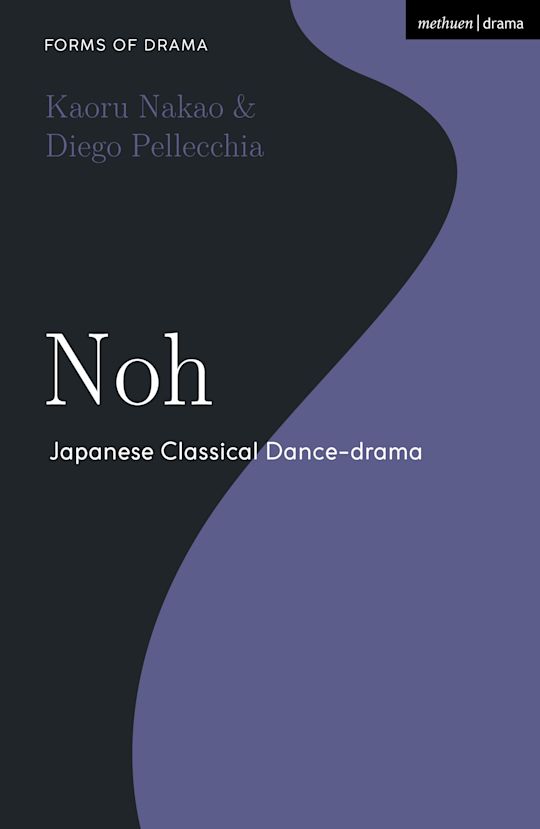
Kaoru Nakao, Diego Pellecchia. Noh: Japanese Classical Dance-drama
Published Feb 20 2025. 208 pages 10 bw illustrations. Bloomsbury Methuen Drama
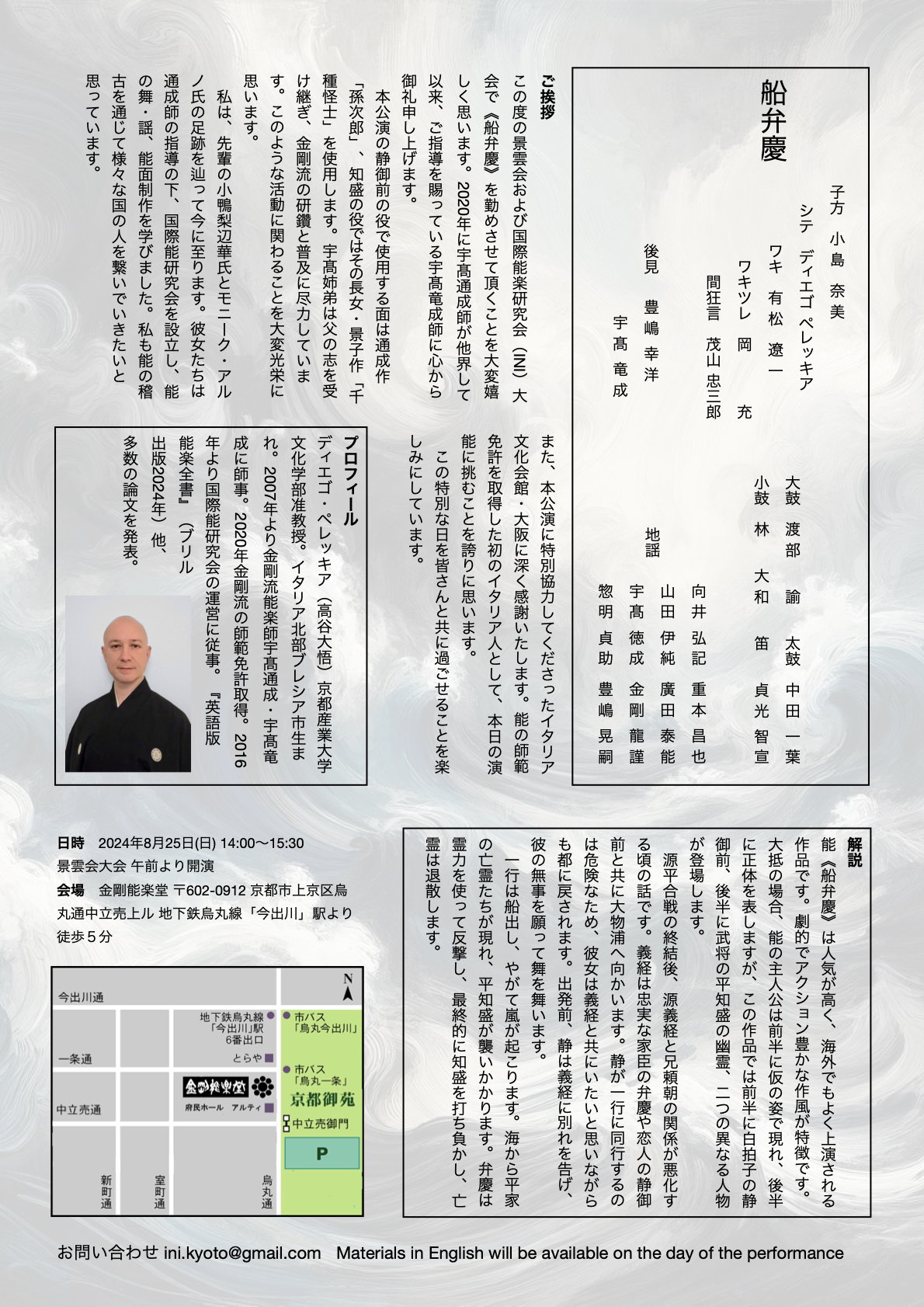
I am thrilled to announce that on August 25, 2024 (Sunday), I will perform the nō play Funa Benkei as the shite (main actor). This is the second time I perform a full nō play with costume and mask; the first was Kiyotsune in 2013.
This performance will be part of the Kei’un-kai recital, organized every summer by the Udaka family. I am also grateful for the support of the Italian Culture Institute in Osaka. I will release more information about this performance soon. For now, I am focusing on training.
I hope you will come share this special day with me and the other members of the Udaka Kei’un-kai!
Canon and IBM Japan will join forces to promote performing arts using volumetric video technology, which I understand as being a form of 3D video filming which will allow to freely move the point of view around the stage. Captured images are digitally processed so that they can be modified adding CGI. The Iemoto of the Hōshō school, Hōshō Kazufusa, is collaborating with this project – you can see samples of his performance of Aoinoue on the Volumetric x Noh Website.
The video of Udaka Tatsushige’s full performance of the nō play Shōjō with English and Italian subtitles is now available online.
Sono molto felice di condividere con voi il video completo del nō Shōjō (猩々), con sottotitoli in inglese e in italiano! La performance e’ prodotta da Udaka Tatsushige e Norishige, ed e’ stata filmata nell’autunno del 2020 presso il teatro della Scuola Kongō, a Kyoto. Il ruolo di protagonista (shite) e’ interpretato da Udaka Tatsushige.
In occasione della pubblicazione di questo video ho avuto il piacere di tradurre il testo del nō e ho deciso di approfittarne per studiare questo brano approfonditamente. Spero di poter pubblicare presto i risultati della mia piccola ricerca in italiano. Anche un dramma breve e apparentemente semplice come Shōjō e’ in realtà molto denso di significati e ricco rimandi a leggende e tradizioni. Purtroppo il formato “video con sottotitoli” non permette di aggiungere le note, supporto indispensabile per apprezzare appieno la molteciplità di significati che ciascun verso contiene. Nella mia traduzione ho cercato di rendere il testo comprensibile anche senza un apparato critico. Aggiungo una breve introduzione e vi auguro buona visione! (Non dimenticate di attivare i sottotitoli in italiano. Se non sapete come fare, leggete qui).
La storia del nō Shōjō è ambientata nella Cina della Dinastia Tang (secoli VII-X). Un uomo di nome Kōfu vive alle pendici del monte Kanekin, nei pressi del villaggio di Yōzu. Kōfu racconta di essere molto devoto ai suoi genitori – la pietà filiale (kōkō 孝行) è una delle virtù centrali del pensiero Confuciano, fondamento etico della società giapponese. Kōfu riceve in sogno un oracolo nel quale i genitori gli suggeriscono di andare al mercato e vendere il sakè. Lui segue diligentemente il consiglio dei genitori, apre un negozio di vino, e si arricchisce. A un certo punto, un misterioso avventore prende a visitare il negozio di Kōfu. Dice di essere “Shōjō” e di venire dal mare. Incuriosito, Kōfu si reca alla baia e attende la nuova venuta di Shōjō, il quale presto emerge dall’acqua. Kōfu e Shōjō bevono insieme, elogiando le virtù del sakè, e Shōjō celebra questo incontro con una danza. Infine, Shōjō premia Kōfu donandogli una giara di vino inesauribile, prova della sua virtù e allo stesso tempo, in termini più pragmatici, assicurazione di prosperità economica per i suoi discendenti.
Fra i molti temi che varrebbe la pena commentare, vorrei soffermarmi brevemente sull’associazione fra sakè e crisantemi, ricorrente nel testo di questo nō. Secondo una tradizione di origine cinese, durante la notte i fiori di crisantemo venivano coperti da pezze di cotone per poter raccogliere la rugiada depositata su di essi il mattino seguente. Si credeva che cospargersi il corpo con questa rugiada profumata potesse allungare la vita o curare le malattie. Questo rito veniva svolto il nono giorno del nono mese del calendario lunare. Tale giorno, noto come chōyō no sekku, era una delle cinque festività stagionali. [1] Nel periodo Heian (secoli VIII-XII) l’aristocrazia giapponese usava festeggiare questo giorno con un banchetto durante il quale si beveva sakè nel quale erano stati immersi fiori di crisantemo. La festa divenne quindi associata al sakè, ma anche alla stagione della raccolta del riso, con il quale si prepara questo vino. [2] Il crisantemo e la luna, simbolo di purezza e di sincerità, sono elementi tradizionalmente associati all’autunno. Il colore rosso, che caratterizza il costume di Shōjō, allude non solo al suo possibile stato di ebrezza, ma anche ai colori del fogliame autunnale. La veste interna surihaku e la gonna-pantalone hakama sono decorate con motivi di onde in oro su fondo rosso, mentre il kimono broccato karaori è ricco di motivi floreali fra cui sono evidenti, appunto, crisantemi di vari colori.
[1] Il significato simbolico della data e’ il seguente: il numero 9, segno dispari, quindi “positivo” (yang) e indivisible e’ il numero a singola cifra più grande. La ripetizione del 9 rende il nono giorno del nono mese il giorno più “yang” dell’anno.
In a recent interview for Tokyo Shimbun, Hōshō Kazufusa, iemoto of the Hōshō school, has commented on the current coronavirus crisis, saying that (I paraphrase) many people think that the tension perceived in a nō performance cannot be transmitted through videos, but there are things such as the breathing of the performers or the sweat dripping from their chins that film techniques can capture in order to convey the “drama” of nō performance.
I very much agree with this. The problem with YouTube videos of nō is that many of them are produced without the necessary attention to how the performances are filmed. Of course, there are reasons for this, including organization, timing, and, most importantly, budget. But there could also be a lack of awareness of the shortcomings and potentials of the video medium.
I think that there could be a future for nō videos if the quality improves. Filmed performances of kabuki, but also of the National Theatre or The Globe may serve as inspiration. The current crisis will eventually (hopefully) end, but the Internet is going to stay. I hope nō will be able to make good use of it.
Among the various recent news from the Nohgaku Performers’ Association (Nōgaku kyōkai) is the announcement of their beautiful new logo, representing the silhouette of a nō stage – four pillars topped with a roof. In the announcement statement it is explained that the four “pillars” in the logo symbolize the four types of nōgaku performer (shite, waki, hayashi, kyōgen), while the roof is the ideogram for “person”. The logo represents the transmission of knowledge from person to person, constituting the history of nōgaku’s ancient tradition.
While the four types of performer represent those who stand on stage, it is worth remembering that there are many other people working “backstage”, including mask carvers, costume weavers, and fan makers, without whom nō and kyōgen performances would just not be possible.
Noh has been performed on festive occasions since its inception. Here is what it would look like to have Noh performed at your marriage ceremony. Beautiful footage.
Only the sound remains,by Kaija Saariaho and Peter Sellars, is a modern opera based on two noh plays Hagoromo and Tsunemasa, which Ezra Pound rendered into English working with Ernest Fenollosa’s translations of the original Japanese texts. There are several reviews of its performances available online – for example, The Guardian or Opera News.
The article on the Asahi Shinbun mentions the ‘ubiquity’ of noh. It seems to me that what is ubiquitous is the noh ‘brand’, not the art. I have not seen the performance but from the trailer below I wonder: what is left of noh?
After a long series of videos on various aspects of Noh in Japanese, Udaka Tatsushige has decided to reach out to the English-speaking public with videos in English. Here is a useful video on how to fold a noh hakama, the so-called ‘split skirt’ used by noh performers. It is not as hard as you could think!
 Performance announcement


 The Noh Diaries