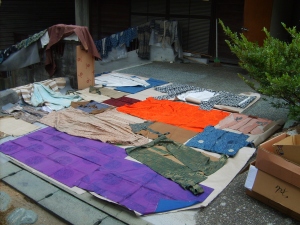
 A few weeks ago I had the privilege to participate to the Mushiboshi (虫干) of the Shinonome Shinto shrine (東雲神社) in Matsuyama, Shikoku, where the ancestors of my Master, Udaka Michishige, used to live and perform under the patronage of the aristocrats settled in Matsuyama castle. Mushiboshi (lit. ‘drying insects’) is a periodical cleaning and refreshing of artifacts usually stored in closed compartments – items are removed from their usual storage location and exposed to fresh air. In Japan temples, shrines, museums and private collections have their own mushiboshi once or twice a year. In this case, the Shinonome collection comprised of a number of Noh masks and costumes which still have not been fully catalogued and dated, though they could range from the early Edo period until today. This collection had been used by professional actors until the Meiji restoration, when Noh theatre underwent hard times as a consequence of the loss of its former patrons. From this moment onwards masks and costumes from Shinonome Jinja has been probably used both by amateurs and low-level professionals. This was noticeable from the poor condition in which the items were found and the signs of bad handling and storing after use were evident. While many masks were covered with dust and simply left sitting on shelves, costumes and wigs were just thrown into boxes without proper cleaning and folding. Although several masks and costumes had already been taken care of and displayed in one of the halls of the jinja, the majority of masks (around 250) and costumes were still to be cleaned and re-stored – it has been a two-day intensive session, but an extremely interesting one! Not only I could closely observe different Noh costumes but also I could learn folding techniques and storage methods. As always, Udaka-sensei put together such a great, hard-working group coming from some of the different locations where he teaches in Japan (in this case Kyoto, Tokyo and Matsuyama) – although it has been intense I have to say thanks to Sensei for this unforgettable experience.
 This was not just an archeological expedition – Udaka Michishige is reconnecting his present and future activities with an equally important past. During the tumultuous years of the Meiji restoration the nobles patronising the Udaka family lost their powers and the Noh troupe was disbanded. Many of the most precious items in the Shinonome collection were sold to big companies and museums in Tokyo. However, many great costumes and masks were still hidden in the storage room, sleeping there but asking for someone to rescue them! Now that so many of them have been taken care of and catalogued, it will be possible to use them in performance in the future. Finally their uneasy sleep has been awaken by summer winds!
P.S.: I apologise for not posting better pictures or not providing better explanations but I am unsure of how much both Shinonome Jinja and Udaka Michishige would want this material to be public in an informal (blog-like) way. It is my intention to write more about this topic through more official channels.
Those who would like to know more about this activity, or purchase a small catalogue of the Shinonome-Jinja collection are encouraged to refer to Udaka Michishige’s official website.




 The Noh Diaries