My teacher wrote this for me the other day. It means something like ‘doesn’t know, doesn’t come’. Could it be the slogan for a new advertising campaign?
Fuchi Furai

My teacher wrote this for me the other day. It means something like ‘doesn’t know, doesn’t come’. Could it be the slogan for a new advertising campaign?

A bit of a random post.
Cycling in the snow this morning reminded me of Mishima’s Spring Snow which I am reading these days. In one of the salient passages of the book, set in the Taisho period (1912-1926), the protagonists Kiyoaki and Satoko take a rickshaw ride on a snowy morning in Tokyo. Covered with various layers of technologic fibre from top to bottom, and still shivering while waiting for the green light at the bicycle crossing, I imagined Kiyoaki and Satoko riding the rickshaw, him dressed in his school uniform, her in a winter kimono and coat, with only a blanket on their knees as additional warming device. In this scene the two exchange their first kiss, as frosty hands move underneath the blanket. With this kind of temperature it would be the last thing I want.
Then I realised that people can stand different temperatures according to the environment in which they grew up. Japanese students today still wear shorts in winter, and some girls still wear a skirt and short socks. British people would go out in their t-shirt on a sunny but cold february day. Not to mention what girls would wear on the same night out.
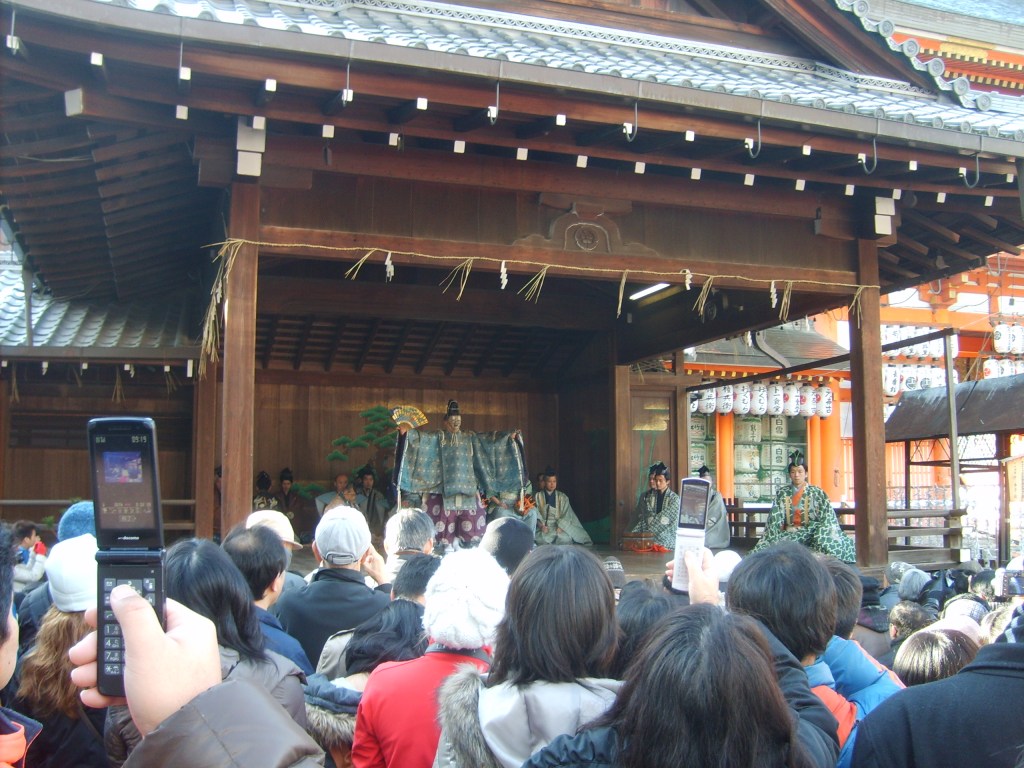
Two years ago I attended the performance of Okina performed by the Iemoto Kongo Hisanori at Yasaka-jinja in Kyoto. I think it was January 3rd and I was observing chorus members sitting in the back of the outdoor stage, dressed in traditional clothes… and I was wondering how many Uniqlo heat-tech garments or kairo heating patches they were actually wearing.
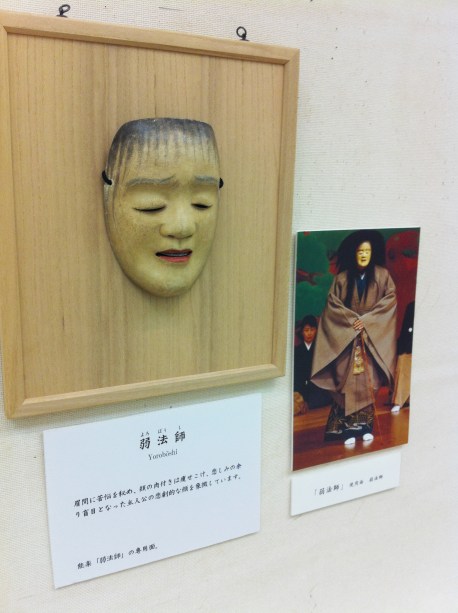
On Wednesday 28th 2012 I visited the 14th Udaka Michishige Men-No-Kai Noh mask exhibition at the Kyoto Prefectural Center for Arts and Culture. The exhibition featured over 30 masks both by Udaka Michishige and by his students. Udaka Michishige is not only a high-profile actor of the Kongo School of Noh, designated Important Cultural Asset by the Japanese government in 1991, but also a superb Noh mask carver. A number of his masks have been approved by the Iemoto Kongo Hisanori, and are now regularly used on stage. I should point out here how normally Noh mask carvers are not professional actors: they conduct their activity independently. Many Noh masks are not even considered to be for stage purpose, but for decorative purpose in private houses, offices, hotel lobbies, etc. I am not saying this in a derogatory way: some of these are very beautiful indeed… except that they are not suitable for stage use. Here is where Udaka Michishige is special: as an actor with extensive experience of mask use on stage he understands what distinguishes a beautiful work of art from the most important expressive tool of the Noh actor on stage, and implements this knowledge in his mask carving activities. Udaka Michishige teaches Noh mask carving in Kyoto, Nagoya, Matsuyama, and Tokyo: if you are interested in masks and would like to observe a carving session, please check the Men-No-Kai website for contact details.
Among the masks displayed during the 3 day exhibition were among Udaka-sensei’s finest pieces – here are some pictures I took with my iPhone (sorry for the bad quality…) – I will post more soon!
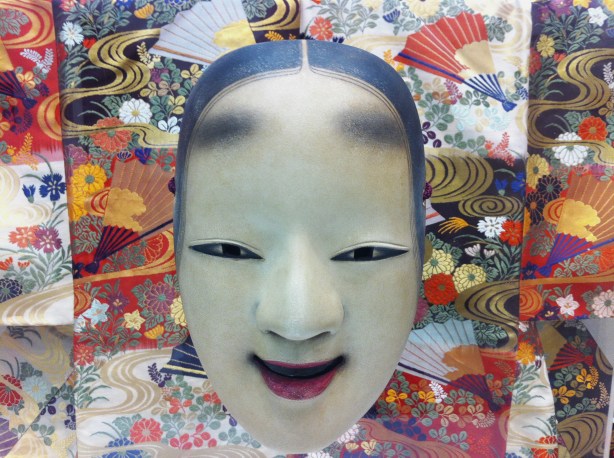



is the theme of this year’s UDAKA Michishige Men-no-Kai Noh mask exhibition. The 14th edition of the exhibition will feature works of Master-Actor UDAKA Michishige, possibly the only Noh actor who is also a professional mask carver, as well as several masks carved by his students. the exhibition will open tomorrow Tuesday 27th November and close on Thursday 28th November. Wednesday at 13:30 it will be possible to attend a talk by UDAKA Michishige and a Noh costuming demonstration. See below for more details and access information.
UDAKA Michishige’s work as Noh mask carver has been collected in various picture books, among which The Secrets of Noh Masks published by Kodansha International.

At the Kyoto Prefectural Center for Arts and Culture 2nd Floor
Kawaramachi Hironokoji-sagaru, Kamigyo-ku (across from the Prefectural Hospital)
10:00 a.m.~6:00 p.m. (5:30 p.m. on the 28th)
28th (Wednesday)1:30 p.m. Talk and Costuming Demonstration by UDAKA Michishige
Access information (in Japanese) http://www.bungei.jp/map/access.html

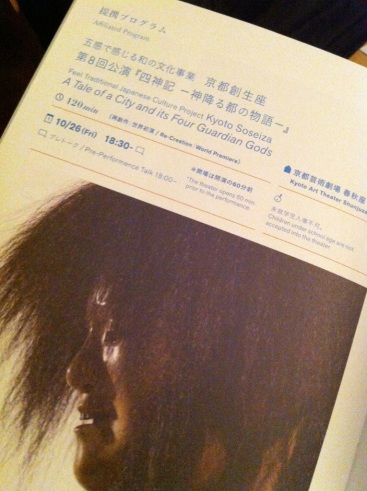 Last Friday I went to see A Tale of a City and its Four Guardian Gods, a Soseiza production that closed the Kyoto Experiment, performing arts festival 2012. The performance featured Kabuki and Noh actors interacting on stage. The venue was the Shunju-za, a full-fledged Kabuki theatre built within Kyoto Zōkei University. Before the staging of the play some of us who applied were taken to a backstage tour of the theatre. All I can say is: ‘holy cow!’ The theatre is unbelievable, and features a mawari butai rotating stage with two rectangular modules that can be lowered and raised independently, wiring for fly-over action, and of course a hanamichi. Japanese universities certainly do not lack funding for this kind of enterprise.
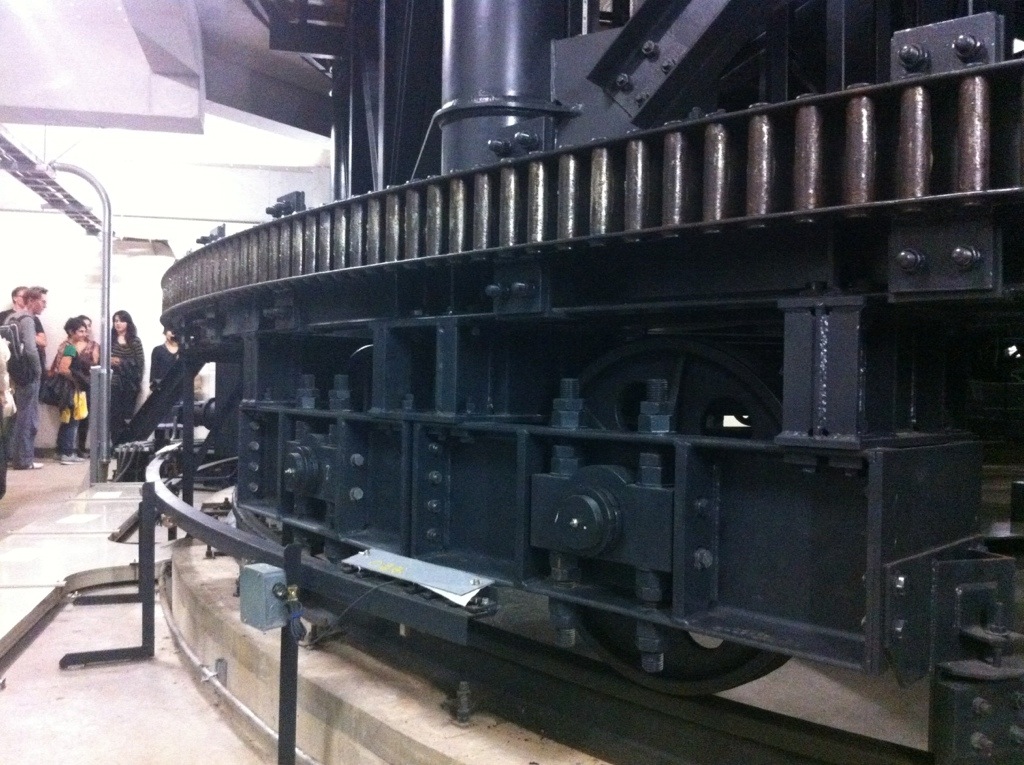
All this beauty is used for all sorts of performances, from classical plays to more experimental stuff such as what I saw on Friday. I must say I was not impressed by the play. To put it bluntly, having Noh and Kabuki sharing the same space seems to be detrimental to both. Kabuki ends up looking like a children panto, while the Noh bits are deadly boring. One of the issues with the Noh actors, who interpreted rather dynamic characters (a warrior and a tiger) was that on such a large space Noh movements lose all intensity. I have seen Noh performed in wide spaces and I keep on feeling that Noh needs the cubical space produced by the ‘orthodox’ Noh stage. Wide spaces flatten the movements, and do not offer a sufficiently tight framing for the intense but minimal Noh gestures.
One thing that bugged my about the performance was the paradox of having different styles on stage without a real attempt at dialogue, except for the fact that… they were both on the same stage, and maybe for a couple of musical moments where the Noh orchestra (sitting on the left) ‘dialogued’ with the Kabuki orchestra (sitting on the right) – they actually played the same tune. This is so typical of the Japanese traditional arts. Fragmentation. Together, but apart. The result was actors who want to talk to each other, but can speak (or want to speak) only their native language, and in the end do not seem to really understand each other.
Those nerds who know videogames might get this: the performance looked like one of those beat’em’up video games, in which a sumo wrestler fights with a muay-thai boxer – it just looks unnatural.
Anyway, it was worth going and I hope I look forward to future Soseiza works that would more baldly experiment with a deeper interaction of their arts.

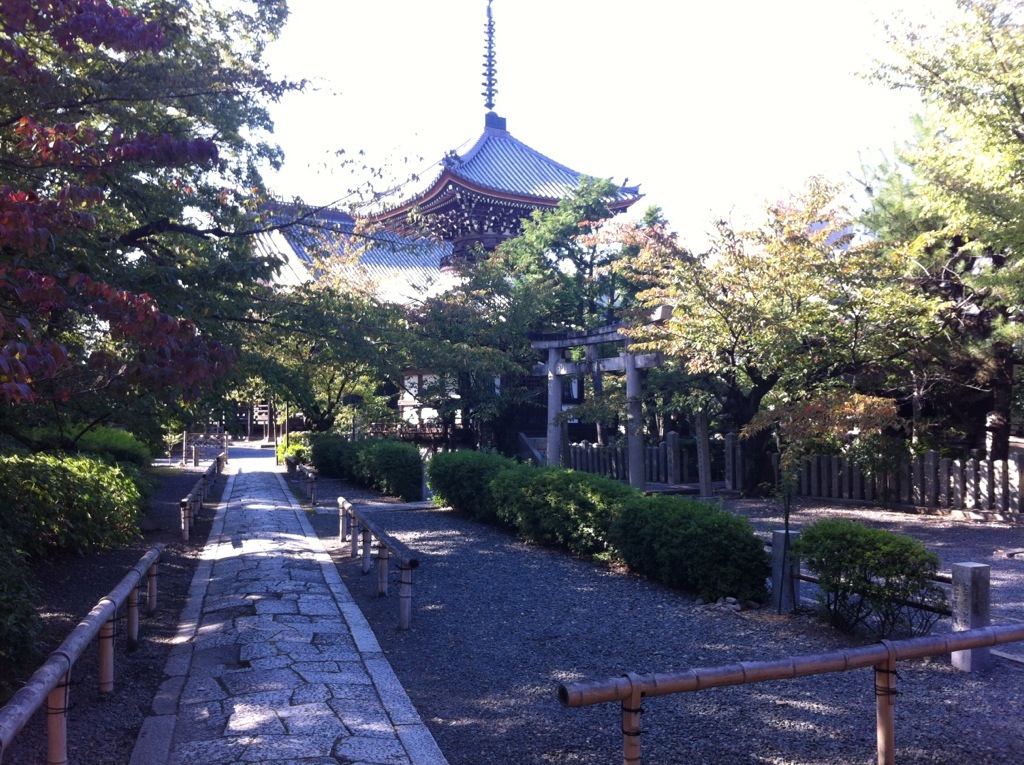 Today I went to the Urasenke kaikan in Kyoto where students of the Midori Kai (a training programme for foreigners who want to train in tea ceremony) hold their periodical ‘an invitation to tea’ gatherings. This is a very good occasion to experience tea with explanations in the English language. The host was a very charming Chinese lady (I believe her name was Lien) while explanations were provided by an American woman who admittedly spoke very little Japanese. I think this was an excellent choice as it showed how it is not necessary to be fluent in Japanese in order to do tea.
The most interesting part of the meeting was of course observing the other guests. I was sitting next to an young American man who must have planned his visit carefully as he came with a furoshiki out of which he pulled a heavy montsuki (notice we still have 24 degrees over here), which he wore on top of his regular clothes. I don’t know what he used to tie it, but I saw no obi. The guy was dying to show off how good he can sit in seiza, so he immediately took a martial kind of seiza with knees wide open, and hands on his upper thighs – I am no expert in tea, but this posture seemed to be far from the relaxed and aware environment of tea. Obviously he left his bags scattered behind him, so when I entered the room (I was destined to be sitting next to him) I had no place to sit.
Observing foreigners in Japan is a continuous source of amazement/hilarity/reflection/disgust and I hope one day to have time to write about it, maybe in a casual/ironic and non academic way. I myself am one of them. But seriously, this dude was quite something. His way of wearing the second-hand shop montsuki as if it were a bathrobe reminded me of some late XIXth century pictures of japoniste collectors like Louis Gonse, or like the French fashion designer at Villa Kujoyama a few years ago, who added the final touch with chopsticks in her chignon. Japonisme never dies.
In the picture: the beautiful Honpo-ji, the Nichiren-sect temple adjacent to the Urasenke-kaikan
 The Noh Diaries