Tickets giveaway! Noh: TORU 3 November 2012

FREE TICKETS!

For international students in the Tokyo-Yokohama area:
Do you know about Minamoto-no-Toru and his world? Answer the following question for a free ticket to the Sanrinshojo Noh performance of TORU on November 3rd.

In TORU a Priest meets an Old Man who is going to collect salt water to make salt. In what Noh play do two sisters appear who are also collecting salt water?

A free ticket is available for the first three correct answers to the question. When applying be sure to state your name, age, nationality/country, the name of institution where you are studying in Japan and address where we should send your ticket. Deadline for answers is October 19th. 

Send your answer to: ogamo-tr@mbox.kyoto-inet.or.jp (INI – International Noh Institute)


New Noh: ‘Shain’

The October issue of the Nōgaku Times features an article on Shain 『沙院』 a shinsaku-noh (new Noh play, not part of the classical canon) by actor Nagajima Tadashi (Kanze).

Shain is based on the character of Shakushain, an Ainu chifetain who led an important rebellion (Shakushain no tatakai, 1669-1672) against the Matsumae clan, the Japanese lords who occupied the Hokkaidō region at that time.

The Noh follows a rather standard structure in which a monk (waki) visiting Hokkaidō meets a local man who tells him the story of Shakushain (shite) before disappearing. In the second half of the play the shite re-enters the stage in his real form, as the spirit of Shakushain. In the interview to the Nōgaku Times, Nagajima-sensei explains how the character for the nochi-ba (second act) was built around that of the Noh Kōu (on the Chinese general Hsiang Yu). One of the highlights of the play is the ezo-nishiki fabric costume for the character of Shakushain, of which you can find pictures on Nagajima-sensei’s website.

Unfortunately not much is said about the ‘post-colonial’ resonance of the play. Obviously the Japanese invasion and subjugation of Hokkaidō has an important meaning in Japanese history, especially if seen in the perspective of Tamura, the only classical Noh play dealing with a similar theme. In Tamura the general Sakanoue no Tamuramaro (758-811) is sent by Emperor Heizei to Mt. Suzaku to contrast an Ainu invasion, whom he defeats with the help of the bodhisattva Kannon, who mercifully sends a thousand arrows on the ‘demons of the North’, killing them all. You can find a synopsis on www.the-noh.com, and perhaps also notice how they artfully avoided to mention that Tamura’s enemies were actually Ainu people.

Those interested in attending Shain can find more info on Nagajima Tadashi’s website.

11/3 – 10th Sanrinshojo: TORU「融」

The National Noh Theatre, Tokyo 1:30~4:20 p.m. (doors open at 12:30p.m.)

Program:
Commentary:  Dr. ONO Yoshiro Professor, Kyoto Institute of Technology
Kyogen: AKUTARO  MIYAKE Ukon
<20 MINUTE INTERMISSION>
Noh: TŌRU jūsandan-no-mai  UDAKA Michishige

Tickets: Reserved (stage front): 7,000 yen
Reserved (waki-shomen–facing the chorus):  6,000 yen
General admission (naka-shomen–facing the sighting pillar):  5,000 yen
Student (naka-shomen–facing the sighting pillar):  2,000 yen

For tickets or further information contact: ogamo-tr@mbox.kyoto-inet.or.jp

http://www.noh-udaka.com/en/index.html

Synopses of the plays will be available at the theater free of charge in English, French, German, and Italian.

Excellent post from Travis, raising the question as to whether academic blogging and publishing can conflict.

Travis's avatar上り口説 Nubui Kuduchi

When we post online about our research topics, or about things we’ve discovered in the course of our research, how much is too much? Where should we draw the line? What should we and should we not share, in order to protect ourselves professionally?

When we write papers, we of course do not write that paper in a public place, such as a blog or a Wiki, while we’re working on it, nor do we post the completed paper online afterwards,* especially if we’re looking to ever develop that paper further, into a dissertation, or into something to get published. There’s too much danger of being accused of plagiarizing yourself (however that works – I have a hard time wrapping my head around precisely why that’s wrong, even though I sense strongly that it is), and, I suppose, if one is worried about such things, too much danger of someone…

View original post 1,284 more words

The speed of time

This year’s Kaki-kenkyūkai (summer training meeting) took place on August 12th at the Dentōgeinōkaikan in Ōtsu, on the Biwa lake. Unlike the Noh stages that belong to families, the  Dentōgeinōkaikan is ‘non-confessional’: it is used by various Noh groups. The venue is also used for other forms of performance and traditional arts, such as tea ceremony. This stage is very close to Miidera, a beautiful temple of important historical heritage, famous for its feud against the Enryaku-ji temple after a schism of the Tendai Buddhist sect, and for its bell, which is portrayed in the homonymous Noh play. This is not the first time for me to perform here: I already attended a summer training meeting last year, and I used the stage in order to rehearse for Monique Arnaud’s Makiginu in 2010. However, this year’s meeting was particularly thought-inspiring.

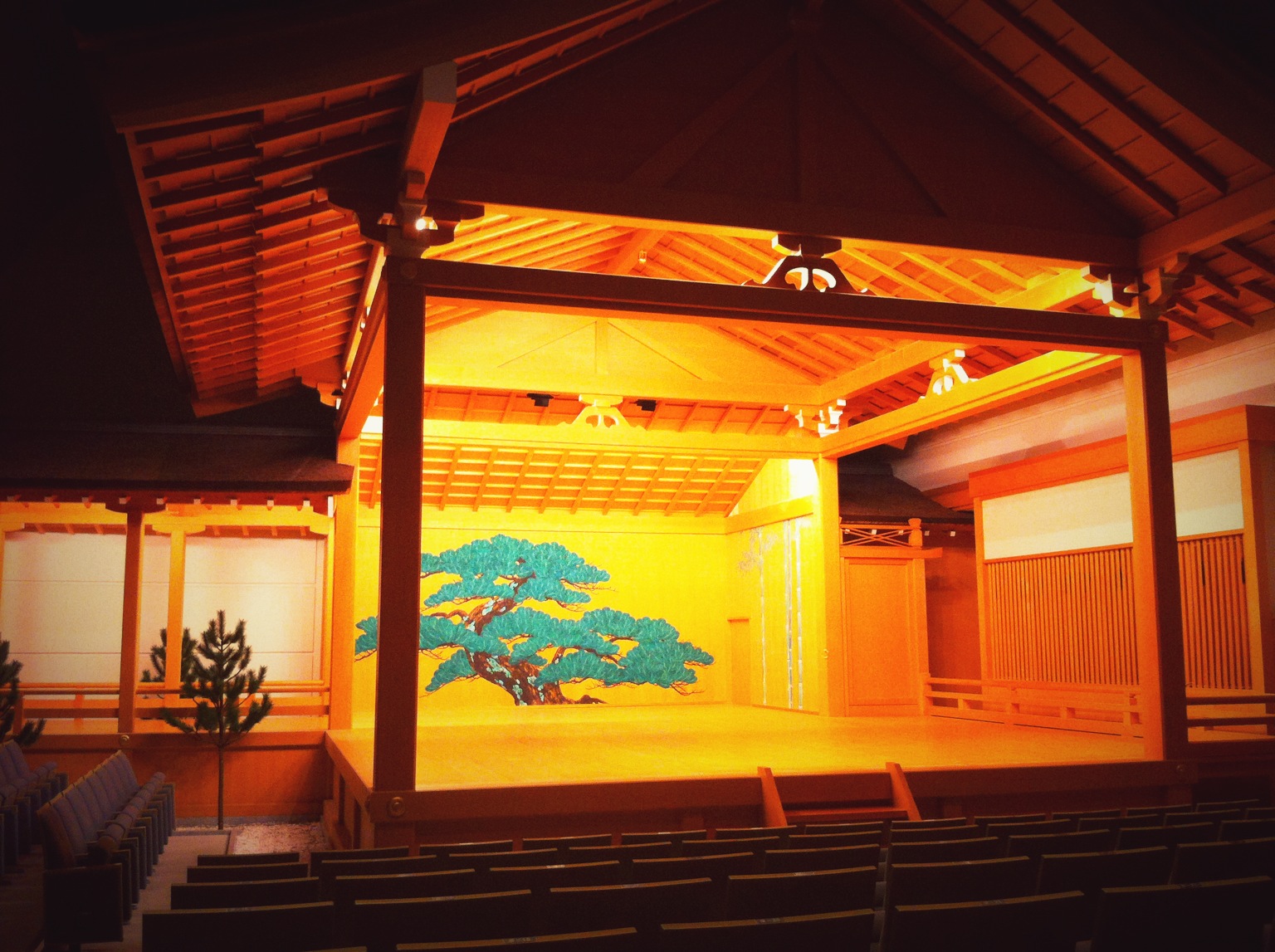
This is how the Dentōgeinōkaikan stage looks like.. when people are not on it. I am sorry for the lack of pictures, but it is not easy to run back and forth between gakuya (backstage) and stalls in order to take pictures. When a kai like this takes place, with more than 20 people involved, there is very little time for souvenir pictures, as your efforts and concentration are 100% projected towards observing, learning, and being ready to help whenever it is needed… I wish we had a professional photographer to document the day!

Kurai wa karukatta! (‘you were too light and superficial’!) Isogashikatta! (‘it looked like you were not in control of time, so you sped up everything’!) Hayakatta (‘you were too fast/too early’!)

These are the comments that I received for my attempt at Kiyotsune maibayashi. I was not expecting anything different: I knew that I was still too unsure of how to perform certain movements, and most of all of how to time myself properly and follow the hayashi and ji-utai in a meaningful way. In my view, being able to harmonise with the music really is one of the characteristic that distinguish an amateur from a professional. My only ‘consolation’ is that being ‘fast’ and ‘light’ (this being a consequence of not pacing pauses and movements appropriately) is a widely shared issue.

Amateurs (and, to be fair, professionals, too) of all arts share the same issue: when in doubt, they speed up. We don’t seem to be able to stay put and appreciate this, say, slow passage before a quick and abrupt stepping forward, or this pause, charged with symbolic meaning, where Kiyotsune stares West before jumping from the boat and drowning himself. ‘Gyutto shite!’ is a remark I often hear from my teacher. Gyutto is an onomatopoeic word suggesting tightening: in this case it means ‘be as compressed and concentrated as possible’. Though this seems to be possible during rehearsal, once on stage concentration and time-control seem to loosen up, and I cannot find that quality of compression I very much enjoy when I notice it in other performers. It seems that whenever the actual performance begins, my sense of time changes, and with it my ability to control and pace myself. Being able to sense the ma, the interval, or pause, which is central to Noh aesthetics, is crucial to a positive movement execution. 

But what does ‘sensing the ma‘ mean? Well I think part of this sensing is in fact sensual: in order to feel a pause, one must enjoy it – and in order to enjoy it, one must be present, there, and not let one’s mind wander off to other places, or – even worse – feel ‘performance anxiety’. We are so full of thoughts and worries about our future that we often forget that the purpose of being here.. is being here, not there! I am becoming too Zen-like now so I will stop here. I just wanted to say that I think that Noh is an activity that goes beyond the ‘mere’ artistic performance, as the polished surface of the big, resonating stage offers a mirror in front of which we confront with our fears and anxieties. I am pretty sure that this very much is what provides motivation and willpower to continue the study of this tradition.

This is Travis’s interesting reflection on the concepts of past and future from a multilingual point of view. Makes me reflect on the spatial-temporal location of tradition… when did tradition cease to be the future in the Western world?

Travis's avatar上り口説 Nubui Kuduchi

Every now and then, one comes across an academic journal article that is of little relevance to one’s field, but which is quite intriguing and interesting nevertheless. I’ll be honest, I have not read all fifty pages of “With the Future Behind Them: Convergent Evidence From Aymara Language and Gesture in the Crosslinguistic Comparison of Spatial Construals of Time” by Rafael Nuñez and Eve Sweetser (Cognitive Science, vol. 30, 2006). But the basic concept is quite thought-provoking. Nuñez and Sweetser discuss Aymara, a native Amerindian language of the Andean highlands in which the past is described as being “in front” or “ahead”, and the future as “behind.” Given the way we in the Anglophone world (and, I’d imagine in most of the other dominant languages in the world today) envision time, this is an interesting concept, and perhaps somewhat difficult for us to wrap our heads around.

We…

View original post 439 more words

Kanze Hisao – short biography

I found this nice, short biography of Kanze Hisao (観世寿夫) curated by the Minato-ku library website. It’s short and nice, and contains information that is normally difficult to find on the internet, so I thought I would share it here. Oddly there is no Wikipedia entry for Kanze Hisao in English (there is one on his brother Hideo).

I have read a number of Hisao’s essays (available only in Japanese) which I found enlightening both from the perspective of the scholar and of the actor. His level of analysis and clarity of expression are impressive. Hisao died one year before I was born but I know of some commercial DVDs of his performances. I would really like to hear how his voice sounds like.

Image

Seiza

I still have not quite understood to what extent working on the floor is good for the body. If one were only to be sitting in seiza that would not be a problem as it actually helps you keeping your back straight. But what about moving, bending, reaching for objects and all the other usual movements we do in a workplace? I find that working on the floor forces my back into painful and not always useful postures. I must admit I have some problems with my lower back, which gets easily tired, and I wonder whether seiza will eventually help me correcting my posture or actually increase the stress on my lower back…

Isuzu Yamada dies

Actress Yamada Isuzu (5 February 1917 – 9 July 2012) dies at 95. Several international newspapers have reported this sad news. I do not know much about her work with other directors, but I have got to know her very well for her role in Kurosawa’s Throne of Blood, which was the topic of my baccalaureate thesis, and my first introduction to the world of Noh theatre. In Throne of Blood (based on Shakespeare’s Macbeth) Yamada was Asaji, Washizu’s diabolical wife.

The mastery of Akira Kurosawa transformed Yamada into a Noh mask in the famous delirium scene where Asaji/Lady Macbeth tries to wash invisible blood stains from the hands that plotted the murder of Lord Kuniharu.

The news has bounced on many international newspapers, such as the Japan Times, the Washington Post, and the Guardian. In this report by ANN news (which even describes what she decided to wear before for cremation) it is reported that Yamada preferred not to have flower vases with showy decorations: the funeral took place in an atmosphere of sobriety that characterised her personality.