According to the business magazine Gendai Bijinesu (Kodansha) the Kanze Nōgakudō in Shōtō, Shibuya, one of Tokyo’s most exclusive residential areas, may be soon put up for sale. In the article reporting the news, the land on which the theatre is now built, measuring 840 tsubo (approx. 2,777 square meters) is stated to be worth over 30 billion yen (approx. 30 million US dollars). Fujisawa Shōwa, owner of Yodobashi Camera, who lives in the neighbourhood, has been identified as a potential buyer. According to an unspecified major real estate company, the Kanze-kai (that is, the company that owns and manages most of the Kanze school property) is considering selling the theatre. Of course – I would add – selling does not mean shutting down the business, but simply relocate elsewhere while cashing what is an extremely valuable piece of land in the heart of Tokyo.
The Kanze Noh Theatre, Shibuya, Tokyo (Google street view)
What crisis?
How to interpret the potential sale of the Kanze Nōgakudō? Could it be justified with a need to renovate the venue? Or is it yet another sign of the crisis that is tightening its grip on the Noh establishment? The post-Lehman financial shock is only an additional factor to a more specific, economic but also cultural (can we separate the two?) crisis that Noh is undergoing since the early 1990s. The Noh audience is ageing, therefore naturally reducing, a trend that might lead to its biological extinction within some 20 years, unless critical measures are taken. According to the Gendai Bijinesu article, the Kanze-kai has shown a loss amounting to 10 million yen between the 2009-2011 fiscal years. However, the manager of the Kanze Nōgakudō has explained that, after the 2011 Tōhoku earthquake, the construction of a safer building has been discussed, and that money is not really the issue. What we should be more concerned with is the ageing of the Noh audience, and the consequent need to make efforts to attract a new generation of young spectators.
This is certainly true, and it would impact on the economic condition of Noh the large majority of Noh actors, who are in need of financial support in order to continue to perform their art. Of the three great performance traditions of Japan, Noh is the only one which, after having lost its aristocratic patrons with the advent of the Meiji restoration, is struggling to survive while maintaining its economic independence, counting primarily on amateur practitioners who learn directly from professional performers (and pay directly to them). Kabuki is managed (owned?) by Shōchiku, a huge movie and theatre production company, and is supported by corporate sponsorship. Bunraku has lost the battle, and is now surviving thanks to public subsidy. Noh still lingers in a limbo between feudalism and capitalism. Meanwhile actors who can’t make ends meet sell their costumes, masks and books, while Wanya-shoten and Hinoki-shoten, publishers of Noh books, close shops in Tokyo and Kyoto. Does Noh need a new economic model in order to get out of this darkness?
I spotted this beautiful, Alphonse Mucha-inspired poster promoting the Todai (Tokyo University) Kanze students and alumni performance (December 21st, Kita Nogakudo, Tokyo). The image portrays the goddess of Mount Kazuraki appearing in the Noh Kazuraki 葛城. Not being able to use stage pictures of professional actors, university clubs usually draw their own posters, which I often find more interesting than the professional ones. As in the play, the goddess here appears bound with vines and ashamed to show her face, points that were used creatively by the artist who drew this, fitting perfectly in the deco-like graphic concept of the poster. Well done!
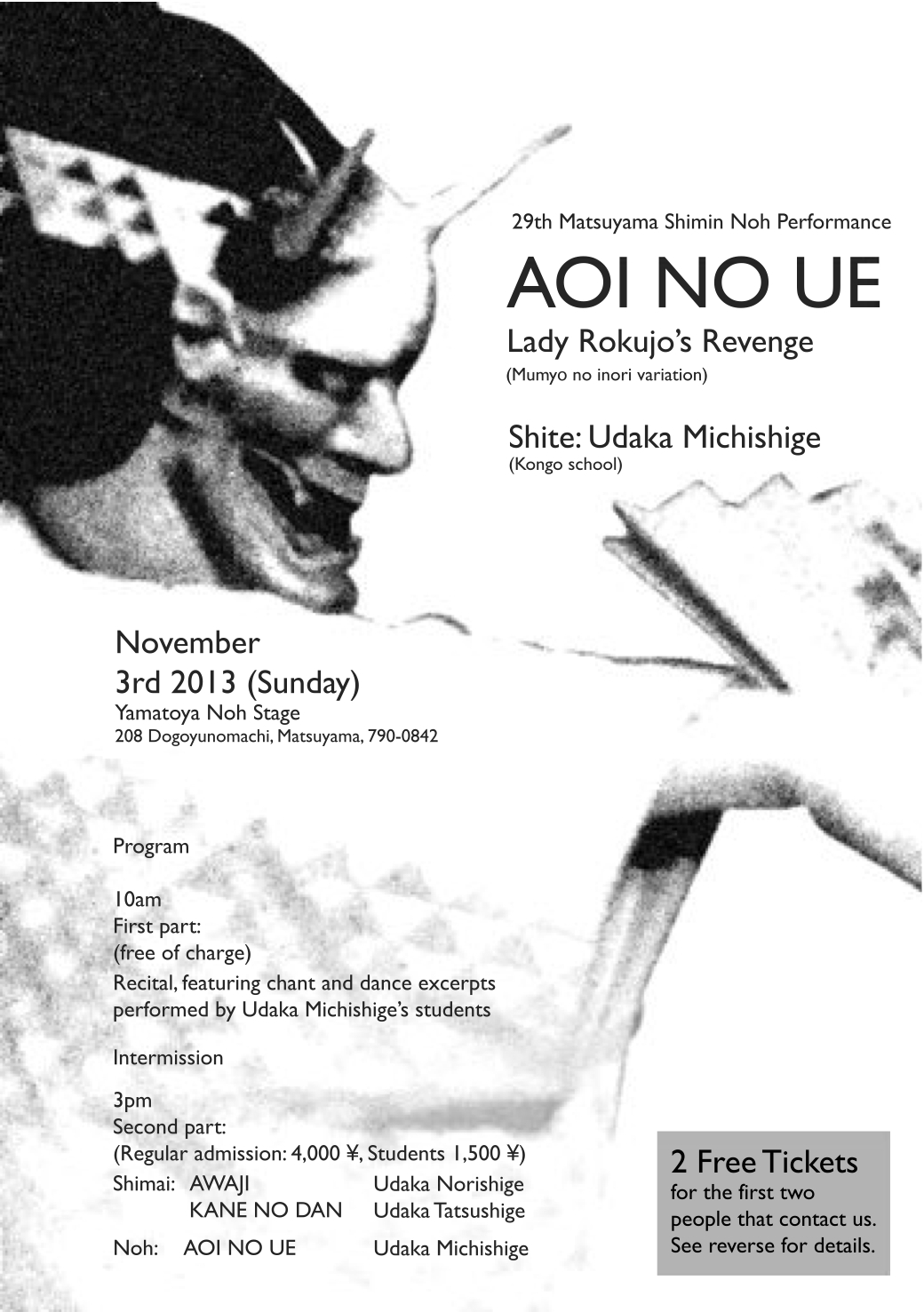
Next Sunday (November 3rd, which is both my birthday and the ‘culture day’ in Japan) I will take part to the Matsuyama Shimin Noh performance at the Yamatoya Honten Noh stage in Matsuyama, Shikoku. The event begins at 10:00 with a recital (entry free of charge), featuring Udaka Michishige’s students. I will perform a shimai, or dance excerpt, from the Noh Uta-ura, and will sing in the su-utai chanting of the Noh Kogō. The main event will be Udaka-sensei’s performance of Aoinoue in the ‘mumyō no inori’kogaki, or variation. I am lucky enough to have a privileged observation spot, serving in the ji-utai chorus for this performance.
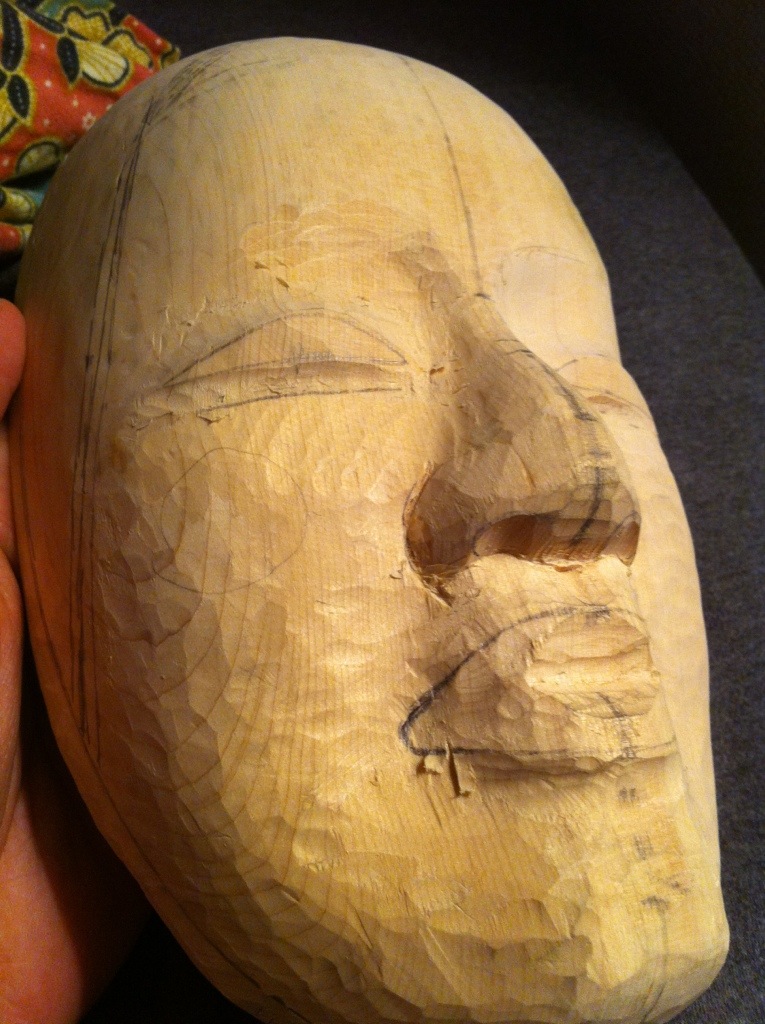
Every year in November Udaka Michishige takes the shite main role at the Matsuyama Shimin Noh performance. Although based in Kyoto, Udaka regularly teaches both utai/shimai and mask carving in Nagoya, Okazaki, Tokyo, Yokohama, and Matsuyama in Shikoku, the area where his family originally comes from. He is a descendent of two Shikoku families: Udaka and Kawada. The Udaka family had a castle in Niihama City during the medieval period and later served the Matusdaira clan feudal lords in Matsuyama as Noh actors from 1712 until the start of the Meiji period.
For this year’s shimin Noh we are giving away 2 free tickets to the first two people who contact us so make sure not to miss this chance if you are in Matsuyama next weekend! Find contact details below.
Aoinoue
Based on an episode from the Tale of Genji, the 11th century masterpiece by Murasaki Shikibu, the main character is not Lady Aoi, the wife of Prince Genji, but Lady Rokujo, the most intriguing female character in the novel. Once Genji’s lover but now abandoned by him and filled with resentment towards his wife after a humiliating incident at the Kamo Festival where her coach was forced out of its viewing spot by Lady Aoi’s retainers, Lady Rokujō’s living spirit torments her rival. A shamaness is sent to discover the source of the possession of Lady Aoi and then an exorcism is performed by the priest Kohijiri, finally bringing Rokujo to her senses by calling on the power of the Buddhist sutras. In the mumyō no inori kogaki or ‘Exorcism in Spiritual Darkness Variation’, the robe used to represent Lady Aoi is white rather than red, and Lady Rokujo leaves the stage for a change of costume rather than retreating to the koken-za stage attendants’ seat for only a change of mask. She returns in nagabakama, long vermillion trousers, often with a Nagakamoji, an extension of the wig that emphasises that Lady Rokujo’s is a noblewoman, increasing the sense of horror at the intensity of the expression of her jealousy in choreography also more graphic than in the standard production.
(Text by Rebecca Teele Ogamo)
Ehime University Noh Club
Udaka Michishige has taught students of the Ehime University Noh Theatre Club for over 30 years. Club activities include the practice of Noh chant and dance as well as workshops and performances. Every year in November club members join other students of Udaka at Matsuyama Municipal Noh Performance. Lessons are held both in Japanese and in English. Email: Kmct1q_es@ezweb.ne.jp
For information please contact:
KYOTO
Keiun-kai INI Main Offices, Training Center
111 Satta-cho, Kami-takano, Sakyo-ku, Kyoto 606-0047
Tel: (075)701-1055
Fax: (075)701-1058
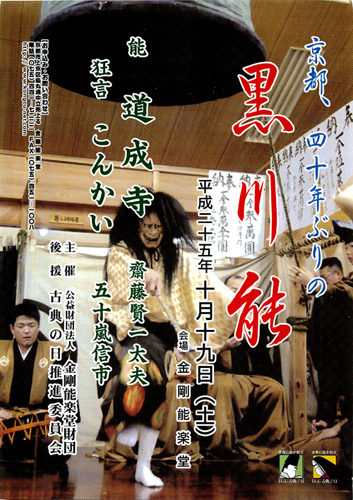
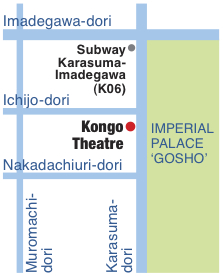
Yesterday I attended a performance of the Kurokawa Noh at the Kongo Noh theatre in Kyoto. Kurokawa is a hamlet part of Tsuruoka City in Yamagata Prefecture, in the deep of the Japanese snowland. A tradition of performing Noh plays has been transmitted within the city by two groups, the kami-za and shimo-za. Noh is performed on a number of occasions during the year, corresponding to religious festivals related to the local shinto shrine. There are various videos available online, perhaps the most interesting is this, made on the occasion of an event in collaboration with the Asia-Pacific Database on Intangible Cultural Heritage (ACCU), which worked to preserve the Kurokawa tradition from the threat of disappearing. More about this project here. Basic readings on Kurokawa Noh at the bottom of the post.
Kurokawa Noh was last performed in Kyoto 40 years ago, and the presenter pointed out how all those who performed in that occasion have now passed away. The Kurokawa Noh kami-za troupe who performed today is touring Japan -they were in Ise just yesterday- promoting this unique performance style that was transmitted in a condition of semi-isolation from the urban styles. When, during the ‘noh renaissance’ period, Kanze Hisao pointed out the need to ‘go back to Zeami’ in order to find the ‘true’ essence of Noh, he immediately thought of Kurokawa Noh, of which he became a great fan.
Yesterday’s programme consisted of one Kyogen, Konkwai (spelled こんくわい or こんかい) which is the Kurokawa version of the famous Kyogen Tsurigitsune (Fox Trapping), and the Noh Dojoji (Dojo Temple), among the most difficult plays of the two respective repertoires. The extent to which the Kurokawa tradition of both Noh and Kyogen plays differs from the urban tradition of the five schools is evident in many aspects of performance. First of all, actors chant/recite using the local dialect, and have a peculiar way to enunciate that makes the text difficult to discern even for the experienced spectator. Actually a Kongo actor friend of main told me it was difficult to understand what they say even backstage (!). I was impressed by the rather low voice of the actors , and I wonder whether this is not because Kurokawa Noh is performed on stages within homes of the villagers, not theatres or open spaces (just my speculation). The quality of acting and the overall effect is that of amateur performance – all performers have regular jobs – Heike Grossman explains this condition in her article. Tsurigitsunelacked the intensity that makes it one of the most difficult Kyogen plays. I could not help but notice how movements are far from the exactitude and concentration of ‘standard’ Kyogen performances. Among the many differences from the usual Kyogen was the attire of the shite in the second half of the play: the mask looks bigger, and the costume is a white overall with what seems to be a real fox skin-fur attached to its back. Unfortunately this part of the play, usually very dramatic because of the jumps and screams of the fox tempted to snatch the bait, was rather uninteresting in the Kurokawa version.
Kurokawa Noh – Tsurigitsune. Note the fox fur costume.
Various details show that this kind of performance belongs to the more ‘popular’, or ‘rougher’ sphere of performing arts: at some point the main actor in Tsurigitsune dropped his fan, and simply picked it up – you would never see this in a normal performance, one of the koken stage assistants wore glasses, members of chorus for Dojoji talked to each other during the performance, etc…
I found Dojoji much more interesting than Tsurigitsune. Here are some thoughts.
The jiutai chorus entered the stage from the hashigakari bridge instead of the usual kiri-do, and came sitting much closer to the front than a usual Noh performer. Usually the heavy bell (some 70kgs) is brought on stage attached to a pole carried on shoulders by a great number of Kyogen actors. Then the rope that will hold the bell has to get into a pulley fixed at the centre of the roof of the stage. This operation, performed by Kyogen actors by attaching the rope to a long pole, is rather difficult because the rope is thick and the pulley narrow, and takes as much time as needed to be completed, almost a performance within the performance in itself ‘will it go through?’… ‘will it not?’. In the Kurokawa version a smaller, much lighter, more realistically decorated bell is brought on stage by three Kyogen actors, while the rope has already been installed before the performance began. My speculation is that it is too difficult for them to do it as part of the performance, and they don’t know how much it will actually take them.
The flute player sits facing the maku curtain, as in the Kiyotsune variation ‘koi-no-netori’.
Actors (both waki and shite) lift themselves up on their toes as a recurring kata – today this movement is only performed by waki actors in First Category (God Noh) plays.
Everything unfolds at a much faster pace than a standard Noh, and not before long we hear clapping from the kagami no ma mirror room, signalling that the shite is ready to enter the stage.
In standard version of the play, where the mae-shite wears a karaori brocade kimono in tsubo-ori style over a silver foiled surihaku undergarment and another black karaori wrapped in koshimaki style around the waist. The Kongō school uses the magojirō mask, exclusive to Kongō. In the Kurokawa version we saw the shite entered with a simple karaori in kinagashi ‘straight’ style, and wore a mask that looked like shakumi or fukai, for middle-aged women roles.
As the presenter explained to us, Kurokawa Noh uses to put the katsura-obiheadband on top of the mask, instead of wearing it behind it. I am not sure when the shift took place in Noh history, but I think that in the past this is the way katsura-obi was used. At some point, probably in order to show more of the beautiful mask, or not to change their looks by donning something over it, this headband started to be worn behind the mask, perhaps in an unrealistic, but more beautiful way. The result is something closer to a coloured hachimaki, the white headband used today for roles of warriors, and worn on top of the mask.
The dance section, consisting of ranbyoshi and jo-no-mai (a peculiar combination) was particularly interesting. With ranbyoshi performed only by flute and ko-tsuzumi, and jo-no-mai performed by o-tsuzumi and ko-tsuzumi, without flute. I liked this second dance very much: I found that dancing without flute produces a very interesting, even more hypnotic effect. Maybe at this point of the performance I was getting used to the peculiar music, and started noticing how the two drummers communicated and challenged each other through slowing down and speeding up, despite the unusually sparseness of kakegoe vocal interjections. Then the shitejumped into the rather narrow bell, and changed costume, mask and wig.
Once the exorcism by the waki reached its climax, and the bell started to lift in order to reveal the serpentine monster hidden inside it, something strange happened. Little spheres, probably from juzu prayer beads, fell on the stage rolling here and there. This generated some confusion among the koken and in the jiutai, or so it seemed to me. After the performance Rebecca Teele and I were wondering whether one of the monk broke his juzu while rubbing it during the exorcism, or rather the juzu sphere did not come from inside the bell, perhaps as a sign of rage of the shite against the exorcism (?! – the pamphlet we were given does not provide information about this)…
There are many more differences between the Kurokawa Noh performances we saw yesterday and the mainstream Noh performed by the five schools. I would not want to go through everything I noticed, as it would take more than just one post. Perhaps most evident difference waskamae or basic standing position: in standard Kyogen and Noh schools, arms are bent inwards, hands on waist for Kyogen, hands in a fist-like position in Noh. The image of the upper body is that of a circle, containing physical tension that is then liberated in movement. However, in Kurokawa Noh arms are open, with the left hand index finger sticking out and pointing down. This position is much weaker than the standard kamae and it makes much sense to me that this basic stance evolved in a much more compact, tense while relaxed position in urban traditions. The Kurokawa Noh kamae reminds of dengaku or ennen, more rustic performance styles I have seen on other occasions. The pointed index finger can still be seen in Okina, when the god stands in the middle of the stage with arms raised pointing East and West.
Kurokawa Noh performance. Note the pointing finger
Udaka Michishige in Okina at Utsukushima-jinja. Note the pointing fingers
What I can say as a conclusion is that I enjoyed the performance: it wasn’t simply an ‘amateur performance’. I was expecting something ‘kagura-esque’, which it was not. Sure, the performance lacked the intensity and perfection of professional performance, and I am sure that it is a kind of event that needs to be enjoyed in its original context.. still, it was moving to discover another Noh style that seemed to come from another time. 参考になりました!
Readings:
– Martzel, Gérard. La fête d’Ogi et le nô deKurokawa. Paris: Publications Orientalistes de France, 1975.
– Grossman, Eike. ‘Under the burden of Noh: Community life in Kurokawa and ritual Noh performances’ in Noh Theatre Transversal. Stanca Scholz-Cionca and Christopher Balme eds. Munich: Iudicium, 2008.
On Sunday 27th October 2013 Kongō-ryu shite actor UDAKA Michishige will perform the rare Noh Hōso, exclusive to the Kongō school of Noh, as part of the Kongo Noh Theatre monthly programme. The Noh Yōkihi and the Kyogen Hagi Daimyō will also be performed on the day.
Noh: Hoso. National Noh Theatre, Tokyo. Shite: Kongo Hisanori. Photo: Aoki Shinji
Noh: Hōso 彭祖
Celebrations are being held at the court of Gi no Buntei in China and among the many immortals who come from their mountain hermitages to pay their respects is one who appears to be a young boy but calls himself ‘Hōso’, the ‘Prosperous Ancestor’. Asked about his identity, he tells how he was once in service at court but was exiled long ago for the crime of stepping over the Emperor’s pillow. In his compassion the Emperor gave the youth the pillow as a keepsake along with a quotation from the Kannon Sutra. Hōso explains that he was acquired eternal youth by drinking the water from the stream running by his hut. Hōso faithfully copied the quotation on the leaves of chrysanthemums which grew by his hut and dew that fell from them transformed the stream into an elixir. The emperor vows to visit Hōso’s hermitage on Mt. Tekken and later Hōso dances for him there.
Hōso is the sequel to Makura Jidō (titled Kiku Jidō in the Kanze school version) in which the young boy is discovered in his place of exile and he first realises that he has become an immortal, thanks to the power of the quotation he has copied on the chrysanthemum leaves. Hōso is performed only by the Kongō school.
(Text: Rebecca Teele Ogamo)
Kongo Noh Theatre, Kyoto. Monthly performance series (October).
Noh Yōkihi: Matsuno Yasunori
Kyogen Hagi Daimyō: Shigeyama Akira
Noh Hōso: Udaka Michshige
Doors open at 13:00, performances start at 13:30.
Tickets: Advance booking: 5,500yen At the door: 6,000yen Students: 3,000yen
For more information on the performance, or to reserve tickets, please contact me here.
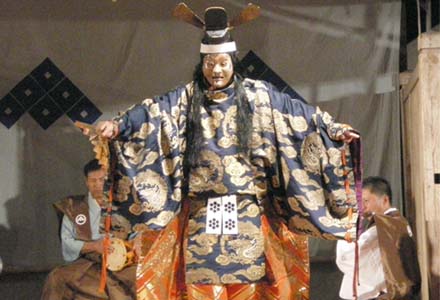
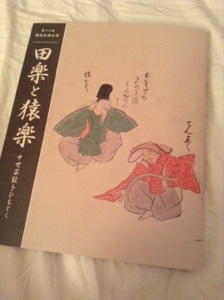
Yesterday I went to see Dengaku to Sarugaku at the National Bunraku Theatre in Osaka. Two groups, the Nachi Dengaku Hozonkai (Nachi, Wakayama pref.) and the Nara Tsuhiko Jinja Okina-mai Hozonkai (Nara) preserve ancient traditions that are thought to predate the performing art we call Noh today. Dengaku (literally ‘field entertainment’, where ‘field’ refers to ‘rice paddy’) is a form of performance where musicians playing taiko and sasara (a kind of wood clapper) dance in symmetrical patterns, at the accompaniment of extremely simple and repetitive musical patterns. Movements mime sowing the fields, evidence of its original purpose of propitiating good crops. Sarugaku (debate is open on the literal meaning of this word) is the old appellation of what we now call Noh. On this occasion the Tsuhiko-jinja troupe performed Okina-mai, a predecessor of the contemporary Okina performed by Noh actors. I won’t get into the discussion on the ‘authenticity’ of such dances – forgive the superficiality of this post.
What can I say about the performance… I took extensive notes. Mostly because I was very bored. As I was looking around, noticing how many people around me were dozing off, I thought of Peter Brook’s ‘rough theatre’ misplaced in a ‘serious’ situation, and of Rustom Bharucha’s talk of ritual performance as something that cannot be detached from its original context. Technically speaking performances such as those I attended today require to be performed at a shrine, on a lawn, in the presence of many people surrounding the performers, chatting, taking pictures, eating, sleeping, moving around.. a ‘rough’ setting. I think that one of the reasons behind the reiteration of simple dance and music sequences is the need to offer a performance that can be ‘followed’ even if distracted or interrupted, something very different from a theatre hall performance, where the audience is sitting, forced to stare at the stage, as we were today.
Moreover, yesterday’s performers were amateurs, whose lack of technique is all the more evident on a ‘proscenium arch stage’. As I wrote on my notes, religious performance contains values transcending the aesthetic: when it’s placed on a theatre stage it loses all true ritualism. All that is left is art, and art requires technique, not belief.
Last Sunday I attended the Seiran-Noh, a regular performance organised by Udaka Michishige, also featuring his two sons, Tatsushige and Norishige. This year Udaka-sensei and his elder son Tatsushige performed the Noh Futari Shizuka. The tsure part in this play is particularly challenging, both because it portrays a common woman who is possessed by the spirit of Shizuka Gozen, entailing a change in the interpretation of the character, and because of the aimai, the synchronised dance performed by tsure and shite, two identical characters, respectively a woman possessed by the spirit of Shizuka (tsure) and Shizuka herself (shite). Most masks we use in Noh seriously hinder sight, so that the actor completely loses peripheral vision. You can imagine how hard synchronised dance can be when you cannot see your partner, and music does not follow a metronome. I was astounded not only by the precision of shite and tsure, but also by the sense of harmony that father and son naturally created on stage, which was all the more interesting if considered within the context of the play.
Watching the two Shizukas on stage, and knowing the difficulty of dancing in such condition, I couldn’t help thinking how each of us has a double, another ‘me’ (or ‘you’) whom we know exists, even though we cannot see it. Most importantly, we cannot control it. It will dance close to you – you will hear the sound of its breath and steps – but you cannot clearly visualise it except for some fleeting instants, between the darkness of the mask and the light of the stage. The only thing you can do is adapt to it, or hint at a movement, hoping that it will adapt to you.
Every year on September 9th from 13:00 UDAKA Michishige performs Makura-jido (aka Kiku-jido in other schools) as han-noh (only the second half of the play) at Horinji (法輪寺), a temple in the Arashiyama area, West of central Kyoto. I have posted about this annual event here, and so did Hanna McGaughey here. The play is set in China and tells the story of a young boy who was exiled to the mountains after he accidentally stepped on the Emperor’s pillow. Before being banished from the palace, as the court rites prescribe, the boy received from the Emperor lines of the Lotus Sutra, which he copied thousands times on chrysanthemum petals, an act that made him immortal… it is a very interesting story, with a Noh beautiful rendition.
I just came back from the Yoseikai tozai godo kenkyu happyokai (養成会東西合同発表会), an annual performance session that brings together the participants to the yoseikai, a training and performance programme for Noh and Kyogen actors and musicians, from different parts of the country. The yoseikai is sponsored by the Bunkacho (Agency for Cultural Affairs), and is one of the few government-sponsored Noh activities.
Now some random thoughts about today’s event (I’m copying what I scribbled on the back of my programme). Firstly, it was GREAT to see many young performers on stage. It is difficult to describe this feeling, but I think it was the pleasure of feeling youthful vigour, perceiving the efforts, sensing the hopes of these performers, whose career as full professionals is just about to begin. It brought the world of Noh closer to the world I am living.
It was refreshing to see young performers as well as many different styles one next to the other: one of the characteristics of this annual event is that performers not only come from different parts of Japan, but also that they belong to artistic schools that you would not easily see on the same stage.
There definitely should be more opportunities to see Noh performed by young actors. I have two simple arguments for this:
I have seen experienced actors who would not stand comparison with some of these young gentlemen (don’t give me Zeami’s flower of age, most of the ‘flowers’ I’ve seen have withered, or else they never really bloomed’). They go on stage simply because they rank higher due to seniority, and family name.
More occasions for young performers to perform (especially shite actors) cannot but help them to hone their skills while they still have the physical and intellectual capability to shape their style.
Not only this: there should be more chances for actors of different schools to perform next to each other. I might be thinking of Kyoto in particular here, where only Kanze and Kongo schools are present. I think that actors should be able to travel more and be confronted with different audiences, and most importantly be exposed to various styles of many different performers. This already happens today, but it is not enough. Noh still is regulated by a bakufu-esque system of territorial subdivision, governed by the much ineffectual Noh Association. Instead of this Noh needs competition and meritocracy.
Finally, among the various things that must be done (yet are not done) to help young performers is advertising these performances, according to the principle of fuchi furai (不知不来, ‘if they don’t know, they don’t come’) Also, programmes should be less cryptical than they are now: they might contain pictures, short bios of performers, something that allows the audience to take an interest in who these people are. Of course, a specialised audience would not need any additional information, they would already know who the actors are, who their parents and grandparents are, etc.. in fact, that’s why programmes are accessible only to a specialised audience – because there is no other audience! It’s August, university hasn’t started yet, and yet! … performers were young and vigorous, but the audience was just out of the convalescent home waiting room, as always!!!






 Yesterday I went to see

 The Noh Diaries