Fukyu Noh HASHI-BENKEI 7 July 2013

Hashi-Benkei Fukkyu

On Sunday 7 July 2013 at 17:00 the Iemoto Kongo Hisanori will perform the Noh Hashi-Benkei at the Kongo Noh Theatre in Kyoto. The performance is offered at the special price of 2,500yen with advanced booking so don’t hesitate to contact me if you want to reserve a ticket.

“Warrior-monk Musashibo Benkei has been warned that a young boy is attacking passersby at Gojo Bridge in the capital and taking their swords. Benkei is determined not to be frightened by such rumors and refuses to avoid the area. He goes to the bridge and sees there what seems to be the form of a young woman. In fact it is Ushiwaka, later to be known as Minamoto no Yoshitsune, a leader of his clan, who has made a vow to collect 1,000 swords, coming down from Mt. Kurama where his mother has ordered him to stay. The two fight, but Ushiwaka cleverly triumphs over Benkei who then becomes his faithful retainer.” (Summary by Ogamo Rebecca Teele)

Fukyu-Noh is a regular summer event aimed at introducing Noh to young/new spectators. The Noh will be preceded by a greeting from our teacher, Udaka Michishige (Vice-Director of the Kongo-kai) and by a short explanation by Prof. Ono Yoshiro (Kyoto Institute of Technology).

After Kiyotsune

Kongo Noh Theatre. Lights out.

I would like to thank all those who came to see my performance of Kiyotsune on June 29th 2013 at the Kongo Noh Theatre in Kyoto, as well as those who supported from a distance but who could not make it to Japan.

It is hard to describe my feelings now that this pivotal event in my personal life and in the history of the International Noh Institute is over. The night before the performance I was preparing my bag with all the necessary clothing and accessory, including dōgi padded undergarment and eri collars, and felt like packing the night before leaving for a long trip. Or maybe Kiyotsune himself was packing his bag, about to take his leave from my room, and from my teacher’s okeikoba, where we lived together during the year of preparation that preceded the performance. Although in Noh there isn’t the same kind of psychological research on the character that you would have in other performance methods, I have become accustomed to live with Kiyotsune… but now Kiyotsune has left, only to live again through someone else’s body. Anyhow, I should not think of it as something belonging to an isolated past, because past things shape our present, and future, too.

Today I was asked by a friend how I felt after the performance. I realised that a Noh performance is like a marriage ceremony. It is a very important event, to which family and friend partake, celebrating a vow of faithfulness and dedication. But the ceremony only lasts one day. What really counts is all the effort behind and before it, and the new path ahead.

Kei’un-kai, INI Gala Recital 2013 *full programme*

June 29~30 (Saturday and Sunday), 2013

Kongo Nohgakudo, Karasuma Ichijo-sagaru, Kamigyo-ku, Kyoto 602-0912
Tel: 075 -441-7222

Please join us at the Kongo Nohgakudo for an opportunity to experience Noh in a variety of forms: shimai, dance excerpts; Maibayashi, dance excerpts with the accompaniment of the Noh ensemble of instruments as well as the chorus; Rengin, concert style performance of a Noh excerpt performed by students in formal kimono and hakama; and 3 fully costumed Noh performances each day.

• Descriptions of the content of each piece will be available in programs provided in English, French, German and Italian.
• The recital is free of charge and open to all. We look forward to seeing you at the Nohgakudo.

Day I Featuring International Noh Institute Students

June 29th (Saturday)

(from about 11.00am)

仕舞 Shimai dance excerpts in formal wear performed to the accompaniment of a small chorus.

舞囃子 Maibayashi excerpt to the accompaniment of the Noh ensemble and chorus:
「胡 蝶」KOCHO ‘The Butterfly’ shite: Cristina Picelli.

Bangai-Shimai Dances by professional Noh performers (UDAKA Tatsushige and UDAKA Norishige):
「加 茂」KAMO
「玉之段」TAMA-NO-DAN

(from about 12:00, noon)
Noh:『清経』KIYOTSUNE Shite: Diego Pellecchia Tsure: Monique Arnaud.

(about 1:20 p.m.)
Rengin concert-style recitation of an excerpt from a Noh.

Bangai-Shimai (performed by UDAKA Michishige):
「鉄 輪」KANAWA

(from about 2:00 p.m.)
Noh:『小鍛冶』 KOKAJI ‘The Swordsmith’ Shite: SOMYO Tadasuke

(from about 3:20 p.m.)
Shimai, dance excerpts

(from about 4:00 p.m.)
Noh: 『猩 々』SHOJO Shite: HIRASAWA Yumiko

Day II Featuring Keiun-kai Students

June 30th (Sunday)

Rengin concert-style recitation of an excerpt from a Noh

(from about 11:20 p.m.)
Shimai

(about 11:40 p.m.)
Noh: 『羽 衣・盤渉』HAGOROMO Banshiki ‘The Robe of Feathers’ Shite: ITOH Yuki

Maibayashi excerpt with the accompaniment of the Noh ensemble:
「融」TORU

(about 1:00 p.m.)
Shimai

Rengin concert style recitation of an excerpt from a Noh.

Bangai Shimai(performed by UDAKA Michishige):
「藤 戸」FUJITO

(from about 2:00 p.m.)
Noh: 『黒塚・白頭』KUROZUKA ‘The Black Mound’ Hakutoh Shite: KUROTAKE Sadato

(from about 3:10 p.m.)
Maibayashi excerpt with the accompaniment of the Noh ensemble:
「松 風」MATSUKAZE
Shimai

(from about 4:00 p.m.)
Noh: 『猩 々』SHOJO Shite: NAGAO Atsushi

*Feel free to come and go quietly as you please during the recital.
*Be sure your cell phone is set on silent or manner mode.
*You may take pictures, but the use of flash is strictly prohibited.
*Please enjoy the tea and sweets provided.

A visit to Ernest Fenollosa’s grave

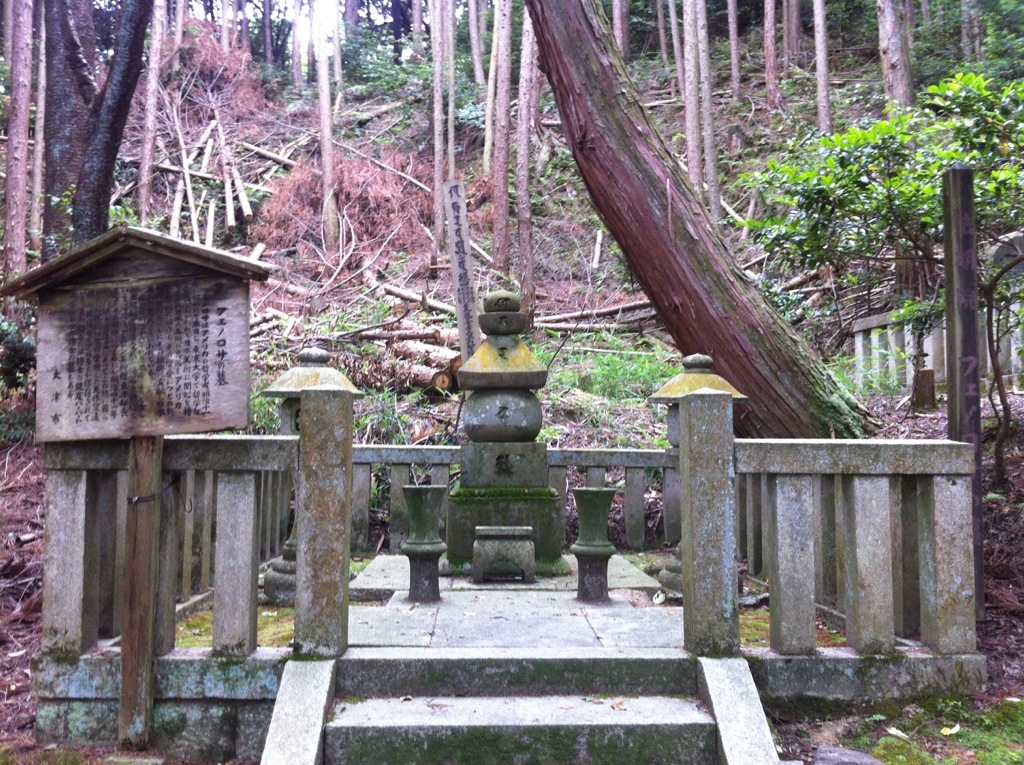
I spent last Sunday in Ōtsu (Shiga pref.) on Lake Biwa, where I attended the annual taikai recital of Ritsumeikan University Noh Theatre Club, featuring both current and old members, at the Dentōgeinōkaikan. It’s been a pleasant day, where I could gather quite a lot of material for my current research on amateur practitioners in Noh. After a long morning-afternoon of shimai, rengin and maibayashi Calder, Cristina (members of the INI) and I decided to take a stroll behind Miidera, just where the kaikan is. Our destination was Ernest Fenollosa‘s grave. Fenollosa (1853-1908) helped to disseminate Noh outside Japan with translations that were later edited by Ezra Pound, and published in the book “Noh”, or, Accomplishment (1916). After his death, his ashes were sent back to Japan, and buried at Hōmyō-in, in the woods close to Miidera.

I have done quite a lot of work on Fenollosa for my PhD thesis so I definitely wanted to visit his grave at least once. It’s actually not that easiest thing to find it, but here are a couple of pictures I took. .

Now that I understood where it is, I will certainly come back, maybe with incense and sakaki leaves.

20130609-211357.jpg

20130609-211425.jpg

20130609-211410.jpg

Thank you readers!

The Kyoto Takigi Noh 2013 is now over. It’s been a very interesting 2-day event, and the audience has been able to enjoy various nuances of the multifarious world of Noh performance. What I was particularly surprised with this time was the amount of people who were able to attend the performance because they found information through my blog. Writing online can be a rather solitary activity and I often wonder who are those people reading, whose presence is signalled by numbers and colours in the blog stats map. It was nice to meet some of them this past weekend at Heian Jingu! I feel all the more motivated to write on this blog and to help people come closer to the world of Noh! Thank you!

Diego

Practice notes #3 technique

photo-1Technique is what is left when you turn off emotions. Knowing every step of the dance, every modulation of the chant, understanding the meaning of each word and movement… none of this is really helpful on stage unless you have real control of the switch between emotion and technique. This ability cannot be acquired through intellectual understanding. Odd as it may seem, I feel it is more of a physical condition than a mental one.

This is why there is no shortcut to true skill. No intensive workshop. No crash course. Physical practice requires time. A matter of choice, I guess.

Practice notes #2 movement and costume

photo-1Today I had okeiko with my teacher’s eldest son Udaka Tatsushige. He gave me precise instructions about various moments of the play which I need to improve. Among all suggestion there is one thing I need to be particularly aware of: if my movements are too dynamic or extreme, if they are too ‘expressive’, it will be to the detriment of the costume. Reflecting on this I realised how much the costume, along with the mask, already does a lot of the narration just by being there on stage. It is important to establish a good relationship with the costume, restraining your movement, compressing your energy. If your acting crosses the line, the costume will disappear, only your movements will be visible. The costume has been perfected through centuries to serve its expressive purpose on stage: let’s make sure it has enough room to say what it has to say.

Eri

A Noh costume is composed of various parts which are assembled and sown together directly on the actor just before the performance. Eri (neck-collars) come in various colours indicating the nature of the character wearing them (age, gender, social status, etc.). For Kiyotsune I will wear a blue collar like the one pictured below. Eri are among the few parts of the costumes that all Noh actors own, as they come directly in touch with parts of the body (such as the neck) which tend to sweat hence to easily damage fabric. The one below is a simple T-shape piece of white cotton with a strip of blue silk sown on top, which was made by a friend in Kyoto.

20130528-163102.jpg


Practice notes #1 voice

photo-1I’ve been keeping a log of my training of Kiyotsune. Probably much of it does not make much sense except to me, but I thought I would share some of them here.

  • The first verse is your chance to set the pitch for the whole play.
  • Kiyotsune is fairly young and educated, the pitch should not be too low and it should have a quality of smoothness and elegance.
  • Start low and use the first verse to find the right ‘pitch increase range’ within one sentence of yowagin.
  • It’s easier to adjust the pitch above than below.
  • Even if your face is covered, remember to keep lips and cheeks relaxed while you sing.
  • The chant is beautiful, be careful not to to let your mind wander too much as you listen to the ji-utai while sitting on the stool. You are the captain.

– 神秘神秘