The 12th Kongō-ryū Fukyū Noh performance will take place on 6 July 2014 at the Kongo Noh Theatre in Kyoto. This year the Iemoto (grand-master) of the Kongō School, Kongō Hisanori, and his son, Kongō Tatsunori, will share the shite main roles in Aoi-no-ue, a ‘classic’ play that draws from episodes of the Genji Monogatari. In this Noh the spirit of Rokujō no Miyasudokoro, transfigured by jealousy after being rejected by Prince Genji, attacks the woman that has replaced her, Lady Aoi. The Kongō Fukyū Noh is a special event that seeks to disseminate the culture of Noh to the public: non-Japanese students can apply to get a FREE TICKET! 50 free tickets are available, and the deadline is June 23rd.Contact us for information on how to apply.
Bounden is a new iPhone app created by Dutch design shop Game Oven and developed by Ernst Meisner of the Dutch National Ballet. Basically, it’s a game meant to be played by two people simultaneously holding the iPhone. Players have to follow a path on a sphere that rotates according to how the iPhone is manipulated, resulting in a sort of dance duet. the app makes good use of the iPhone on-board gyroscope. Bounden is ‘just a game’, but it is interesting to see portable technology increasingly allowing us to engage with artistic practice that are not only music and drawing, which you can do sitting at your desk, but also performing arts that require us to move and to interact with other bodies. I have no trouble (kinda) seeing myself dancing alone in a studio, while Google Glass, Oculus Rift or whatever similar technology will be available in the future, shows other performers, or a sparring partner, or the shadow of my teacher on the glasses surface.
These days I am preparing for the tsure (companion) role in the Noh Yuya. I have performed a similar role in the past, albeit as a male character, and I am familiar with some of the chant and movement sequences, so instead of having a usual utai chant class to introduce the piece, my training started out as tachigeiko (standing lesson), where actors go through movements and chant on stage while holding the katazuke (score) in one hand in order to keep an eye on it. I have sometimes performed a kind of self-tachigeiko on my own holding a small tablet in one hand, where I playback videos I took in previous lessons. I literally dance as I watch the screen. (Warning: this is a rather ‘advanced’ technique that I do not recommend if you have not mastered the kata movements, as you are likely to misinterpret the video which was forcibly taken from a point of view which is not the one you have on stage.) With wearable technology developing so quickly, I can only wonder what kind of instruments we will use in our dance practice, say, in five years time. I am not entirely sure all the change it will bring will be for the good, but we will need to deal with that anyway.
It’s finally LIVE!The INI – International Noh Institute has a website of its own, with a blog section, a gallery etc. We literally just got it started, and we look forward to upload lots of information about who we are, what we do, etc. If you are interested in keeping updated don’t forget to subscribe to the blog, like us on Facebook, and follow us on Twitter. From now on I will use 外国人と能 The Noh Diaries only to post personal reflections on the various topics I usually treat here. All official announcements about performances, workshops, exhibitions from the International Noh Institute will be posted on the newINI website. I encourage all my readers and subscribers who wish to to continue receiving updates about the INI activities to subscribe to the new website.
As I have written in a previous post, I am about to leave for London where a group of Noh performers from Kyoto and Osaka will perform Noh music and dances at the London Contemporary Music Festival. I am lucky enough to be serving in the ji-utai chorus, and as the day draws near I am getting excited, but also a little nervous about performing Noh in such an unusual context. Even in Japan, Noh is not only performed in Noh theatres: there are a variety of ‘alternative’ stages, such as outdoors stages at shrines or indoors platforms at hotel banquet halls, where Noh is regularly performed. However this time our group will perform in an ex-carpet factory, in front of a mixed audience (the other acts are Stockhausen and Pain Jerk) who might not be familiar with Noh theatre’s conventions, and most importantly our schedule is so tight that will not have much time to familiarise with the local mood (and time zone).
The hyōshiban, a wood block used in training to reproduce the beats of the three drums. (Photo: Elaine Czech)
How does a group of Noh performers ‘get ready’ for this kind of event? It’s simple, we don’t. ^_^ Noh performers study a shared canon of plays that consist of pre-established choreographies and musical scores, but they do so separately. Movements, lines, drums and flute patterns are the same, but there are various ‘stylistic schools’ for each role. For example, this time Kongō school actors will meet with Morita School flute, Kō School shoulder drum, Kanze School hip drum and Konparu School Taiko. This is one of the many possible combination of schools, and each will perform according to their specific way of interpreting the canon. What is exciting about Noh is that since everyone knows what they are going to play, and what the others are going to play on stage, there is no need for weeks of rehearsals. A brief and even partial run-through, known as mōshiawase, is all you need to check that you are ‘on the same page’ with the others.
This quality of impromptu is what allows every Noh performance to be unique and fresh, reflecting the Japanese notion of ichi-go, ichi-e, which one could translate as ‘one meeting, one chance’. So when I asked Tatsushige-sensei, who is leading our band, how long would we need to rehearse our programme on the performance day, he replied that we absolutely need to avoid ‘over-rehearsing’, as ‘that wouldn’t be Noh’.
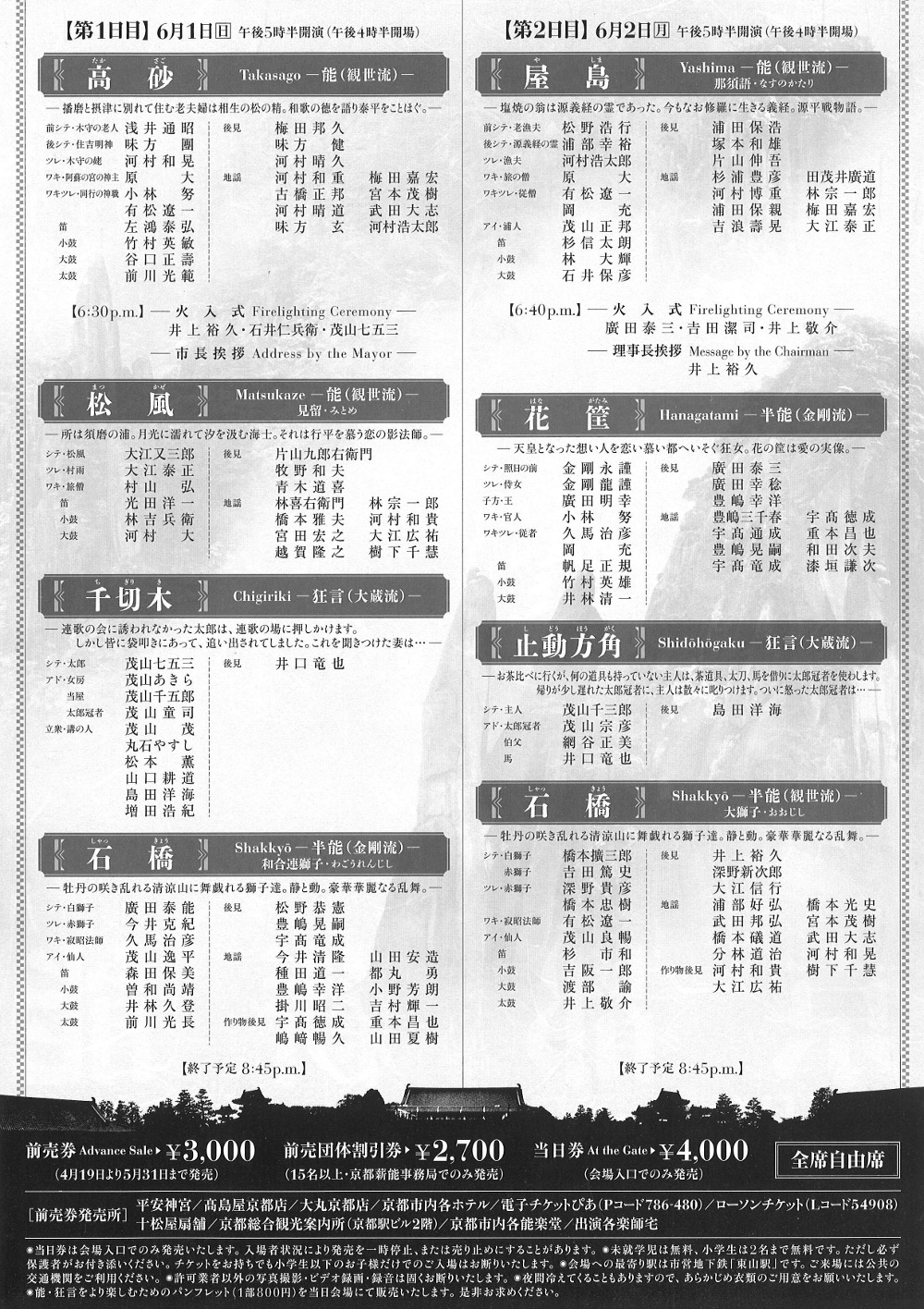
This year’s Kyoto Takigi (Fire-lit) Noh performance, at the Heian-jingu Shrine, Kyoto 1, 2 June 2014, will commemorate 680th anniversary of the birth of Kan’ami and the 650th anniversary of the birth of his son, Zeami. The programme features various classics, such as Matsukaze and Yashima, but its highlight is the double performance of Shakkyō as ending play for both days. The first day it will be performed by masters of the Kongō School, while the second day it will be performed by masters of the Kanze School. It is a great chance to appreciate the differences in the kogaki, or variations of the same play that are part of the Kongō and Kanze canon. Kongō will stage the sagorenjishi variation, with one white lion and one red lion, while Kanze will stage the ōjishi variation, with one white lion and three red lions. White and red are celebratory colours in Japan, which makes Shakkyō a suitable choice for the commemoration of the birth of the ‘fathers of Noh’, Kan’ami and Zeami.
Performances start at 17:30 and finish at 20:45. Gates will open at 16:00. Seats are not reserved so I suggest you to come early, and bring something to cover your head with (you might need to queue in the sun).
Advanced sale tickets: 3,000yen. At the door: 4,000yen. Groups (15+): 2,700yen.
Sōseiza is a Kyoto-based group of performers belonging to different performance traditions, including members of the Kongō school of shitekata. Every year the group stages performances that cross genres, but are generally based on traditional arts such as Kabuki, Nihon-buyō, Noh, Nagauta, Shakuhachi, etc. This year Sōseiza is taking it one step further with the performance that brings together the story of Dōjō-ji and the vocaloid computer star Hatsune Miku.
Dōjō-ji tells the story of a young woman who, driven by her passionate love for a priest, transforms into a demonic snake and coils herself around the bell where he was hiding, melting the bell and burning him to death. The story is much more complex and interesting – check a synopsis with stage pictures from the Noh adaptation here.
This vocaloid version sounds like a rather bold experiment, fusing traditional Japanese performance with very contemporary (and equally local) technology, giving the classic tale a pop twist. I have my reservations, though one cannot tell before actually attending (which I won’t be able to do this time..). If you happen to go see this show, please let me know how it was! I’d be happy to post your review here.
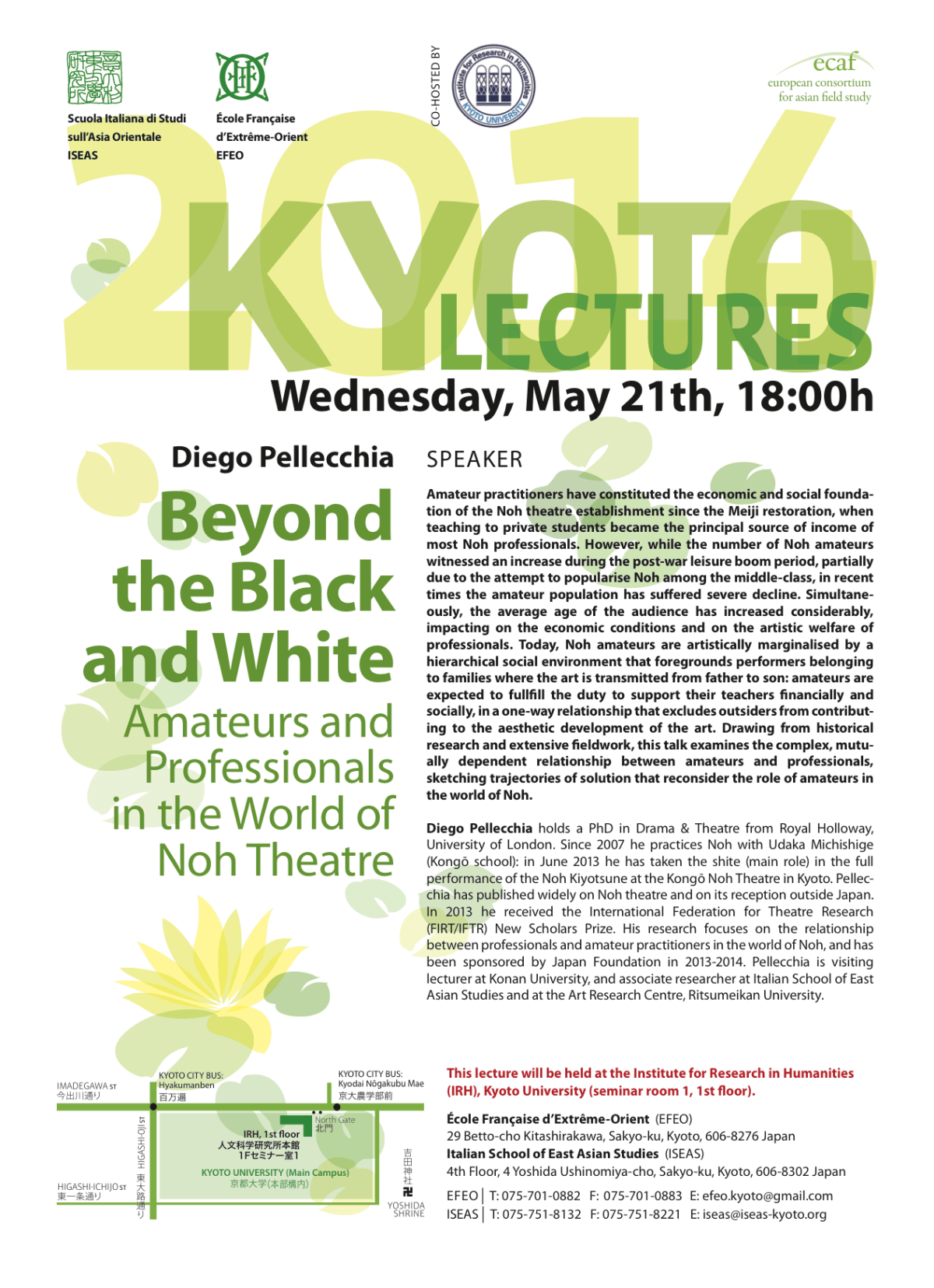
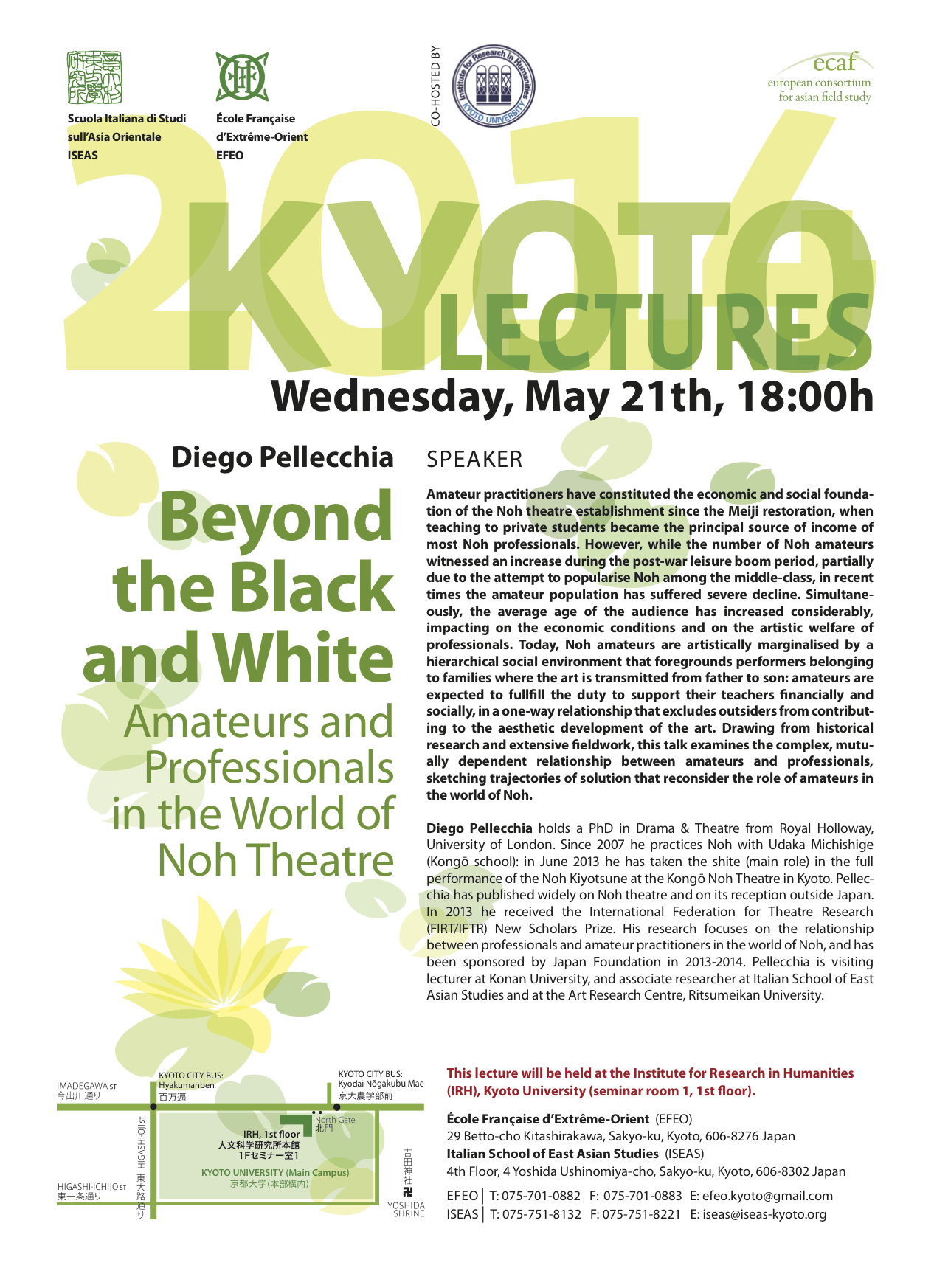
On Wednesday May 21st 2014 at 18:00 I will present my current research in an event part of the Kyoto Lectures series, organised by the ISEAS/EFEO. The lecture will be held at the Institute for Research in Humanities (IRH), Kyoto University (seminar room 1, 1st floor). Free entry, booking not required.
Beyond the Black and White: Amateurs and Professionals in the World of Noh Theatre
Abstract:
Amateur practitioners have constituted the economic and social foundation of the Noh theatre establishment since the Meiji restoration, when teaching to private students became the principal source of income of most Noh professionals. However, while the number of Noh amateurs witnessed an increase during the post-war leisure boom period, partially due to the attempt to popularise Noh among the middle-class, in recent times the amateur population has suffered severe decline. Simultaneously, the average age of the audience has increased considerably, impacting on the economic conditions and on the artistic welfare of professionals. Today, Noh amateurs are artistically marginalised by a hierarchical social environment that foregrounds performers belonging to families where the art is transmitted from father to son: amateurs are expected to fullfill the duty to support their teachers financially and socially, in a one-way relationship that excludes outsiders from contributing to the aesthetic development of the art. Drawing from historical research and extensive fieldwork, this talk examines the complex, mutually dependent relationship between amateurs and professionals, sketching trajectories of solution that reconsider the role of amateurs in the world of Noh.
“The Japanese Extreme” is the headline of the third night (29 May) of the London Contemporary Music Festival 2014 at Britannia House, Spitalfields, London. The organisers have put together an impressive and bold line-up that crosses genre boundaries: Karlheinz Stockhausen’s Himmels Tür,(a percussion piece of Japanese inspiration) the Japanese noise act Pain Jerk, and…… NOH THEATRE.
Udaka Tatsushige and Udaka Norishige, sons of my teacher Udaka Michishige, along with four hayashimusicians from Kyoto and Osaka will perform the ibayashi (solo music and choir) of Shakkyō(The Stone Bridge), and the maibayashi (dance and music excerpts) of Hagoromo(The Celestial Robe) and Funa-Benkei(Benkei and the Boat). I will sing in the ji-utai chorus.
The repertoire we are going to perform is classic, and will be put on stage according to the Noh conventions. It is rather unusual for Noh to be performed along with other acts, all the more so in the context of a contemporary music festival, and we are very excited and honoured to participate to the LCMF this year. If you are in/around London don’t miss the chance to attend this unique event!
People often wonder what differences are there between Noh stylistic schools, or ryū. In this video Kanze actorKatayama Shingo (on the left), and Kongō actorTeshima Kōji (on the right) demonstrate side by side a number of kata that exemplify various differences between shite dance styles. Ō-tsuzumi (hip-drum) player Taniguchi Masayoshi, conducting the experiment, introduces the two styles according to a well-established view of Kanze style as refined, purified from unnecessary movements, and Kongō style as elaborate, focusing on bodily technique. From 19:14 you can watch the performance of the shimai dance excerpt from the Noh Yashima, followed by an analysis of the kata differences. From 30:00 the chant of the kiri final section of Hagoromo is compared. Again, Kanze is thought to be refined while Kongō is dynamic. Ask anyone in the Noh about the differences between these schools and they will most likely say something very similar to this. I have my reservations about what seems to be anoversimplification or even a stereotype, though I understand why marketing requires (over)simplification in order to enhance penetration. Kongō dance is often more theatrical, featuring wide movements, but Kanze dance can be very elaborate, too. If refined means heavily embellished then Kanze chanting style certainly is refined. However I think that, if properly performed, Kongō school’s more essential chanting style is equally sophisticated. Anyway here is the video – you don’t need to know Japanese to enjoy.
(sorry for the HTML code below the video – I don’t seem to be able to delete it when embedding USTREAM…)
Fantastic novel, but horrendous cover design. Then you wonder why people think Noh masks are scary. I never thought an onnamen (female mask) was scary until I saw this! Luckily the Italian edition which I read ages ago has a more plain cover art. And by the way, onnamen is the original title, not just ‘masks’… Ah, now I see why they needed to add the creepy female mask picture.






 The Noh Diaries