[UPDATE]
Japanese Theatre Transcultural is now available in the USA via amazon.com, as well as in Japan via amazon.co.jp, and in Europe via the various Amazon marketplaces.
[UPDATE]
Japanese Theatre Transcultural is now available in the USA via amazon.com, as well as in Japan via amazon.co.jp, and in Europe via the various Amazon marketplaces.

AsiaTeatro is a new project coordinated by Carmen Covito (writer and translator), dedicated to the dissemination of knowledge of Asian traditional performance in the Italian language. AsiaTeatro is both a website and an academic journal. The website offers introductory notions of performance traditions belonging to the four geographic areas in which it is subdivided (Japan, China, India and South-East Asia). Subsections dedicated to specific genres explore in greater detail each topic, while a rich bibliography provides the reader with a general overview of the scholarship produced to date.
The content of the sections is written in a style devoid of specialist jargon or theoretical shorthand, and is a valid and much needed resource for Italian students, or for anyone who wishes to take an interest in Asian performance.
One of my main academic interests, which was also one of the frames of my PhD thesis, is the intersection of aesthetics and ethics, especially in the intercultural experience. European philosophy has developed ways to relate to the the spheres of the ‘beautiful’ and the of the ‘good’ in very different ways if compared with Japanese thought. A recent book by Saito Yuriko, Everyday Aesthetics (2008), discusses many of these differences in extremely lucid and insightful ways, drawing examples from from fine arts, architecture, and other crafts, and has greatly inspired my work on the aesthetics and ethics of Noh theatre.
The other day I was doing some Christmas shopping at Juliet’s Letters in Tenjin, Fukuoka when I bumped into this agenda.

The cover reads:
‘The philosophy of my life. Aesthetics 2012 For every single day Remember to add beauty, nobility, elegance, and tenderness to daily life’.Those of you who live in, or have visited Japan are used to the rather awkward sentences written in English on bags, clothes, notebooks, etc. This could be a good example of this bizarre fashion. However, I think the agenda gestures to the attitude that Saito eloquently describes in her book. Japanese culture fosters care and attention for beauty in the objects and gestures that populate our every day life. ‘Beauty’ is a rather broad term, which the creator of the agenda above accompanies by ‘nobility’, ‘elegance’, and, most interestingly, ‘tenderness’. Certainly the form of beauty the author of the plain white-clothed agenda above is not of the sophisticated kind, and its quality of ‘nobility’ and ‘elegance’ do not belong to the aristocratic sphere. It is a ‘tender’, sober (jimi) beauty that this Japanese agenda represents.
Of course it seems to showy for me to carry an agenda that says ‘aesthetics’ on its cover. This, again, provides interesting material for a reflection of the aesthetic sense ‘in translation’ – or, the perception of Western aesthetics through Japanese eyes. Probably, a more sober agenda would not have a sign pointing at itself, saying ‘hey, look at me! I’m sober hence elegant!’
Diego Pellecchia
 The other day I was doing some winter clothes shopping at the local Uniqlo store when something peculiar happened. For the past couple of weeks I have been living in Dazaifu (Fukuoka prefecture), a small, yet historically relevant village where the ‘Asian-other’ population (Korean and Chinese) is rather large, while ‘Western-looking people’ are almost unknown. I am now getting used to people staring at me when I go to the local supermarket – something that never happened to me in places such as Kyoto or Osaka. Anyway, what happened at Uniqlo was much more interesting than the usual grannie freezing at my sight in the middle of the miso aisle. A group of 4 kids (5 to 7 years old I would say) and their mum where also checking out clothes when they bumped into me. The mother was holding a 5th baby in her arms and I could tell from her built and facial features that she was half-Japanese, half-caucasian, probably American. I am not good at numbers and genealogy, but I would say that if she were half, her kids should be at least 1/4th something (either Japanese or Western, depending on the father). Fact is that the 4 kids where literally shocked at my sight. They forgot about their mum and started following me. They would not speak to each other but just stare with huge, glaring eyes. What were they looking at? What did they see? I should say that this is not the first bunch of kids I meet in Dazaifu, but their reaction was completely different: Japanese kids might be curious to check out how a foreigner looks like, but they are usually not so insistent. This group of kids, instead, was literally x-raying me, speechless, with eyes so big that I could see my face reflected in them… or was this what they actually saw in mine?
I might be wrong here, assuming much about their background that I don’t know, but I had the clear impression that these guys, growing up in the countryside, with almost zero exposure to foreigners, saw in my face, completely different from what they are used to in their everyday life, something that belonged to them. It could be the face of their father, or uncle, or grandpa. It certainly isn’t that of their school teacher, even of her mother: it is alien to the models they apprehend in their everyday-life. The encounter with something that somehow belongs to them, though they still cannot recognise it as such, shocked these kids as much as it shocked me. I don’t know whether their mum realised what was going on or not (she was very busy with her baby) and I was left to wonder whether this encounter became a topic for conversation or not. It surely was a very, very interesting experience for me…
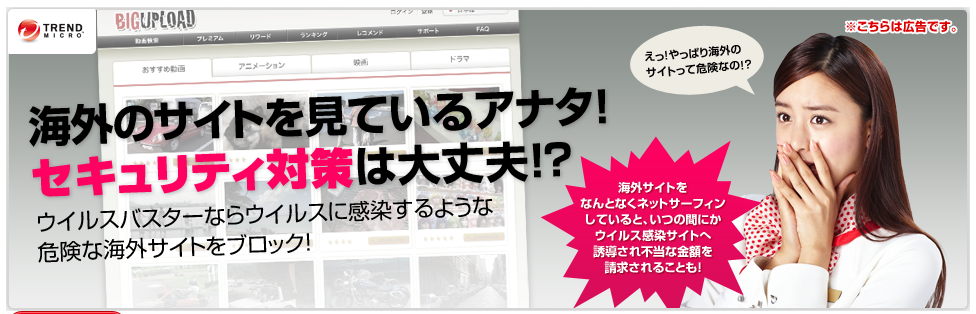
As a post-scriptum to my previous post, commenting on the difficulty encountered by the condition of ‘otherness’ of the foreign scholar operating within the Japanese field, I wanted to share something that popped up on my laptop screen right after I closed the WordPress window.
It’s an anti-virus advertisement showing up when visiting websites hosted outside Japan. The heading reads: ‘Hey you, browsing foreign websties! Have you taken the appropriate security measures?’ while the worried girl, depicted in the typical bikkuri pose (a mixture of surprise and innocence) is thinking ‘Really? Are foreign websites that dangerous?’
The ad campaign is founded on the Japanese stereotype of the ‘world beyond the seas’ (kaigai) as receptacle of impurities. The risk of visiting the alien territory is obviously that of contracting some unknown disease. I know for sure that Japan pullulates with indigenous internet crap (spam, viruses, malware of all sorts) and it was explained to me that one of the reasons why Japanese people of all ages have such ridiculously long mobile email addresses (ie sl33py-OxO-rabu666@whatever.ne.jp) is to prevent spam attacks. Nonetheless, advertising the risk of not being ready to face the unknown dangers of the outside world is certainly a great way to convince users to purchase an anti-virus and feel safe, who will nod at each other on the dangers of something they ignore, and, I am afraid, will continue to ignore for a long time. Sure, Japan is not the only ‘xenophobe’ (excuse my language) country in the world, but they way it does it is so, so peculiar.
 Like treading on the tiger’s tail, such is the condition of the ‘foreign’ researcher studying anything related to the Japanese culture. Sure, our non-Japanese opinions are kept in high regard, as the gaze of the ‘other’ is fundamental in the constitution of identity in every society, and all the more so in the Japanese society. The foreign opinion is considered, sure, but considered as the ‘foreign opinion’, not as an opinion with a value in itself. It exists in virtue of its cultural otherness. Listened to, then packed into a box, and put somewhere safe, where it will not disturb or divert the ‘natural flow’ of the Japanese ‘way’. This typically Japanese attitude has been criticised for decades now, sometimes even ridiculed because of its inadequacy to the post-modern society many thought we were living in. However. In a world reverting from utopian dreams of interculturalism to new nationalisms and post-traditionalisms, will Japan end up being right about its conservative attitude?
As I approach a new project in which I will discuss aspects of Japanese conservatism in relation to history and tradition, I am once more faced with my incompetence, in the literal meaning of ‘something that does not compete with me’, outside my jurisdiction, a concept close to that of the literal meaning of gaijin. This form of incompetence, which is evidently not technical, is intrinsic to my condition of foreigner. While this thought might appear obvious in an every-day life context – anybody living in or dealing with Japan know what I am talking about, and many got over it (while others never will) – it is not so obvious when it comes to academic research and scholarship, which is the matter I am engaged with. Until when will ‘foreign’ scholarship continue to be ignored as something that adds luster to the ‘things Japanese’, but that eventually does not belong there?
PS: The title of the post is inspired by an early Akira Kurosawa film, The Men Who Tread on the Tiger’s Tail, recounting the famous episode, also depicted in the Noh Ataka and in the Kabuki Kanjincho, describing Minamoto Yoshitsune and his bodyguard Musashibo Benkei crossing the barrier of Ataka disguised as yamabushi priests.
“NOH: a ONE POINT Lecture” 8th (Saturday) from 1:30 p.m.
7th Floor 3rd Exhibition Room
Nagoya City Nakaku-Shimin Gallery–Sakae
Supported by:
the Aichi Prefectural Board of Education, the Nagoya City Board of Education, Chunichi Shimbun

Photo: “IZUTSU” at National Noh Theater; Mask: Magojiro;
performance and mask by UDAKA Michishige

Nakakuyakusho Asahi Seimei Bldg. 7th Fl.
By Subway: Higashiyama Line or Meitetsu Line Sakae Station
one minute’s walk East from Exit 12
By Bus: 5 minute walk from the Sakae Bus Stop

Un’opportunità per studiare e provare il canto e la danza del Noh, secondo la tradizione della scuola Kongoh, con la Maestra Monique Arnaud
Inizio del corso con stage intensivo: Domenica 16 ottobre 2011
Il corso sarà strutturato in: Lezioni individuali, Lezioni collettive di avviamento allo studio del Noh (gruppi di max 5 persone), Allievi uditori
A beautiful example for all women involved in the often sexist world of Japanese traditional arts.
Just when you think you heard all the possible idiotic puns on Noh, that is when a new onecomes up (usually from an American publication). I have already explored the topic in a previous post, but this time I give you.. The American Who Couldn’t Say Noh, by Charles Danziger.

I haven’t read the book – I kind of feel I have enough from the title – but will welcome reviews by anyone who already endeavoured to… I know a lot of people find these puns very amusing and trust me, I would like to find them amusing too, so that I would be more natural in my reactions when talking to such people. But I can’t help thinking they are simply very lame…
 The Noh Diaries