As part of my year at the Art Research Centre at Ritsumeikan University under the Japan Foundation Fellowship Programme, I have been asked to write a brief article about my current research on the role of amateurs in the world of Noh. The article is available both in English and in Japanese on the Japan Foundation web magazine Wochikochi.
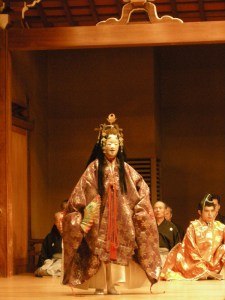
Tomorrow I will be dancing the tennyo-no-mai (a variation of the chu-no-mai) as nochi-tsure (supporting role in the second half) in the noh Kamo at a training session tomorrow. After many roles in ‘han-mi’ martial stance, I’m going back to a character with a rather feminine stance, probably the first time with awareness of the character. The nochi-tsure of Kamo is the mother of the thunder-god Wakeikazuchi, who later became a goddess herself. Goddesses of this kind are not easy to perform as they are both feminine and stately (‘godly’?) at the same time, and I have been instructed to use large arm movements (I would wear a chōken dance cloak in a full Noh) but keep a my knees together and take small steps. For people with big feet like myself (27.5cm) this is not an easy thing to do, as it forces you to slide-step for even less than the length of the actual foot. It might not be too difficult in a slow dance, but the tennyo-no-mai I am doing tomorrow is a rather ‘light’ dance, which is supposed to be performed smoothly and at a rather rapid pace, in creating contrast with the stronger and more imposing movements of the shite (the god Wakeikazuchi), dancing after the tsure.
Although Japanese actors too come in all shapes (from super-tall to extra-wide) I always find myself wondering whether this body of mine is not inadequate to perform this genre. Compared to east-asian standards, I have narrow shoulders, a long neck, long feet and most of all long arms, which means that I need to adjust all these proportions in order to look better in kamae (basic stance). I will need to make an extra effort and try to be stable despite the fast, little steps I have to take during the dance. However, the other day my teacher’s son revealed a good trick for people with long legs/feet… I shall try and see if it works tomorrow!
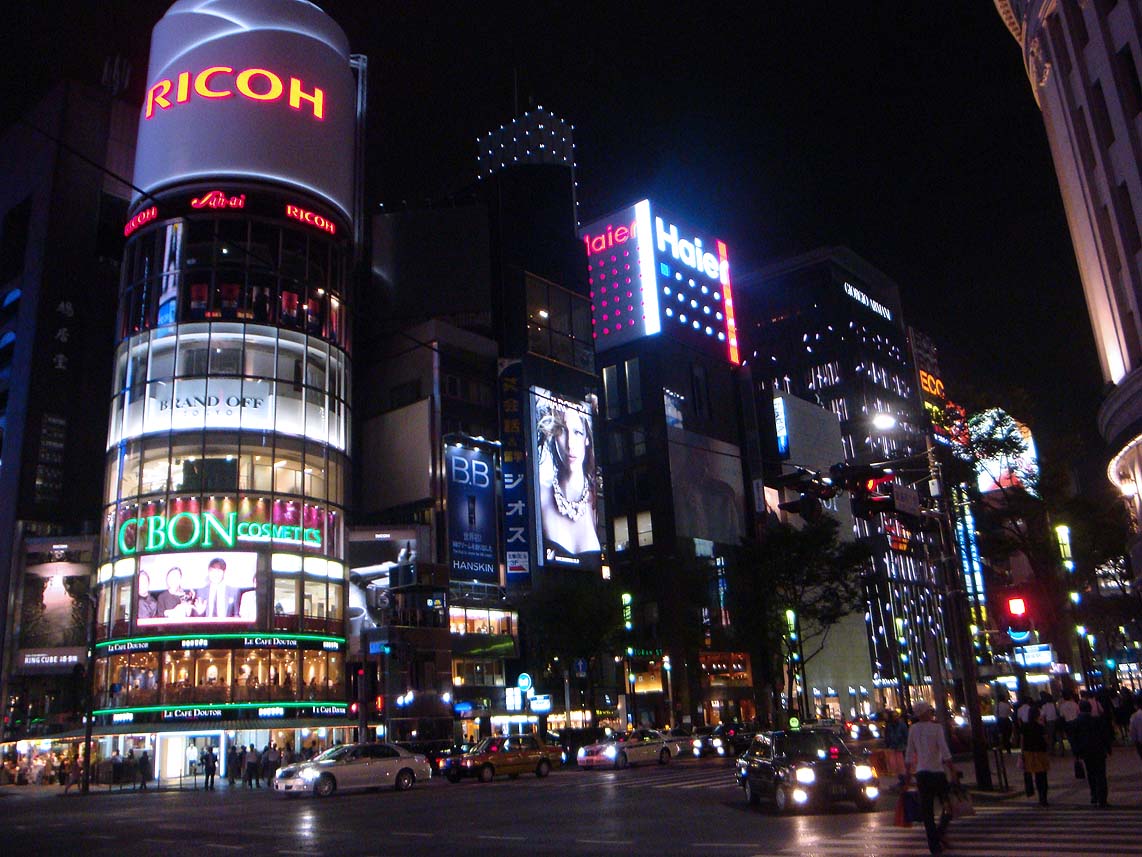
Following the rumours that came out last fall, the Kanze Association has officially announced that the Kanze Noh Theatre will move from its current location in Shōtō, Shibuya to a new building in Ginza, Nōgaku Times (Feb. 2014) reports. The move will be completed in 2016, with the theatre opening in fall. The traditional wooden stage will be rebuilt in the new location, and the hall will be provided with the same number of seats of the current theatre, which will continue to host shows until March 2015. Kanze-kai performances will take place at the Umewaka Nōgakuin kaikan in Nakano until the moving operations are complete.
The current Kanze Noh Theatre in Shibuya
The rationale behind this huge operation stated in the article appear to be the ageing of the current early 1970s building. Moreover, the Kanze Association appears to be prepping up for the 2020 Tokyo Olympics, which will function as a huge attention catalyst for Japan, and a chance to promote traditional arts internationally. However, an article appearing on Gendai Bijinesu(Oct, 6th 2013) hinted at the unstable economic situation of the Kanze Association (i.e. the Noh establishment at large). It seems that, whatever difficulties Kanze is undergoing, they decided to face the crisis with an important investment rather than with austerity, a choice that is up to the expectations for a Noh school often considered to be representative of the Noh tradition in Japan and abroad, and that might well pay off in the long run.
On February 23rd 2014 from 1:30pm Udaka Michishige will perform Uneme, a Noh of the 3rd category (women Noh) by Zeami Motokiyo, as part of the monthly (teiki) performances of the Kongō school at the Kongo Noh Theatre in Kyoto. For ticket reservation and for more information, please contact me here.
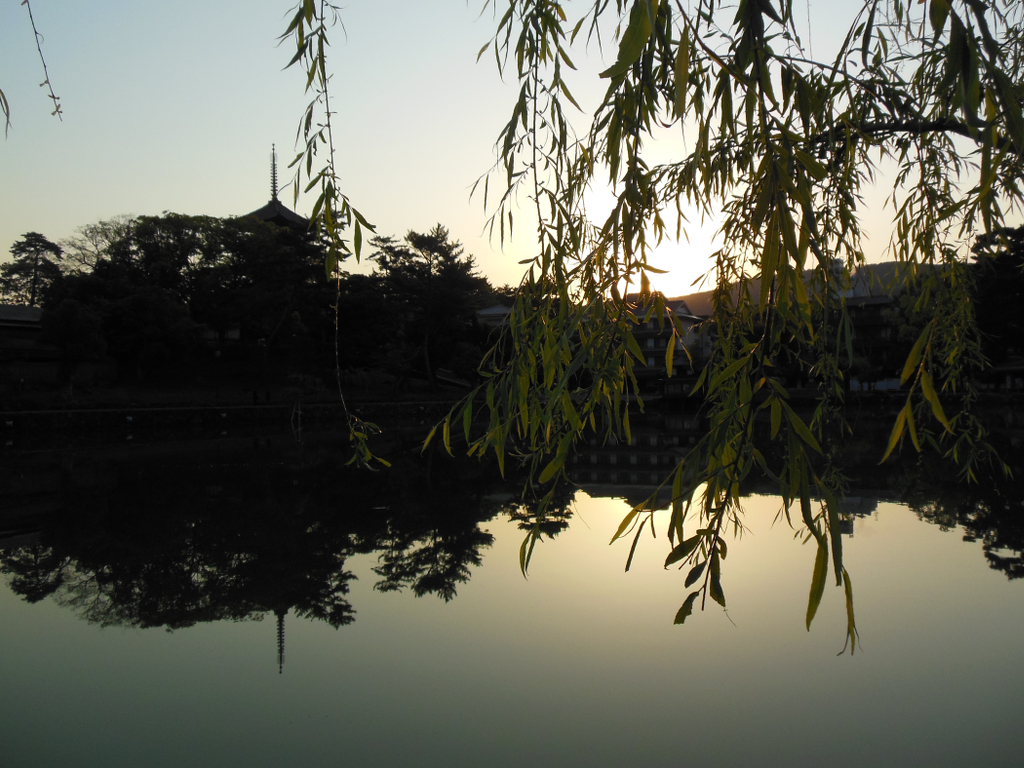
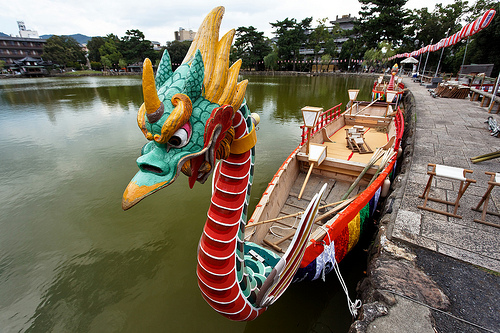
Long ago an Uneme, or Lady in Waiting, drowned herself in Sarusawa Pond after the Emperor, who had once shown her so much affection, turned his attentions elsewhere. After hearing her story from a Woman who reveals that she is the spirit of the Uneme, a Priest prays for her salvation. She then appears as she was in the past, recalling banquets on the pond long ago, and dances. Even now, on the night of the full moon in September a service is held for her, a dragon boat such as the one she would have ridden, circling the pond. (Summary by Rebecca Teele Ogamo)
Another feature of the story is that after Uneme’s death a shrine was built next to the pond for her consolation. However the shrine could not bear to face the place where she took her life, and turned around overnight. The Uneme Matsuri festival is held every year in September. The festival features a parade of Heian period characters and the typical dragon boats circling the pond.
The Sarusawa Pond (Photo: Terao Kaionin)Dragon boat of the Uneme Matsuri (Photo: s.yume)
Due to popular demand the Special Opening of Udaka Michishige’s Noh Mask Carving Atelier has been extended. We have received many requests of Japanese and non-Japanese, Kyoto residents and Kyoto visitors who wished to learn about the world of Noh masks from the direct experience of a professional carver and actor such as Udaka Michishige.
Three new dates (February 6th, 20th and 27th) have been added. There are two time slots: afternoon (14:00~17:00) or the evening (18:00~21:00).
This is a great opportunity for those interested in masks and in the mask-making process, as well as in the use of the masks in actual performance: Michishige is the only Noh actor who is also a skilled mask carver, regularly using his own masks on stage. In 2010, Michishige published the photobook The secrets of Noh Masks (Kodansha/Oxford) with photographer Shuichi Yamagata. I have posted more about Michishige’s activities as mask carver here.
If you are in Kyoto don’t miss this chance to be introduced to the world of Noh masks – both Japanese and English speakers are welcome!
Observers are admitted FREE OF CHARGE
Udaka’s atelier is just a few minutes on foot from the Kokusai-kaikan subway stop (Karasuma line).To reserve a place, or for more information, please feel free to contact me here.
‘Magojiro’ by Udaka Michishige. Photo: Fabio Massimo Fioravanti
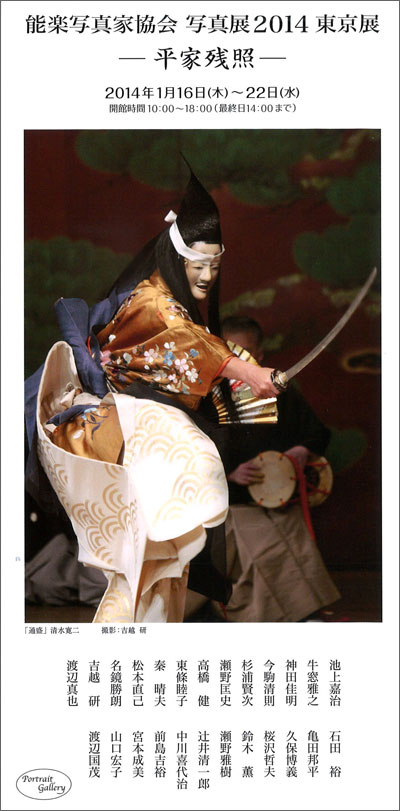
From January 16th to the 22nd at the Tokyo portrait gallery, close to Yotsuya station, members of the Noh Theatre Photographers Association 能楽写真協会 will exhibit pictures collected under the theme ‘Heike zanshō’ 平家残照, or ‘Afterglow of the Heike’. The title refers both to the Taira clan (aka Heike) and to the Heike monogatari, the warrior epic describing the rise and fall of the Heike, and the struggle with the rival Minamoto clan (aka Genji). The photographs portray scenes from the many plays featuring characters (mostly, but not only, warriors) from the Heike monogatari appearing in Noh plays such as Michimori, Yashima, or Hashi Benkei.
What about Noh photography? Just yesterday I was having a twitter conversation with a young Noh professional and a young Noh amateur on the role of ‘creativity’ in traditional performing arts. Noh photography pretty much follows the ‘rules of tradition’. Since Noh photographers are, for better or for worse, part of the Noh establishment, hence they are subject to its rules. Naturally, in order to take photos of a Noh performance it is necessary to get a permission from the performer, who is in turn responsible for the photographer’s presence in the theatre. Usually there is an agreement between the two parts, with the photographer complying with the wish of the actors in order to be allowed to take pictures. This does not necessarily mean that the performer is forcing on the photographer, simply because in most cases the photographer shares the same aesthetic taste of the actor, that is, an aesthetic that is inscribed in tradition. Let me elaborate this.
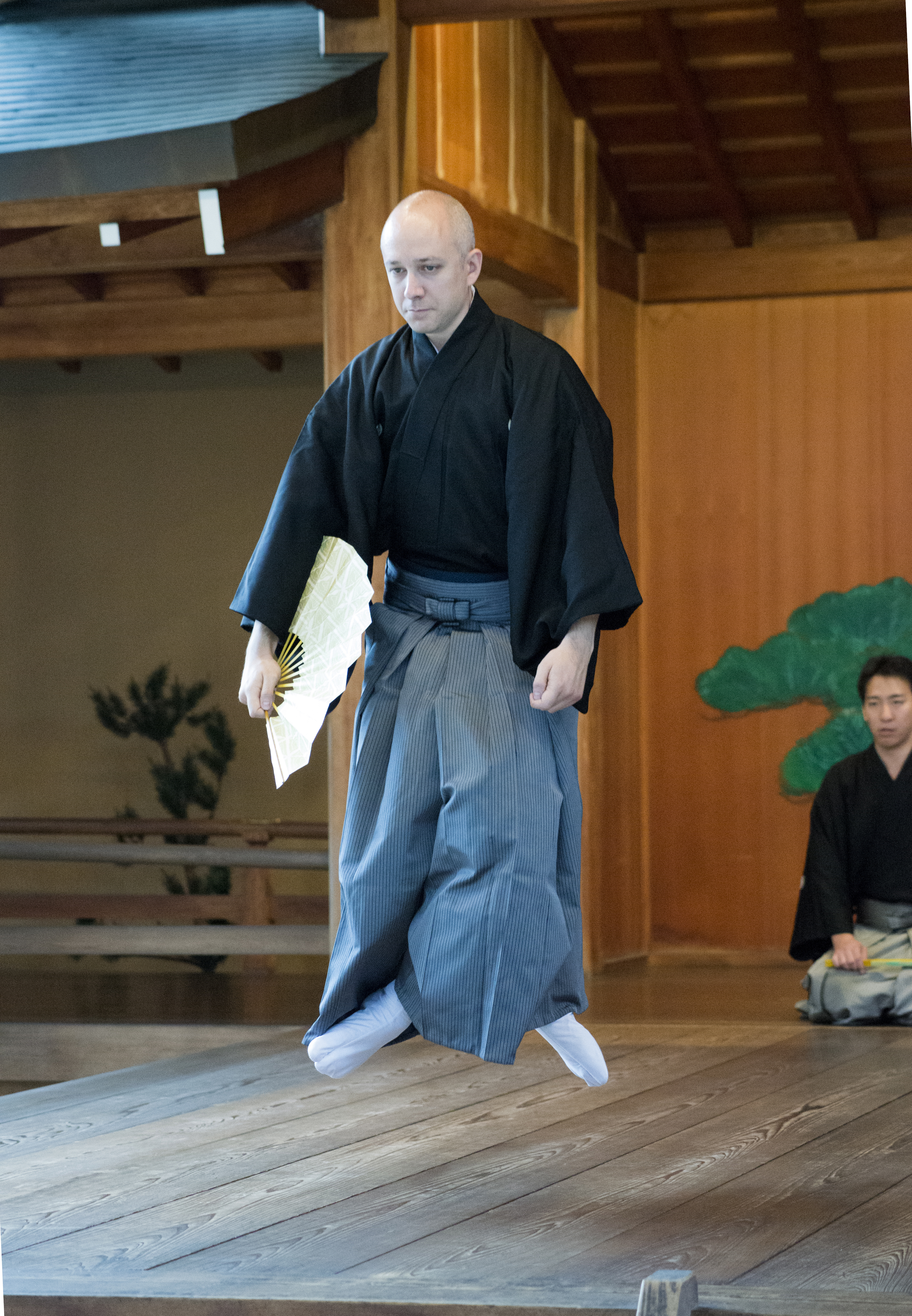
Like all traditional arts, Noh dance is based on sequences of kata 型, or ‘choreography clusters’ prescribed by tradition, which are transmitted from teacher to pupil, and reproduced on stage. Kata are combinations of movements that have a beginning, a development, and a conclusion, and aesthetic value is attached to how beautifully the kata is executed. Since a katais a movement, its beauty depends on various kinetic factors – how to capture this in a photo? Oftentimes Noh photographers (especially those belonging to the association I am referring to in this post) tend to shoot pictures of a static instant within the kata (often the conclusion) where the actor freezes, sometimes only for a brief instant, on a certain pose – something that kabuki has developed further in mie techniques. Traditionally, Noh photos are shots of ‘still’ kata, and may result in a rather static effect. (See an excellent exception). Since ‘professional’ Noh photographers know the plays very well, they wait for the ‘highlight’ of a scene and then shoot. Obviously actors are aware of this, and make sure to keep the pose long enough for photographers to catch it. I’m not suggesting that actors act for the photographers, but I am pretty sure there is awareness of that, too.
Imperfect gestures: an instant in the sequence of the ‘tobi-hanza’ jump kata. (Photo: Fabio Massimo Fioravanti)
I am reflecting on Fabio Massimo Fioravanti‘s pictures of Udaka-sensei he took during his trips to Japan in the past two years. Massimo is not a ‘Noh photographer’per se, meaning that 1) he was not educated in Japan, 2) he is not a Noh specialist. This provides him with a very different perspective of the stage, which of course is very interesting. Many of his pictures lack the static composition of traditional Noh photography, resulting in a ‘rougher’ yet ‘true-to-life’ effect, something close to what you can see in my picture above. During the editing process of the photo book he is about to publish, we have skimmed through hundreds of pictures, confronting his preferences with those, more used to traditional Noh photography, of Udaka-sensei himself. The result is a compromise between Massimo’s point of view, generally disregarding the perfection of kata, but looking for dynamism and intensity of expression of the overall frame, and Udaka-sensei’s point of view, more concerned with the photo’s capacity to reproduce his idea of formal perfection of his acting.
I will make sure to post more about Massimo’s forthcoming book as well as about Noh photography in general (I did a bit already here). There’s a lot more to say!
When I introduce myself or talk about my training in Noh, I often find myself in need to explain what I mean by ‘Kongō school’ (金剛流 Kongō-ryū). There is a common misunderstanding deriving from the use of the word ‘school’ (or it. scuola; fr. école; ger. Schule – it extends to all European languages) as translation of the Japanese ryū. Since many have asked me to explain what exactly a ‘Noh school’ is, I would like to use this space to clarify a couple of things regarding this matter.
The Kongo School stage
The Kongō school, to which I belong, is one of the five stylistic schools of shite actors (the others being Kanze, Komparu, Hōshō, and Kita). ‘School’ is none other than a free translation of ryū (lit. ‘current’, or ‘flow’), a word defining a performance style peculiar to a certain group of actors who are organised in a ‘guild’, a pyramid structure on top of which is the iemoto (lit. ‘foundation/origin of the house’). These ryū are the contemporary configuration of troupes of performers called za, which emerged in the Muromachi period, and that later underwent a process of professionalisation that led to the creation of ryū specialised in particular roles and instruments. Various styles, or ‘ways of performing’ a specific element of Noh become formalised during the Edo period, multiplying the possible combinations of chant, dance, drum and flute performance when these elements come together on stage. In fact, one of the difficulties performers need to face is getting used to a variety of styles in order to be able to perform with more than one ryū, because all performing roles (as shite actors are grouped in the five ryū mentioned above, waki, kyogen, taiko, ko-tsuzumi, ō-tsuzumi, fue – all have different ryū). For example, a Kongō-ryū shite could perform with a Fukuō-ryū waki or a Takayasu-ryū waki, with a kō-ryū or okura-ryū ko-tsuzumi, etc. (However, ryū are not represented equally across the territory, which makes it so that some ryū always get to perform with a certain other ryū more often than others… it’s getting complicated… I might need to write another post to explain this).
The Noh ryū system
Anyway, each ryū has a iemoto on top of it, and his (male) heirs immediately under him. However, ryū are also composed of other families which have been affiliated with a certain ryū, and might to some extent have developed a particular ‘style within the style’. Although dependent to the iemoto supreme leader, such families achieve a certain degree of independence which has often led (and still leads) to power struggles within the ryū. The obvious example is the Umewaka family, a formerly independent group which were incorporated into the Kanze school at the beginning of the Edo period (early seventeenth century). When, at the beginning of the nineteenth century, the Umewaka family attempted to declare independence, it was excommunicated from the Kanze school by the iemoto, only to rejoin a few years later. Disputes like this are common in the history of Noh, and still continue today.
In short, a ryū is a conglomerate of individuals, some of whom are descendants of families that have been in the Noh profession for generations, while others are associates of these families – they can be amateur students who turn to professionalism, or relatives adopted into the professional family. The iemoto family, from which the style takes the name, is the highest ranking within the school. The iemoto himself, as the ultimate leader of the school, holds the rights to grant teaching licenses, to authorise performances, to revise and publish scripts (hence to earn publication revenues), to accept and to expel members, etc.
This is to say that a Noh ‘school’ is not an educational institution like a drama academy, with lectures, practice rooms, recitals, etc. Noh actors do practice and perform recital, but their training and performance is not structured and regulated as in a Western-style conservatory. There is no ‘school building’ where all trainees report to in the morning. Most young professionals are either born into families of professionals, or become apprentices (uchi-deshi, or house-apprentice) to a professional. This means they either visit the home/practice space (the two do not necessarily coincide) of their teacher, or else they actually live in the home/practice space. This second option, called sumi-komi (live-in) is normal when the teacher is the iemoto or a high-ranking actor from an affluent family with a long heritage in the Noh profession, simply because these two figures are the only ones likely to own a stage as well as facilities big enough to serve the purpose of training disciples. An additional reason is that proximity to the origin of tradition (i.e. the iemoto) is likely to provide the ‘purest quality of technique’, as opposed to learning from another teacher, whose style will be similar but different from that of the iemoto. Finally, learning directly from the iemoto allows a performer to… well, claim that he/she has learnt directly from the iemoto: it is pedigree. For example, my teacher (Udaka Michishige) was uchi-deshi of the previousiemoto (Kongō Iwao II), which means he had direct transmission, while I am removed by one degree. In a small school like the Kongō school, undergoing an uchi-deshi training period with the iemoto is the only way to ensure a young actor is exposed to all the necessary kinds of knowledge he/she will need in order to become a full professional.
I feel like I have made things more complex than I intended to – feel free to ask for clarification if you need to!
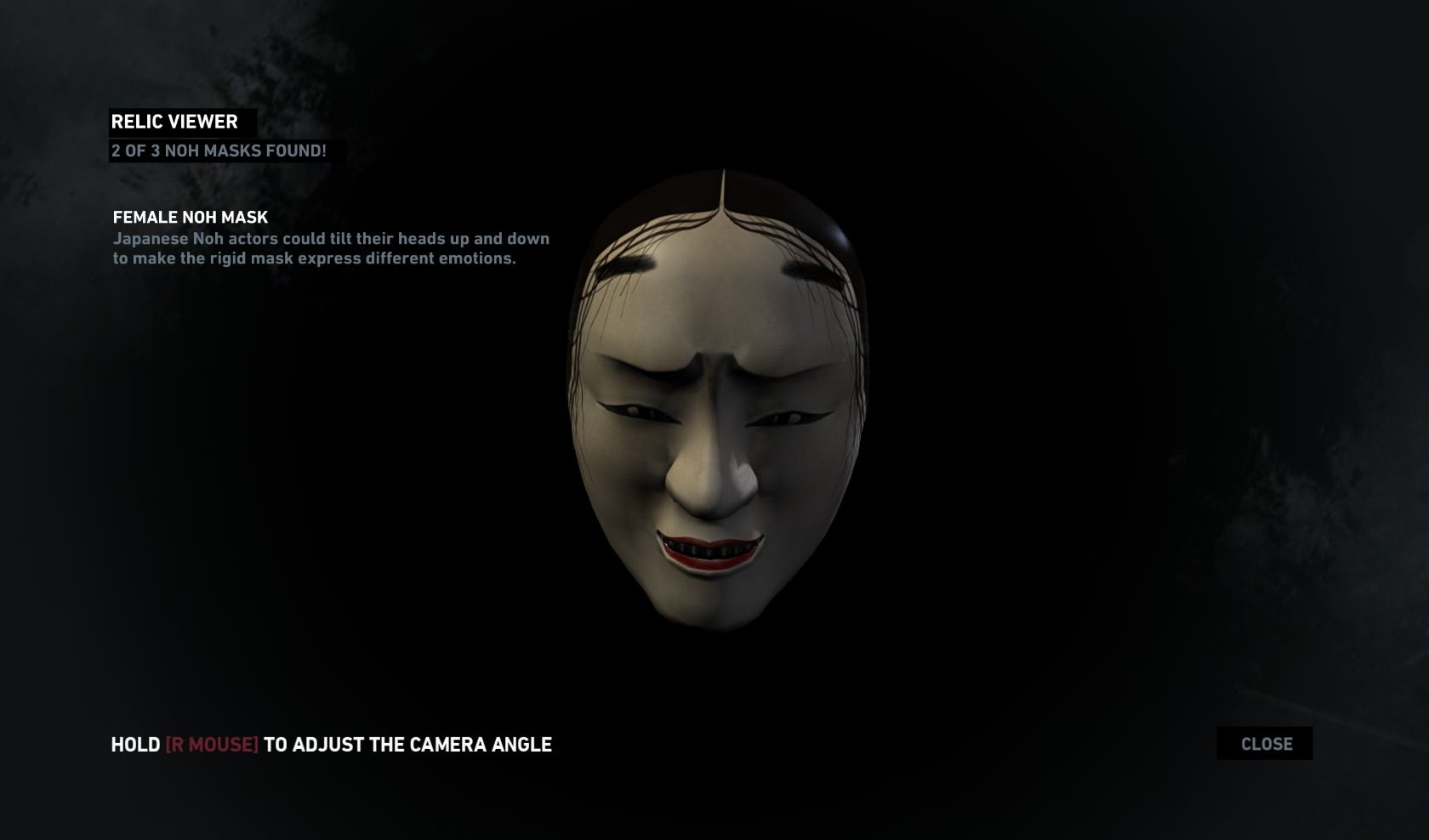
I have shown in other posts how images and suggestions from Noh theatre populate a number of videogames. While Japanese-made videogames such as Tekken or Sengoku Taisen (I doubt this one has even been translated in other languages) contain elements of traditional culture, and Noh is one of them, it is more difficult to find Noh in American productions. Here is an exception! Tomb Raider 2013features three Noh masks as hidden collectible items! I wonder whether the presence of Noh in videogames will spark interest for Noh in the players!
Obviously the names are messed up, but the 3D graphic rendering looks good! The actual names would be namanari (used in some versions of the play Sesshōseki) masugami (for roles of possessed women, as in Makiginu) and something that looks like a ja (an extreme version of a hannya mask, used in a variation of the play Dōjōji).
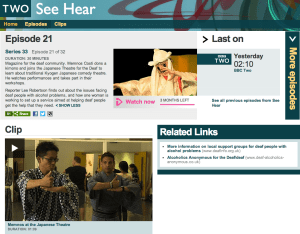
Quick link. Tokyo-based theatre group Japanese Theatre of the Deaf (also on Facebook) performs traditional Kyogen in sign language (shuwa 手話in Japanese). Following up their recent performances in London BBC reporter joins one of their workshops in sign-language traditional comedy. Unfortunately the video only works for those in the UK. I have only recently found out about this company, and their work looks amazing. I am looking forward to learning more about their activities, and how they contribute to spreading traditional performance in areas other genres have trouble reaching.
Japan (as the UK as far as I know) is particularly active in spreading the culture of sign language. Signed news are broadcasted on a daily basis, and I am a fan of minna no shuwa, the sign language course on the national TV educational channel, NHK t-テレ , broadcasted on Sunday evenings. Japanese Theatre of the Deaf also offers multi-level sign language classes.








 The Noh Diaries
