11/3 – 10th Sanrinshojo: TORU「融」

The National Noh Theatre, Tokyo 1:30~4:20 p.m. (doors open at 12:30p.m.)

Program:
Commentary:  Dr. ONO Yoshiro Professor, Kyoto Institute of Technology
Kyogen: AKUTARO  MIYAKE Ukon
<20 MINUTE INTERMISSION>
Noh: TŌRU jūsandan-no-mai  UDAKA Michishige

Tickets: Reserved (stage front): 7,000 yen
Reserved (waki-shomen–facing the chorus):  6,000 yen
General admission (naka-shomen–facing the sighting pillar):  5,000 yen
Student (naka-shomen–facing the sighting pillar):  2,000 yen

For tickets or further information contact: ogamo-tr@mbox.kyoto-inet.or.jp

http://www.noh-udaka.com/en/index.html

Synopses of the plays will be available at the theater free of charge in English, French, German, and Italian.

The 13th Annual Udaka Seigan-Noh

9 September 2012

Kongo Noh Theatre 1:30~4:30 p.m. (doors open at 1:00p.m)

Noh: YASHIMA Shite: UDAKA Tatsushige

Tsure: UDAKA Norishige
(Masks:  Sanko-jo and Heita)

Kyogen: CHIKUBUSHIMA MAIRI  Shite: SHIGEYAMA Shime
Ado: SHIGEYAMA Akira

Noh: MAKURA JIDO Zengo-no-narai JIDO AND THE PILLOW”
Shite: UDAKA Michishige
(Mask: Doji)

Tickets: Center Reserved Seats 7,000 yen
Side Reserved Seats 6,000 yen
General Admission Mid-center Seats 5,000 yen
Student, Balcony Seats 2,000 yen

Synopses of the plays will be available at the theater in English, 
French, German, and Italian.

The Udaka Michishige-no-kai Office
(For questions or reservations.)
TEL: +81 (075) 701-1055
FAX :+81 (075) 701-1058
Email: ogamo-tr@mbox.kyoto-inet.or.jp

Art Project Hōnōmai – ‘Yuki’

Iori is a beautiful Kyoto machiya (traditional guesthouse), offering traditional art courses and art-related activities. In this clip Noh actor Udaka Tatsushige (son of my teacher, Udaka Michishige) is performing the shimai from the Noh Yuki (‘Snow’), a play that is exclusive to the Kongō school repertoire. In the Noh Yuki, a priest on his way to the Tennō-ji temple is caught in a snowstorm when he encounters a mysterious woman, who in reality is the spirit of snow. After reading a sutra, the woman dances as she disappears in a whirlwind of snow. I saw this Noh performed by Ogamo Rebecca Teele in the recital to which I participated June 2010. It is a very refined, delicate Noh, where all sounds and movements seem to be softened by the snow. Even the typical stomps of certain Noh dances are performed so that the feet softly touch the floor, producing no sound.

アートプロジェクト2012『奉納舞』Collaborate with Art and Noh Drama

“Kyoto Kyo-Machiya Stay Arts Project –Art and Noh Drama Collaboration-”
Iori Co. also offers a unique designed program for experiencing the traditional culture of Japan.
For cerebrating the first Project, there was Noh Drama performing collaborating with four Artists’ works of Art.

「京都・京町家ステイ・アートプロジェクト」参加作家によるコラボレーション奉納舞
京都で伝統文化体験を提供する庵。事務所に併設された稽古舞台には、プロジェクトの記念すべき第1回参加作家4名が、それぞれの作品を共鳴させた特別しつらいがなされ、金­剛流シテ方 宇高竜成さんが、「雪」を舞った。

10/4~9 Mask Exhibition of the Nagoya Branch of the “UDAKA Michishige Men-no-Kai” Mask Carving Group

October 4 (Tuesday) ~ 9 (Sunday) 9:30 a.m.~6:00 p.m.

“NOH: a ONE POINT Lecture” 8th (Saturday) from 1:30 p.m.

7th Floor 3rd Exhibition Room
Nagoya City Nakaku-Shimin Gallery–Sakae
Supported by:

the Aichi Prefectural Board of Education, the Nagoya City Board of Education, Chunichi Shimbun

名古屋面展
Photo: “IZUTSU” at National Noh Theater; Mask: Magojiro;
performance and mask by UDAKA Michishige
名古屋面展地図

Nakakuyakusho Asahi Seimei Bldg. 7th Fl.
By Subway: Higashiyama Line or Meitetsu Line Sakae Station
one minute’s walk East from Exit 12
By Bus: 5 minute walk from the Sakae Bus Stop

A life of dedication to Noh

I re-post here the article that appeared today on Japan Times online. I consider the work of Rebecca Ogamo Teele as a model for all those who would like to pursue the study of Noh in a serious way. I wish Rebecca-sensei all best for her next performance.  

Saturday, June 18, 2011  

American woman pours self into noh

By JANE SINGER

Special to The Japan Times

According to Rebecca Ogamo Teele, an American instructor, performer and mask carver for noh, falling asleep is a perfectly respectable response to attending such plays.

In fact, she would almost recommend it.

A noh performance can be likened to a meditative state, with a rhythm forged from drum calls and breath-based vocalizations, she explains. This dreamlike world harkens back to the womb, pulsing with the mother’s heartbeat.

“The rhythms of noh can draw you into a trance state,” Teele says. “You may sleep, but at some point there will be a change in the tension, and you’ll wake naturally.”

Teele, 62, speaks about noh with familiarity born of 39 years of study, including three decades as an instructor of the classical dramatic and musical art. Her longtime teacher, Michishige Udaka, is a master actor and mask carver in the Kyoto-based Kongo school, one of the largest of the five major noh schools.

Teele’s first exposure to noh was as a child in Kobe, where her father, an educational missionary and scholar of contemporary literature, taught at Kwansei Gakuin University during two stints in Japan totaling nine years that began in 1950.

“My father studied utai (noh chanting) and often brought our family to classical art performances. I can remember when I was very young waking up at noh performances and feeling transported by the otherworldly sounds and the unexpected sight of masked actors,” she says.

After returning to the United States in 1960, Teele fueled her interest in Japanese arts with a fine arts major at Bennington College in Vermont. She returned to Japan in 1971, settling to Kyoto, to learn more about classical theater arts.

She first studied with a mask carver but desired a stronger connection to the plays themselves. Intrigued by Udaka’s insistence on carving the masks for his noh roles himself and his rare openness to teaching women and foreigners, she began to study at the Kongo school.

“Udaka-sensei felt that noh is universal; that if someone trains and has the necessary commitment, they can interpret a role, no matter where they’re from,” she says.

Teele began studying dramatic roles right away, along with daily stretching and vocalization exercises. “In the Kongo School you learn to read notation by parroting the teacher. You start with the simplest, most abstract movements and you learn to listen to and to later interpret the text.”

She gradually mastered the performer’s gliding walk, in which the feet never leave the floor, the elbows are held out and to the side, and fingers are folded in a fist. She demonstrates by gliding across the carpet, with posture held erect but the torso set at a low center of gravity and legs bent. In noh, she says, movement is controlled and usually slow, but it can sometimes unfold explosively fast.

“This posture creates a larger sounding board for your voice and nicely sets off the costume, which often features sleeves twice as long as your arms. Holding your arms this way is physically demanding, calling on stamina and strength,” she explains. The performer typically holds a fan to amplify gestures or mime movements, such as drinking or holding a shield.

“Kabuki has a wonderful flamboyance, but I was attracted by the depth of noh,” she says. “In noh the audience is a kind of witness, called on to participate in the performance. Rather than passively having things laid out for them, they must create something by listening to the chorus and watching the abstract movements, which assume meaning when attached to a text.”

In noh, costumes, dance, utai and poetry help to express overwhelming emotions, such as rage or sorrow, with stories often based on famous historical scenes or Buddhist themes. The main character, the shite, is assisted by an on-stage chorus and a wakikata, or secondary character, who acts as the foil for the shite.

A noh performance typically includes several plays as well as a farcicalkyogen performance.

Over the years, as Teele improved as a noh performer, she began to conceive of a role for herself, she said, “in facilitating communication and understanding among performers and learners.” After nine years of study she became certified as a shihan, or instructor, one of the three foreign instructors whom Udaka has trained. In 1996 she was accepted into the Noh Association under her noh name, Rebecca Ogamo (a play on words, since “kamo” means duck, and a “teal” is a small dabbling duck).

Most noh plays are performed wearing masks, although not all. When performing without a mask the face remains completely emotionless. For the Western actor, the face is the greatest medium of expression, but the use of a mask in noh, rather than serving as a handicap, allows for greater expression of creative energy, Teele says.

“Because the audience is not distracted by the face, you become more aware of the performer’s body and voice. It seems that it would be limiting, but it allows you to access greater powers of expression,” she says. “The mask is the focusing lens for the actor’s energy, and that can be quite transporting.”

She displays a lacquered mask she has carved herself from lightweight Japanese cypress, with straps and linen backing attached. Most masks are carved for specific roles or character types; this one is for Lady Rakujo, the betrayed wife of Prince Genji in the play “Aoi no ue.” The horns and the savage, tooth-bared grimace symbolize a woman transformed by resentment, grief and disillusionment into a demonic spirit, Teele says.

It takes up to a year for Teele to complete a mask like this. “The finest masks have an intense immediacy and can express love, devotion, or grief,” she says. “With an accomplished performer, the mask should seemingly come alive, with the expression changing as the viewing angle changes.”

Teele provides information on noh and teaches both foreign and Japanese students as associate director of the International Noh Institute, a Kyoto-based network of instructors and students affiliated with Michishige Udaka. She says Japanese have no problem accepting a foreign teacher: “Sometimes Japanese prefer a foreigner, since they can ask questions and admit their ignorance of noh without embarrassment.”

Much of the appeal of noh is in the texts, which are often very short narratives but with compressed layers of meaning. Although many of the most famous noh plays, like “Hagoromo” and “Dojoji,” date back more than five centuries, new plays are being written and performed regularly, many to address contemporary issues.

After the Sept. 11, 2001, terrorist attacks in the U.S., Udaka pondered the fate of the souls of those who died instantly in mass carnage, leading him to write a play about Hiroshima atomic bomb victims. In the play, “Inori” (“Prayer”), a mother follows the voice of her missing child to the underworld, where a guide escorts her to a site where victims of nuclear and terror attacks reside. Teele accompanied Udaka on a tour of the play to Paris, Dresden and Berlin in 2007, where it was met with enthusiastic, focused audiences, she says.

Teele has appeared on NHK TV, and has lectured and led workshops about noh in Latin America, Europe and New Zealand. In 2003 the Kyoto Prefectural Government recognized her dedication to the dance form by awarding her the Akebono Prize, for women who have contributed greatly to their fields.

She believes that she is the only foreigner to be accepted into the Noh Association, which recognizes professional performers.

She is currently working on a compilation of translated noh plays intended for a general readership, and she has embarked on a project to create smaller-proportioned masks specifically designed for female performers. Last June, she performed as the shitekata, or central character, of the play “Yuki” at the Kongo Noh Theater, a highly abstract role in which, as the spirit of the snow, she materializes before a lost priest and seeks his intercession for finding enlightenment.

“The character is essentially an accumulation of our memories, attachments and illusions,” she says. “In noh, plays like this allow us to experience an awakening of awareness of both the dangers of attachment and the importance of the living things on Earth.”

Repost: Interview with Ogamo Rebecca Teele

Ogamo Rebecca Teele is a Noh actress, mask carver, translator and scholar; she is the coordinator of the International Noh Institute, led by Noh Master-Actor Udaka Michishige. It is also thanks to Rebecca-sensei’s efforts to pursue the way of Noh that I have been able to begin my journey through this art.

I am copying here the full text of the interview that appeared on the Yomiuri Shimbun (Feb. 6, 2011).

Wedded to her art, noh two ways about it.
Yoshihiro Kitaura / Yomiuri Shimbun Staff Writer

KYOTO–Face-to-face at a rehearsal hall at the foot of Mt. Hiei in Kyoto, the elder U.S. teacher and her Australian pupil bowed and engaged in a traditional “Yoroshiku onegaishimasu” (thank you for your support).

The teacher, noh actress Ribekka Ogamo, then began demonstrating a model performance, moving and lowering her center of gravity as if skating across some ice. She then coaxed her student into dancing more slowly and expressively.

Ogamo, 61, whose real name is Rebecca Teele, has described noh as having ongoing inspiration on her life. She has been learning noh for 39 years under the tutelage of Master-Actor Michishige Udaka, 63, a professional noh actor of the Kongo school. Udaka has much praise for Teele, saying, “She is good at noh chants and her performance is also solid.”

Born in Michigan, Teele first encountered noh as a child in Japan, at a performance she went to with her father who was then teaching at a university in Kansai.

Teele was mesmerized by the scene facing her when she woke from a nap. Orotund noh chants, emotive noh masks and the subtle rustling of long skirts all contributed to a profound atmosphere on stage that left an indelible impression on the young girl.

Teele, who later returned to the United States and graduated from high school there, majored in theater at a U.S. university. She thought while Western theater called on actors to possess certain physical charms, including a modicum of attractiveness, the noh she knew from Japan instead emphasized people’s spirituality. She thought she would be able to explore this theatrical expression, which she felt lacking in Western theater, by performing noh.

As her obsession grew, she again visited Japan and observed many noh performances. Fascinated with the beauty of the works staged by the Kongo school, Teele decided in 1972 to become Udaka’s pupil, as he had previously accepted foreign students.

===

Becoming Udaka’s pupil

Despite being accepted into the Udaka school, Teele faced much difficulty. First, she had to practice sitting seiza-style on her heels. She had no difficulty speaking conversational Japanese but it was a challenge to understand the noh chants written in classical Japanese.

Yet Teele was determined to succeed. Consulting her dictionary, she slowly made her way through many noh works. She also practiced the requisite chants in a loud voice at a riverside in the neighborhood.

Meanwhile, swimming helped Teele developed a physique better suited to the art form and she eventually conquered movements such as how to shuffle properly. She was making her living working at an English conversation school and translating, but Teele was completely devoted to noh.

Teele’s journey to become a noh master took nine years. Upon being admitted to join the Nohgaku Kyokai association–itself an unusual move–she identified herself as noh actor Ribekka Ogamo.

“[Teele’s membership] has inspired Japanese disciples,” Udaka said.

Teele, who also serves as secretariat chief of the International Noh Institute, a body comprising of overseas noh students among others, now herself teaches foreign students, her efforts a testament of her devotion to the art form.

The work is not without its challenges. The quality of a noh performance depends not only on the actors’ expertise in traditional dances and chants but also how the noh masks are displayed to the audience.

The significance of these principles is not always understood among beginner pupils hailing from overseas. According to Teele, she was once asked by a non-Japanese student whether it was acceptable to make small changes to the basic style of noh dancing.

Teele also recalled a pupil from South America unable to imagine snow. On such occasions, Teele would advise the students to visit temples and shrines in Kyoto and look at pictures on display depicting the four seasons.

In spite of the fact that many foreigners visit Japan to learn noh just like she did many years ago, Teele is disappointed their Japanese peers seem uninterested in learning the traditional art.

In June last year, Teele took part in a performance to celebrate the 50th anniversary of Udaka’s stage career. She played the main role in the program “Yuki” (snow), a snow spirit that dances in the moonlight for about one hour.

The performance was even more remarkable as Teele danced while enduring severe pain in her left knee. She had fallen down some station stairs six months earlier and injured the knee, which had already been broken once before. The accident prevented Teele from rehearsing enough before the performance.

“You should improve your dancing so that the noh mask becomes more expressive,” Udaka commented following her performance. His uncompromising attitude toward the art made Teele even more determined.

Teele has one unrealized dream: To perform noh in the United States. She hopes to fulfill this by almost any means possible, her will unchanged from when she first decided years ago to devote herself to noh.

(Feb. 6, 2011)

Continue reading

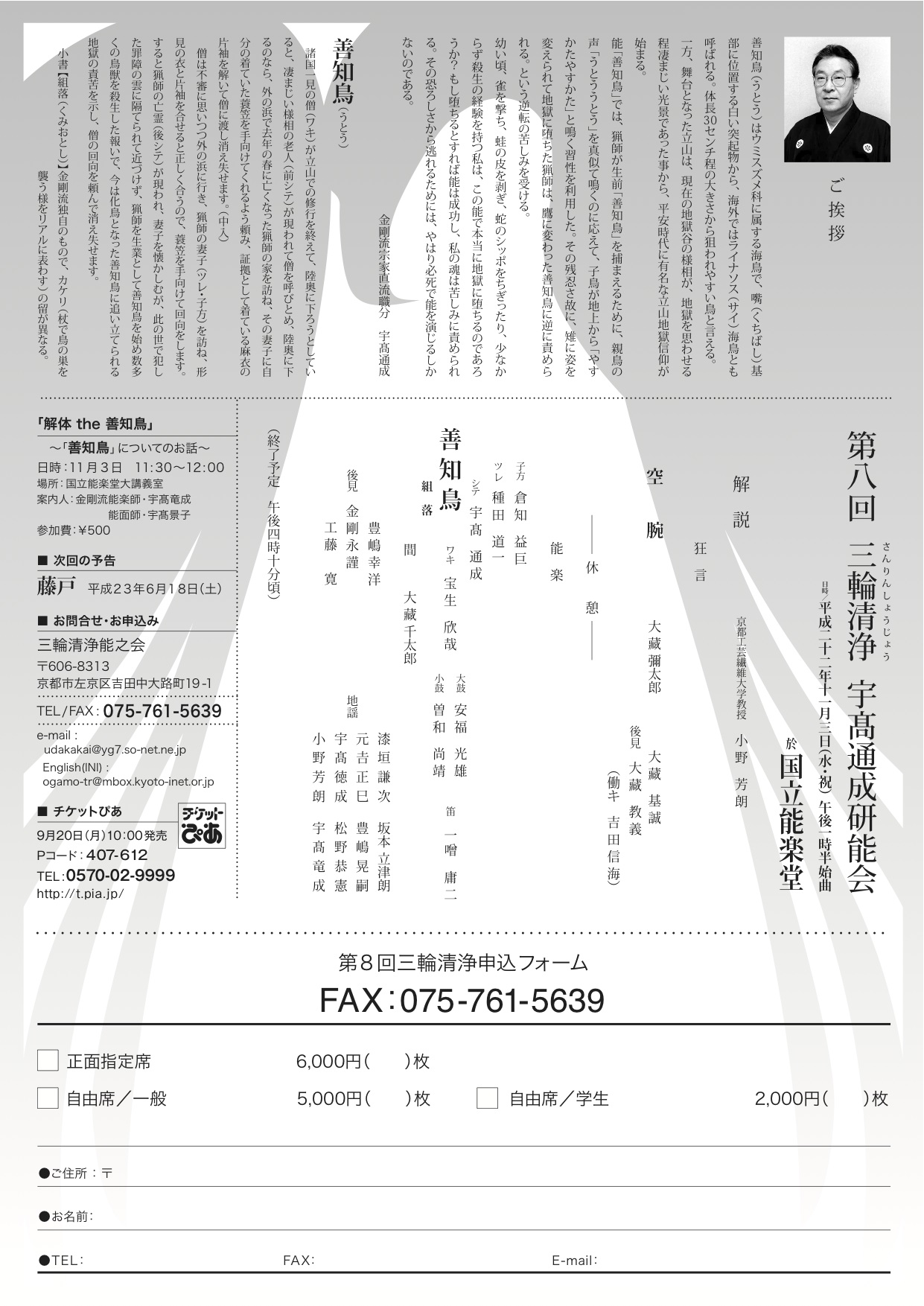
11/3 The 8th Annual Sanrinshojo Noh Performance

The National Noh Theatre, Tokyo 1:30~4:10 p.m. (doors open at 12:30)
Kyogen: SORA UDE – OKURA Yataro, OKURA Motonari
Noh: UTOH (Kumiotoshi) – UDAKA Michishige

Tickets: Reserved (stage front): 6,000 yen General admission: 5,000 yen, Student: 2,000 yen

For tickets or further information contact: ogamo-tr@mbox.kyoto-inet.or.jp

Information about the plays will be available in English, French, German, and Italian

Exercises of Memory – Makura-Jido at Hourinji

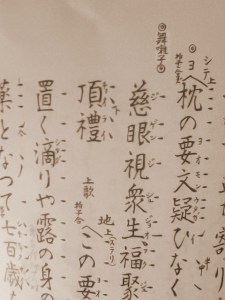
On Friday, 10th September I joined Udaka Michishige’s performance of the Noh Makura-jido (枕慈童) at Hourinji temple (法輪寺) in the Arashiyama area. Another student of Sensei, Hanna McGaughey, has posted on this performance a couple of years ago. I served as a member of the ji-utai chorus, reason why I have been spending the week before the performance trying to learn the text: this exercise of memory has led to some reflections I would like to share. Memorising a Noh text is not an easy task first of all because of the 6-century old language used, rich in rare alternate readings and special pronunciations. Secondly, the lyrics do not always follow a narrative progression, but consist of more or less abstract associations of images and overlapping of textual layers. It is very hard to ‘make logical sense’ out of the lyrics in order to remember them as one remembers a dialogue with its causes and consequences. This does not mean a Noh text is completely deprived of logical sense, but that if one plans to rely only on ‘meaning’ in order to remember, he or she will face a very hard time.

The other night, at okeiko, while talking about this with Ogamo Rebecca Teele, international coordinator of the Udaka-kai and International Noh Institute, and first foreigner to become Noh professional in the history of Noh, I realised my difficulties are shared by many practitioners. We found out that one common way to approach the memorisation is to re-write the utai on separate sheets. This is not a mere ‘verbal’ exercise: as Japanese is an ideographic language, one does not write the ‘sounds’ of the lyrics, rather he paints the text, that slowly takes the form of a matrix of sounds and images. While singing, one visualises the ideograms that have a strong pictorial, hence evocative, component. Of course, the most common and effective way of memorising is listening to the lesson recording and repeating, repeating, repeating … ad libitum.

枕慈童 謡本 金剛流

However, even in the repetition one might distinguish between learning by heart or learning by understanding. There is no time here but to make some superficial comments on this distinction. Where the first is a rather mechanical activity, in which one mostly focuses on the sounds, the second focuses on the meaning of the verses and relies on the logical or grammatical flow of the text in order to recall the words. As one might imagine, both methods are necessary combinable. What I found interesting is that the more my language proficiency grows, the more I naturally tend to rely on the memory of the meaning of the lyrics, immediately understandable, rather than on the sounds, which require time and repetition. However, relying on the meaning means that my brain needs to be in continuous conscious activity, focusing on what comes next in what I would describe as an ‘active’ recalling of the words. When I sing using this technique, I can hardly do anything else. If my minds get distracted by something else, the flow of meaning is interrupted, and I will skip some syllables trying to catch up with the delay. If, instead, I memorise by sound, which would at first appear as a rather ‘dull’ form of learning, I can easily multitask, as my brain is not ‘actively’ involved in thinking about the story, what came before and what comes next. Words come out automatically or instinctively.

I am not sure what sort of conclusion I want to draw after this but I would just want to encourage those who cannot understand Japanese. Memorising the sounds without the meaning is an excellent (the best) start in the training of utai. Focus on the breathing, on the emission, on the rhythm instead – those are the qualities that the audience will appreciate, rather than your understanding. First come the image, then the meaning – this is very close to another famous say by Zeami.

I feel thankful toward Udaka-sensei who allowed me to take part in the performance (I wonder how many foreigners had the privilege to be singing for a Noh professional actor of his caliber in a public performance) and I hope this chances will become more and more frequent as I refine my singing skills.

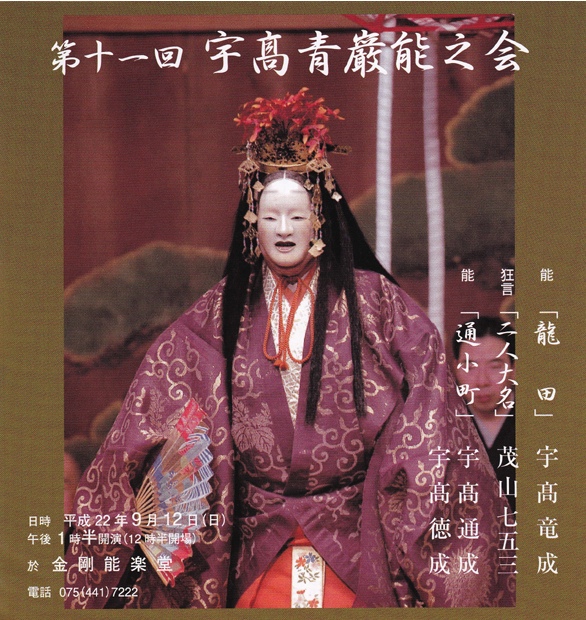
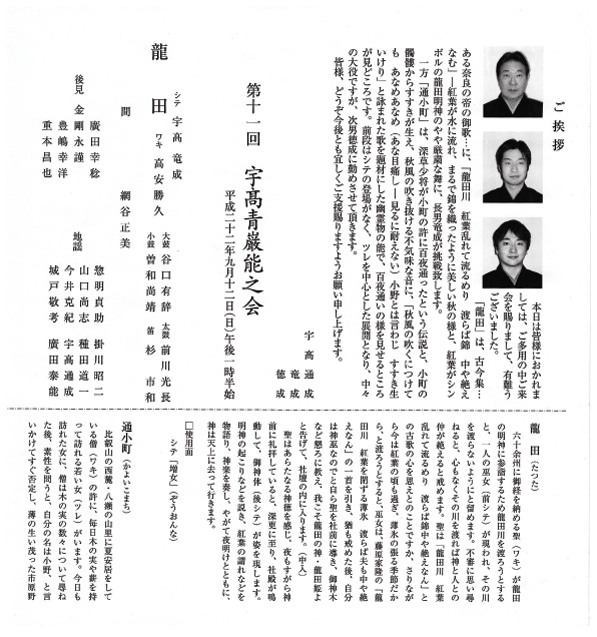
9/12 The 11the Annual Udaka Seigan Noh Performance


Kongo Noh Theatre, Kyoto 1:30~5:00 p.m. (doors open at 12:30)
Noh: TATSUTA Shite: UDAKA Tatsushige

Kyogen: FUTARI DAIMYO Shite: SHIGEYAMA Shime
Ado: SHIGEYAMA Doji
Koado: SHIGEYAMA Akira

Noh: “KAYOI KOMACHI The Nightly Courting of Komachi ” Shite: UDAKA Michishige
Tsure: UDAKA Norishige


Tickets: General admission advance ¥5,000
(At the door ¥6,000) all non-reserved seating
Student ¥2,500

Information about the plays will be available in English, French,
German, and Italian.

The Udaka Michishige-no-kai Office
(For questions or reservations.)

TEL: +81 (075) 701-1055

FAX :+81 (075) 701-1058

Email: ogamo-tr@mbox.kyoto-inet.or.jp