Memory loss

20120702-194628.jpgRecently I have attended a number of Noh performances where actors or chorus members would forget their lines. I am not talking about amateurs but professional actors on important stages. Some might find this surprising: forgetting lines would be inadmissible in other kinds of theatre. Imagine a super-famous tenor, or a Shakespearean actor forgetting what they had to sing or say during a performance at La Scala or at The Globe. Unthinkable as it might be in other contexts, this kind of mistake is fairly common, and to a certain extent accepted, in Noh.

How so? There are various reasons I can think of:

  1. Actors cannot concentrate on studying only one single play intensively for an extended period of time. Noh shite actors are involved in many other performances as ji-utai chorus while studying for their own part as shite main actor. This means studying a great number of libretti at the same time.
  2. A good Noh actor is like Ray Bradbury’s ‘living books’ in Farenheit 451: they should be able to recall the lines of dozens of plays at any time without the need to look at the utaibon. Maybe a ‘living juke-box’ would be a better metaphor.
  3. Since, to put it simply, Noh chants are basically variations around a very limited set of melodies, one can easily get confused, and take one line for the other. Oftentimes some verses are also the same or very similar, adding to the risk of confusion.
  4. Unlike other forms of theatre (not opera or anything that follows the libretto literally) it is impossible for a Noh actor to improvise. If the line does not come to mind, one can only wait for the koken stage assistant to prompt him, or else jump to the next line.
  5. Finally, one of the reasons why this kind of mistake is more accepted than in other contexts is that in Noh there is no intention to ‘hide’. There is no ‘trick’ or pretence of ‘fourth wall removal’ everything is on stage, including the fact that actors are humans.

Concluding, I hope this won’t happen to me during the forthcoming Kiyotsune! It is accepted, but better not to have the audience accept it!

Don’t use your face

Noh actors never should use their face. This also applies to those singing in the chorus. Arching your eyebrows during a lyrical passage, opening your eyes wide during a fierce passage, all this might be ‘natural’ (actually I don’t think it is) but it lets your emotions appear on your face. This is all too normal, too ‘everyday life’. It shows that you are not in control/aware of your face. It also distracts the audience. What is the reason why a Noh actor or chorus member should show their emotion to the audience? In Noh, there is no such reason. Keep your face still. Let the audience feel what they want to feel.

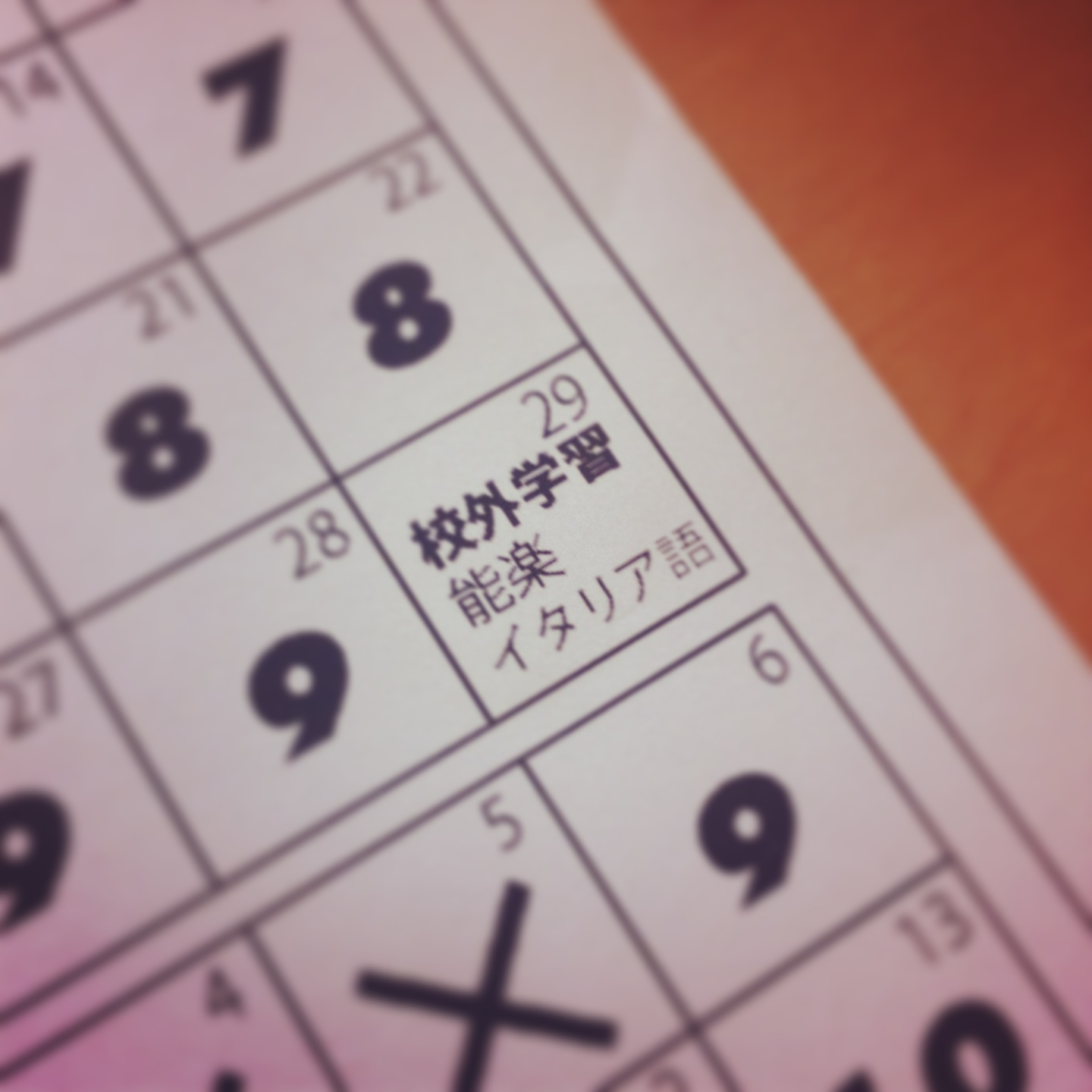
Kiyotsune 29 June 2013

I am pleased to announce that on 29 June 2013 I will take shite lead role in the Noh Kiyotsune「清経」on the Kongo Noh Theatre stage, in Kyoto, Japan. This will be my first performance as shite in a full Noh production. The event is part of the INI International Noh Institute 2013 Gala Recital, featuring other performances by Japanese and international students of Udaka Michishige, and is co-hosted by the Asahi Shibun Foundation, the Istituto Italiano di Cultura, and Gochang Conservation Institute of Cultural Properties, in collaboration with ISEAS Italian School of East Asian Studies. I will post more on Kiyotsune during the following weeks, so watch this space for updates on rehearsals, thoughts, and pictures!

I look forward to meeting you all on 29 June 2013 in Kyoto!

KiyotsuneA4

Kiyotsune_ura210*297

Udaka Michishige no Kai 宇髙通成の会                                                                                                                         INI – International Noh Institute 国際能楽研究会

The International Noh Institute Taikai Gala Recital 2013

Kiyotsune

29 June 2013 12:00-14:00

Kongo Noh Theatre, Kyoto

Shite: Diego PELLECCHIA, Tsure: Monique ARNAUD

FREE ADMISSION Explanatory materials available in English, Italian, French and German. Kongo Noh Theatre  Subway Karasuma-Imadegawa (K06), South Exit 6,  walk South 300m.

Kongo map english

The event is co-hosted by:

The Asahi Shinbun Foundation

公益財団法人 朝日新聞文化財団

IIC-logo-1

Gochang logo2

in collaboration with

iseas logo

Emotional recorder: on photographing Noh performance

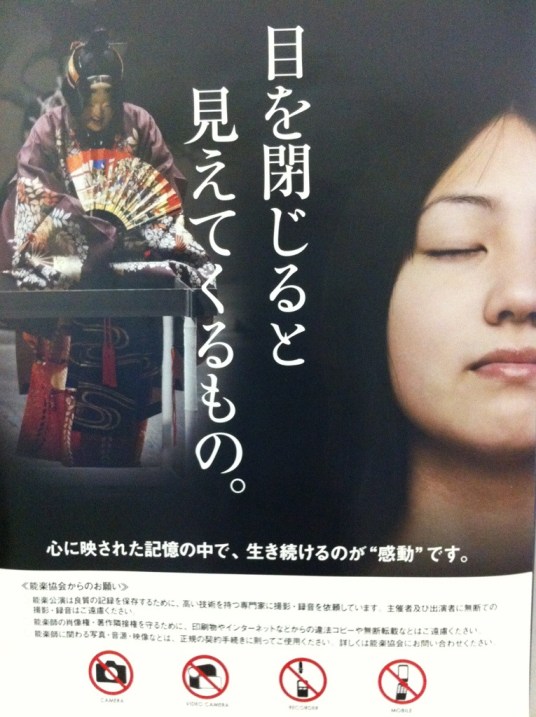
[This is] what you see when you close your eyes

… says this poster I noticed in the lobby of the Dentogeino Kaikan in Otsu (Shiga pref.) next to Miidera. A woman closes her eyes and remembers an instant from the Noh Izutsu (The Stone-Well). The poster very delicately warns the audience that it is prohibited to take pictures or film in the Noh theatre. I think this this a very well thought campaign, not only because of its gentleness but also because of the depth of its message.

20130319-223733.jpg

“Emotion” lives on in the memories written on your heart

Leaving aside those who might have an economic or other interest in recording a performance (be it Noh or something else) I am always impressed by the number of people who feel the urge of taking out a camera and filming or taking pictures of whatever work of art they are watching. I was at the British Museum last year and I remember a group of Italian tourists who took pictures of every single piece in the Japanese section – I can assure you, they were not art researchers. Here in Japan, where taking pictures is a stereotypical feature of the Japanese prototype, photographing anything at hand is the norm. And now we have smartphones. Going to an open air-performance is difficult even for me (I’m 180cm tall) because you have to watch the stage through a thick forest of raised arms holding coloured mobiles with Kitty straps and such. The habit of taking pictures of the stage does not only apply to open-air performances, where it is often allowed, but also to indoor performances, where it is clearly prohibited. You hear digital shutters shut, see flashes flash. It is terribly disturbing for the audience, let alone for the performers on stage.

But there’s more beyond the merely physical nuisance. Whenever I see some ojisan (old geezer) with a checkered shirt, a fishing vest and a baseball hat taking a picture of the Noh stage I wonder what they will do with it. Will they watch it before sleeping? Will they print it out at the convenience store? Will they send it to their pals? I don’t know. Or maybe I know: they won’t do anything with it. They just take the picture for the sake of taking it. They satisfy an idiotic compulsiveness. Because no one can convince me that after watching a Noh, and filming it, you go home and watch it again.

There is simply no point in filming what you are actually experiencing live and I won’t spend words explaining the obvious (that performance is an act perceived through a number of senses, and that retains a quality of ‘liveness’ that cannot be reproduced). I think it is enough to think of what you actually do with what you have recorded. Think about it.

Japanese, Korean faces and masks

The 2013 Word Figure Ice Skating Championship is now over – Kim Yuna (KOR) Carolina Kostner (ITA!) Asada Mao (JPN) on the podium. Watching the competition on TV reminded me of an interesting post I saw years ago on this blog. It is an interesting comparison, probably produced by some ice skating idol fan, between the faces of Kim Yuna and Asada Mao, and those of Noh masks and Buddha statues. Have a look.

女の子 女面

Kim Yuna is compared to the Noh mask Zo-onna, used for roles of goddesses or celestial beings, such as the Tennyo in Hagoromo. Though I think Zo-onna is a more mature face than Kim Yuna at the time of this shot (probably some 5-6 years ago) there are some interesting similarities between the two. This can only prove one thing: Kim Yuna is gorgeous.

女の子 菩薩

Asada Mao, instead, is compared to two sculptures of Bodhisattva, supernatural beings that decide to renounce to becoming ‘full Buddha’ and stay in ‘this world’ in order to help mankind reach enlightenment. I am not sure about the first picture, but I like the comparison with one of my favourite representations of Miroku Bosatsu (the Bodhisattva of the Future), sitting with a foot resting on the knee, the hand close to his face, with the index delicately touching the cheek. The childish face of young Asada Mao, with a high eyebrow arc resembles to that of this meditating Miroku Bosatsu, though I think it is too childish to be compared to the otherworldly face of a Bodhisattva.

I tried but failed to find the source of the pictures (they seem to have spread over so many websites that I can’t find the original).

“Gio” Kanze Kaikan, March 31st 2013

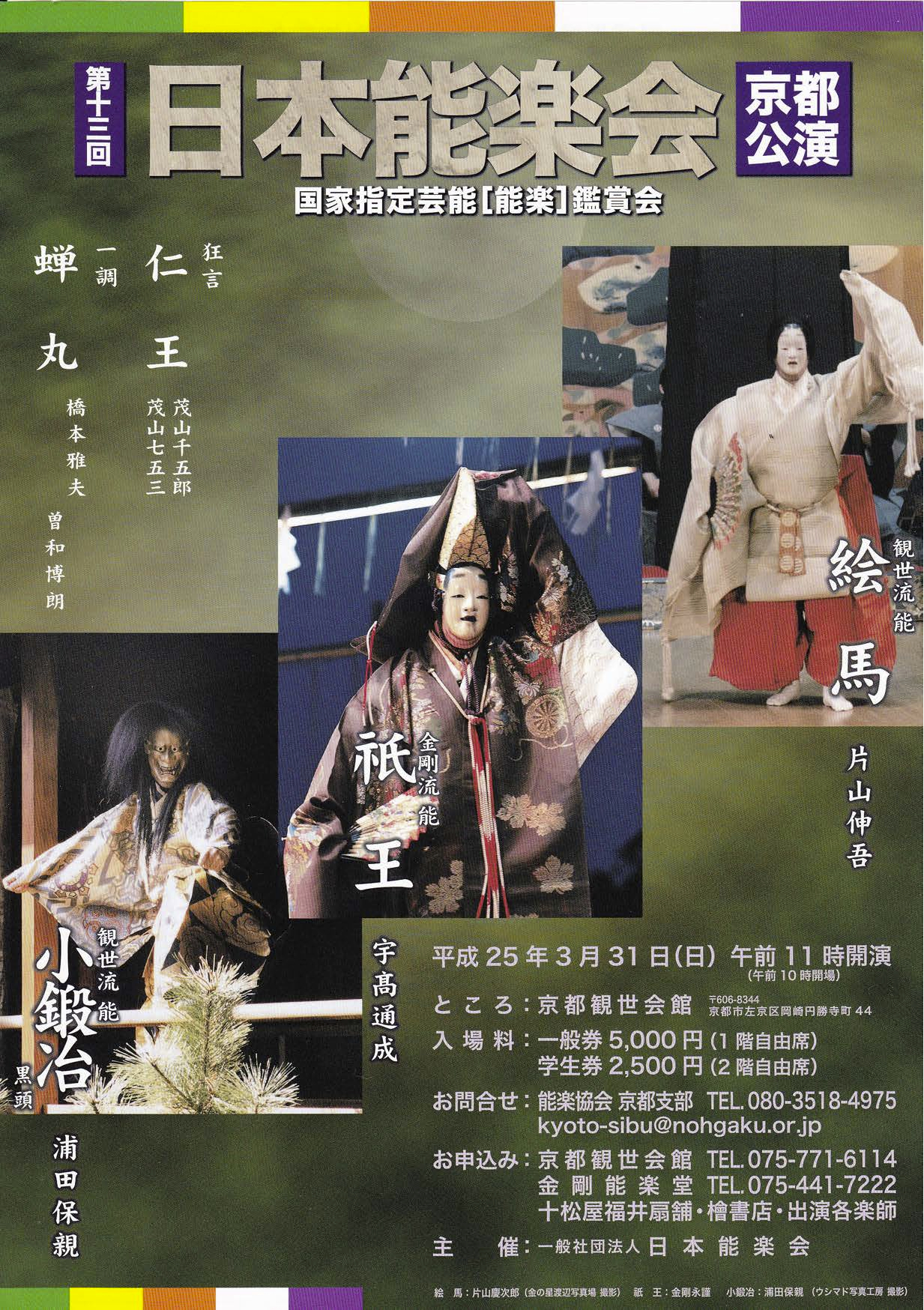
My teacher, Udaka Michishige was chosen by the Nihon Nōgakukai to perform the Noh Giō (祇王)at their annual “Noh appreciation event” on March 31st 2013. This year 3 performances will be held at the Kanzekaikan theatre in Kyoto: EmaGiō, and Kokaji.

Giō is a play by Zeami, currently in the repertoire of the Hōshō, Kongō, and Kita (under the title Futari Giō) schools, though it is not often performed. Giō Gozen, one of the favourite dancers at the service of Taira no Kiyomori has helped dancer Hotoke Gozen to gain the lord’s favour. After having seen Hotoke’s dance, Kiyomori likes her more, but she promises Giō not to take her place. Similarly to the play Futari ShizukaGiō has shite and tsure dancing in synchronous on stage.

See details below

3_31_GIO_o3_31GIO

Date and Time:   March 31, 2013 (Sunday)   11:00 a.m. ~16:30 p.m. (doors open at 10:30 a.m.)
Venue:   Kanze Kaikan
Tickets:  general admission 5,000 Yen (first floor)  student 2,500 Yen (balcony)

A  Program of Noh, Shimai dance excerpts, Kyogen, and Itcho, drum and chant duet

11:00 a.m. NOH featuring the  Kanze School: EMA

13:30 p.m.  NOH featuring the Kongo School: GIO   Shite: UDAKA Michishige 

Kyogen featuring the Okura School:  NIO

15:20 p.m. NOH Featuring the Kanze School: KOKAJI Kurogashira

 The Udaka Michishige-no-kai Office
(For questions or reservations.)
TEL: +81 (075) 701-1055
FAX :+81 (075) 701-1058
Email: ogamo-tr@mbox.kyoto-inet.or.jp

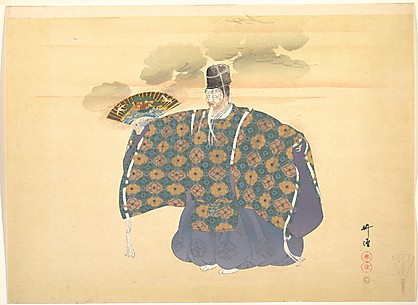
Tsukioka Kogyo’s Noh prints on Exhibit

From the Ohio State University website:

The Japanese Noh Theatre in Woodblock: The Smethurst Collection of Prints by Tsukioka Kōgyo (1869-1927)

The Lawrence and Lee Theatre Research Institute, Japanese Studies, and the Department of East Asian Languages and Literatures collaborated to host an exhibition in the Special Collections Gallery of Japanese Noh theatre woodblock prints on loan from collectors Richard and Mae Smethurst.  Richard Smethurst gave an accompanying lectured on the artist Tsukioka Kōgyo (1869-1927) in Thompson 165.

DP143333

Watching Ebizo on TV

20130303-222709.jpg

I’m watching Ichikawa Ebizo on a TV talk show, just one month after his father, Danjuro XII, passed away. The atmosphere is light, as is the general tone of talk shows in Japan. My first reaction was: “what?! Is he already there on TV??” This makes me think on how death and mourning are treated differently in Japan as opposed to Italy, where appearing on such talk show shortly after the death of the father would be inappropriate for a celebrity. Catholicism vs Buddhism, I suppose…

[21/08/13] Following up on this – this morning an interview of his late father Danjuro XII was on TV. After the airing the commentator said with a smile ‘… and these were the late Ichikawa Danjuro XII’s thoughts on his art. We are looking forward to seeing his son Ebizo continuing the Danjuro tradition – it is wonderful to see this tradition continuously evolving’. I almost cried.


Hatsubutai 2013

I am happy to announce that on June 29th 2013 I will take the role of shite (main actor) in the full production of a play from the traditional repertoire. The performance will take place at the Kongo Noh Theatre in Kyoto, on the occasion of the Udaka-kai Taikai, and will be my hatsubutai (初舞台, first appearance on stage) as main actor in a full production – with mask, costume and professional musicians. That’s all for now. I will be posting more about this event in the following weeks, so watch this space.

For now make sure you clear your schedule on June 29th (Sat). I am looking forward to meeting you in Kyoto and to celebrate after the performance!

Diego Pellecchia

20130225-132634.jpg