The 14th UDAKA Michishige Men-no-Kai Mask Exhibition

‘Warriors and Women of the Heike Clan’

is the theme of this year’s UDAKA Michishige Men-no-Kai Noh mask exhibition. The 14th edition of the exhibition will feature works of Master-Actor UDAKA Michishige, possibly the only Noh actor who is also a professional mask carver, as well as several masks carved by his students. the exhibition will open tomorrow Tuesday 27th November and close on Thursday 28th November. Wednesday at 13:30 it will be possible to attend a talk by UDAKA Michishige and a Noh costuming demonstration. See below for more details and access information.

UDAKA Michishige’s work as Noh mask carver has been collected in various picture books, among which The Secrets of Noh Masks published by Kodansha International.
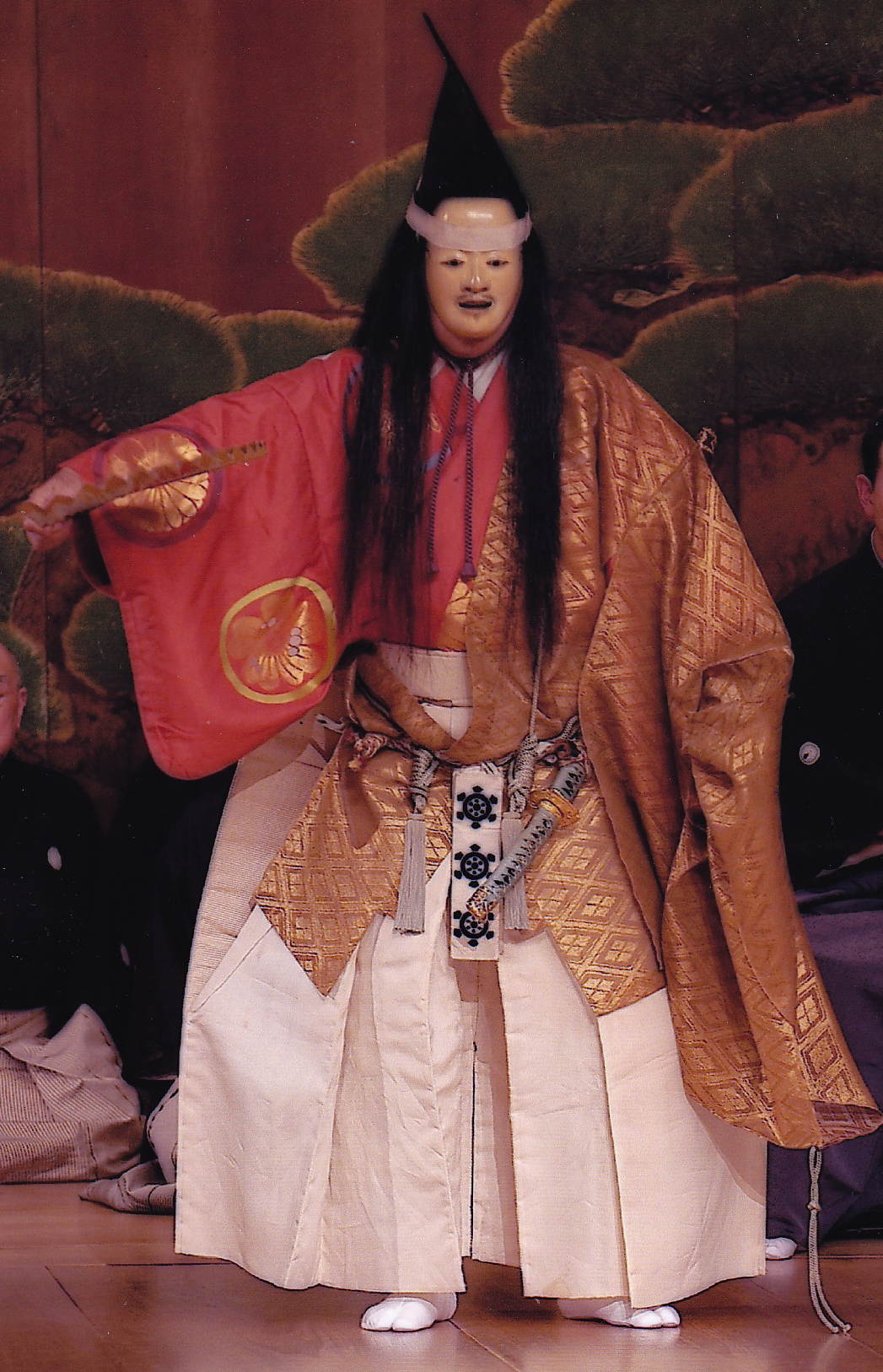
Noh: Michimori. Mask: Chujo, by UDAKA Michishige. Photograph by HARADA Shichikan

The 14th UDAKA Michishige Men-no-Kai Mask Exhibition

At the Kyoto Prefectural Center for Arts and Culture 2nd Floor
Kawaramachi Hironokoji-sagaru, Kamigyo-ku (across from the Prefectural Hospital)
10:00 a.m.~6:00 p.m. (5:30 p.m. on the 28th)
28th (Wednesday)1:30 p.m. Talk and Costuming Demonstration by UDAKA Michishige

Access information (in Japanese) http://www.bungei.jp/map/access.html


Yashima shimai in Matsuyama

I am going to perform the shimai (short dance excerpt of a longer play) of the Noh Yashima on Friday 23rd November, on the occasion of Udaka Michishige’s performance at the Matsuyama Shimin Noh at the Dogo Yamatoya Nogakudo in Matsuyama.

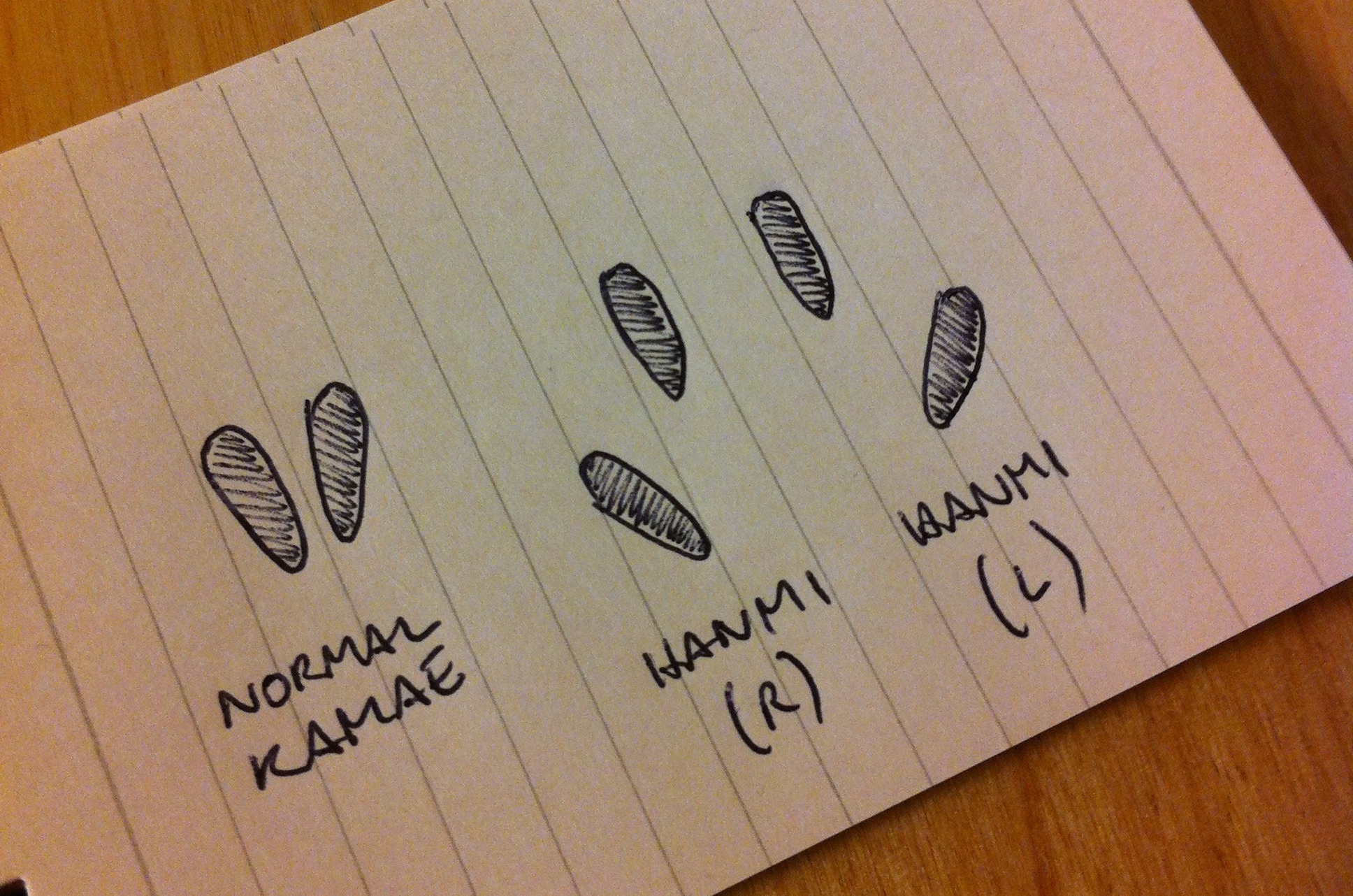
This is my third shura-mono (warrior play) shimai after I danced the kiri section of Tamura, and the maibayashi of Kiyotsune. As I have pointed out in a previous post, dancing shura-mono (second category plays) is rather challenging because of the kamae posture which in the case of warriors often switches to the hanmi (lit. ‘half-body) martial mode. This posture, thrusting half of the body forward, and keeping the other half covered, is probably familiar to those who practice any kind of martial art. The idea is offering the least possible amount of body to the opponent, while being ready to attack.

Hanmi feet (the way I see them)

Unlike the basic kamae, this position is fairly asymmetrical and requires advanced knowledge of weight distribution to master. One of the tricky bits of hanmi is walking: while basic kamae does not change while walking – one does not change much of the posture when either walking or simply standing – it is not possible to keep hanmi while taking more than a just a few steps. This means that the actor starts a movement in hanmi, then changes into a more symmetrical feet posture, and then ends the movement again in hanmi. Therefore, the last step of a walking sequence should be performed so that the body ends being in hanmi. Normally this produces a rather dramatic effect of enlargement of the figure of the shite as he comes to a halt, especially when approaching sumi, the corner of the Noh stage that is thrusted into the auditorium. Hanmi also influences all the other kata, for example shikake-hiraki (pointing and opening) might be performed in a right hanmi when pointing, switching to left hanmi when opening, and then back to normal.

My teacher seems to be keen on teaching me warrior dances lately: I don’t feel I am particularly prone to this kind of characters, but I trust my sensei’s experience of knowing when it is the right time to progress on this path.

Wish me good luck! (I might or might not have pictures of the performance to show in the future).

Matsuyama Shimin Noh 2012

11/23 – 28th Matsuyama Shimin Noh Performance

My teacher, Udaka Michishige is the descendant of the Udaka Clan, serving the Matsudaira lords in Matsuyama from 1712 until the beginning of the Meiji period, when the clan disbanded as a consequence of the upheavals of the Meiji restoration. Having the desire to restore the connection with his ancestors, Udaka-sensei has established a practice group in Matsuyama, where he eventually built a shiki-butai, a personal training space, in 1997. Udaka-sensei has been performing regularly in Matsuyama in various events, including the Shinonome Noh and the Matsuyama Shimin Noh. In addition, Udaka-sensei has been collaborating with the Matsuyama Shinonome shrine cataloguing and restoring the vast Noh masks and costumes collection.

This year’s performance for the Matsuyama Shimin Noh series will be Sesshōseki (‘The Death Rock’), centring on the figure of Tamamo-no-mae, the beautiful and lethal courtesan serving the Emperor Konoe (1139-1155), in reality an evil fox-spirit in disguise. In Sesshōseki a travelling monk meets the spirit of Tamamo-no-mae, now imprisoned in a rock that kills everything that touches it. Thanks to the mystic powers of the monk, Tamamo-no-mae is subdued. The ‘nyotai’ variation of Sesshōseki, which Udaka-sensei will perform on November 23rd in Matsuyama, features a different idetachi (costume, mask, wig set-up) for the shite, who appears as a more ‘feminine’ character  instead of the usual demonic or beastly shape. The performance will be preceded by a recital of su-utai and shimai by Udaka-sensei’s students – will write more about this soon.

Matsuyama Dogo  Yamatoya Nohgakudo 10:00 a.m.~5:00 p.m.

Part I    (10:00 a.m.~2:30 p.m.) :
Student recital of chant and dance~free of charge

Part II     (3:00 p.m.~5:00 p.m.) :
Maibayashi (excerpt with ensemble accompaniment):
JINEN KOJI  UDAKA Norishige
Noh:  SESSHOSEKI  Nyotai  Shite: UDAKA Michishige

General Admission ¥5,000   Advance Sale: ¥4,000
Student Admission ¥1,500

The Udaka Michishige-no-kai Office
(For questions or reservations.)
TEL: +81 (075) 701-1055
FAX :+81 (075) 701-1058
Email: ogamo-tr@mbox.kyoto-inet.or.jp

Notes on MANABU 2012

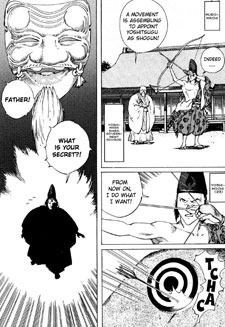
An image from ‘Ikkyū’, by Sakaguchi Hisashi (Kodansha)

On October 23 2012 the twelfth edition of MANABU, a seminar for Italian researchers hosted by the ISEAS (Italian School of East Asian Studies) took place. The event, which I had the pleasure to organise, was hold in Italian so here are some notes in English for those who could not attend. The meeting brought together scholars from various research fields: Matteo Casari (Bologna) is an anthropologist, Katja Centonze (Tokyo) specialises in contemporary dance/performance, Monique Arnaud (Venice) is a Noh instructor and theatre director, and myself. Silvio Vita, director of ISEAS, has been a wonderful host, facilitating the discussion and organising post-meeting events.

Matteo Casari (University of Bologna) introduced the topic of Noh and Manga, looking at Noh-inspired manga such as Hana yori mo hana no gotoku and Ikkyū (which, I learnt, is surprisingly translated in Italian) and to manga-inspired Noh, such as Umewaka Rokurō’s Kurenai Tennyo. Katja Centonze described the work of dancer/musician/choreographer Alessio Silvestrin and his collaboration with Noh practitioner Tsumura Reijirō, presenting clips of Kakekotoba, Monique Arnaud talked about her directing work in Venice, showing  clips of her most recent production Silent Moving, taking place in the interiors of the magnificent Palazzo Ducale, Venice, implementing techniques borrowed from Japanese traditions such as bunraku in a modern ‘Theatre du Complicite’ style. My presentation introduced the issue of limiting the study of Noh to Japanese literature departments. I suggested that, in order to prevent Noh to become a museum piece, it should be also studied as performance in theatre departments, just like Shakespeare or Aeschylus are.

After the conference we went to my teacher, Udaka Michishige’s okeikoba in order to observe the training session. Since Arnaud and I are both students of Udaka-sensei, we were called on stage for our okeiko. This was not my intention as I thought we would go with the purpose of introducing our guests, but it is difficult to say ‘no’ to your teacher…

We enjoyed the day, especially the rare chance to discuss with members from different backgrounds, and we concluded the day agreeing on the intention of creating another similar event (in English) in the not-so-far future.

Hojogawa

An image of the contemporary Hojo ritual (©Asahi Shinbun)

Last Sunday I attended the Noh Hōjōgawa, which my teacher, Udaka Michishige, performed as part of the Teiki Noh (regular subscription series) at the Kongō theatre in Kyoto. Hōjōgawa is a rather unusal play – I learnt from Ogamo Rebecca Teele that it was the first time to be performed in sixty years, which probably means that the last person to perform it in our school was the late iemoto Kongō Iwao II. Hōjōgawa is a first category Noh (Kami-nō), and is attributed to Zeami. To my knowledge no full translation of he play has been published to date – the only available translation is by Ross Bender, who translated the first half, and has also written on the origin of the Hōjō ritual and its relation with the cult of the god Hachiman in places like Usa and Iwashimizu. In the play a shinto priest visits the Iwashimizu Hachiman shrine in Autumn, during the Hōjō-e ritual, when fish are returned to the river symbolising repentance for the killing of animals, prohibited by the Buddhist law. There he meets an old man carrying a pail with fish in it, who explains to the priest about the ritual. In the second half the god Takeuji appears and dances in celebration of the wealth of the country and of its emperor.

I thoroughly enjoyed the play which features the typical Kami-nō powerful entrance for the waki, and a stately Shin-no-jo-no-mai slow tempo dance. First category plays are not particularly interesting because of their dramaturgy – the real midokoro are the atmosphere of solemnity and sacredness brought by the presence of a god, and emphasised by special music, such as the long shin-no-issei for the entrance of Shite and Tsure in the first half, or the Raijo exit music, where Shite and Tsure, still in the form of commoners, exit the stage at the accompainment of the taiko stick drum, usually associated with supernatural beings, thus revealing their true identity.

A Tale of a City and its Four Guardian Gods

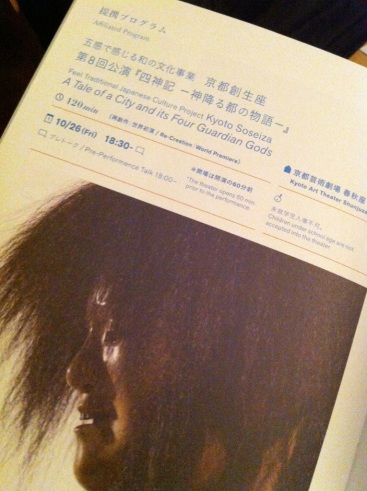
20121028-233815.jpgLast Friday I went to see A Tale of a City and its Four Guardian Gods, a Soseiza production that closed the Kyoto Experiment, performing arts festival 2012. The performance featured Kabuki and Noh actors interacting on stage. The venue was the Shunju-za, a full-fledged Kabuki theatre built within Kyoto Zōkei University. Before the staging of the play some of us who applied were taken to a backstage tour of the theatre. All I can say is: ‘holy cow!’ The theatre is unbelievable, and features a mawari butai rotating stage with two rectangular modules that can be lowered and raised independently, wiring for fly-over action, and of course a hanamichi. Japanese universities certainly do not lack funding for this kind of enterprise.
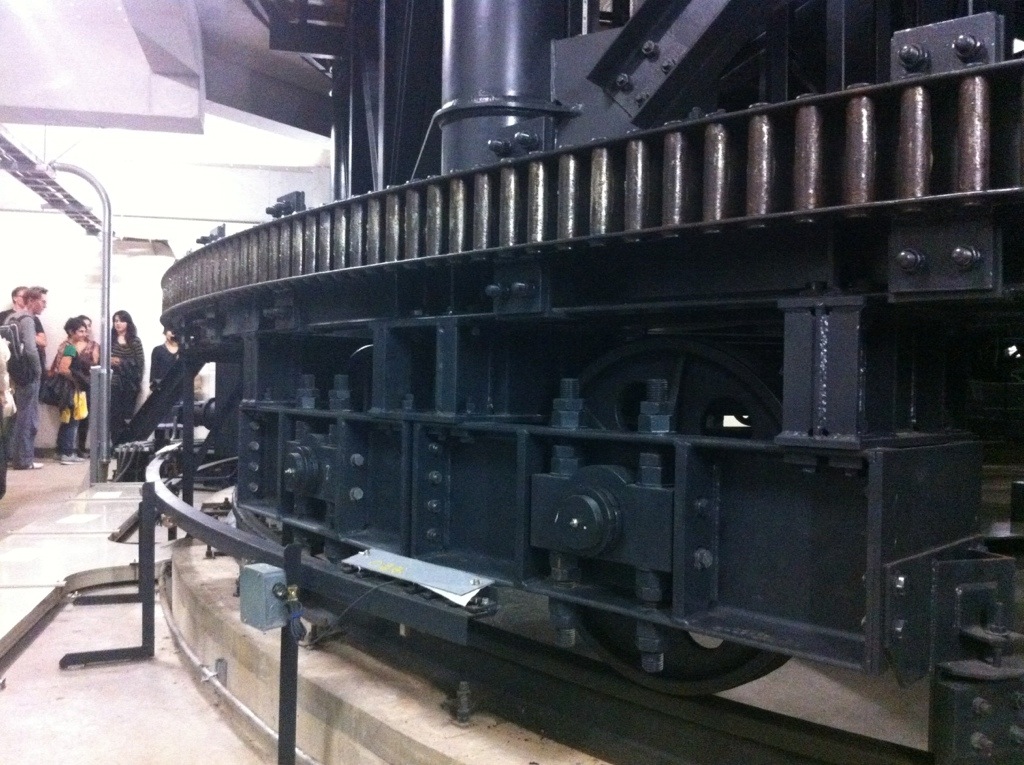
The massive cog that moves the rotating stage

All this beauty is used for all sorts of performances, from classical plays to more experimental stuff such as what I saw on Friday. I must say I was not impressed by the play. To put it bluntly, having Noh and Kabuki sharing the same space seems to be detrimental to both. Kabuki ends up looking like a children panto, while the Noh bits are deadly boring. One of the issues with the Noh actors, who interpreted rather dynamic characters (a warrior and a tiger) was that on such a large space Noh movements lose all intensity. I have seen Noh performed in wide spaces and I keep on feeling that Noh needs the cubical space produced by the ‘orthodox’ Noh stage. Wide spaces flatten the movements, and do not offer a sufficiently tight framing for the intense but minimal Noh gestures.

One thing that bugged my about the performance was the paradox of having different styles on stage without a real attempt at dialogue, except for the fact that… they were both on the same stage, and maybe for a couple of musical moments where the Noh orchestra (sitting on the left) ‘dialogued’ with the Kabuki orchestra (sitting on the right) – they actually played the same tune. This is so typical of the Japanese traditional arts. Fragmentation. Together, but apart. The result was actors who want to talk to each other, but can speak (or want to speak) only their native language, and in the end do not seem to really understand each other.

Those nerds who know videogames might get this: the performance looked like one of those beat’em’up video games, in which a sumo wrestler fights with a muay-thai boxer – it just looks unnatural.

Anyway, it was worth going and I hope I look forward to future Soseiza works that would more baldly experiment with a deeper interaction of their arts.

An invitation to tea

Today I went to the Urasenke kaikan in Kyoto where students of the Midori Kai (a training programme for foreigners who want to train in tea ceremony) hold their periodical ‘an invitation to tea’ gatherings. This is a very good occasion to experience tea with explanations in the English language. The host was a very charming Chinese lady (I believe her name was Lien) while explanations were provided by an American woman who admittedly spoke very little Japanese. I think this was an excellent choice as it showed how it is not necessary to be fluent in Japanese in order to do tea.

The most interesting part of the meeting was of course observing the other guests. I was sitting next to an young American man who must have planned his visit carefully as he came with a furoshiki out of which he pulled a heavy montsuki (notice we still have 24 degrees over here), which he wore on top of his regular clothes. I don’t know what he used to tie it, but I saw no obi. The guy was dying to show off how good he can sit in seiza, so he immediately took a martial kind of seiza with knees wide open, and hands on his upper thighs – I am no expert in tea, but this posture seemed to be far from the relaxed and aware environment of tea. Obviously he left his bags scattered behind him, so when I entered the room (I was destined to be sitting next to him) I had no place to sit.

Observing foreigners in Japan is a continuous source of amazement/hilarity/reflection/disgust and I hope one day to have time to write about it, maybe in a casual/ironic and non academic way. I myself am one of them. But seriously, this dude was quite something. His way of wearing the second-hand shop montsuki as if it were a bathrobe reminded me of some late XIXth century pictures of japoniste collectors like Louis Gonse, or like the French fashion designer at Villa Kujoyama a few years ago, who added the final touch with chopsticks in her chignon. Japonisme never dies.

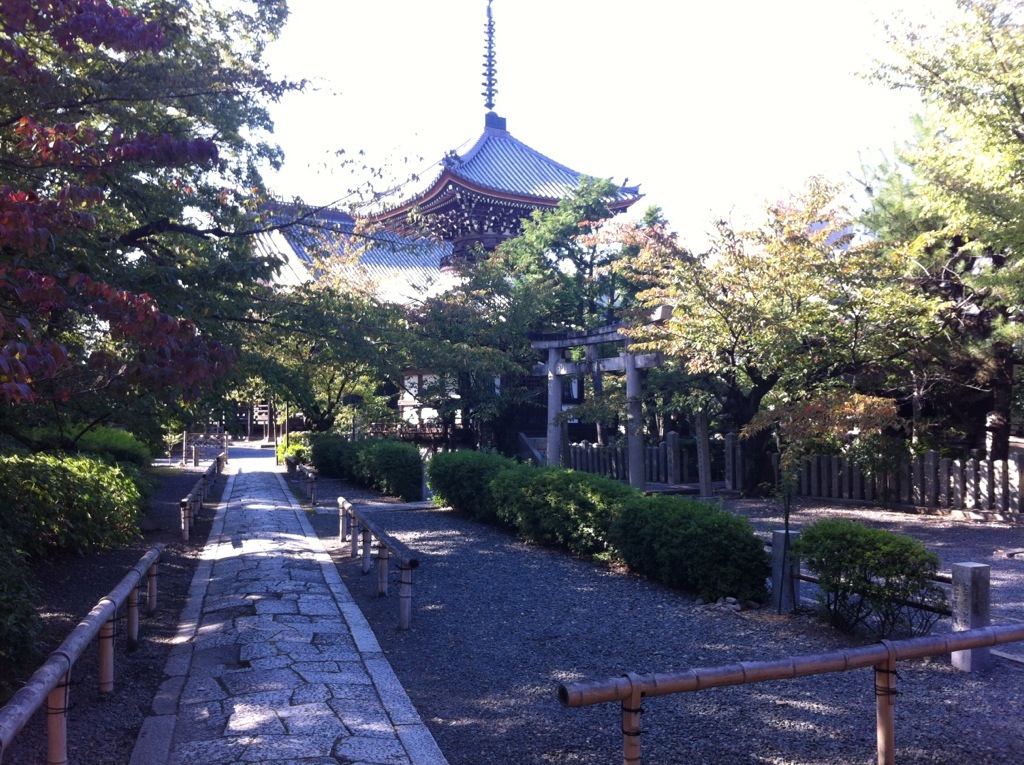
In the picture: the beautiful Honpo-ji, the Nichiren-sect temple adjacent to the Urasenke-kaikan


24/10 ‘MANABU’: giornata di studio per ricercatori italiani in Giappone

This post is about a research seminar that I have organised in Kyoto, coming up in a few days. This is probably my first post in Italian, so I just wanted to warn my readers. I will report about the event (in English) towards the end of the month so stay tuned ^^

La tradizione oggi: uno sguardo interdisciplinare sul teatro giapponese

Seminario della serie ‘MANABU’, Giornate di studio dei dottorandi, borsisti e ricercatori italiani in Giappone

La giornata riunisce quattro ricercatori con formazione e interessi diversi (antropologia, studi giapponesi, studi teatrali, regia), e si propone di investigare la relazione fra tradizione e modernità nel teatro giapponese da un ampio spettro di prospettive (letterarie, critiche e pratiche). Gli interventi spazieranno dall’adattamento Nō dei manga al rapporto fra corpo e tecnologia, dall’insegnamento in ambito interculturale alla storiografia del teatro. A una presentazione del ricco panorama della ricerca sul teatro giapponese oggi, seguirà una discussione nella quale i partecipanti confronteranno teorie ed esperienze, incoraggiando un produttivo scambio di approcci che possa gettare le basi per ulteriori iniziative in futuro.

Il seminario si terrà il giorno 24 Ottobre 2012 presso la sede della Scuola Italiana di Studi sull’Asia Orientale (ISEAS) a Kyoto 4, Yoshida Ushinomiya-chō, Sakyō-ku

PROGRAMMA:

11:00-11:10 Introduzione
11:10-11:30 Matteo Casari (Università di Bologna) Il Nō e il Manga, un primo sguardo
11:30-11:50 Katja Centonze (Universität Trier) L’Erma Bifronte: Eclettismo nelle arti performative del Giappone che guarda alla tradizione e alla contemporaneità
11:50-12:10 Monique Arnaud (Università IUAV di Venezia) La regia come dimensione nascosta
12:10-12:30 Diego Pellecchia (Scuola Italiana di Studi sull’Asia Orientale) I confini della tradizione: Educazione al teatro giapponese oggi

Per informazioni:
ISEAS Scuola Italiana di Studi sull’Asia Orientale (ISEAS)
Tel 075-751-8132
Fax 075-751-8221
E-mail iseas@iseas-kyoto.org