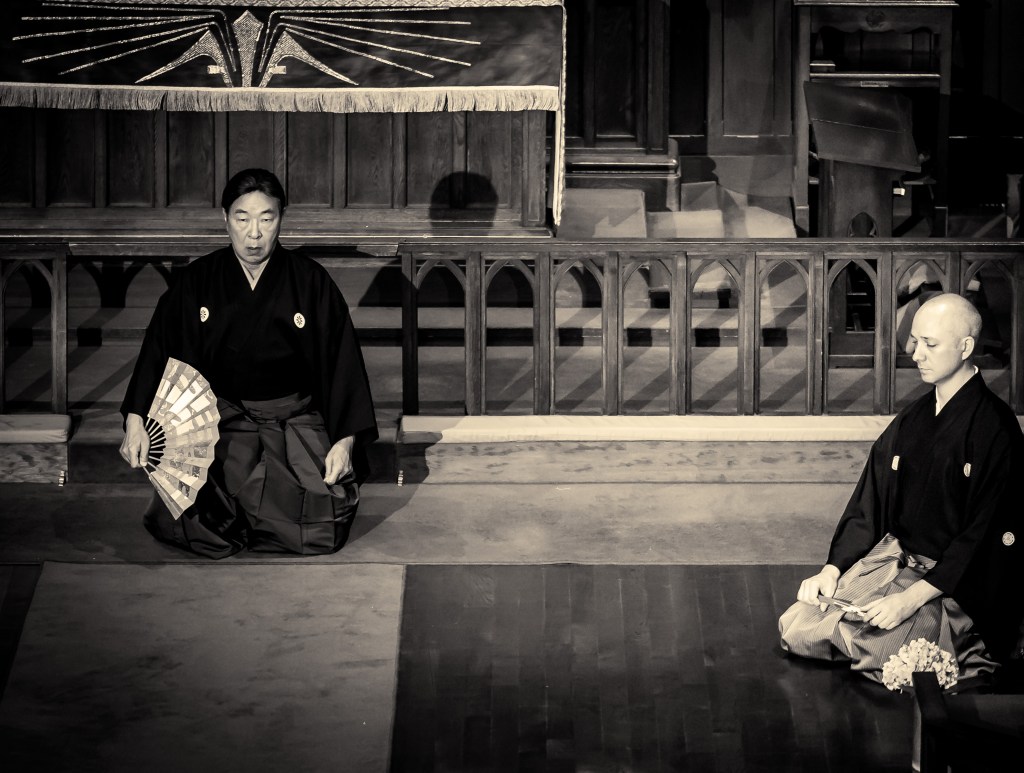
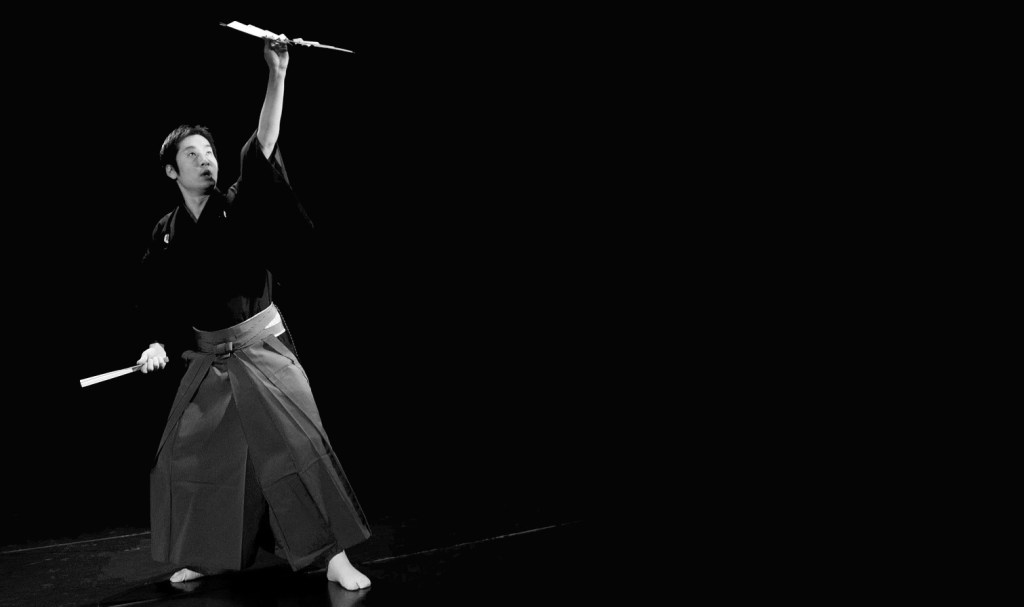
On August 17th 2014 The Kei’un-kai Memorial Performance, including INI members, took place at the Kongo Noh Theatre in Kyoto. It was a long day, with shimai, rengin, maibayashi and full Noh plays performed from dawn to dusk. This year’s performance took place at the end of the o-bon period in Japan, during which people remember and honour the dead. It was an occasion for us performers and for the audience to express their gratitude to those who are not with us anymore.
For this purpose, Udaka Michishige has chosen a poem by Henjo (816-890), quoted in the Noh Sumizome-zakura, ‘The Ink-dyed Cherry Tree’. “Everyone is wearing colourful robes, while my mossy sleeves (a monk’s robes) are yet to dry.” Henjo became a priest after the death of Emperor Nimmyo, and the poem expresses the poet’s grief and his reluctance to return to colourful robes…
On 17 August 2014 from 9:30am the Kei’un-kai (the group Udaka Michishige’s students, incuding the International Noh Institute) will hold a Memorial Performance at the Kongō Noh Theatre in Kyoto. The performance will begin with two bangai shimai or special feature dance excerpts by masters Taneda Michikazu (Eguchi) and Udaka Michishige (Fujitō), followed by a recitation of an excerpt from the Noh Seigan-ji by Udaka Michishige’s sons, Tatsushige and Norishige. Student performances will begin at 9:50 and will feature a number of shimai, maibayashi and two full Noh plays (from 13:00 Atsumori, Shite: Nagao Atsushi; from 17:00 Funa Benkei, Shite: Higaki Takafumi).
ADMISSION FREE: feel free to come and go quietly. An English synopsis of the program will be available. Download here the full program (Japanese only).
Members of the International Noh Institute will perform the following dances:
Interesting performance today at the Kongō Nōgakudō: the young Iemoto of the Hōshō school, Hōshō Kazufusa (27) and the future Iemoto of the Kongō school, Kongō Tatsunori (25) performed in the same event that brings together the current/future leaders of their respective stylistic schools. Hōshō Kazufusa performed Makiginu (sōkagura version), and it was very interesting for me to observe the Hōshō-style staging of a play I am rather familiar with, since I took part in it as tsure in 2010, and compare it with the Kongō rendition. Kongō Tatsunori performed Kokaji (hakutō version), a variation for which the Kongō is renown, featuring the stunning white and gold costume, white wig, and ō-tobide golden mask.
The event celebrates a long lasting relationship between the Hōshō and the Kongō school, but also acknowledges the efforts and achievements of two young protagonists of the contemporary Noh scene. The event will take place again in Tokyo at the Hōshō Nōgakudō on November 8th.
Monique Arnaud and Cristina Picelli from the Italian branch of the International Noh Institute will join the Nipponbashi Festival in Treviso, Italy on Saturday 12th July. The event features an open lecture on Noh theatre by Prof. Bonaventura Ruperti (Ca’ Foscari University – Venice) from 18:00 to 20:00, followed by a chant and dance from 21:30 to 22:30. This is a wonderful opportunity for those in the area to attend an introduction to Noh by Monique Arnaud (IUAV University – Venice), the only licensed Noh instructor currently resident in Europe.
On Sunday 13th from 10:00 to 18:00 visitors of the festival will be able to participate to a Noh theatre workshop. If you are interested in the participating contact nohitalia@gmail.com
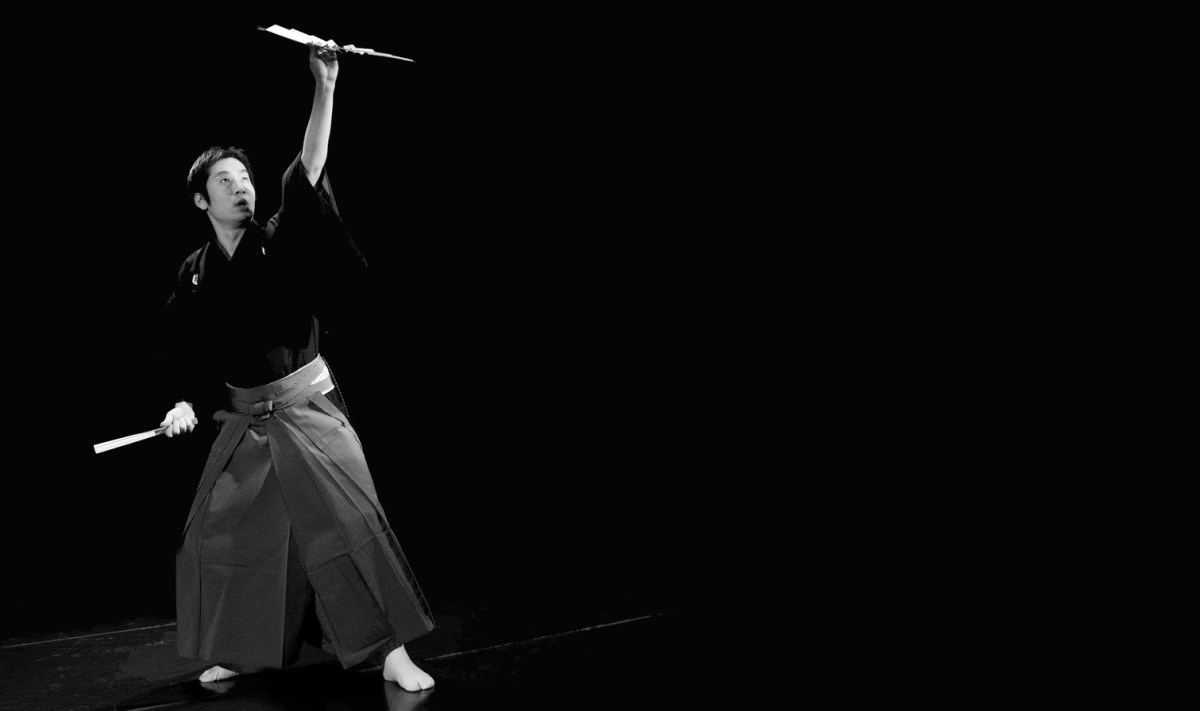
On Wednesday 25 June 2014 I took part to the event Wayō no Saikai, which I have blogged about here. In the original plan Udaka Tatsushige, my teacher’s eldest son, was supposed to sing and dance Noh excerpts, as representative of the Japanese classical repertoire. Unfortunately Tatsushige-sensei was unable to make it to the performance so his father, Michishige-sensei, took his place. I took part in various Noh pieces that were performed during the evening, but what I was concerned the most with was the shimai dance excerpt from the Noh Yamamba, for which I was supposed to sing as the only jiutai chorus singer.
Until now I have only sung in jiutai with other chanters – from a minimum of 2-3 to a maximum of 8, depending on the situation. This has been the first time for me to be the only singer in a shimai dance. When singing in a jiutai the most important thing is memorise the text and make sure that you follow the chorus leader. Ideally you should memorise the text and score perfectly, and sing with confidence while continuously paying attention to the chorus leader. However, if you are a beginner you will probably be told that the most important thing is not to get into other people’s way. In other words, don’t sing too loud, pay extra care to fit into the pauses, etc.
Things will start to change when as your understanding of rhythm, pauses, and fushi embellishments improves. Now you know enough to sing full force, which means that people are actually going to hear you! You won’t be able to hide behind a wall of other voices anymore. This stage is the beginning of a new phase which I feel I have now entered. Maturity means will and capability to be responsible for your own voice: you have to follow the leader but be able to continue singing even if someone makes a mistake. You have to be independent while harmonising with the others.
When I learned that Tatsushige-sensei could not make it to the performance, and that Michishige-sensei, my direct teacher, would stand in his place, I was rather worried: in a usual setting a junior/student like myself would dance, while the senior/teacher would sing. In addition, singing in a solo jiutai means that there is literally nowhere to hide, no one helping in case of emergency. It also means that (obviously) there is no leader to follow. This might have been my only chance in this life to sing as a soloist for Udaka-sensei. So I did it, and it went well. Udaka-sensei’s dance was easy to accompany even if Yamamba is a piece I had only rehearsed twice before the actual performance.
The other day I received the provisional programme for our forthcoming Gala Performance on August 17th (more news to come about this) and I spotted my Japanese name (高谷大悟 – Takaya Daigo) among the four jiutai chanters for a bulk of shimai that other students will dance. This is a position that, in our school, only professional take. A good sign, I think.
The Kamigata seiyō kogaku ensōkai presents Wayō no Saikai, a musical event featuring pieces from the European tradition (gregorian chant, renaissance music, early baroque music) and Noh flute, chant, and dance. The representatives of the Noh tradition will be flute player Saco Yasujiro (Morita school) and Udaka Tatsushige(Kongō school, my teacher’s eldest son). I will have the privilege to sing for Tatsushige-sensei’s shimai (Yamamba kiri) and rengin (Kane no dan), from the Noh Miidera. Tatsushige-sensei carefully chose pieces that would suit the theme of the event: the kiri section of Yamamba is a dialogue between actor and chorus, close to the format of some ancient European sacred music, while Kane no dan describes how listening to the sound of the (Buddhist) temple bells helps achieving enlightenment.
Kamigata Seiyō kogaku ensōkai.
Wayō no Saikai – A meeting of classical Japanese and Western musical traditions
Time: 25 June 2014 from 19:00
Place: Nihon Seikōkai Kawaguchi Kirisuto Kyōkai, Osaka-shi, Nishi-ku Kawaguchi 1-3-8 〒550-0021 Subway Chuo line Awaza station (exit n. 7)
As I have written in a previous post, I am about to leave for London where a group of Noh performers from Kyoto and Osaka will perform Noh music and dances at the London Contemporary Music Festival. I am lucky enough to be serving in the ji-utai chorus, and as the day draws near I am getting excited, but also a little nervous about performing Noh in such an unusual context. Even in Japan, Noh is not only performed in Noh theatres: there are a variety of ‘alternative’ stages, such as outdoors stages at shrines or indoors platforms at hotel banquet halls, where Noh is regularly performed. However this time our group will perform in an ex-carpet factory, in front of a mixed audience (the other acts are Stockhausen and Pain Jerk) who might not be familiar with Noh theatre’s conventions, and most importantly our schedule is so tight that will not have much time to familiarise with the local mood (and time zone).
The hyōshiban, a wood block used in training to reproduce the beats of the three drums. (Photo: Elaine Czech)
How does a group of Noh performers ‘get ready’ for this kind of event? It’s simple, we don’t. ^_^ Noh performers study a shared canon of plays that consist of pre-established choreographies and musical scores, but they do so separately. Movements, lines, drums and flute patterns are the same, but there are various ‘stylistic schools’ for each role. For example, this time Kongō school actors will meet with Morita School flute, Kō School shoulder drum, Kanze School hip drum and Konparu School Taiko. This is one of the many possible combination of schools, and each will perform according to their specific way of interpreting the canon. What is exciting about Noh is that since everyone knows what they are going to play, and what the others are going to play on stage, there is no need for weeks of rehearsals. A brief and even partial run-through, known as mōshiawase, is all you need to check that you are ‘on the same page’ with the others.
This quality of impromptu is what allows every Noh performance to be unique and fresh, reflecting the Japanese notion of ichi-go, ichi-e, which one could translate as ‘one meeting, one chance’. So when I asked Tatsushige-sensei, who is leading our band, how long would we need to rehearse our programme on the performance day, he replied that we absolutely need to avoid ‘over-rehearsing’, as ‘that wouldn’t be Noh’.
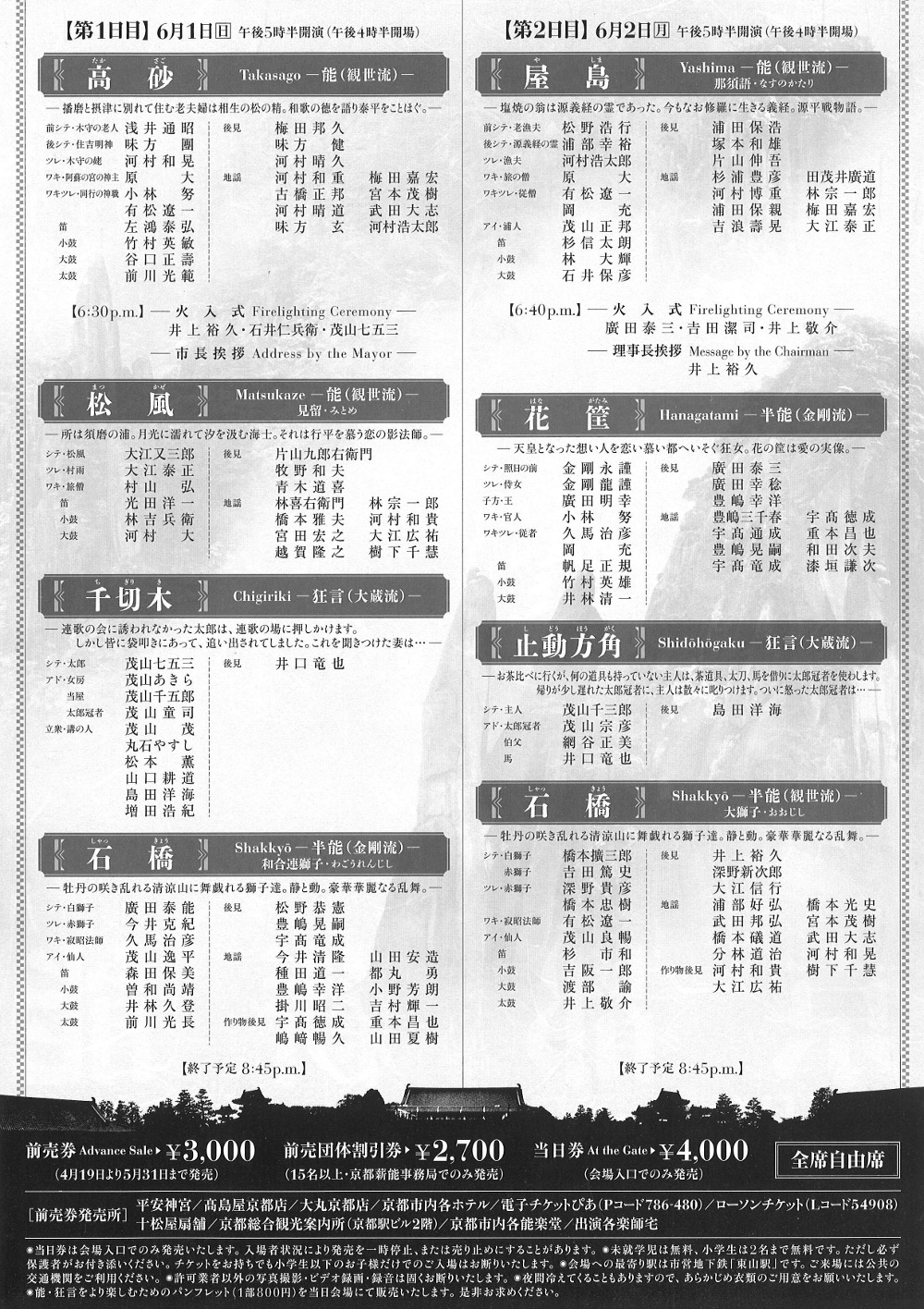
This year’s Kyoto Takigi (Fire-lit) Noh performance, at the Heian-jingu Shrine, Kyoto 1, 2 June 2014, will commemorate 680th anniversary of the birth of Kan’ami and the 650th anniversary of the birth of his son, Zeami. The programme features various classics, such as Matsukaze and Yashima, but its highlight is the double performance of Shakkyō as ending play for both days. The first day it will be performed by masters of the Kongō School, while the second day it will be performed by masters of the Kanze School. It is a great chance to appreciate the differences in the kogaki, or variations of the same play that are part of the Kongō and Kanze canon. Kongō will stage the sagorenjishi variation, with one white lion and one red lion, while Kanze will stage the ōjishi variation, with one white lion and three red lions. White and red are celebratory colours in Japan, which makes Shakkyō a suitable choice for the commemoration of the birth of the ‘fathers of Noh’, Kan’ami and Zeami.
Performances start at 17:30 and finish at 20:45. Gates will open at 16:00. Seats are not reserved so I suggest you to come early, and bring something to cover your head with (you might need to queue in the sun).
Advanced sale tickets: 3,000yen. At the door: 4,000yen. Groups (15+): 2,700yen.
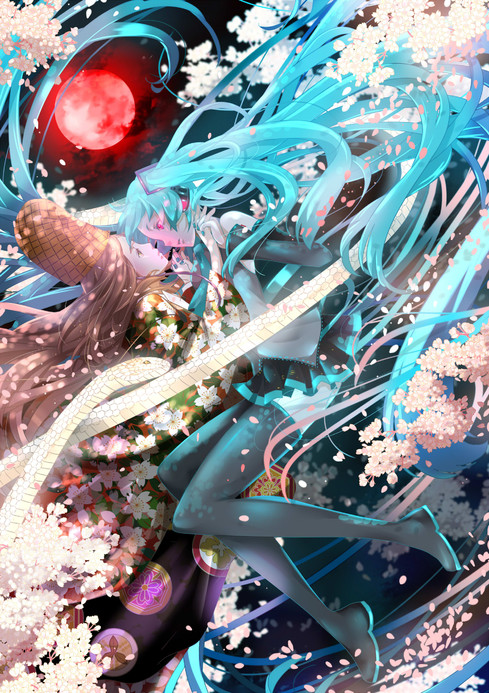
Sōseiza is a Kyoto-based group of performers belonging to different performance traditions, including members of the Kongō school of shitekata. Every year the group stages performances that cross genres, but are generally based on traditional arts such as Kabuki, Nihon-buyō, Noh, Nagauta, Shakuhachi, etc. This year Sōseiza is taking it one step further with the performance that brings together the story of Dōjō-ji and the vocaloid computer star Hatsune Miku.
Dōjō-ji tells the story of a young woman who, driven by her passionate love for a priest, transforms into a demonic snake and coils herself around the bell where he was hiding, melting the bell and burning him to death. The story is much more complex and interesting – check a synopsis with stage pictures from the Noh adaptation here.
This vocaloid version sounds like a rather bold experiment, fusing traditional Japanese performance with very contemporary (and equally local) technology, giving the classic tale a pop twist. I have my reservations, though one cannot tell before actually attending (which I won’t be able to do this time..). If you happen to go see this show, please let me know how it was! I’d be happy to post your review here.
“The Japanese Extreme” is the headline of the third night (29 May) of the London Contemporary Music Festival 2014 at Britannia House, Spitalfields, London. The organisers have put together an impressive and bold line-up that crosses genre boundaries: Karlheinz Stockhausen’s Himmels Tür,(a percussion piece of Japanese inspiration) the Japanese noise act Pain Jerk, and…… NOH THEATRE.
Udaka Tatsushige and Udaka Norishige, sons of my teacher Udaka Michishige, along with four hayashimusicians from Kyoto and Osaka will perform the ibayashi (solo music and choir) of Shakkyō(The Stone Bridge), and the maibayashi (dance and music excerpts) of Hagoromo(The Celestial Robe) and Funa-Benkei(Benkei and the Boat). I will sing in the ji-utai chorus.
The repertoire we are going to perform is classic, and will be put on stage according to the Noh conventions. It is rather unusual for Noh to be performed along with other acts, all the more so in the context of a contemporary music festival, and we are very excited and honoured to participate to the LCMF this year. If you are in/around London don’t miss the chance to attend this unique event!

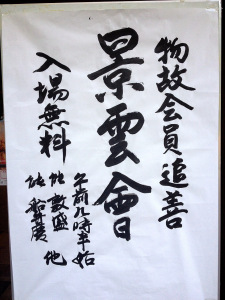 The program board outside the theatre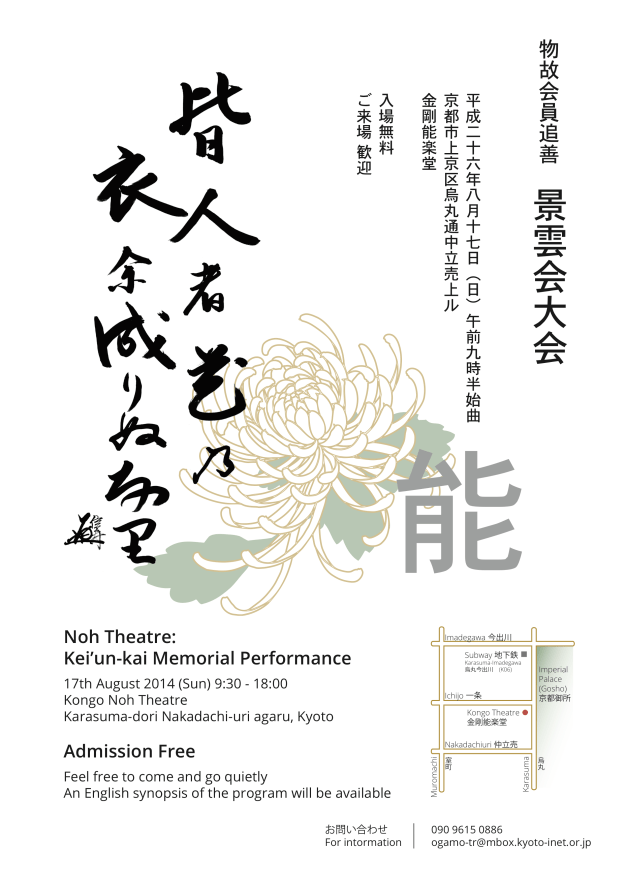


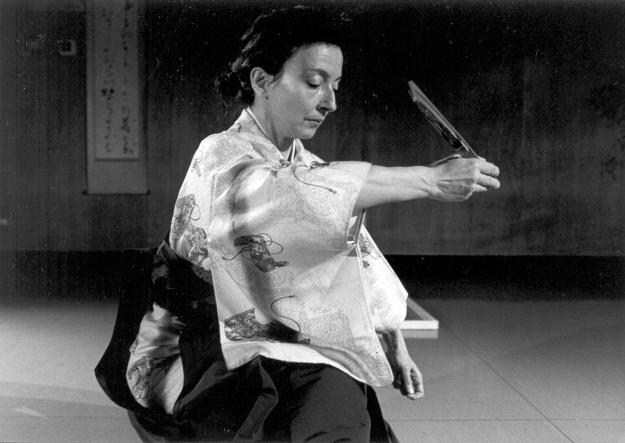 Kongo-ryu Shihan Monique Arnaud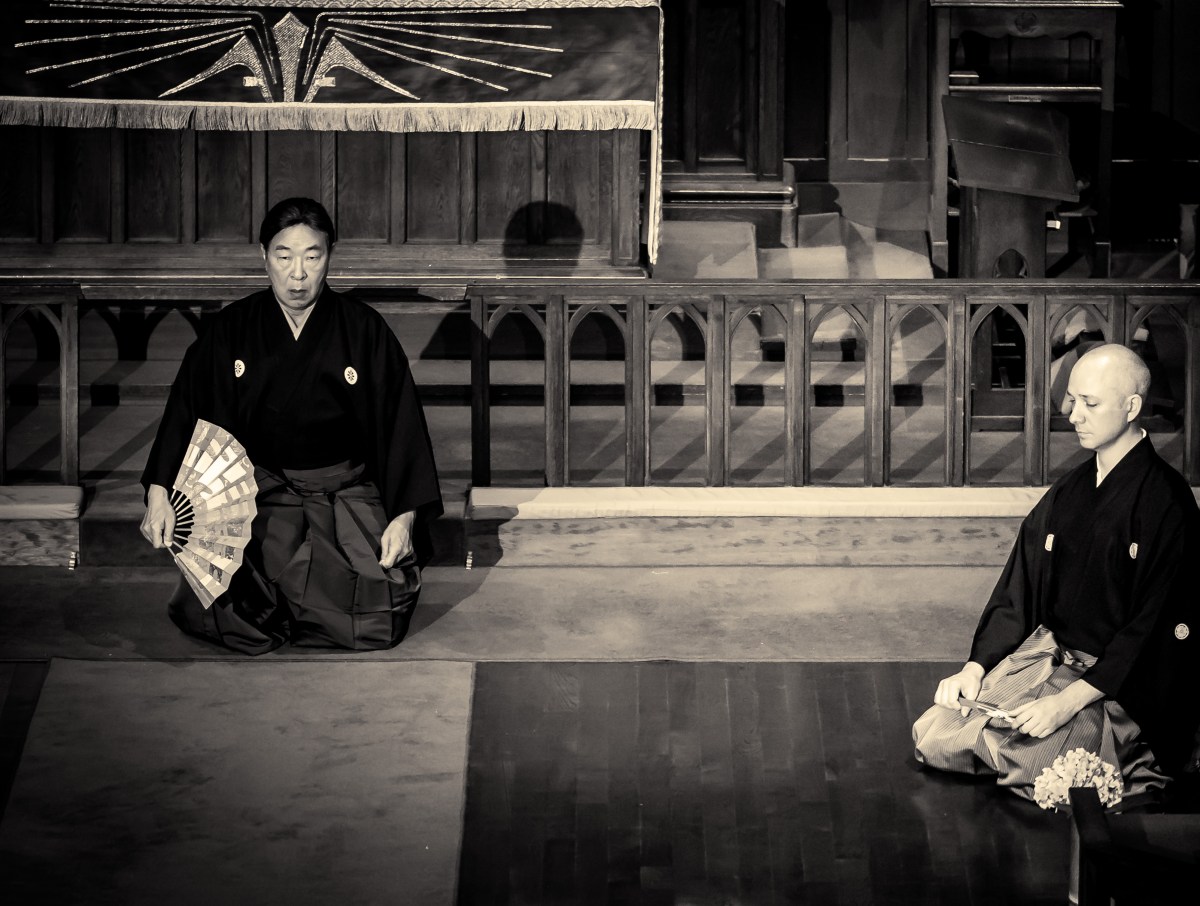


 The Noh Diaries