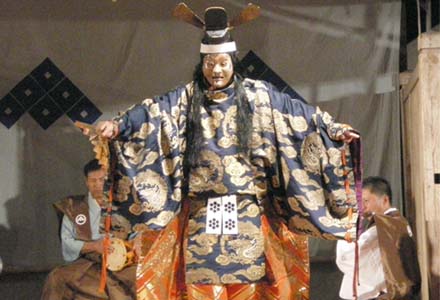
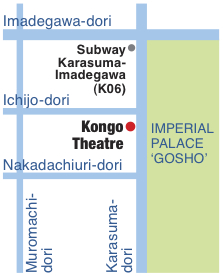
On February 23rd 2014 from 1:30pm Udaka Michishige will perform Uneme, a Noh of the 3rd category (women Noh) by Zeami Motokiyo, as part of the monthly (teiki) performances of the Kongō school at the Kongo Noh Theatre in Kyoto. For ticket reservation and for more information, please contact me here.
Long ago an Uneme, or Lady in Waiting, drowned herself in Sarusawa Pond after the Emperor, who had once shown her so much affection, turned his attentions elsewhere. After hearing her story from a Woman who reveals that she is the spirit of the Uneme, a Priest prays for her salvation. She then appears as she was in the past, recalling banquets on the pond long ago, and dances. Even now, on the night of the full moon in September a service is held for her, a dragon boat such as the one she would have ridden, circling the pond. (Summary by Rebecca Teele Ogamo)
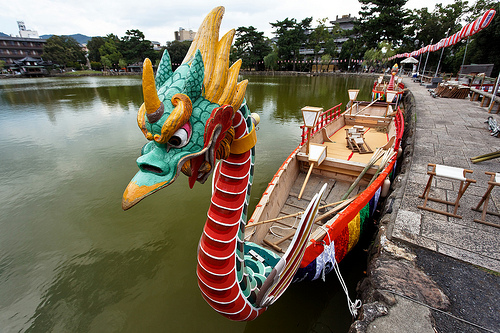
Another feature of the story is that after Uneme’s death a shrine was built next to the pond for her consolation. However the shrine could not bear to face the place where she took her life, and turned around overnight. The Uneme Matsuri festival is held every year in September. The festival features a parade of Heian period characters and the typical dragon boats circling the pond.
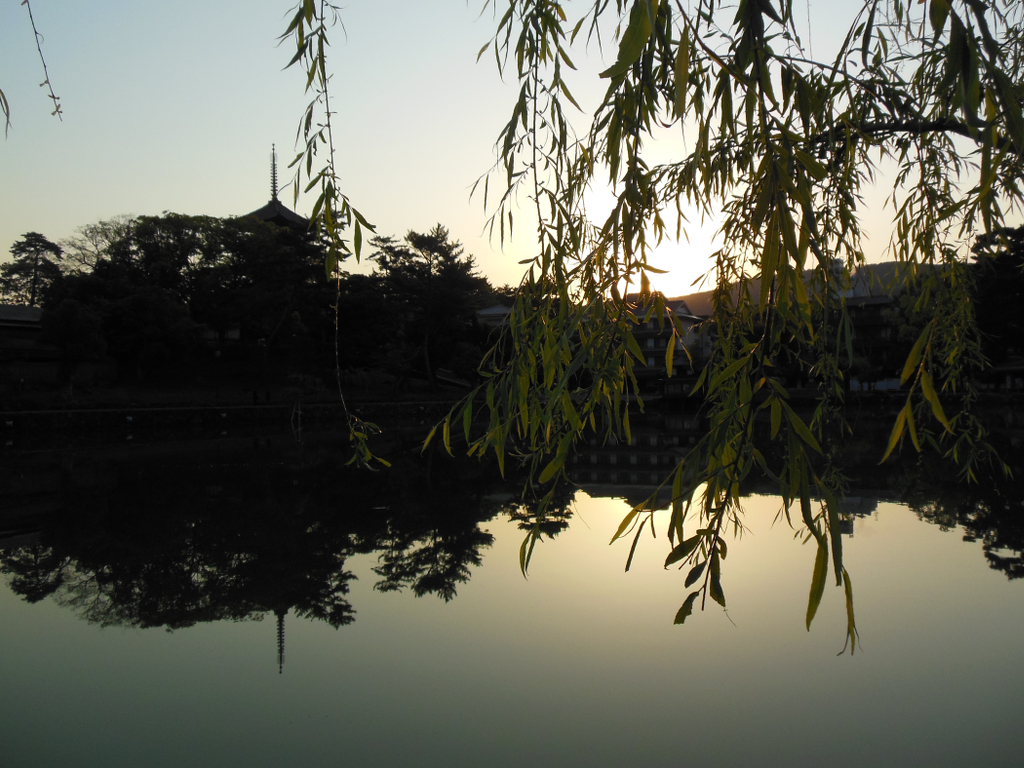
The Sarusawa Pond (Photo: Terao Kaionin)Dragon boat of the Uneme Matsuri (Photo: s.yume)
Yesterday I went to theOnmatsuri festival at the Kasuga Wakamiya Shrine in Nara. I was invited to attend a special sequence of performances called Tabi shosai, staged in front of a shrine where the god is temporarily residing. An academic treatment of the festival can be found here. I wish I had more time to talk about the performances here, but I don’t. Yesterday it was cold and dark (after 16:30) so I could not take good pictures. However, I wanted to share here a the only few snapshots of a performance that was listed as sarugaku in the programme. It was in fact kagura-shiki, a stripped-down version of Okina usually performed without mask and with plain white costumes instead of the usual okina-kariginu embroidered cloak. This kind of performance is often staged around this time of the year by high-ranking Noh actors. Other analogous acts, part of a ritual sequence called ‘under the pine tree’ such as yumiya tachiai, were performed in the morning. All performances take place on a ‘lawn stage’, the front facing the shrine, so performance need to wear special shoes instead of the usual white tabi socks. These performances remind us of the ritual origin of Noh, though the contemporary staging of such rituals has naturally changed with time. Here are a few pictures:
Matsu no shita, ‘under the pine tree’ – Yumiya tachiai, in an old postcard, showing exactly the same ritual that is performed todayKagura-shiki: the ji-utai chorus seen from the back. On the left, the temporary shrine where the god resides.OkinaSpecial shoes worn over tabi
Yesterday I attended the last of the Kongō monthly series of the year. As usual two Noh plays were performed, but I was particularly interested in seeing the Iemoto Kongō Hisanori perform Genzai shichimen, a play that has been staged yesterday for the first time in 60 years. The play is currently in the repertorie of the Kanze and Kongō schools only, and its special feature is a costume change and mask ‘change’ on stage (not seven masks, just one – in case you are wondering…) in second half. In this play two masks are donned one on top of the other.
Rebecca Teele Ogamo regularly writes extensive programme notes with detailed costume and mask information every month – thanks to Rebecca’s notes of Genzai shichimen I was able to appreciate the play even more. I did go through the utai of the play with Udaka Michishige-sensei, who was jigashira chorus leader, a couple of times, but the kyūhon ‘old’ cursive utai-bon script made it difficult to follow the story, so I am grateful to Rebecca for that!
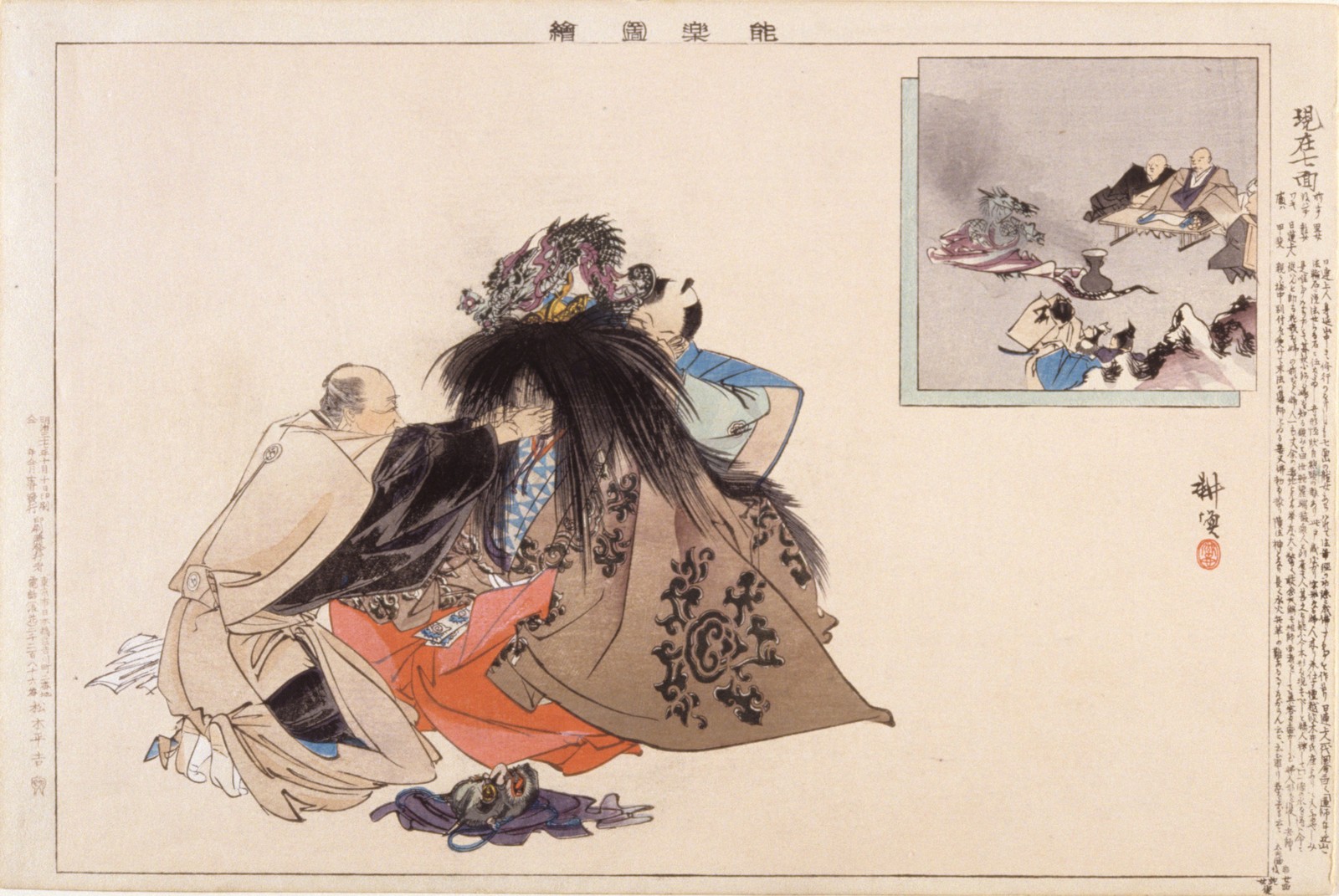
The costume change in Genzai Shichimen – print by Tsukioka Kogyo
In the play the waki, Nichiren Shōnin (1222-82), founder of the Nichiren sect of Buddhism, is preaching at Mt. Minobu (Yamanashi prefecture). A local woman rejoices in hearing the Lotus Sutra preached, and. upon Nichiren’s questioning, she replies that she suffers the Three Burning Torments. Eventually, she reveals her true nature: she is the Dragon who lives in the Shichimen Pond. At this point thunders and lightings fill the sky and the woman disappears. In the second half of the play, a Dragon enters, with a particular costume and mask set up. Though Kanze uses a Hannya mask, the Iemoto chose a terrifying dai-ja (great serpent) mask, of the kind used for the Noh Dōjōji. This mask in the Kongō collection is rather scary due to its asymmetry and grotesque, contorted fanged mouth. However, after Nichiren has recited lines from the Lotus Sutra, the Dragon goes retreats to the back of the stage, where assistants help to change costume and mask. Besides Dai-e, where the shite wears the shaka Buddha mask on top of a beshimi tengu mask, Genzai shichimen is the only other play I know were two masks are worn one on top of the other. I can only imagine how difficult it is to move on stage with such set-up. The Dragon transforms into a heavenly maiden (zo-onna was the mask used yesterday) who then dances a kagura Shinto Dance in thanks for having reached enlightenment, and finally flies away in the clouds.
Nichiren was a militant preacher, advocating the primacy of the Lotus Sutra above all other Buddhist doctrines. His aggressive attitude towards the other Sects, which he deemed responsible for the corruption of the country during his time, was extreme. He founded the first Buddhist doctrine originating in Japan, and could be seen as an precursor of Japanese religious nationalism (though this is usually associated with Shinto). The combination of Buddhist and Shinto elements can be found in other plays, but it is even more justified in this play since Nichiren (as others before him) comprised Shinto elements, such as the Sun-Goddess Amaterasu, within the all-encompassing cosmos of the Lotus Sutra.
The author of the play is unknown, but I wonder whether the various special features – a dragon god/heavenly maiden, an important waki character, special effects such as costume and mask change) – don’t indicate that the play was probably written in the late Muromachi Period. Yamanaka Reiko and Lim Beng Choo have written about plays composed during this period here and here.
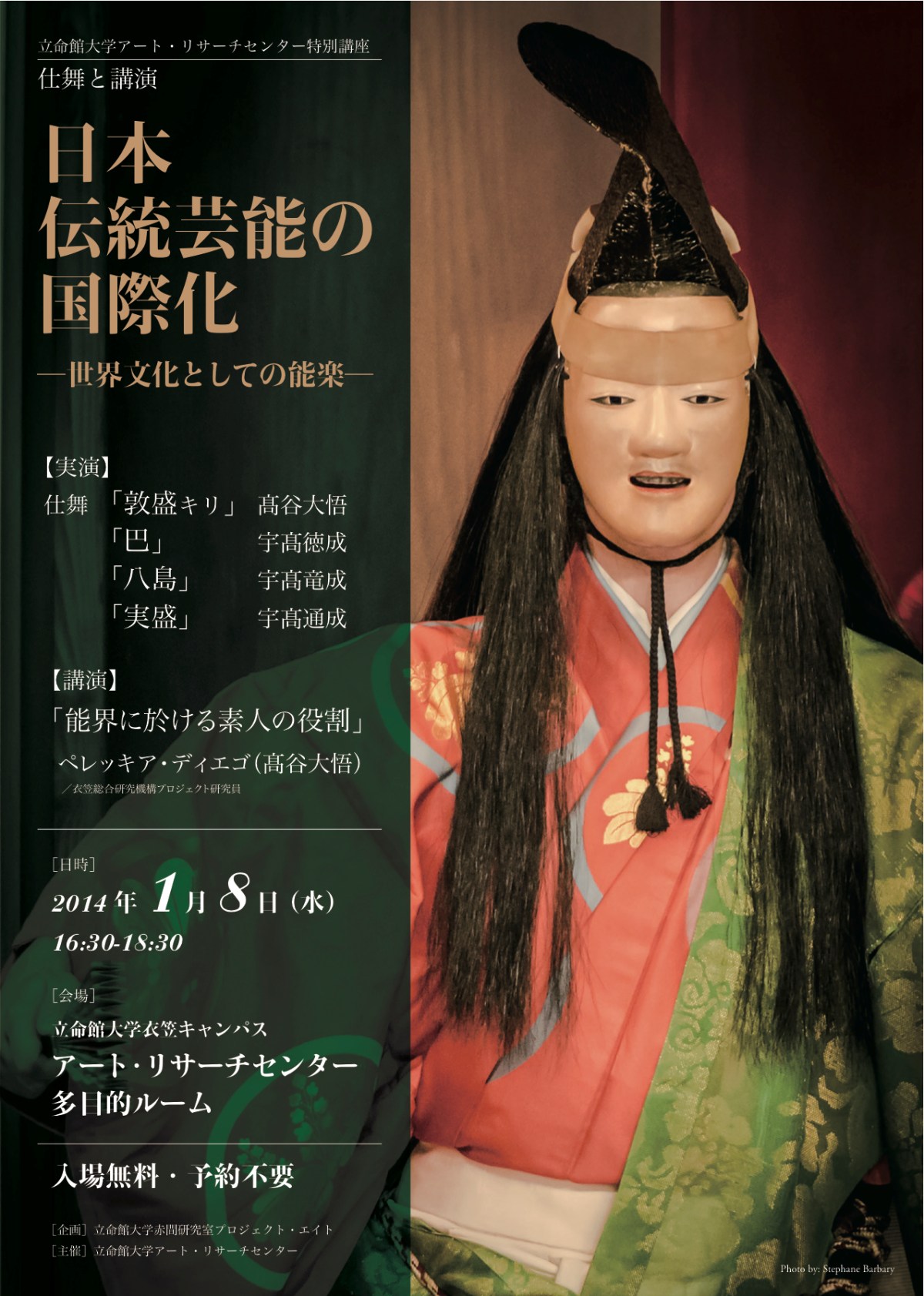
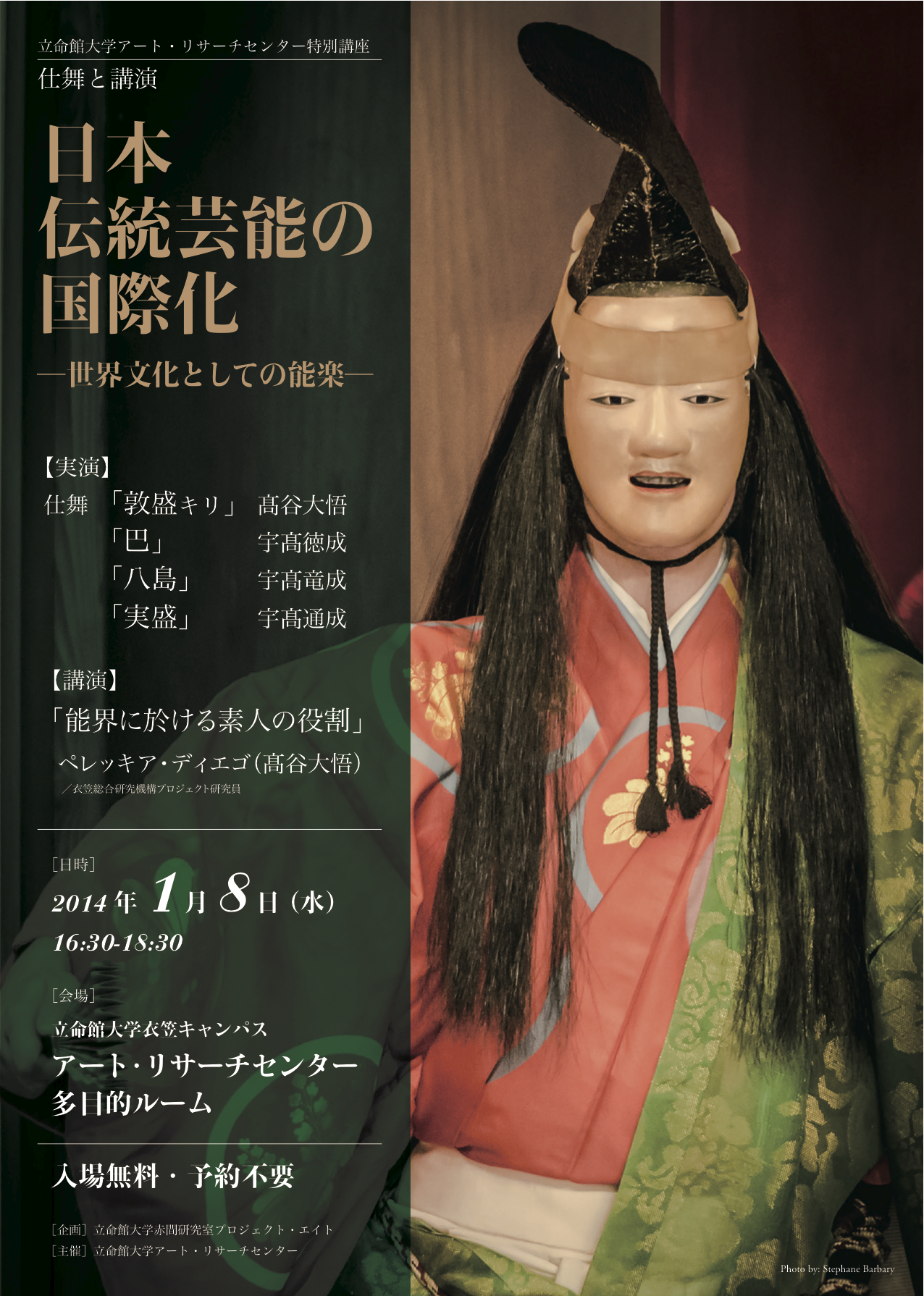
On January 8th 2014 the ARC Art Research Centre at Ritsumeikan University will host the event ‘Internationalisation of Japanese Performing Arts – Noh as Culture of the World’. The event combines performance, theory and discussion. See below for details (in English and Japanese).
The first part features shimai dance excerpts by masters of the Kongo School of Noh Udaka Michishige (Sanemori), Udaka Tatsushige (Yashima) and Udaka Norishige (Tomoe). I will also perform a shimai under my stage name Takaya Daigo (Atsumori – kiri). In the second part of the event I will showcase my current research: ‘The role of amateurs in the world of Noh’, as a work-in-progress. In this lecture I will explore the various kinds of amateur practitioners that populate the cultural world of Noh and how their social, economic and political role has changed throughout history. Unlike other kinds art professionals, most Noh performers depend on teaching amateurs in order to socially and financially sustain their artistic activities. Noh is currently undergoing a difficult phase in its history, with dwindling audiences and a lack of young blood among its professional ranks. In order to look for trajectories of solution to these issues, I believe that is necessary to consider the role of amateurs as one of the pillars on which the Noh world is based, and understand the complex relationship between audience, amateurs, and professionals. In the third part of the afternoon I will invite Udaka Michishige to discuss the role of amateurs in his experience as Noh actor and leader of the Kei’un-kai and of the INI International Noh Institute.
Internationalisation of Japanese Performing Arts
– Noh as Culture of the World –
January, 8th 2014 (Wednesday)
Ritsumeikan University, Kinugasa Campus
Art Research Center
Programme:
16:00 Opening remarks
16:40 Performance (shimai)
Atsumori – kiri Takaya Daigo
Tomoe Udaka Norishige
Yashima Udaka Tatsushige
Sanemori Udaka Michishige
17:00 Intermission
17:10 Lecture – The role of amateurs in the world of Noh -Diego Pellecchia (Visiting Researcher, Art Research Centre, Ritsumeikan University).
17:45 Udaka Michishige and Diego Pellecchia in conversation
On Sunday 24th of November a special celebratory event marked the 10th anniversary of the construction of the new Kongō Nō theatre, in Kyoto. The old theatre in Muromachi-street was a landmark in the history of Kyoto Noh, as it was the only stage rebuilt after all three main stages in Kyoto were burnt during the the Meiji upheavals. In 2004 the new state-of-the-art Kongō theatre opened on Karasuma street, in front of the imperial palace. I never had the pleasure of visiting the old theatre, but I heard many stories about it from actors in the school. It still had tatami mats instead of chairs, and large windows that let warm daylight illuminate the stage, across clouds of tobacco smoke lifting from the back seats. There, important guests would be able to sit in privacy, hidden behind lowered bamboo curtains, which they would lift only to watch the performance. Unfortunately the building did not conform to the modern health & safety (and fire protection) standards, and had to be demolished.
The Shin-Kongō Nōgakudō (New Kongō Nōgakudō) is one of the best Noh theatres I have ever visited. The design style of the building mixes traditional and modern, wood and concrete, in a unique blend that creates an atmosphere that is not too relaxed, nor too intimidating. It has comfortable armchairs (but not too dangerously comfortable), and the temperature usually is just right, unlike other places where you either freeze or steam.
Sunday’s performance opened with a special variation of Okina a ritual performance celebrating long and prosperous life. In this variation, called jūnitsukiōrai, the Iemoto Kongō Hisanori and his son Kongō Tatsunori took the roles of two Okina exchanging verses describing the characteristics of each lunar month. The choice of the variation was excellent because it emphasises the cycle of time and seasons with both the Kongō father and son on stage, symbolising the generational transmission of the Kongō heritage. It closed with a final left-right salutation from Kongō Tatsunori, who will be the future Iemoto.
The maibayashi extracted from the Noh Ema featured three of the senior Noh actors in the Kongō school, Teshima Michiharu, Imai Kiyotaka and my teacher, Udaka Michishige, who took the strong role of the god Tajikarao, pulling the Sun-Goddess Amaterasu out of the cave where she was hiding.
Hagoromo (shōgi no monogi variation) featured the beautiful ‘phoenix robe’, a costume only worn by the Kongō Iemoto. In this variation the tennyō (celestial maid) dons the costume while sitting on a stool in the middle of the stage.
Shakkyō (The Stone Bridge) concluded the long day of performances, with Kongō Tatsunori taking the role of the lion (an avatar of the Bodhisattva Manjusri) frolicking among white and red peonies.
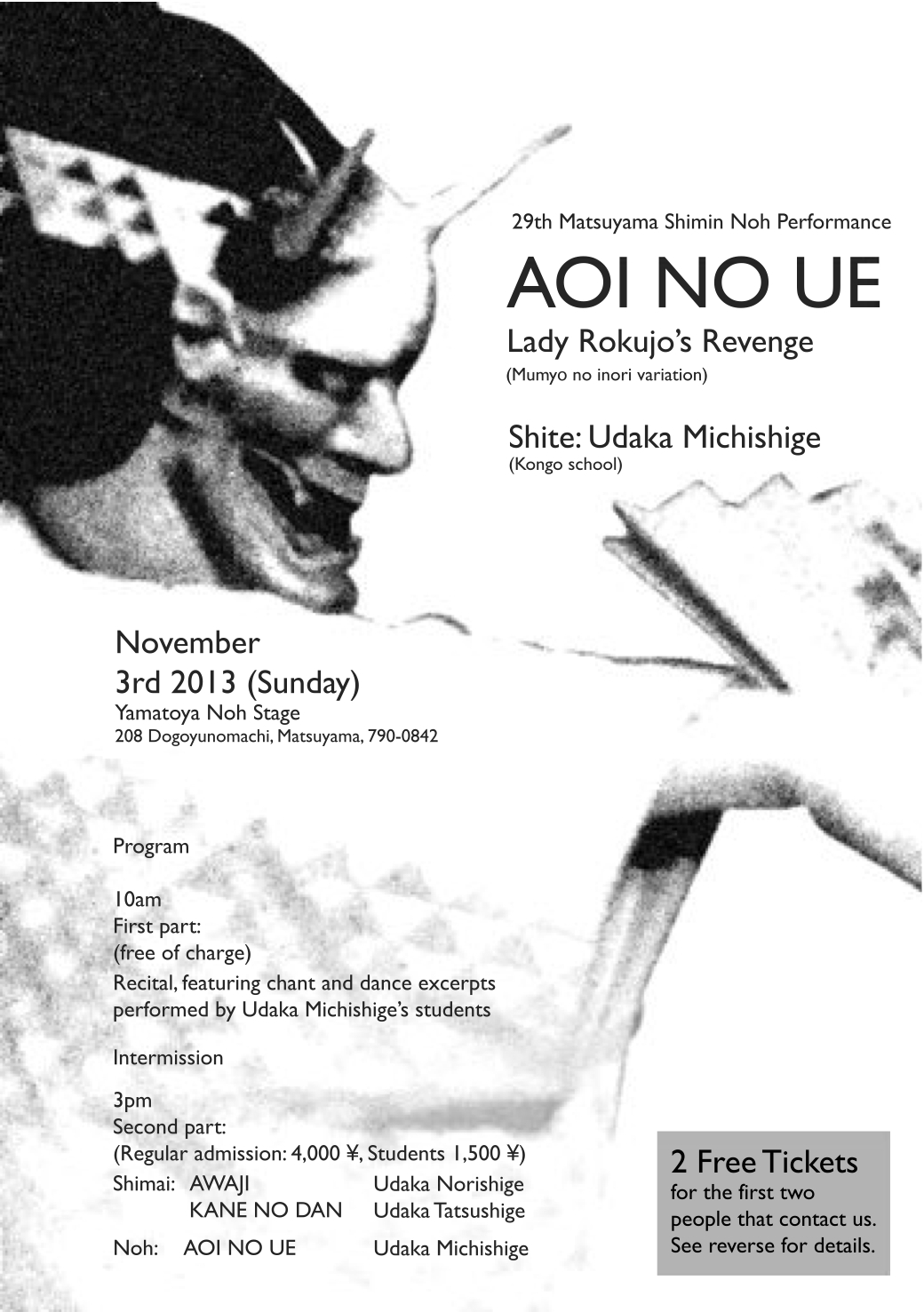
Next Sunday (November 3rd, which is both my birthday and the ‘culture day’ in Japan) I will take part to the Matsuyama Shimin Noh performance at the Yamatoya Honten Noh stage in Matsuyama, Shikoku. The event begins at 10:00 with a recital (entry free of charge), featuring Udaka Michishige’s students. I will perform a shimai, or dance excerpt, from the Noh Uta-ura, and will sing in the su-utai chanting of the Noh Kogō. The main event will be Udaka-sensei’s performance of Aoinoue in the ‘mumyō no inori’kogaki, or variation. I am lucky enough to have a privileged observation spot, serving in the ji-utai chorus for this performance.
Every year in November Udaka Michishige takes the shite main role at the Matsuyama Shimin Noh performance. Although based in Kyoto, Udaka regularly teaches both utai/shimai and mask carving in Nagoya, Okazaki, Tokyo, Yokohama, and Matsuyama in Shikoku, the area where his family originally comes from. He is a descendent of two Shikoku families: Udaka and Kawada. The Udaka family had a castle in Niihama City during the medieval period and later served the Matusdaira clan feudal lords in Matsuyama as Noh actors from 1712 until the start of the Meiji period.
For this year’s shimin Noh we are giving away 2 free tickets to the first two people who contact us so make sure not to miss this chance if you are in Matsuyama next weekend! Find contact details below.
Aoinoue
Based on an episode from the Tale of Genji, the 11th century masterpiece by Murasaki Shikibu, the main character is not Lady Aoi, the wife of Prince Genji, but Lady Rokujo, the most intriguing female character in the novel. Once Genji’s lover but now abandoned by him and filled with resentment towards his wife after a humiliating incident at the Kamo Festival where her coach was forced out of its viewing spot by Lady Aoi’s retainers, Lady Rokujō’s living spirit torments her rival. A shamaness is sent to discover the source of the possession of Lady Aoi and then an exorcism is performed by the priest Kohijiri, finally bringing Rokujo to her senses by calling on the power of the Buddhist sutras. In the mumyō no inori kogaki or ‘Exorcism in Spiritual Darkness Variation’, the robe used to represent Lady Aoi is white rather than red, and Lady Rokujo leaves the stage for a change of costume rather than retreating to the koken-za stage attendants’ seat for only a change of mask. She returns in nagabakama, long vermillion trousers, often with a Nagakamoji, an extension of the wig that emphasises that Lady Rokujo’s is a noblewoman, increasing the sense of horror at the intensity of the expression of her jealousy in choreography also more graphic than in the standard production.
(Text by Rebecca Teele Ogamo)
Ehime University Noh Club
Udaka Michishige has taught students of the Ehime University Noh Theatre Club for over 30 years. Club activities include the practice of Noh chant and dance as well as workshops and performances. Every year in November club members join other students of Udaka at Matsuyama Municipal Noh Performance. Lessons are held both in Japanese and in English. Email: Kmct1q_es@ezweb.ne.jp
For information please contact:
KYOTO
Keiun-kai INI Main Offices, Training Center
111 Satta-cho, Kami-takano, Sakyo-ku, Kyoto 606-0047
Tel: (075)701-1055
Fax: (075)701-1058
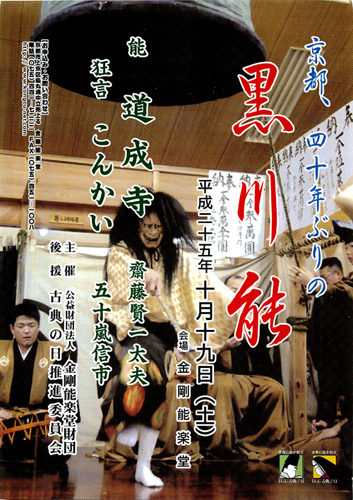
Yesterday I attended a performance of the Kurokawa Noh at the Kongo Noh theatre in Kyoto. Kurokawa is a hamlet part of Tsuruoka City in Yamagata Prefecture, in the deep of the Japanese snowland. A tradition of performing Noh plays has been transmitted within the city by two groups, the kami-za and shimo-za. Noh is performed on a number of occasions during the year, corresponding to religious festivals related to the local shinto shrine. There are various videos available online, perhaps the most interesting is this, made on the occasion of an event in collaboration with the Asia-Pacific Database on Intangible Cultural Heritage (ACCU), which worked to preserve the Kurokawa tradition from the threat of disappearing. More about this project here. Basic readings on Kurokawa Noh at the bottom of the post.
Kurokawa Noh was last performed in Kyoto 40 years ago, and the presenter pointed out how all those who performed in that occasion have now passed away. The Kurokawa Noh kami-za troupe who performed today is touring Japan -they were in Ise just yesterday- promoting this unique performance style that was transmitted in a condition of semi-isolation from the urban styles. When, during the ‘noh renaissance’ period, Kanze Hisao pointed out the need to ‘go back to Zeami’ in order to find the ‘true’ essence of Noh, he immediately thought of Kurokawa Noh, of which he became a great fan.
Yesterday’s programme consisted of one Kyogen, Konkwai (spelled こんくわい or こんかい) which is the Kurokawa version of the famous Kyogen Tsurigitsune (Fox Trapping), and the Noh Dojoji (Dojo Temple), among the most difficult plays of the two respective repertoires. The extent to which the Kurokawa tradition of both Noh and Kyogen plays differs from the urban tradition of the five schools is evident in many aspects of performance. First of all, actors chant/recite using the local dialect, and have a peculiar way to enunciate that makes the text difficult to discern even for the experienced spectator. Actually a Kongo actor friend of main told me it was difficult to understand what they say even backstage (!). I was impressed by the rather low voice of the actors , and I wonder whether this is not because Kurokawa Noh is performed on stages within homes of the villagers, not theatres or open spaces (just my speculation). The quality of acting and the overall effect is that of amateur performance – all performers have regular jobs – Heike Grossman explains this condition in her article. Tsurigitsunelacked the intensity that makes it one of the most difficult Kyogen plays. I could not help but notice how movements are far from the exactitude and concentration of ‘standard’ Kyogen performances. Among the many differences from the usual Kyogen was the attire of the shite in the second half of the play: the mask looks bigger, and the costume is a white overall with what seems to be a real fox skin-fur attached to its back. Unfortunately this part of the play, usually very dramatic because of the jumps and screams of the fox tempted to snatch the bait, was rather uninteresting in the Kurokawa version.
Kurokawa Noh – Tsurigitsune. Note the fox fur costume.
Various details show that this kind of performance belongs to the more ‘popular’, or ‘rougher’ sphere of performing arts: at some point the main actor in Tsurigitsune dropped his fan, and simply picked it up – you would never see this in a normal performance, one of the koken stage assistants wore glasses, members of chorus for Dojoji talked to each other during the performance, etc…
I found Dojoji much more interesting than Tsurigitsune. Here are some thoughts.
The jiutai chorus entered the stage from the hashigakari bridge instead of the usual kiri-do, and came sitting much closer to the front than a usual Noh performer. Usually the heavy bell (some 70kgs) is brought on stage attached to a pole carried on shoulders by a great number of Kyogen actors. Then the rope that will hold the bell has to get into a pulley fixed at the centre of the roof of the stage. This operation, performed by Kyogen actors by attaching the rope to a long pole, is rather difficult because the rope is thick and the pulley narrow, and takes as much time as needed to be completed, almost a performance within the performance in itself ‘will it go through?’… ‘will it not?’. In the Kurokawa version a smaller, much lighter, more realistically decorated bell is brought on stage by three Kyogen actors, while the rope has already been installed before the performance began. My speculation is that it is too difficult for them to do it as part of the performance, and they don’t know how much it will actually take them.
The flute player sits facing the maku curtain, as in the Kiyotsune variation ‘koi-no-netori’.
Actors (both waki and shite) lift themselves up on their toes as a recurring kata – today this movement is only performed by waki actors in First Category (God Noh) plays.
Everything unfolds at a much faster pace than a standard Noh, and not before long we hear clapping from the kagami no ma mirror room, signalling that the shite is ready to enter the stage.
In standard version of the play, where the mae-shite wears a karaori brocade kimono in tsubo-ori style over a silver foiled surihaku undergarment and another black karaori wrapped in koshimaki style around the waist. The Kongō school uses the magojirō mask, exclusive to Kongō. In the Kurokawa version we saw the shite entered with a simple karaori in kinagashi ‘straight’ style, and wore a mask that looked like shakumi or fukai, for middle-aged women roles.
As the presenter explained to us, Kurokawa Noh uses to put the katsura-obiheadband on top of the mask, instead of wearing it behind it. I am not sure when the shift took place in Noh history, but I think that in the past this is the way katsura-obi was used. At some point, probably in order to show more of the beautiful mask, or not to change their looks by donning something over it, this headband started to be worn behind the mask, perhaps in an unrealistic, but more beautiful way. The result is something closer to a coloured hachimaki, the white headband used today for roles of warriors, and worn on top of the mask.
The dance section, consisting of ranbyoshi and jo-no-mai (a peculiar combination) was particularly interesting. With ranbyoshi performed only by flute and ko-tsuzumi, and jo-no-mai performed by o-tsuzumi and ko-tsuzumi, without flute. I liked this second dance very much: I found that dancing without flute produces a very interesting, even more hypnotic effect. Maybe at this point of the performance I was getting used to the peculiar music, and started noticing how the two drummers communicated and challenged each other through slowing down and speeding up, despite the unusually sparseness of kakegoe vocal interjections. Then the shitejumped into the rather narrow bell, and changed costume, mask and wig.
Once the exorcism by the waki reached its climax, and the bell started to lift in order to reveal the serpentine monster hidden inside it, something strange happened. Little spheres, probably from juzu prayer beads, fell on the stage rolling here and there. This generated some confusion among the koken and in the jiutai, or so it seemed to me. After the performance Rebecca Teele and I were wondering whether one of the monk broke his juzu while rubbing it during the exorcism, or rather the juzu sphere did not come from inside the bell, perhaps as a sign of rage of the shite against the exorcism (?! – the pamphlet we were given does not provide information about this)…
There are many more differences between the Kurokawa Noh performances we saw yesterday and the mainstream Noh performed by the five schools. I would not want to go through everything I noticed, as it would take more than just one post. Perhaps most evident difference waskamae or basic standing position: in standard Kyogen and Noh schools, arms are bent inwards, hands on waist for Kyogen, hands in a fist-like position in Noh. The image of the upper body is that of a circle, containing physical tension that is then liberated in movement. However, in Kurokawa Noh arms are open, with the left hand index finger sticking out and pointing down. This position is much weaker than the standard kamae and it makes much sense to me that this basic stance evolved in a much more compact, tense while relaxed position in urban traditions. The Kurokawa Noh kamae reminds of dengaku or ennen, more rustic performance styles I have seen on other occasions. The pointed index finger can still be seen in Okina, when the god stands in the middle of the stage with arms raised pointing East and West.
Kurokawa Noh performance. Note the pointing finger
Udaka Michishige in Okina at Utsukushima-jinja. Note the pointing fingers
What I can say as a conclusion is that I enjoyed the performance: it wasn’t simply an ‘amateur performance’. I was expecting something ‘kagura-esque’, which it was not. Sure, the performance lacked the intensity and perfection of professional performance, and I am sure that it is a kind of event that needs to be enjoyed in its original context.. still, it was moving to discover another Noh style that seemed to come from another time. 参考になりました!
Readings:
– Martzel, Gérard. La fête d’Ogi et le nô deKurokawa. Paris: Publications Orientalistes de France, 1975.
– Grossman, Eike. ‘Under the burden of Noh: Community life in Kurokawa and ritual Noh performances’ in Noh Theatre Transversal. Stanca Scholz-Cionca and Christopher Balme eds. Munich: Iudicium, 2008.
On Sunday 27th October 2013 Kongō-ryu shite actor UDAKA Michishige will perform the rare Noh Hōso, exclusive to the Kongō school of Noh, as part of the Kongo Noh Theatre monthly programme. The Noh Yōkihi and the Kyogen Hagi Daimyō will also be performed on the day.
Noh: Hoso. National Noh Theatre, Tokyo. Shite: Kongo Hisanori. Photo: Aoki Shinji
Noh: Hōso 彭祖
Celebrations are being held at the court of Gi no Buntei in China and among the many immortals who come from their mountain hermitages to pay their respects is one who appears to be a young boy but calls himself ‘Hōso’, the ‘Prosperous Ancestor’. Asked about his identity, he tells how he was once in service at court but was exiled long ago for the crime of stepping over the Emperor’s pillow. In his compassion the Emperor gave the youth the pillow as a keepsake along with a quotation from the Kannon Sutra. Hōso explains that he was acquired eternal youth by drinking the water from the stream running by his hut. Hōso faithfully copied the quotation on the leaves of chrysanthemums which grew by his hut and dew that fell from them transformed the stream into an elixir. The emperor vows to visit Hōso’s hermitage on Mt. Tekken and later Hōso dances for him there.
Hōso is the sequel to Makura Jidō (titled Kiku Jidō in the Kanze school version) in which the young boy is discovered in his place of exile and he first realises that he has become an immortal, thanks to the power of the quotation he has copied on the chrysanthemum leaves. Hōso is performed only by the Kongō school.
(Text: Rebecca Teele Ogamo)
Kongo Noh Theatre, Kyoto. Monthly performance series (October).
Noh Yōkihi: Matsuno Yasunori
Kyogen Hagi Daimyō: Shigeyama Akira
Noh Hōso: Udaka Michshige
Doors open at 13:00, performances start at 13:30.
Tickets: Advance booking: 5,500yen At the door: 6,000yen Students: 3,000yen
For more information on the performance, or to reserve tickets, please contact me here.
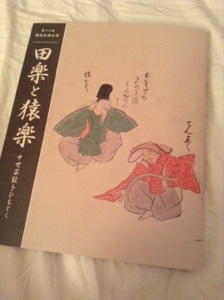
Yesterday I went to see Dengaku to Sarugaku at the National Bunraku Theatre in Osaka. Two groups, the Nachi Dengaku Hozonkai (Nachi, Wakayama pref.) and the Nara Tsuhiko Jinja Okina-mai Hozonkai (Nara) preserve ancient traditions that are thought to predate the performing art we call Noh today. Dengaku (literally ‘field entertainment’, where ‘field’ refers to ‘rice paddy’) is a form of performance where musicians playing taiko and sasara (a kind of wood clapper) dance in symmetrical patterns, at the accompaniment of extremely simple and repetitive musical patterns. Movements mime sowing the fields, evidence of its original purpose of propitiating good crops. Sarugaku (debate is open on the literal meaning of this word) is the old appellation of what we now call Noh. On this occasion the Tsuhiko-jinja troupe performed Okina-mai, a predecessor of the contemporary Okina performed by Noh actors. I won’t get into the discussion on the ‘authenticity’ of such dances – forgive the superficiality of this post.
What can I say about the performance… I took extensive notes. Mostly because I was very bored. As I was looking around, noticing how many people around me were dozing off, I thought of Peter Brook’s ‘rough theatre’ misplaced in a ‘serious’ situation, and of Rustom Bharucha’s talk of ritual performance as something that cannot be detached from its original context. Technically speaking performances such as those I attended today require to be performed at a shrine, on a lawn, in the presence of many people surrounding the performers, chatting, taking pictures, eating, sleeping, moving around.. a ‘rough’ setting. I think that one of the reasons behind the reiteration of simple dance and music sequences is the need to offer a performance that can be ‘followed’ even if distracted or interrupted, something very different from a theatre hall performance, where the audience is sitting, forced to stare at the stage, as we were today.
Moreover, yesterday’s performers were amateurs, whose lack of technique is all the more evident on a ‘proscenium arch stage’. As I wrote on my notes, religious performance contains values transcending the aesthetic: when it’s placed on a theatre stage it loses all true ritualism. All that is left is art, and art requires technique, not belief.
Last Sunday I attended the Seiran-Noh, a regular performance organised by Udaka Michishige, also featuring his two sons, Tatsushige and Norishige. This year Udaka-sensei and his elder son Tatsushige performed the Noh Futari Shizuka. The tsure part in this play is particularly challenging, both because it portrays a common woman who is possessed by the spirit of Shizuka Gozen, entailing a change in the interpretation of the character, and because of the aimai, the synchronised dance performed by tsure and shite, two identical characters, respectively a woman possessed by the spirit of Shizuka (tsure) and Shizuka herself (shite). Most masks we use in Noh seriously hinder sight, so that the actor completely loses peripheral vision. You can imagine how hard synchronised dance can be when you cannot see your partner, and music does not follow a metronome. I was astounded not only by the precision of shite and tsure, but also by the sense of harmony that father and son naturally created on stage, which was all the more interesting if considered within the context of the play.
Watching the two Shizukas on stage, and knowing the difficulty of dancing in such condition, I couldn’t help thinking how each of us has a double, another ‘me’ (or ‘you’) whom we know exists, even though we cannot see it. Most importantly, we cannot control it. It will dance close to you – you will hear the sound of its breath and steps – but you cannot clearly visualise it except for some fleeting instants, between the darkness of the mask and the light of the stage. The only thing you can do is adapt to it, or hint at a movement, hoping that it will adapt to you.








 Yesterday I went to see
 The Noh Diaries