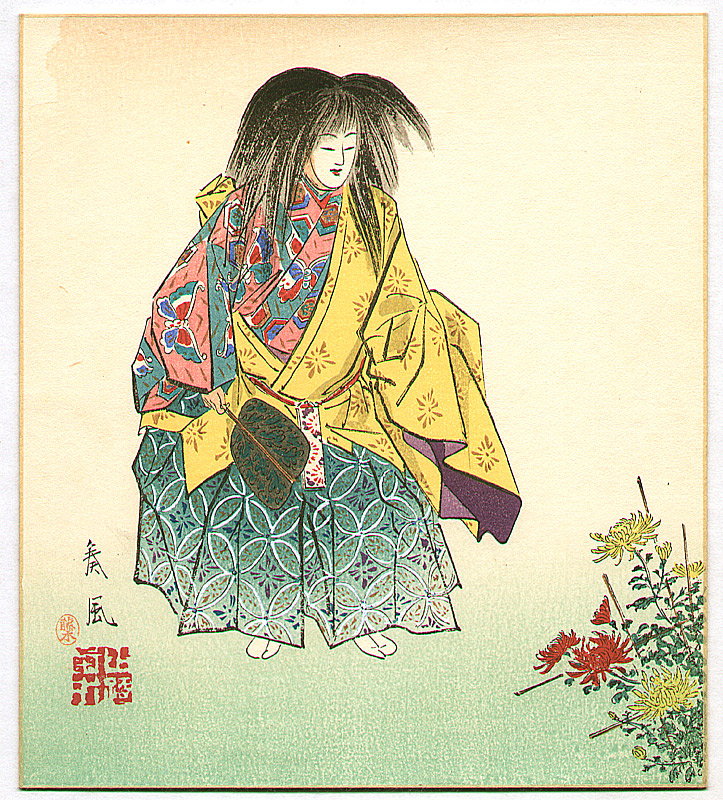
 Every year on September 9th from 13:00 UDAKA Michishige performs Makura-jido (aka Kiku-jido in other schools) as han-noh (only the second half of the play) at Horinji (法輪寺), a temple in the Arashiyama area, West of central Kyoto. I have posted about this annual event here, and so did Hanna McGaughey here. The play is set in China and tells the story of a young boy who was exiled to the mountains after he accidentally stepped on the Emperor’s pillow. Before being banished from the palace, as the court rites prescribe, the boy received from the Emperor lines of the Lotus Sutra, which he copied thousands times on chrysanthemum petals, an act that made him immortal… it is a very interesting story, with a Noh beautiful rendition.
Events
Young Noh performers series: annual East-West joint session 2013
 I just came back from the Yoseikai tozai godo kenkyu happyokai (養成会東西合同発表会), an annual performance session that brings together the participants to the yoseikai, a training and performance programme for Noh and Kyogen actors and musicians, from different parts of the country. The yoseikai is sponsored by the Bunkacho (Agency for Cultural Affairs), and is one of the few government-sponsored Noh activities.
Now some random thoughts about today’s event (I’m copying what I scribbled on the back of my programme). Firstly, it was GREAT to see many young performers on stage. It is difficult to describe this feeling, but I think it was the pleasure of feeling youthful vigour, perceiving the efforts, sensing the hopes of these performers, whose career as full professionals is just about to begin. It brought the world of Noh closer to the world I am living.
It was refreshing to see young performers as well as many different styles one next to the other: one of the characteristics of this annual event is that performers not only come from different parts of Japan, but also that they belong to artistic schools that you would not easily see on the same stage.
There definitely should be more opportunities to see Noh performed by young actors. I have two simple arguments for this:
- I have seen experienced actors who would not stand comparison with some of these young gentlemen (don’t give me Zeami’s flower of age, most of the ‘flowers’ I’ve seen have withered, or else they never really bloomed’). They go on stage simply because they rank higher due to seniority, and family name.
- More occasions for young performers to perform (especially shite actors) cannot but help them to hone their skills while they still have the physical and intellectual capability to shape their style.
Not only this: there should be more chances for actors of different schools to perform next to each other. I might be thinking of Kyoto in particular here, where only Kanze and Kongo schools are present. I think that actors should be able to travel more and be confronted with different audiences, and most importantly be exposed to various styles of many different performers. This already happens today, but it is not enough. Noh still is regulated by a bakufu-esque system of territorial subdivision, governed by the much ineffectual Noh Association. Instead of this Noh needs competition and meritocracy.
Finally, among the various things that must be done (yet are not done) to help young performers is advertising these performances, according to the principle of fuchi furai (不知不来, ‘if they don’t know, they don’t come’) Also, programmes should be less cryptical than they are now: they might contain pictures, short bios of performers, something that allows the audience to take an interest in who these people are. Of course, a specialised audience would not need any additional information, they would already know who the actors are, who their parents and grandparents are, etc.. in fact, that’s why programmes are accessible only to a specialised audience – because there is no other audience! It’s August, university hasn’t started yet, and yet! … performers were young and vigorous, but the audience was just out of the convalescent home waiting room, as always!!!
14th ‘Seiran Noh’ – MIDARE, FUTARI SHIZUKA

The Seiran-Noh (青蘭能) is a yearly performance at the Kongo Noh theatre in Kyoto featuring Udaka Michishige and his sons, Udaka Tatsushige and Udaka Norishige. Until now known as ‘Seigan Noh’, the event has recently changed its name into ‘Seiran’ honouring Udaka Michishige’s great-grandfather, painter Kawada Shoryo (1824-1898), who was closely related to Sakamoto Ryoma, one of the central characters in the Meiji restoration. Kawada’s favourite flower was the orchid (‘ran’ 蘭).
See below for ticket reservation
This year’s Seiran Noh (8 September 2013) features the Noh Midare, a special variation (kogaki) of the Noh Shōjō in which the midare-ashi a particularly unusual and challenging dance, is performed instead of the usual chu-no-mai medium tempo dance. Midare is a hiraki-mono, one of the plays marking a performer’s passage into a new phase of their career. This year Udaka Norishige will perform Midare, follow ing his father and elder brother’s steps.
The second play is Futari Shizuka, (‘Two Shizukas’), a third category play based on happenings and characters from the Genpei War tales. The special feature of this play is the instrumental dance performed by identically dressed shite and shite-tsure: the spirit of Minamoto no Yoshitsune’s lover Shizuka Gozen and a woman possessed by her. Futari Shizuka will be performed by Udaka Michishige and his eldest son, Udaka Tatsushige.
8 September 2013・The 14th Annual Udaka Seiran Noh Performance
Kongo Noh Theatre 1:30~5:00 p.m. (doors open at 1:00p.m.)
Noh: FUTARI SHIZUKA
Shite: UDAKA Michishige, Tsure: UDAKA Tatsushige
Kyogen: KURI YAKI
Shite: SHIGEYAMA Shime, Ado: SHIGEYAMA Motohiko
Noh: MIDARE
Shite: UDAKA Norishige
Tickets: Center Reserved Seats 7,000 yen, Side Reserved Seats 6,000 yen, General Admission Mid-center Seats 5,000 yen, Student, General Admission Mid-center Seats 2,000 yen
Synopses of the plays will be available at the theater in English, French, German, and Italian.
Contact me for information and ticket reservation
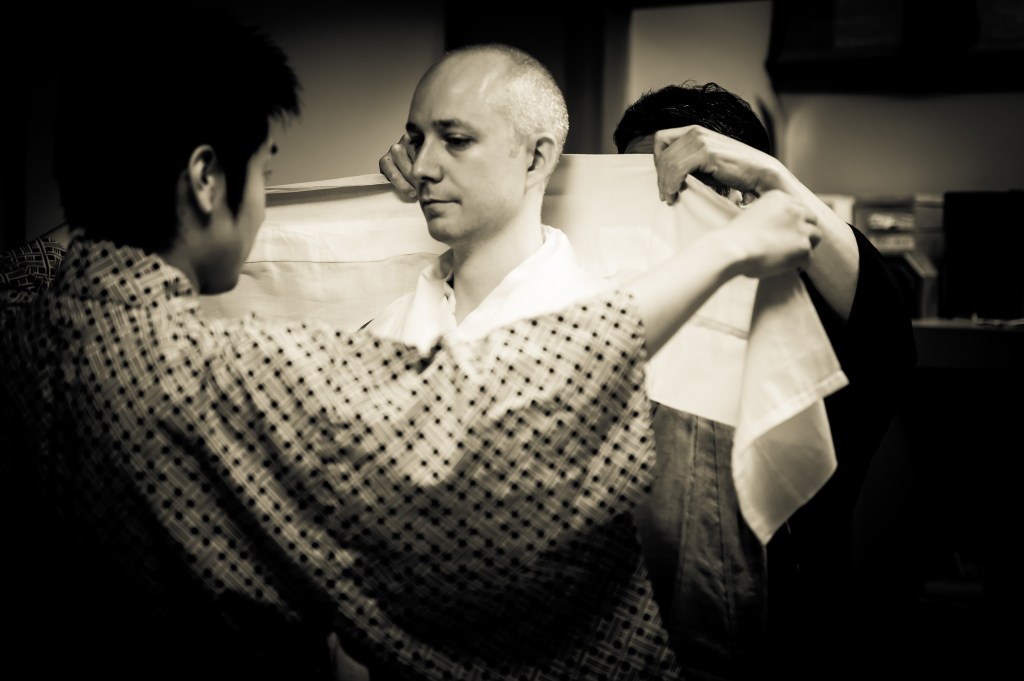
Kiyotsune seen by Stéphane Barbery
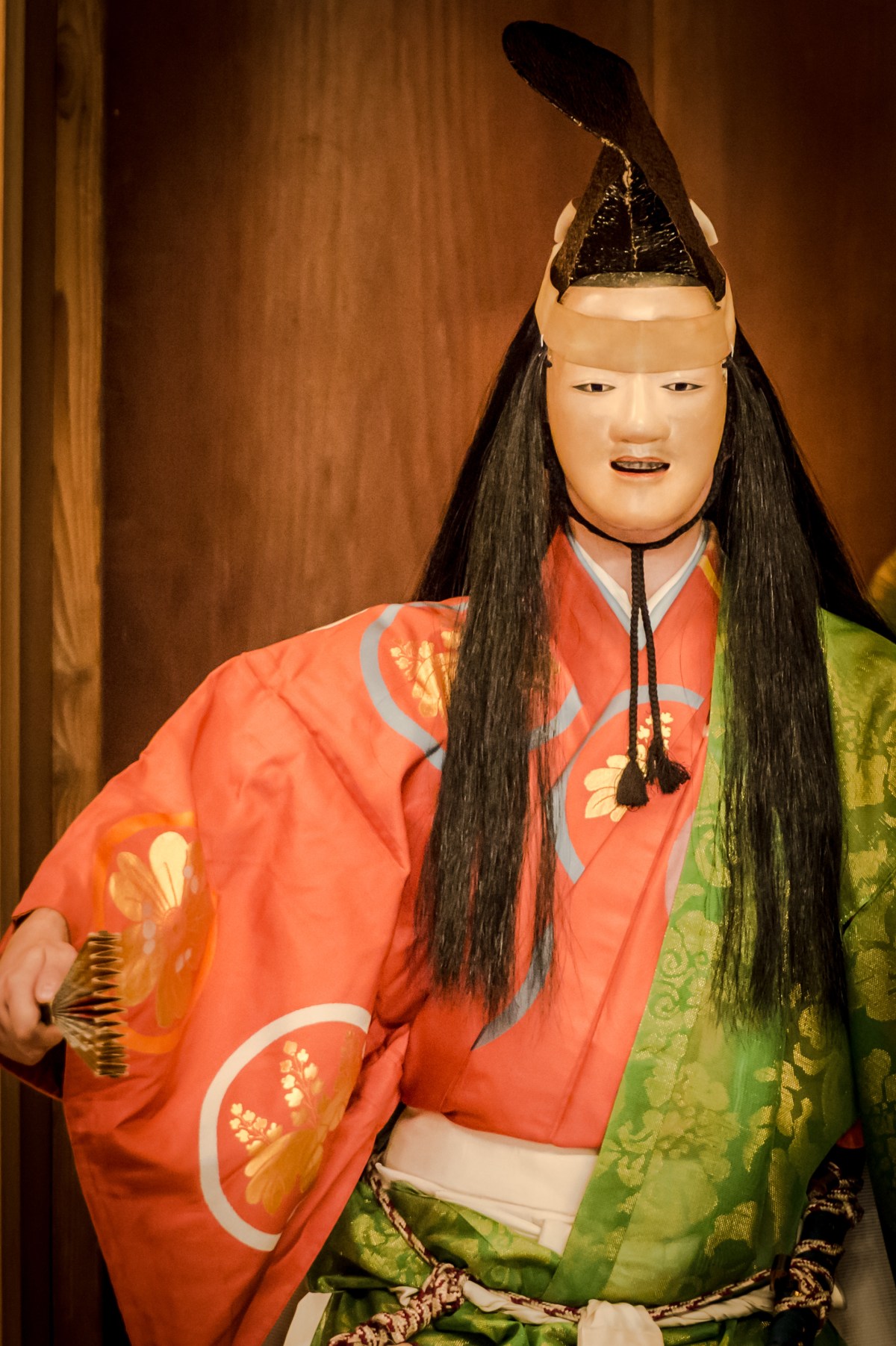
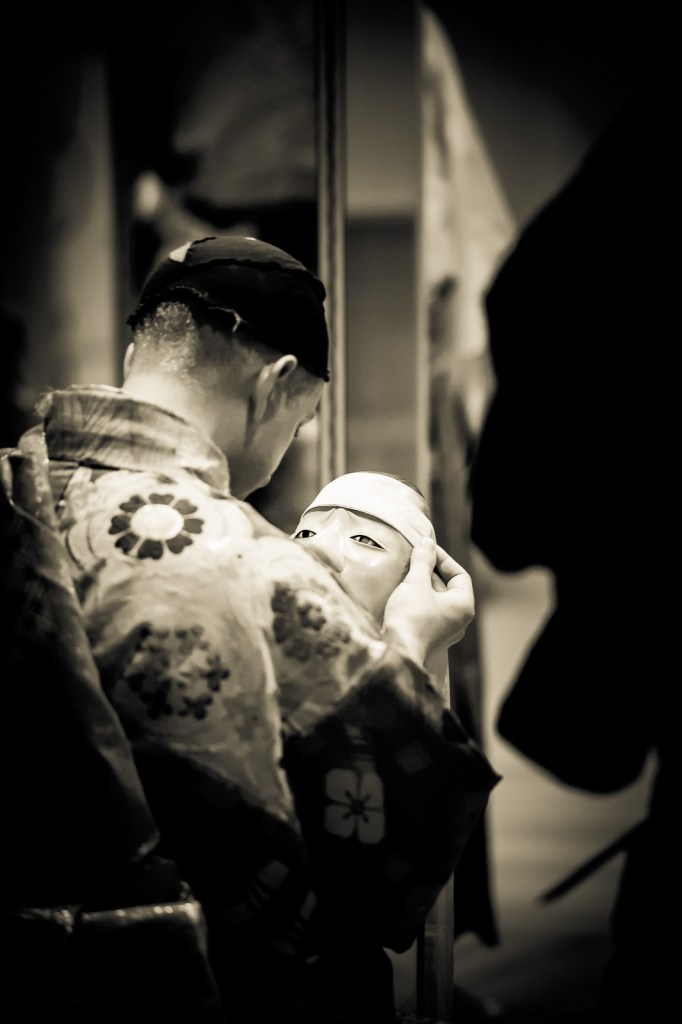
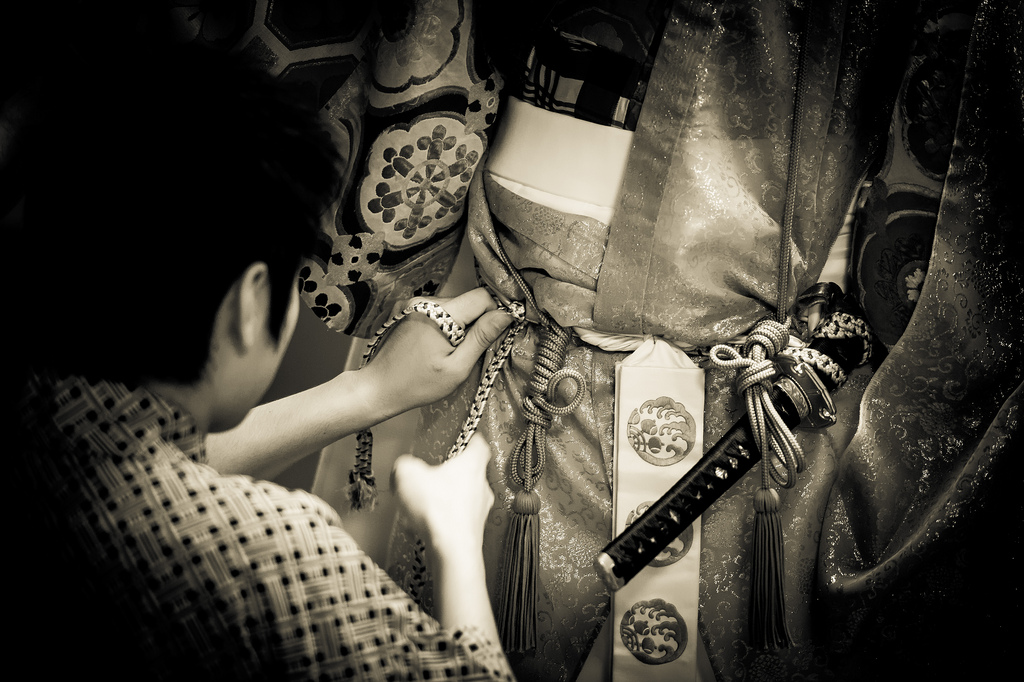
Kyoto-based French photographer Stéphane Barbery has worked with a number of Noh actors in Kyoto over the past few years, and has developed a special eye for capturing meaningful moments in the performance. Photographers working with Noh have to endure the torment of being assigned a fix position from where they can only shoot using a powerful zoom, hence losing much of the tridimensionality that the Noh stage in particular is able to convey to its audience. Stéphane mostly works with B&W which allows him to sharpen details and recreate depth even in low light conditions. I am sure you will agree he has done a wonderful job.
I am reposting a couple of stills from Kiyotsune (both the performance and the dress rehearsal) but I invite you to visit his Flickr page to see more of his amazing work!
Enjoy!
Diego


Fukyu Noh HASHI-BENKEI 7 July 2013

On Sunday 7 July 2013 at 17:00 the Iemoto Kongo Hisanori will perform the Noh Hashi-Benkei at the Kongo Noh Theatre in Kyoto. The performance is offered at the special price of 2,500yen with advanced booking so don’t hesitate to contact me if you want to reserve a ticket.
“Warrior-monk Musashibo Benkei has been warned that a young boy is attacking passersby at Gojo Bridge in the capital and taking their swords. Benkei is determined not to be frightened by such rumors and refuses to avoid the area. He goes to the bridge and sees there what seems to be the form of a young woman. In fact it is Ushiwaka, later to be known as Minamoto no Yoshitsune, a leader of his clan, who has made a vow to collect 1,000 swords, coming down from Mt. Kurama where his mother has ordered him to stay. The two fight, but Ushiwaka cleverly triumphs over Benkei who then becomes his faithful retainer.” (Summary by Ogamo Rebecca Teele)
Fukyu-Noh is a regular summer event aimed at introducing Noh to young/new spectators. The Noh will be preceded by a greeting from our teacher, Udaka Michishige (Vice-Director of the Kongo-kai) and by a short explanation by Prof. Ono Yoshiro (Kyoto Institute of Technology).
Kyoto Takigi Noh 2013: Oe-yama

KYOTO TAKIGI NOH
(Fire-lit performance)
Heian-jingu Shrine, Kyoto
1, 2 JUNE 2013
I strongly recommend those in Japan on June 1, 2 to come and attend the Heian Jingu Takigi Noh fire-lit performances in Kyoto. It is a unique chance to see full performances both by Kanze and Kongo master-actors, in the context of the evocative Heian-jingu shinto shrine. Performances begin at 5:30 (doors open at 4:30 and I encourage you to come before this time – seating is on a first come, first served basis) and end at around 8:45. Tickets are between 4,000 and 2,700 yen depending on the type. The INI International Noh Institute will have a stand with free information, translation and synopses in English – I will be there in person! ^_^ Do not hesitate to contact me if you are planning to come! See below for more info.
—- UPDATE : advance tickets are now sold out!
2 JUNE 2013 Noh: OE-YAMA
Mae-shite: UDAKA Michishige
大江山 OE-YAMA
Synopsis (from P.G. O’Neill’s A Guide to Noh)
Yorimitsu and his companions, disguising themselves as yamabushi priests, set off at the command of the Emperor to find and kill a demon known as Shuten-doji. Guided to his dwelling on Oe-yama by a woman who has been captured and made to work for him, they beg a night’s lodging there. Shuten-doji is alarmed that his hiding-place is has been discovered, but because of a promise he has made never to lift his hand against priests, he feels bound to receive them hospitably. They drink together, but later that night when he has taken on his true form as a demon, he is surprised in his sleep and eventually killed by his enemies.


“Gio” Kanze Kaikan, March 31st 2013

My teacher, Udaka Michishige was chosen by the Nihon Nōgakukai to perform the Noh Giō (祇王)at their annual “Noh appreciation event” on March 31st 2013. This year 3 performances will be held at the Kanzekaikan theatre in Kyoto: Ema, Giō, and Kokaji.
Giō is a play by Zeami, currently in the repertoire of the Hōshō, Kongō, and Kita (under the title Futari Giō) schools, though it is not often performed. Giō Gozen, one of the favourite dancers at the service of Taira no Kiyomori has helped dancer Hotoke Gozen to gain the lord’s favour. After having seen Hotoke’s dance, Kiyomori likes her more, but she promises Giō not to take her place. Similarly to the play Futari Shizuka, Giō has shite and tsure dancing in synchronous on stage.
See details below
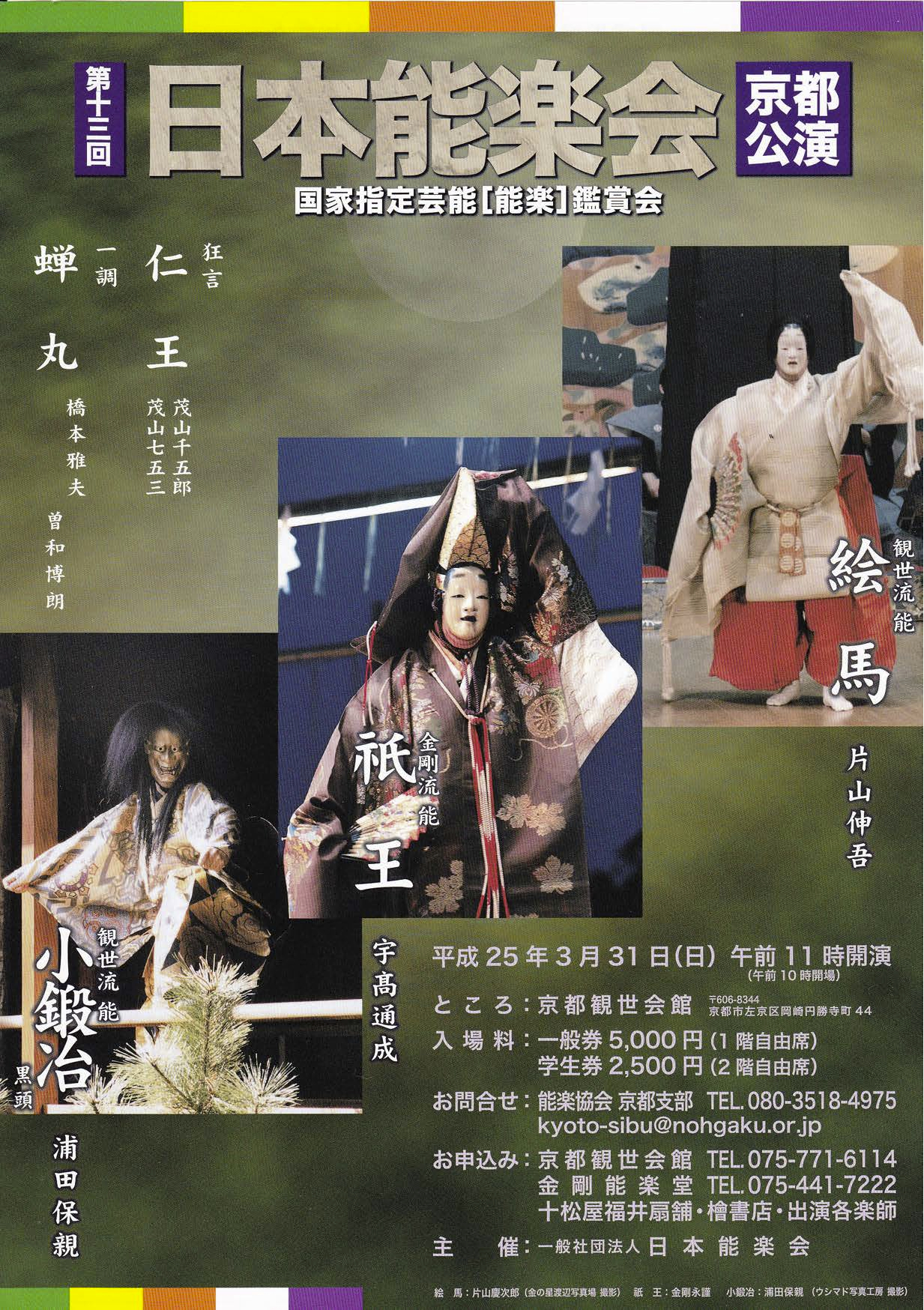

Date and Time: March 31, 2013 (Sunday) 11:00 a.m. ~16:30 p.m. (doors open at 10:30 a.m.)
Venue: Kanze Kaikan
Tickets: general admission 5,000 Yen (first floor) student 2,500 Yen (balcony)
A Program of Noh, Shimai dance excerpts, Kyogen, and Itcho, drum and chant duet
11:00 a.m. NOH featuring the Kanze School: EMA
13:30 p.m. NOH featuring the Kongo School: GIO Shite: UDAKA Michishige
Kyogen featuring the Okura School: NIO
15:20 p.m. NOH Featuring the Kanze School: KOKAJI Kurogashira
The Udaka Michishige-no-kai Office
(For questions or reservations.)
TEL: +81 (075) 701-1055
FAX :+81 (075) 701-1058
Email: ogamo-tr@mbox.kyoto-inet.or.jp
(For questions or reservations.)
TEL: +81 (075) 701-1055
FAX :+81 (075) 701-1058
Email: ogamo-tr@mbox.kyoto-inet.or.jp
Hatsubutai 2013
I am happy to announce that on June 29th 2013 I will take the role of shite (main actor) in the full production of a play from the traditional repertoire. The performance will take place at the Kongo Noh Theatre in Kyoto, on the occasion of the Udaka-kai Taikai, and will be my hatsubutai (初舞台, first appearance on stage) as main actor in a full production – with mask, costume and professional musicians. That’s all for now. I will be posting more about this event in the following weeks, so watch this space.
For now make sure you clear your schedule on June 29th (Sat). I am looking forward to meeting you in Kyoto and to celebrate after the performance!
Diego Pellecchia
Super-Noh: “Zeami”
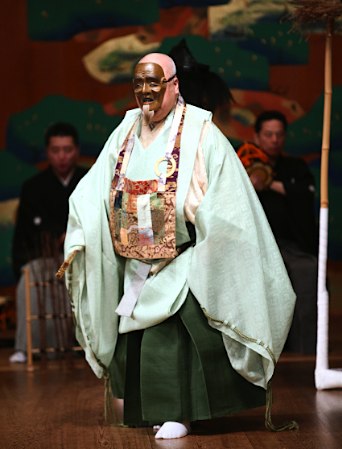
This year the National Noh Theatre in Tokyo is celebrating its 30th anniversary. The article on the first page of the February issue of the Nogaku Times reminded me of something I wanted to blog about a month ago or so, after a friend (journalist Okada Naoko) gave me a heads up about it: the first performance to open the special programme will be philosopher Umehara Takeshi’s ‘super-Noh’ Zeami (April 15 2013), featuring Kanze Actor Umewaka Gensho. The play was recently performed at the Kanze Theatre in Kyoto, though I could not go (it was a Wednesday, and I had okeiko).
As Umehara explains in an interview for the Asahi Asian Watch, in order for Noh to be able to speak to a broader audience, it is important to modernise its language. As Noh audiences are progressively ageing, actors and critics alike are concerned about what will be of Noh in the near future. Since the Noh establishment draws almost the entirety of its resources from the aficionados who buy seasonal passes, donate to fangroups and study as amateurs, no generational turnover means jeopardising the survival of the art. Umehara’s answer to the question of how to bring new spectators to Noh is modernising its language. “Its outdated words prevent people from enjoying Noh. If spectators cannot understand the dialogues, naturally they cannot enjoy Noh.” Umehara says (in translation).
I am concerned with the health of Noh spectatorship as much as Umehara is, but I am not convinced by his proposal to modernise the language. Saying that not understanding the dialogues ‘naturally’ leads to not understanding is an oversimplification to say the least. There is so much more in Noh to enjoy besides poetry. But of course one of its most important elements is the poetry that constitutes its literary basis. How does modernised Shakespeare sound to you? Sure, most people don’t understand Noh poetry (even if you knew how the verses go, Noh pronunciation distorts the words so much it is hard to follow anyway). The question that comes to mind is – what would my aesthetic experience be if the language were so familiar that I understood everything? I am not sure that ‘understanding’ is crucial to aesthetic appreciation, at least not in the way Umehara seems to put it.
“The strength of classical performing arts is their excellent techniques to grab their audiences’ attention, which have been polished over a long period. Using modern-day words, they can grab the hearts of a wide range of people,” Umehara says. Yes, and those techniques clearly stopped addressing the popular audience several centuries ago, when Noh became the art of the aristocracy, thus refining its aesthetics in ways that would have been unthinkable outside the intellectual milieu of which it became an essential component. Do we want Noh to speak the language of dorama? I say that we can leave this to other performing arts. The beauty of Noh lies in the undefined, that is, in its poetry. I wish Noh playhouses still used candles or gas-lights. There’s too much light on stage these days.
Shinshun Wakakusa Noh – Nara
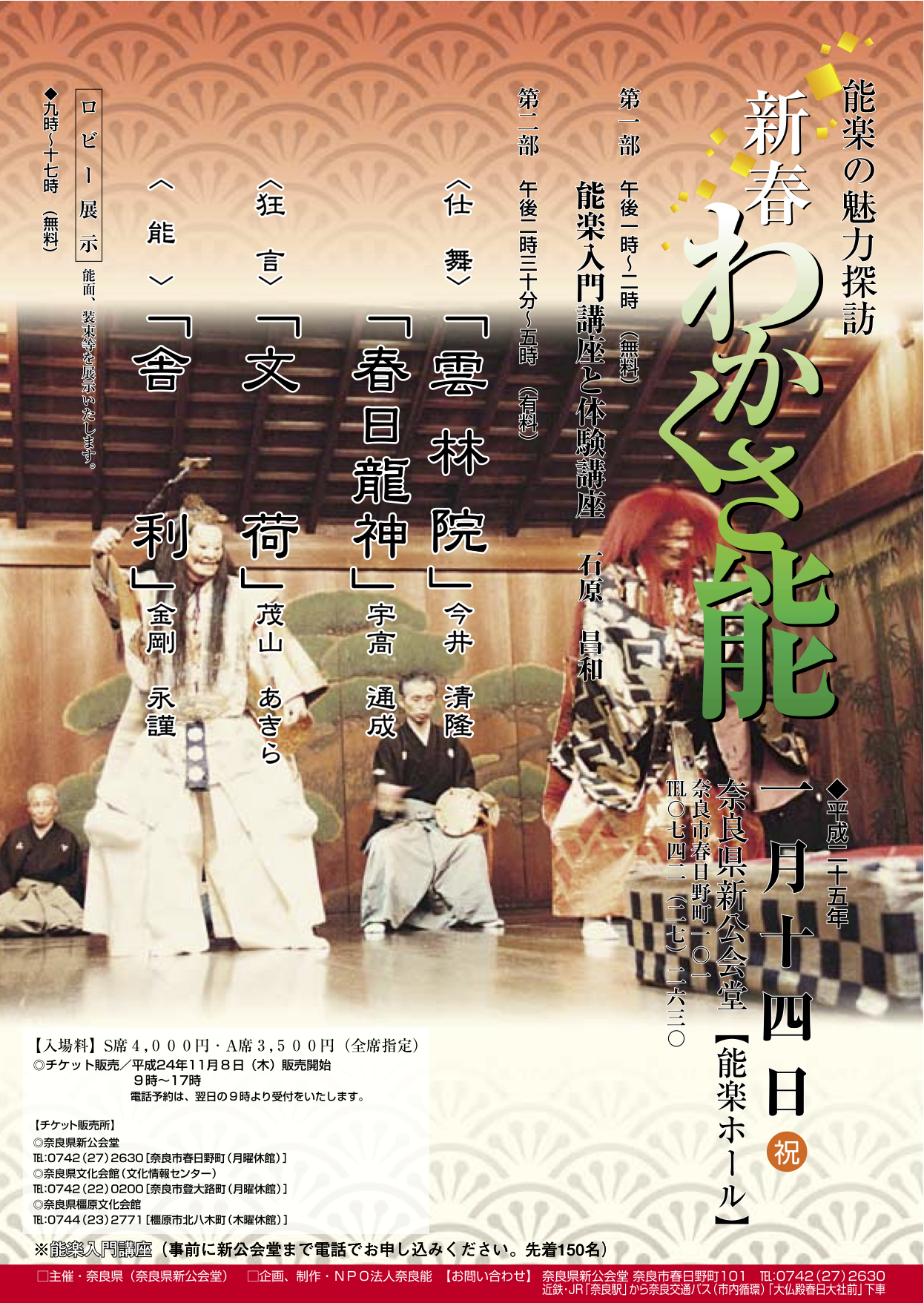
Just a quick note to signal the Shinshun Wakakusa Noh on January 14th in Nara (Prefectural Public Hall). The Oiemoto Kongo Hisanori will perform the Noh Shari (a very dynamic play in which a demon tries to steal the relics of a Buddha, only to be chased and chastised by the god Idaten) while Udaka Michishige will perform the shimai of the Noh Kasuga-Ryujin (‘The Dragon-God of Kasuga’, almost a site-specific piece!). Details here (in Japanese).
 The Noh Diaries