Shimai pictures – Yashima

I rarely publish pictures of myself on stage. Today I will make an exception as I received some great shots from Massimo Fioravanti, a very talented Italian photographer who has been following Udaka-sensei the past few months, taking pictures of performances and training sessions. Massimo has been working on various projects in Japan. Most notably, he published a photography book on Zuigan-ji in Matsushima, which has been severely damaged by the tsunami, and photographed the costumes collection of the Kongo family on the occasion of the 1989 exhibition at the Sforza Castle in Milan, published in a luscious volume.

In November 2012 Massimo came to Matsuyama where Sensei performed Sesshoseki (nyotai ‘female’ version). Before the performance there was a recital to which various members of the International Noh Institute took part with su-utai chant and shimai dances I did Yashima, which I have already blogged about here and here. Here are a couple of pictures that Massimo has kindly sent me.
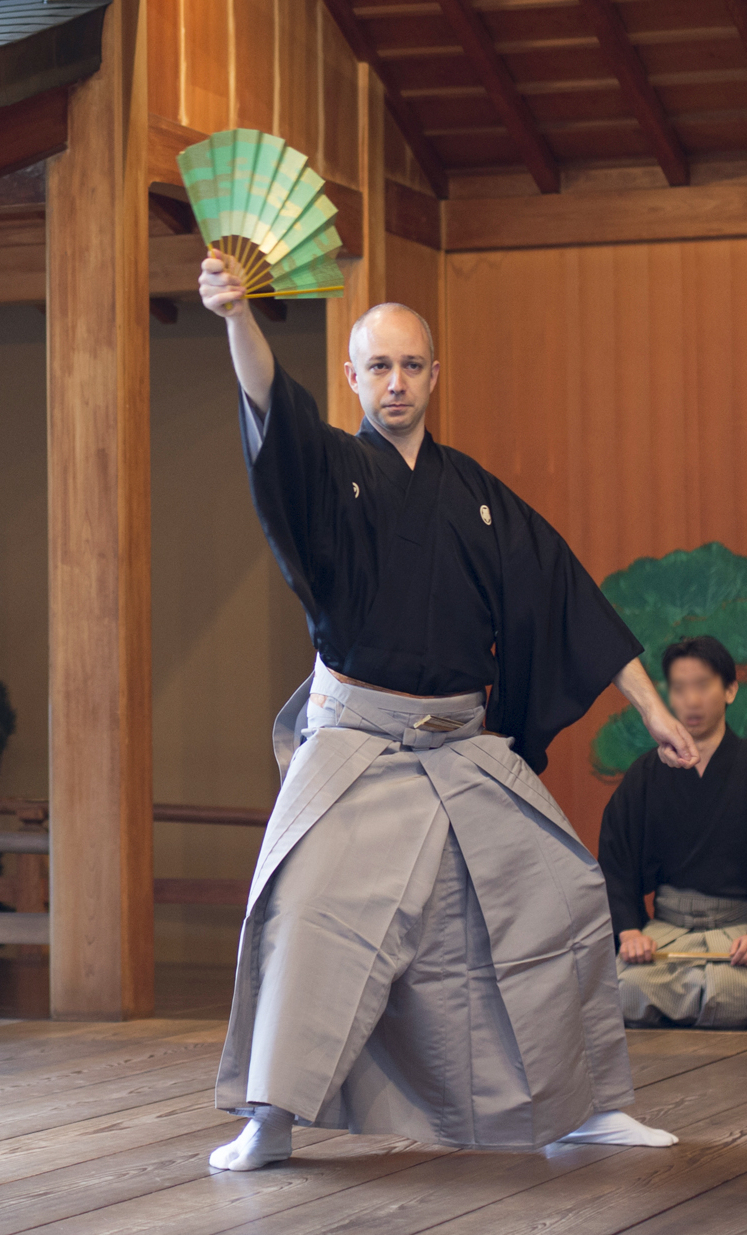
Yashima 1
… 海山一同に震動して…

For those new to Noh, a shimai is a short excerpt of a play, something like an aria in opera. Shimai dances are studied independently from the full Noh, and are often performed as complement of a programme featuring full plays. Masks and costumes are not used, but formal montsuki (a plain black or white silk kimono) and hakama – the equivalent of a formal Western suit. There is no hayashi orchestra playing, only a small chorus of four sitting in the back of the stage. A shimai is the adaptation of the dance that would be performed in the full Noh, so movements are slightly different, and props are rarely used. In the case of Yashima the shite holds a sword, here substituted by the fan – the open fan in my left hand is a shield (this is the way it is portrayed in the Noh, too).

Yashima 2
… 打ち合い刺し違ふる…

Publishing pictures of Noh performances is not easy because of copyright issues. I will try and post more pictures of me – if I have decent ones – in the future. Massimo Fioravanti has been taking some amazing pictures of Udaka-sensei’s performances during the past few months and he is planning to hold an exhibition (in Venice and in Rome) and hopefully to publish a catalogue afterwards, which I hope will be available internationally.

War dances in translation

Today I helped Udaka Norishige one of my teacher’s sons, with a Noh workshop at Iori Machiya in Kyoto. I don’t know much about the background of the workshop itself, as I only came upon request of Norishige-sensei, and my only duty was that of interpreting. The group of 18 people who participated to the workshop was mostly composed of Israeli and British citizens. Some of the Israeli participants were actually members of the Cameri Theatre of Tel Aviv, where director Ninagawa Yukio is currently working on an adaptation of the Trojan Women with a mixed Israeli-Palestinian-Japanese cast. 

At the end of the workshop, which was very well received by the enthusiastic participants (we were flooded with questions!) Udaka Michishige danced a shimai, while Norishige-sensei and I sang as a small chorus. The piece was Yashima, which I also recently performed in Matsuyama.

Yashima ô-kassen (八島大合戦, The Battle of Yashima) by Hayashi-ya Shôgorô

The Noh Yashima (second category, warrior plays) tells the story of the homonymous battle that took place in the late 12th century at Yashima Island, (present Takamatsu City, Kagawa Prefecture). Yashima is one of the most important battles of the Genpei War between the rival Minamoto and Heike clans. In Yashima the ghost of General Minamoto no Yoshitsune appears in front of a travelling monk and re-enacts various phases of the battle. Although the play Yashima is one of the three kachi-shura or ‘winning Noh’ (the other two being Tamura and Ebira), the tone of the play is far from being celebratory of the Minamoto victory. Death and killing is on both sides and as the chorus describes how, end of the battle, warriors scatter away like seagulls, while the ghost of Yoshitsune disappears in white foam, as the wind sweeps the desolate battlefield.

I wanted to write more in this post but I think I have actually said enough. Today I did my best.

Yashima island (image from the Samurai Archives)

Yashima shimai in Matsuyama

I am going to perform the shimai (short dance excerpt of a longer play) of the Noh Yashima on Friday 23rd November, on the occasion of Udaka Michishige’s performance at the Matsuyama Shimin Noh at the Dogo Yamatoya Nogakudo in Matsuyama.

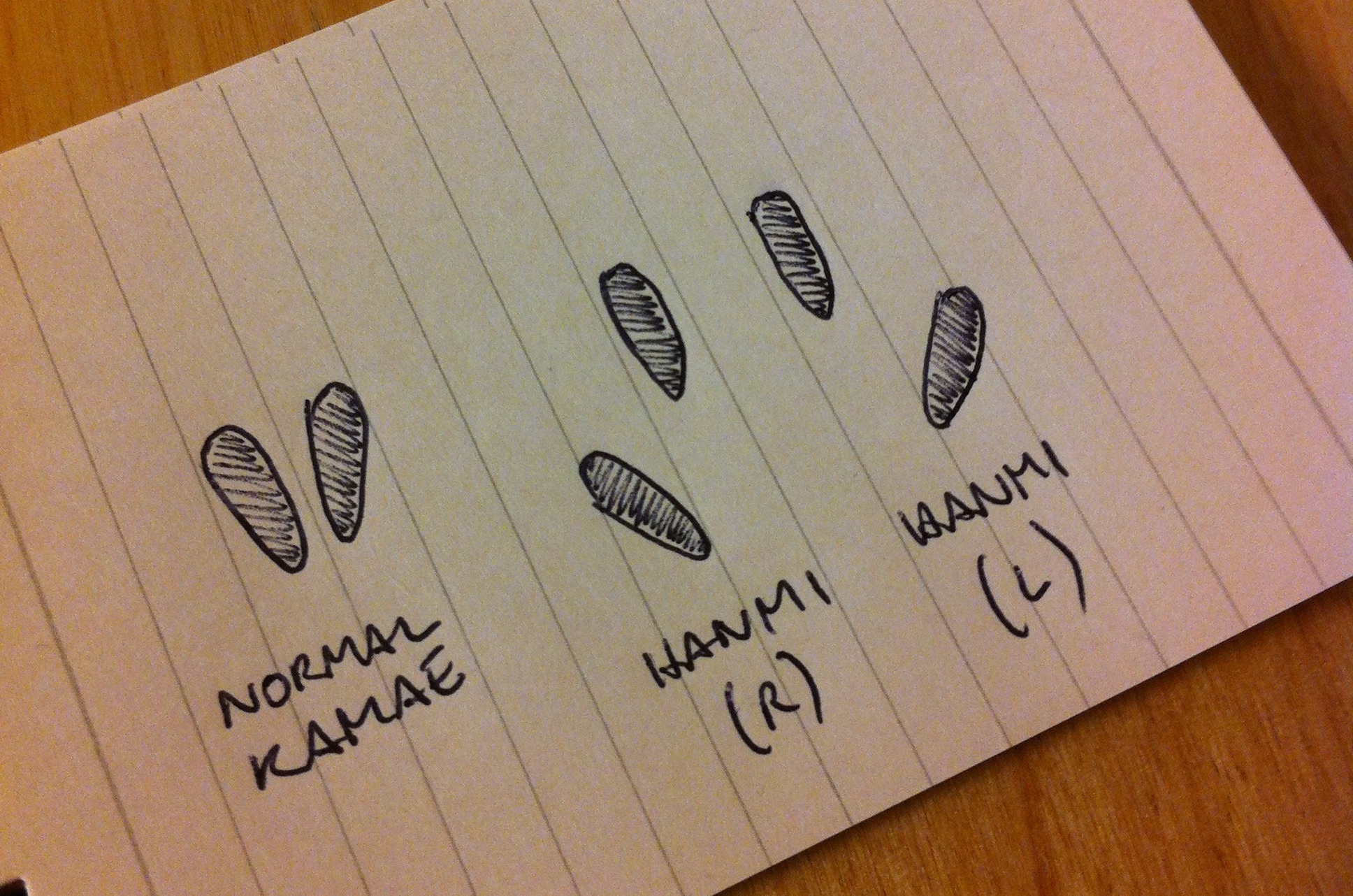
This is my third shura-mono (warrior play) shimai after I danced the kiri section of Tamura, and the maibayashi of Kiyotsune. As I have pointed out in a previous post, dancing shura-mono (second category plays) is rather challenging because of the kamae posture which in the case of warriors often switches to the hanmi (lit. ‘half-body) martial mode. This posture, thrusting half of the body forward, and keeping the other half covered, is probably familiar to those who practice any kind of martial art. The idea is offering the least possible amount of body to the opponent, while being ready to attack.

Hanmi feet (the way I see them)

Unlike the basic kamae, this position is fairly asymmetrical and requires advanced knowledge of weight distribution to master. One of the tricky bits of hanmi is walking: while basic kamae does not change while walking – one does not change much of the posture when either walking or simply standing – it is not possible to keep hanmi while taking more than a just a few steps. This means that the actor starts a movement in hanmi, then changes into a more symmetrical feet posture, and then ends the movement again in hanmi. Therefore, the last step of a walking sequence should be performed so that the body ends being in hanmi. Normally this produces a rather dramatic effect of enlargement of the figure of the shite as he comes to a halt, especially when approaching sumi, the corner of the Noh stage that is thrusted into the auditorium. Hanmi also influences all the other kata, for example shikake-hiraki (pointing and opening) might be performed in a right hanmi when pointing, switching to left hanmi when opening, and then back to normal.

My teacher seems to be keen on teaching me warrior dances lately: I don’t feel I am particularly prone to this kind of characters, but I trust my sensei’s experience of knowing when it is the right time to progress on this path.

Wish me good luck! (I might or might not have pictures of the performance to show in the future).

Matsuyama Shimin Noh 2012

11/23 – 28th Matsuyama Shimin Noh Performance

My teacher, Udaka Michishige is the descendant of the Udaka Clan, serving the Matsudaira lords in Matsuyama from 1712 until the beginning of the Meiji period, when the clan disbanded as a consequence of the upheavals of the Meiji restoration. Having the desire to restore the connection with his ancestors, Udaka-sensei has established a practice group in Matsuyama, where he eventually built a shiki-butai, a personal training space, in 1997. Udaka-sensei has been performing regularly in Matsuyama in various events, including the Shinonome Noh and the Matsuyama Shimin Noh. In addition, Udaka-sensei has been collaborating with the Matsuyama Shinonome shrine cataloguing and restoring the vast Noh masks and costumes collection.

This year’s performance for the Matsuyama Shimin Noh series will be Sesshōseki (‘The Death Rock’), centring on the figure of Tamamo-no-mae, the beautiful and lethal courtesan serving the Emperor Konoe (1139-1155), in reality an evil fox-spirit in disguise. In Sesshōseki a travelling monk meets the spirit of Tamamo-no-mae, now imprisoned in a rock that kills everything that touches it. Thanks to the mystic powers of the monk, Tamamo-no-mae is subdued. The ‘nyotai’ variation of Sesshōseki, which Udaka-sensei will perform on November 23rd in Matsuyama, features a different idetachi (costume, mask, wig set-up) for the shite, who appears as a more ‘feminine’ character  instead of the usual demonic or beastly shape. The performance will be preceded by a recital of su-utai and shimai by Udaka-sensei’s students – will write more about this soon.

Matsuyama Dogo  Yamatoya Nohgakudo 10:00 a.m.~5:00 p.m.

Part I    (10:00 a.m.~2:30 p.m.) :
Student recital of chant and dance~free of charge

Part II     (3:00 p.m.~5:00 p.m.) :
Maibayashi (excerpt with ensemble accompaniment):
JINEN KOJI  UDAKA Norishige
Noh:  SESSHOSEKI  Nyotai  Shite: UDAKA Michishige

General Admission ¥5,000   Advance Sale: ¥4,000
Student Admission ¥1,500

The Udaka Michishige-no-kai Office
(For questions or reservations.)
TEL: +81 (075) 701-1055
FAX :+81 (075) 701-1058
Email: ogamo-tr@mbox.kyoto-inet.or.jp

Hojogawa

An image of the contemporary Hojo ritual (©Asahi Shinbun)

Last Sunday I attended the Noh Hōjōgawa, which my teacher, Udaka Michishige, performed as part of the Teiki Noh (regular subscription series) at the Kongō theatre in Kyoto. Hōjōgawa is a rather unusal play – I learnt from Ogamo Rebecca Teele that it was the first time to be performed in sixty years, which probably means that the last person to perform it in our school was the late iemoto Kongō Iwao II. Hōjōgawa is a first category Noh (Kami-nō), and is attributed to Zeami. To my knowledge no full translation of he play has been published to date – the only available translation is by Ross Bender, who translated the first half, and has also written on the origin of the Hōjō ritual and its relation with the cult of the god Hachiman in places like Usa and Iwashimizu. In the play a shinto priest visits the Iwashimizu Hachiman shrine in Autumn, during the Hōjō-e ritual, when fish are returned to the river symbolising repentance for the killing of animals, prohibited by the Buddhist law. There he meets an old man carrying a pail with fish in it, who explains to the priest about the ritual. In the second half the god Takeuji appears and dances in celebration of the wealth of the country and of its emperor.

I thoroughly enjoyed the play which features the typical Kami-nō powerful entrance for the waki, and a stately Shin-no-jo-no-mai slow tempo dance. First category plays are not particularly interesting because of their dramaturgy – the real midokoro are the atmosphere of solemnity and sacredness brought by the presence of a god, and emphasised by special music, such as the long shin-no-issei for the entrance of Shite and Tsure in the first half, or the Raijo exit music, where Shite and Tsure, still in the form of commoners, exit the stage at the accompainment of the taiko stick drum, usually associated with supernatural beings, thus revealing their true identity.

11/3 – 10TH SANRINSHOJO: TORU「融」

10th, and Final, Sanrinshojo series Noh Performance

TORU

(Jusandan-no-mai)

Master-Actor UDAKA Michishige

3 November 2012 The National Noh Theatre, Tokyo
 1:30~4:20 p.m. (doors open at 12:30p.m.)

Synopses of the plays will be available at the theatre free of charge in English, French, German, and Italian.

UDAKA Michishige created his ‘Sanrinshojo series’ to take on the challenge of performing in Tokyo once a year one of the ten great classics of Noh drama. The title of the series is from lines in the Noh MIWA that refer to the development and purification of the body or action, speech or vocal expression, and mind or intention. When these become one on stage an unforgettable experience of the world of Noh occurs. Before this final performance of the series, UDAKA Michishige treasures advice he was given ten years ago, the words of Edo period poet Basho: “Do not follow in the footsteps of the men of the past; rather, seek what they sought”.

In the Noh Toru we meet the spirit of Minister Minamoto-no-Toru. He built a magnificent villa in Kyoto where he created a replica of the salt kilns of Shiogama in Miyagi prefecture. This highly evocative Noh describes the beauty of the Matsushima area, one of the three most famous scenic spots in Japan, through the eyes of Toru. The Noh closes with the Jusandan-no- mai, the kogaki variation featured in this year’s performance. A Dance in Thirteen Movements, it repeats the standard five movements of the Haya-mai Fast Tempo Dance in the Banshiki mode related to the element water, and closes with three movements of the Kyu-no-mai, Rapid Dance in a rapturous meditation on the fleeting beauty of life.

PROGRAMME:
Commentary:     Dr. ONO Yoshiro, Professor (Kyoto Institute of Technology)
Kyogen:                AKUTARO (MIYAKE Ukon)
Noh:                      TORU Jusandan-no-mai (UDAKA Michishige)

Tickets:
Reserved (stage front) 7,000 yen, Reserved (side) 6,000 yen, General admission (middle) 5,000 yen, Student (middle) 2,000 yen. For tickets or further information contact: ogamo-tr@mbox.kyoto-inet.or.jp and mention INI (International Noh Institute) when you book your ticket!

↓↓↓ Download the programme below ↓↓↓

The 13th Annual Udaka Seigan-Noh

9 September 2012

Kongo Noh Theatre 1:30~4:30 p.m. (doors open at 1:00p.m)

Noh: YASHIMA Shite: UDAKA Tatsushige

Tsure: UDAKA Norishige
(Masks:  Sanko-jo and Heita)

Kyogen: CHIKUBUSHIMA MAIRI  Shite: SHIGEYAMA Shime
Ado: SHIGEYAMA Akira

Noh: MAKURA JIDO Zengo-no-narai JIDO AND THE PILLOW”
Shite: UDAKA Michishige
(Mask: Doji)

Tickets: Center Reserved Seats 7,000 yen
Side Reserved Seats 6,000 yen
General Admission Mid-center Seats 5,000 yen
Student, Balcony Seats 2,000 yen

Synopses of the plays will be available at the theater in English, 
French, German, and Italian.

The Udaka Michishige-no-kai Office
(For questions or reservations.)
TEL: +81 (075) 701-1055
FAX :+81 (075) 701-1058
Email: ogamo-tr@mbox.kyoto-inet.or.jp

Taiko at 夏季研究会

This year’s summer kenkyukai will take place at Otsu dentogeino kaikan, a Noh theatre next to Miidera, on the Biwa lake. I will perform the maibayashi of the Noh
Kiyotsune, will serve in the chorus of the Noh Yashima and Ama, and finally play the taiko drum for the chu-no-mai dance from the Noh Shojo. This is my third attempt at taiko chu-no-mai and I feel I have improved a lot, though I still make mistakes. I realised that improving means being more and more aware of what the other instruments do, rather of how well you play your part. This form of music is collective, after all. Again I can see here an ethical value in an aesthetic context: an excess of concentration on one’s own role results in the lowering of the overall aesthetic result. Obviously this does apply to all forms of music, but for some odd reason I only realised it now…

Art Project Hōnōmai – ‘Yuki’

Iori is a beautiful Kyoto machiya (traditional guesthouse), offering traditional art courses and art-related activities. In this clip Noh actor Udaka Tatsushige (son of my teacher, Udaka Michishige) is performing the shimai from the Noh Yuki (‘Snow’), a play that is exclusive to the Kongō school repertoire. In the Noh Yuki, a priest on his way to the Tennō-ji temple is caught in a snowstorm when he encounters a mysterious woman, who in reality is the spirit of snow. After reading a sutra, the woman dances as she disappears in a whirlwind of snow. I saw this Noh performed by Ogamo Rebecca Teele in the recital to which I participated June 2010. It is a very refined, delicate Noh, where all sounds and movements seem to be softened by the snow. Even the typical stomps of certain Noh dances are performed so that the feet softly touch the floor, producing no sound.

アートプロジェクト2012『奉納舞』Collaborate with Art and Noh Drama

“Kyoto Kyo-Machiya Stay Arts Project –Art and Noh Drama Collaboration-”
Iori Co. also offers a unique designed program for experiencing the traditional culture of Japan.
For cerebrating the first Project, there was Noh Drama performing collaborating with four Artists’ works of Art.

「京都・京町家ステイ・アートプロジェクト」参加作家によるコラボレーション奉納舞
京都で伝統文化体験を提供する庵。事務所に併設された稽古舞台には、プロジェクトの記念すべき第1回参加作家4名が、それぞれの作品を共鳴させた特別しつらいがなされ、金­剛流シテ方 宇高竜成さんが、「雪」を舞った。

March 11/Sunday Great East Japan Earthquake Memorial Service and Prayer for Rebuilding at Soji-ji, (Soto-zen Daihonzan)

A memorial service and votive performances in celebration of renewal
and reconstruction
will be held at Sojo-ji in Tsurumi Ward, Yokohama.
Schedule of events:
11:30  Memorial Service
12:00  Offering of a Taiko drum performance by 108 volunteers and flower arrangement offering
12:30  Chanting of the Kannon 10 Great Prayers
12:45  Noh:  SHAKKYO Sange-no-shiki”  Shite (White Lion) : UDAKA Michishige, Tsure (First and Second Red Lions): Tatsushige and Norishige
13:30  Special Lecture
14:46  Silent prayer as the temple bell is rung to mark the time of the earthquake

実盛表

Admission:  free of charge
For information in Japanese call the Daihonzan Sojo-ji information
office: 045・581・6021
Access: click here for a map in Japanese