Autumn is finally here! The leaves are turning to beautiful shades of red and gold in the crisp autumn air, and we are getting ready to admire the gorgeous foliage on the hills that surround Kyoto, the ancient capital. In this wonderful and refreshing atmosphere we renew our invitation to visit Udaka Michishige’s Noh mask carving atelier.
Udaka Michishige is unique in being both a Noh actor and a mask carver. Students in his mask carving classes in Kyoto, Nagoya and Tokyo learn to sculpt masks of a high quality that can be used on stage. Every two years a group mask exhibition is held in Kyoto to show the latest results of students efforts. These mask exhibitions include free-standing displays of some masks, performance pictures, costumes and lecture-demonstrations to promote a deeper understanding of the place of the Noh mask in the world of Noh.
This is the first of a series of posts on photographers who have worked with the INI and with Udaka Michishige.
Irwin Wong is a professional photographer based in Tokyo. A few months ago he contacted the INI as he was looking to arrange a photo shoot commissioned by camera maker Hasselblad for the advertising campaign of their new model. We arranged to meet at Iori, a machiya, or traditional house in downtown Kyoto: Michishige brought his costumes and the masks he carves, and his sons Tatsushige and Norishige helped him with the complex dressing process. Irwin brought his camera and lighting equipment, while his collaborator Kondō Keiichi filmed the behind-the-scenes that you can watch in the video below. It was very productive day and Irwin’s pictures are just stunning: make sure to check out his post on the photo session, which also includes technical information about the cameras and the lights.
SPECIAL PROMOTION! The INI is offering 5 ‘buy one, get one free’ tickets to the 15th Udaka Seiran Noh on September 14th (Sun). The promotion applies to general admission mid-center seats (5,000 yen). Available until Sept. 1st. Contact the INI to apply.
This year the annual Udaka Seiran Noh performance will feature the Noh Ataka with the very special kogaki (performance variations) ennen takinagashi, kai-tsuke kai-date. Udaka Michishige will take the leading shite role, while his sons Tatsushige and Norishige will take the tsure supporting roles as disguised yamabushi priests. Michishige’s eldest son Tatsushige will also perform his first Noh with a kogaki: Hagoromo (banshiki variation).
Minamoto no Yoshitsune, one of Japan’s tragic heros, is known as a talented and charismatic general, and as the lover of shirabyoshi dancer Shizuka Gozen. The relatiohship between Yoshitsune and his retainer, the warrior-monk Musashibo Benkei, is particularly celebrated in the Noh plays Hashi-Benkei, Funa-Benkei, and Ataka. In all of these Noh the role of Yoshitsune is played by a ko-kata, or child actor. In Ataka the role of Musashibo Benkei is taken by the shite, or main player.
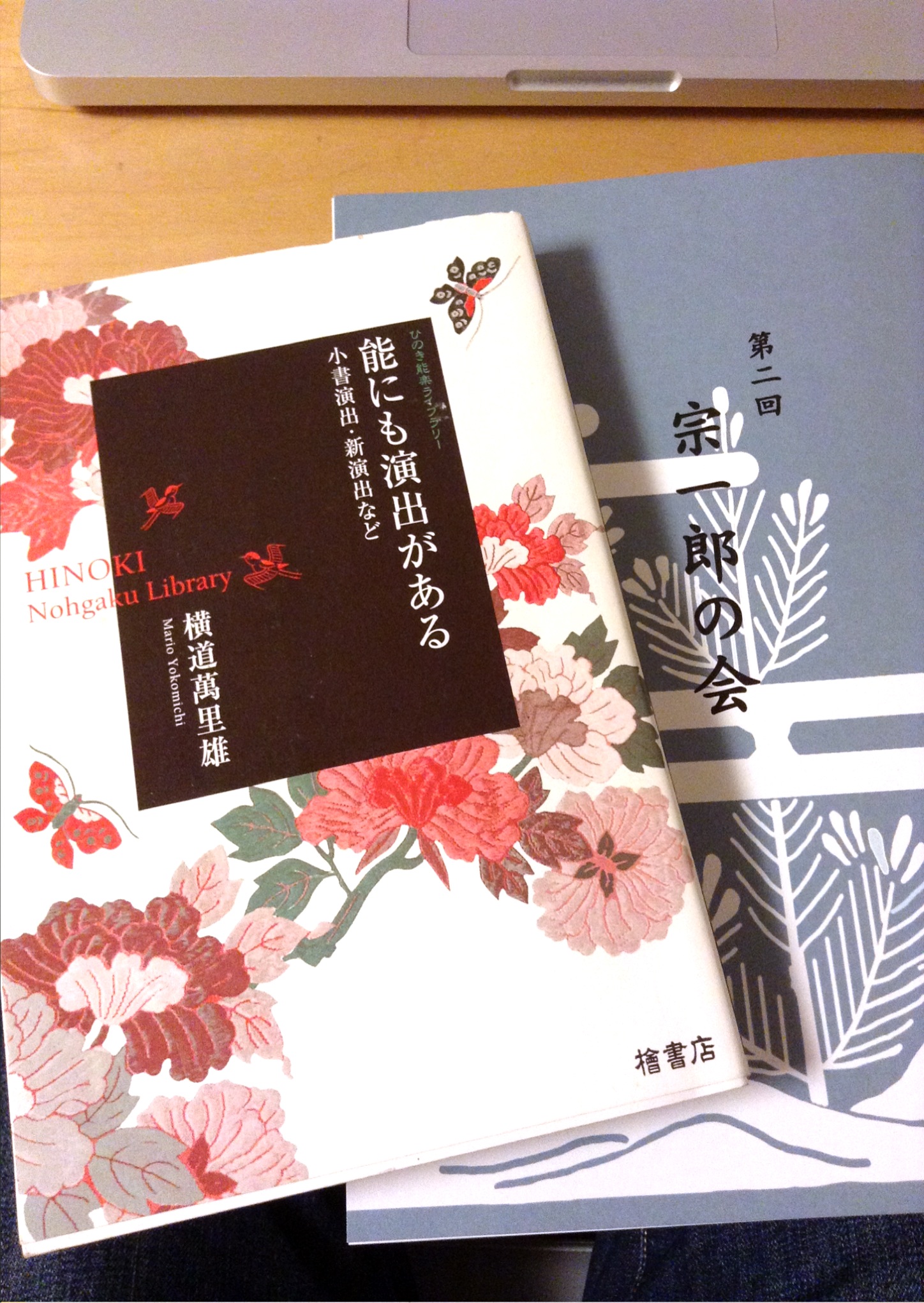
Today I went to the second Sōichirō-no-kai performance, organised by young Kanze school shite actor Hayashi Sōichirō. The main performance was Matsukaze, performed by Sōichirō and Sakaguchi Takanobu. The Kanze Iemoto, Kanze Kiyokazu (whose name is written 清河寿 and not 清和 starting this year) was the chorus leader, but also performed the maibayashi Tōru,shaku-no-maikogaki (staging variation) before Matsukaze. Since I will perform the maibayashi from the Noh Tōru next August I thought I would go and watch this performance.
What an interesting performance! The normal version of Tōru features a haya-mai rapid tempo dance in 5 dan or sections. The Kongō school usually stages it as banshiki haya-mai, where banshiki indicates a shift in the flute mode during the second section (shodan). Among the variations in the Kongō repertoire is also the extremely demanding jū-san-dan no mai, or 13 movements dance, which Udaka Michishige danced last year at the National Noh Theatre in Tokyo.
The shaku-no-mai (酌之舞) kogaki, exclusive of the Kanze school, begins with a special tachimawari circling of the stage, followed by a shortened version of the hayamai, filled with special movements (for example the tappai position that signals the beginning of the dance is unusually performed while kneeling at jō-za, in front of the taiko player). What makes this kogaki particularly special is that the initial tachimawari is actually derived from the okina-no-mai dance in the ritual Okina. The shite goes to sumi (downstage right) and waki-za (downstage left) and stands still facing front while the flute plays one long, piercing note. In the context of Tōru I interpreted this as the spirit of the minister Minamoto no Toru contemplating the scenery of his villa in Kyoto (and the scenery of Matsushima and Michinoku that the villa itself reflects), his heart filled with nostalgia. It is a rather intense moment. Then the shite stamps exactly like in Okina, before completing the tachimawari and getting ready for the beginning of the actual hayamai.
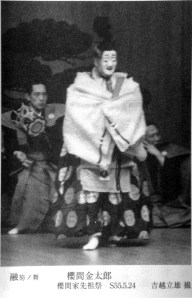
Konparu school actor Sakurama Kintaro
Another interesting thing is the name of this kogaki. The Kanze school performs the 酌之舞, where 酌 (shaku) is the act of pouring beverages, in this case rice wine. In the play, the spirit of the minister Minamoto no Tōru observes the full moon reflected on a cup of rice wine, as he used to let cups flow on the surface of the artificial sea he created within his Kyoto residence, Kawara-no-in, during the banquets he used to hold there. However, Konparu, Kita and Hōshō schools perform the 笏之舞, where 笏 shaku is the wooden rod that was part of the formal gear of high ranking aristocrats such as Minamoto no Tōru, and that nowadays only shinto priests use. In this variation the shite uses an actual wooden shaku instead of the fan.
PS: Yokomichi Mario’s book on kogaki Nō ni mo enshutsu ga aru (Hinoki 2007) comes in very handy for checking variations of many Noh plays.
Teaching Noh and Kyogen at elementary, middle, and high schools is part of a larger plan to educate the Japanese youth in the Japanese classic performing arts introduced by the ministry of education in recent years. This sounds like a good idea, as one of the biggest problems the contemporary world of Noh is facing is its inability to attract young audiences. If kids received more exposure to Noh and Kyogen, they could grow an interest in it, or at least it would not feel as alien as it does to most young Japanese. Teaching Noh at school sounds good… but how? Critics of this educational plan pointed out how school teachers, many of whom are ignorant of the classic arts in general, are in fact the reason why kids don’t get to like Noh and Kyogen. Adding plays to textbooks is not sufficient: teachers need to know what they are talking about in order to make the topic meaningful and engaging.
Kongo School Noh workshop at Uji Shiritsu Nanbu Elementary School
In order to address this important issue the Nōgaku Kyōkai (Noh Professionals Association) has organised educational activities in which Noh professionals visit schools and give workshops both to students and teachers. Last year I attended one of these at the Uji Shiritsu Nanbu Elementary School. The workshop was led by Udaka Tatsushige, who is one of the performers in charge of such activities for the Kyoto area. It was an interesting experience, and he students responded very well to the various activities offered.
Kongo School Noh workshop at Uji Shiritsu Nanbu Elementary School
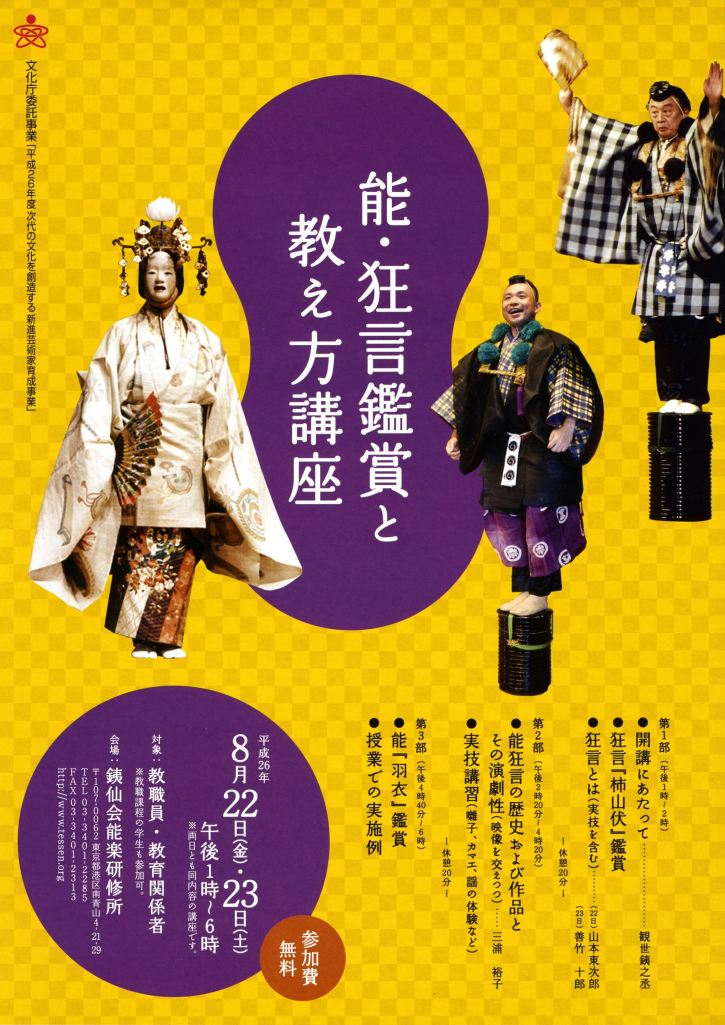
However, sporadic visits to schools will not yield outstanding results: some Noh groups such as the Katayama family in Kyoto and the Tessen-kai in Tokyo are providing more extensive and regular teaching sessions, specifically aimed at instructing the teachers, who will then be able to lecture on Noh and Kyogen even without the need of specialists. One of these sessions, commissioned by the Agency for Cultural Affaires and organised by Tessen-kai, will take place at the Tessen-kai research office in Tokyo on August 22nd and 23rd from 13:00 to 18:00. This event targets school teachers and educators, who will be able attend the performance of the Kyogen Kaki Yamabushi (‘Persimmon Yamabushi’) and the Noh Hagoromo (‘The Robe of Feathers’), plays that feature current school textbooks. Participants will also join practical sessions on performance techniques, as well as lectures on the dramaturgy and history of Noh and Kyogen. The event is free of charge.
The 12th Kongō-ryū Fukyū Noh performance will take place on 6 July 2014 at the Kongo Noh Theatre in Kyoto. This year the Iemoto (grand-master) of the Kongō School, Kongō Hisanori, and his son, Kongō Tatsunori, will share the shite main roles in Aoi-no-ue, a ‘classic’ play that draws from episodes of the Genji Monogatari. In this Noh the spirit of Rokujō no Miyasudokoro, transfigured by jealousy after being rejected by Prince Genji, attacks the woman that has replaced her, Lady Aoi. The Kongō Fukyū Noh is a special event that seeks to disseminate the culture of Noh to the public: non-Japanese students can apply to get a FREE TICKET! 50 free tickets are available, and the deadline is June 23rd.Contact us for information on how to apply.
It’s finally LIVE!The INI – International Noh Institute has a website of its own, with a blog section, a gallery etc. We literally just got it started, and we look forward to upload lots of information about who we are, what we do, etc. If you are interested in keeping updated don’t forget to subscribe to the blog, like us on Facebook, and follow us on Twitter. From now on I will use 外国人と能 The Noh Diaries only to post personal reflections on the various topics I usually treat here. All official announcements about performances, workshops, exhibitions from the International Noh Institute will be posted on the newINI website. I encourage all my readers and subscribers who wish to to continue receiving updates about the INI activities to subscribe to the new website.
People often wonder what differences are there between Noh stylistic schools, or ryū. In this video Kanze actorKatayama Shingo (on the left), and Kongō actorTeshima Kōji (on the right) demonstrate side by side a number of kata that exemplify various differences between shite dance styles. Ō-tsuzumi (hip-drum) player Taniguchi Masayoshi, conducting the experiment, introduces the two styles according to a well-established view of Kanze style as refined, purified from unnecessary movements, and Kongō style as elaborate, focusing on bodily technique. From 19:14 you can watch the performance of the shimai dance excerpt from the Noh Yashima, followed by an analysis of the kata differences. From 30:00 the chant of the kiri final section of Hagoromo is compared. Again, Kanze is thought to be refined while Kongō is dynamic. Ask anyone in the Noh about the differences between these schools and they will most likely say something very similar to this. I have my reservations about what seems to be anoversimplification or even a stereotype, though I understand why marketing requires (over)simplification in order to enhance penetration. Kongō dance is often more theatrical, featuring wide movements, but Kanze dance can be very elaborate, too. If refined means heavily embellished then Kanze chanting style certainly is refined. However I think that, if properly performed, Kongō school’s more essential chanting style is equally sophisticated. Anyway here is the video – you don’t need to know Japanese to enjoy.
(sorry for the HTML code below the video – I don’t seem to be able to delete it when embedding USTREAM…)
Fantastic novel, but horrendous cover design. Then you wonder why people think Noh masks are scary. I never thought an onnamen (female mask) was scary until I saw this! Luckily the Italian edition which I read ages ago has a more plain cover art. And by the way, onnamen is the original title, not just ‘masks’… Ah, now I see why they needed to add the creepy female mask picture.
Tomorrow I will be dancing the tennyo-no-mai (a variation of the chu-no-mai) as nochi-tsure (supporting role in the second half) in the noh Kamo at a training session tomorrow. After many roles in ‘han-mi’ martial stance, I’m going back to a character with a rather feminine stance, probably the first time with awareness of the character. The nochi-tsure of Kamo is the mother of the thunder-god Wakeikazuchi, who later became a goddess herself. Goddesses of this kind are not easy to perform as they are both feminine and stately (‘godly’?) at the same time, and I have been instructed to use large arm movements (I would wear a chōken dance cloak in a full Noh) but keep a my knees together and take small steps. For people with big feet like myself (27.5cm) this is not an easy thing to do, as it forces you to slide-step for even less than the length of the actual foot. It might not be too difficult in a slow dance, but the tennyo-no-mai I am doing tomorrow is a rather ‘light’ dance, which is supposed to be performed smoothly and at a rather rapid pace, in creating contrast with the stronger and more imposing movements of the shite (the god Wakeikazuchi), dancing after the tsure.
Although Japanese actors too come in all shapes (from super-tall to extra-wide) I always find myself wondering whether this body of mine is not inadequate to perform this genre. Compared to east-asian standards, I have narrow shoulders, a long neck, long feet and most of all long arms, which means that I need to adjust all these proportions in order to look better in kamae (basic stance). I will need to make an extra effort and try to be stable despite the fast, little steps I have to take during the dance. However, the other day my teacher’s son revealed a good trick for people with long legs/feet… I shall try and see if it works tomorrow!








 The Noh Diaries