It seems that the Kyoto university Noh theatre club is getting ready for the new term. As far as Noh is concerned, Kanze, Kongo and Hosho school are represented. Interesting graphic, very ‘kyodaiesque’…
Noh club

A new blog on traditional Japanese theatre by a Tokyo-based, non-Japanese researcher.

Noh 能 or nōgaku 能楽 is a multifaceted art combining music, dance, chant, masked acting, and beyond them all a kind of cultural memory shared by the performers and the audience, which allows for details of the story to be left unsaid, only alluded to.
The best way to know this theatre form is unarguably through the performance itself – to experience the tempo of the actor’s movement on stage, to feel the chills at seeing the expression of the mask he is wearing, to hear the music of the flute and the rhythm of the drums – all hinting at the fact that you are witnessing an apparition from another world. The acting techniques and all the details of the performance have been handed out through generations of actors and the long history of this tradition gives noh its specific atmosphere.
On the other hand, a more accessible way of…
View original post 510 more words
Someone just posted info about this exhibition at Portland Art Museum on the AAP mailing list.

This special exhibition presents a selection of traditional masks, costumes, and musical instruments that evoke the solemnity and celebratory splendor of Noh, while woodblock prints illustrate the performance on stage.
 I am happy to announce that I was selected as a winner of the IFTR International Federation for Theatre Research New Scholars’ Prize 2012-2013 for my essay “Ezra Pound and the Politics of Noh Films”, which I hope to publish soon. I will receive the prize on the occasion of the IFTR annual conference in Barcelona 21-26 July 2013, which I look forward to attend.
This is one of those situations where an academic who also blogs about academic topics would like to reveal more about his work but cannot because he has to wait for the actual paper to be out there lest his stuff is illegitimately taken by some ill-intentioned guy (it happens all the time). See Travis Seifman’s thoughts on academic posting online. Anyway I am very excited about receiving the prize, and I can’t wait to publish the article!
See you guys in Barcelona!
D.
Walking is one of the fundamental elements of Noh. I like the appellation hakobi (carrying) rather than suriashi (sliding steps) because hakobi gives the idea of carrying a weight, which is indeed what you actually do when you walk this way. The movement of your body on the stage should be controlled and inexorable, like that of a heavy locomotive. Iron bars turn the wheels, but the vehicle above does not jolt.
Forget about learning difficult pieces, showy kata, and focus on walking. Spend a lot of time just walking back and forth. If your walking is good you have accomplished 50% of the overall performance.
 Bitter review on the Nogaku Times for the recent performance of Takahime, Yokomichi Mario’s retro-version of Yeats’s Noh-influenced play for dancers At the Hawk’s Well (1916), on stage at the National Noh Theatre in Tokyo on December 25h 2012. Takahime is a ‘shinsaku-Noh’ or ‘newly composed Noh’, the denomination of those plays that do not belong to the traditional repertoire. It is difficult to assess what constitutes the canon and what does not. The traditional repertoire (around 25o plays) has been updated throughout the years and many old plays that were not performed for generations have recently been ‘restored’ or ‘re-choreographed’. Ultimately there is no institution holding the right to decide what is in and what is out of the canon.
Tessen-kai (Kanze School) has included Takahime as part of its own repertoire, and has been performing it a number of times since it was written in the early 1950s. However, the Nogaku Times critic Murakami Tatau is disappointed by this latest staging, which he defines as ‘dull’, wondering whether the play is still talking to contemporary audience, or whether it can already be called an ‘old new Noh’. The review is very short and does not really go into details, but I can imagine how the conversion of a (once) experimental play into the Noh canon could lead to the petrification of what was instead meant to be an act of transformation. The politics of the re-appropriation of At the Hawk’s Well have often been analysed through the lens of anti-nihonjinron criticism, and the provoking ‘old new Noh’ label could be interpreted as a way to problematise the canonisation of non-traditional plays.
This year the National Noh Theatre in Tokyo is celebrating its 30th anniversary. The article on the first page of the February issue of the Nogaku Times reminded me of something I wanted to blog about a month ago or so, after a friend (journalist Okada Naoko) gave me a heads up about it: the first performance to open the special programme will be philosopher Umehara Takeshi’s ‘super-Noh’ Zeami (April 15 2013), featuring Kanze Actor Umewaka Gensho. The play was recently performed at the Kanze Theatre in Kyoto, though I could not go (it was a Wednesday, and I had okeiko).
As Umehara explains in an interview for the Asahi Asian Watch, in order for Noh to be able to speak to a broader audience, it is important to modernise its language. As Noh audiences are progressively ageing, actors and critics alike are concerned about what will be of Noh in the near future. Since the Noh establishment draws almost the entirety of its resources from the aficionados who buy seasonal passes, donate to fangroups and study as amateurs, no generational turnover means jeopardising the survival of the art. Umehara’s answer to the question of how to bring new spectators to Noh is modernising its language. “Its outdated words prevent people from enjoying Noh. If spectators cannot understand the dialogues, naturally they cannot enjoy Noh.” Umehara says (in translation).
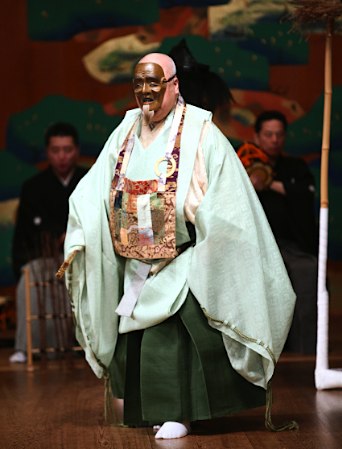
I am concerned with the health of Noh spectatorship as much as Umehara is, but I am not convinced by his proposal to modernise the language. Saying that not understanding the dialogues ‘naturally’ leads to not understanding is an oversimplification to say the least. There is so much more in Noh to enjoy besides poetry. But of course one of its most important elements is the poetry that constitutes its literary basis. How does modernised Shakespeare sound to you? Sure, most people don’t understand Noh poetry (even if you knew how the verses go, Noh pronunciation distorts the words so much it is hard to follow anyway). The question that comes to mind is – what would my aesthetic experience be if the language were so familiar that I understood everything? I am not sure that ‘understanding’ is crucial to aesthetic appreciation, at least not in the way Umehara seems to put it.
“The strength of classical performing arts is their excellent techniques to grab their audiences’ attention, which have been polished over a long period. Using modern-day words, they can grab the hearts of a wide range of people,” Umehara says. Yes, and those techniques clearly stopped addressing the popular audience several centuries ago, when Noh became the art of the aristocracy, thus refining its aesthetics in ways that would have been unthinkable outside the intellectual milieu of which it became an essential component. Do we want Noh to speak the language of dorama? I say that we can leave this to other performing arts. The beauty of Noh lies in the undefined, that is, in its poetry. I wish Noh playhouses still used candles or gas-lights. There’s too much light on stage these days.
A small piece of advice for those who practice Noh utai (chant). If your teacher’s voice is that of an elderly man, it doesn’t mean that you have to sound elderly, too. What I think the student should do when imitating the teacher’s chant is grasp its ‘essence’, focusing on melody and rhythm, if possible simplifying the ornaments and embellishments that you might hear and concentrating on the core of the chant. Listen to how young actors (of the same group) chant and try understand what the link between their young voices and that of your teacher is.
Remember that imitating requires a great deal of personal commitment.

My teacher wrote this for me the other day. It means something like ‘doesn’t know, doesn’t come’. Could it be the slogan for a new advertising campaign?
 The Noh Diaries

