Shinshun Wakakusa Noh – Nara

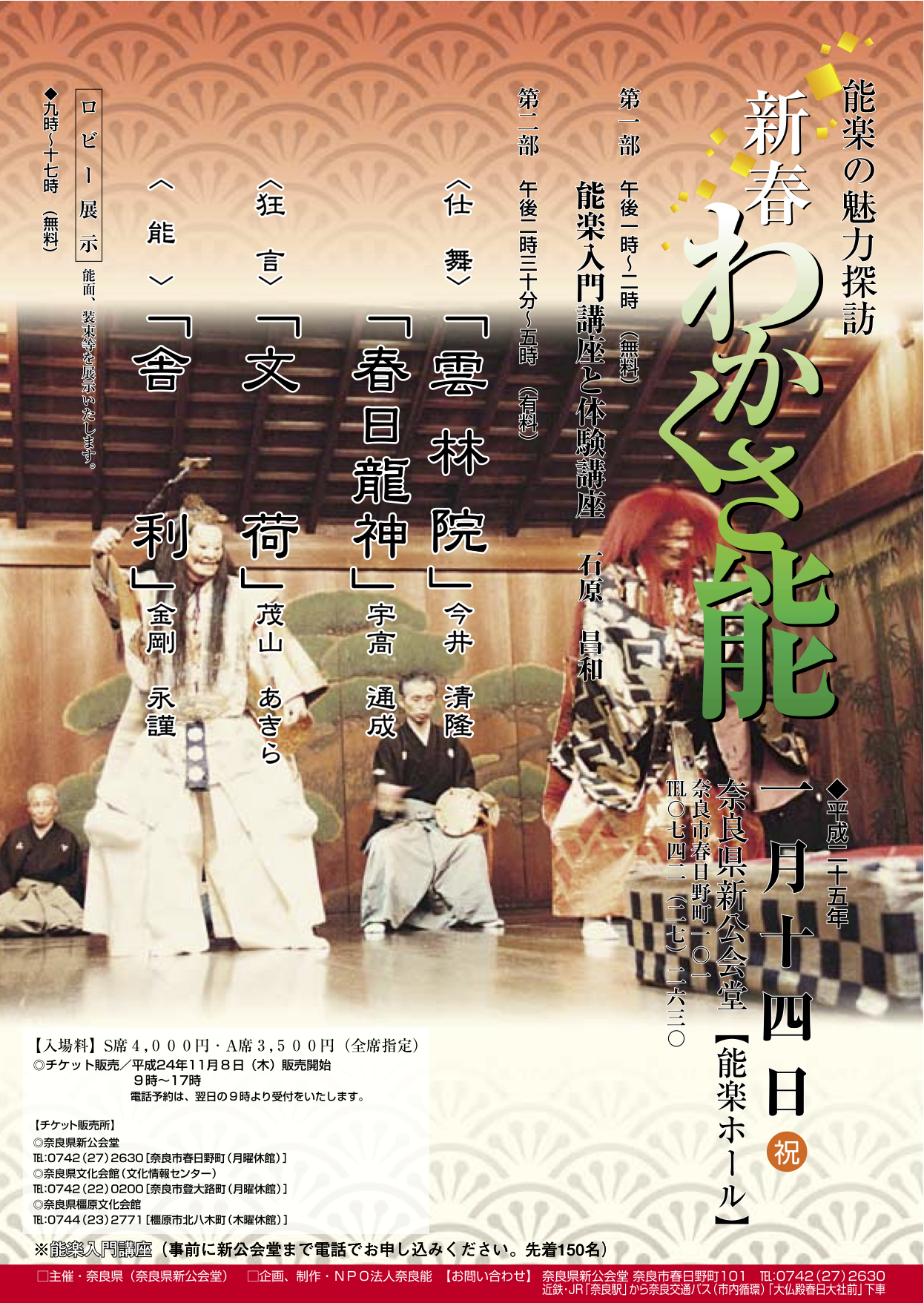
Just a quick note to signal the Shinshun Wakakusa Noh on January 14th in Nara (Prefectural Public Hall). The Oiemoto Kongo Hisanori will perform the Noh Shari (a very dynamic play in which a demon tries to steal the relics of a Buddha, only to be chased and chastised by the god Idaten) while Udaka Michishige will perform the shimai of the Noh Kasuga-Ryujin (‘The Dragon-God of Kasuga’, almost a site-specific piece!). Details here (in Japanese).

24wakakusafront


Shimai pictures – Yashima

I rarely publish pictures of myself on stage. Today I will make an exception as I received some great shots from Massimo Fioravanti, a very talented Italian photographer who has been following Udaka-sensei the past few months, taking pictures of performances and training sessions. Massimo has been working on various projects in Japan. Most notably, he published a photography book on Zuigan-ji in Matsushima, which has been severely damaged by the tsunami, and photographed the costumes collection of the Kongo family on the occasion of the 1989 exhibition at the Sforza Castle in Milan, published in a luscious volume.

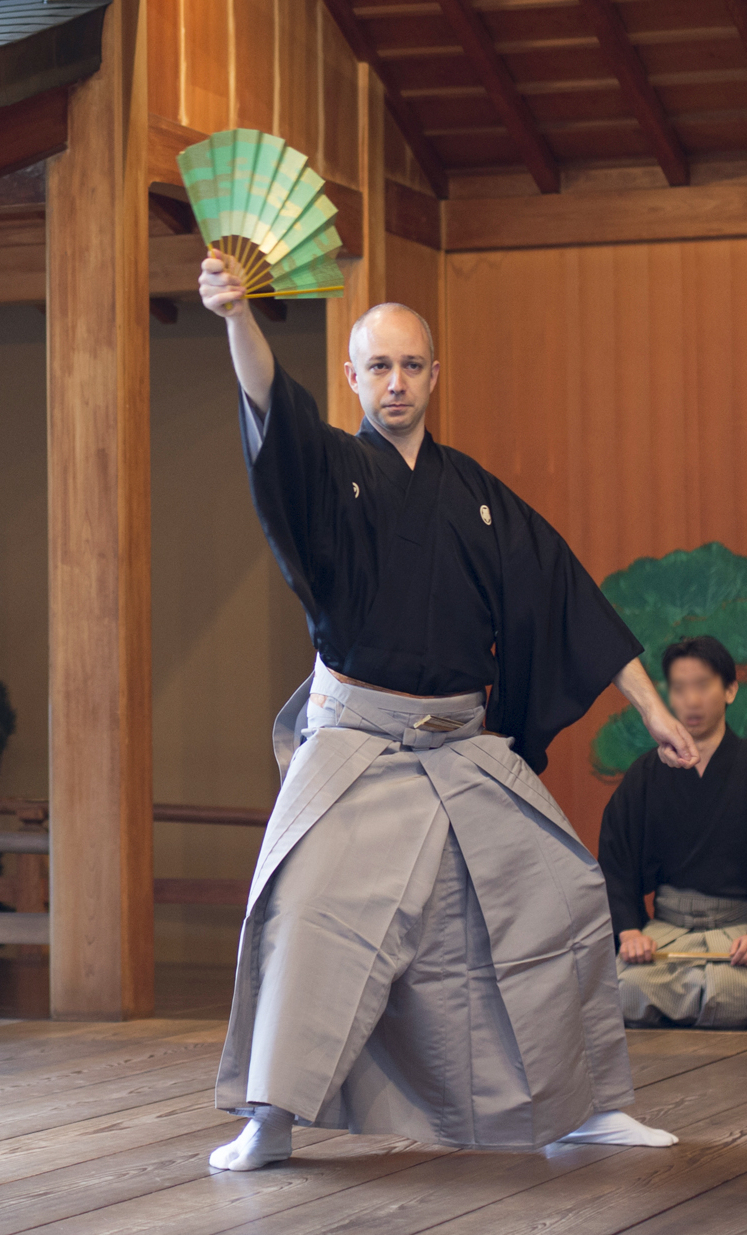
In November 2012 Massimo came to Matsuyama where Sensei performed Sesshoseki (nyotai ‘female’ version). Before the performance there was a recital to which various members of the International Noh Institute took part with su-utai chant and shimai dances I did Yashima, which I have already blogged about here and here. Here are a couple of pictures that Massimo has kindly sent me.

Yashima 1
… 海山一同に震動して…

For those new to Noh, a shimai is a short excerpt of a play, something like an aria in opera. Shimai dances are studied independently from the full Noh, and are often performed as complement of a programme featuring full plays. Masks and costumes are not used, but formal montsuki (a plain black or white silk kimono) and hakama – the equivalent of a formal Western suit. There is no hayashi orchestra playing, only a small chorus of four sitting in the back of the stage. A shimai is the adaptation of the dance that would be performed in the full Noh, so movements are slightly different, and props are rarely used. In the case of Yashima the shite holds a sword, here substituted by the fan – the open fan in my left hand is a shield (this is the way it is portrayed in the Noh, too).

Yashima 2
… 打ち合い刺し違ふる…

Publishing pictures of Noh performances is not easy because of copyright issues. I will try and post more pictures of me – if I have decent ones – in the future. Massimo Fioravanti has been taking some amazing pictures of Udaka-sensei’s performances during the past few months and he is planning to hold an exhibition (in Venice and in Rome) and hopefully to publish a catalogue afterwards, which I hope will be available internationally.

Ageing Noh

Today I went to the Kanze Nogakudo to see the last Urata Teiki Noh. Today’s programme featured the rare Morihisa,  and Hagoromo. There is a lot to say about the two performances I saw, but in this post I will talk about another aspect of today’s experience. Something that I am afraid contributed to an at least partially negative reception of the performance.

I’m not going to write an essay here, I will just copy here some thoughts that I jotted down during the play.

Today's average age of the audience: 70 years. There's all kinds of good reasons for this. Will write about them next time.
Issues resulting from the increasing age of the Noh audience:
  • Bad smell in the theatre. Most of it comes from cheap/old fashioned hair spray.
  • Huge queue at the toilet during the break.
  • Amateurs who bring their utaibon and take the Nogakudo for a Noh sing-along karaoke kind of place.
  • Grannies sucking on candies, usually taking ages to unwrap them from a very noisy plastic wrapping.
  • Bad hearing makes people shout instead of whisper.
No wonder young people don't want to go to the Noh theatre. If I took a friend today I'm sure he/she would have never wanted to come back to what seems to be a retirement house... AGE IS AN ISSUE!

This post is ironic but the matter is serious. Will expand it in a more academic fashion some other time.

The Cambridge Companion to Theatre History

9780521149839i

I am happy to announce that The Cambridge Companion to Theatre History, edited by David Wiles and Christine Dymkovski, has been published. I have contributed to the book with a chapter (9) on traditional theatre, looking at Noh theatre from a historiographical point of view. The premise the book is the awareness of the post-modern fragmentation of ‘History’ in an infinite number of distinct micro-narratives, resulting in the difficulty of understanding history as a flow of interconnected events. As the editors put it, one of the problems encountered when attempting to write a comprehensive history of theatre is that of balance: ‘how to weigh a synchronic (or contemporary) awareness of global diversity and the equal rights of all human beings against a diachronic (or historical) awareness that sets out how our multifarious world came to be as it is and thus how we might change it’.

I was asked by the editors to contribute with a chapter on traditional theatre in Japan, describing not only a cultural, political and economic context that differed from that of the dominant Anglo-American academia, but also a radically diverging way of conceptualising history itself. In order to tackle such a vast topic within the limited word count I was given, I decided to focus on Noh theatre, looking at how notions of ‘tradition’ and ‘modernity’, ‘native’ and ‘imported’ have shaped theatre history in Japan. One of the themes I have developed in my chapter is the separation between contemporary, ‘Western-influenced’ theatre and traditional performing arts such as Noh. This distinction, I have argued, is not only evident in theatre practice, but also in scholarship and educational curricula. Looking at the history of Japan since the opening of the country to the West in the late 19th century, I have outlined the cultural and political reasons for this divide, supporting my argument with notable examples and personal experiences.

The Cambridge Companion to Theatre History is available for purchase (or pre-order) on Cambridge’s website as well as Amazon, etc.

Below is the table of contents of the book:

Introduction: why?
1. Why theatre history? David Wiles
Part I. When?:
Indicative Timeline: 2. Modernist theatre Stefan Hulfeld
3. Baroque to romantic theatre Christopher Baugh
4. Medieval, renaissance and early modern theatre David Wiles
5. Classical theatre Erika Fischer-Lichte
Part II. Where?:
6. Liverpool Ros Merkin
7. Finland S. E. Wilmer
8. Egypt Hazem Azmy
9. Traditional theatre: the case of Japanese Noh Diego Pellecchia
10. Reflections on a global theatre history Marvin Carlson
Part III. What?:
11. The audience Willmar Sauter
12. The art of acting Josette Féral
13. Music theatre and musical theatre Zachary Dunbar
14. Circus Marius Kwint
Part IV. How?:
15. The nature of historical evidence: a case study Thomas Postlewait
16. The visual record: the case of Hamlet Barbara Hodgdon
17. Museums, archives and collecting Fiona Macintosh
18. Re:enactment Gilli Bush-Bailey
19. The internet: history 2.0? Jacky Bratton and Grant Tyler Peterson.

Snow

A bit of a random post.

Cycling in the snow this morning reminded me of Mishima’s Spring Snow which I am reading these days. In one of the salient passages of the book, set in the Taisho period (1912-1926), the protagonists Kiyoaki and Satoko take a rickshaw ride on a snowy morning in Tokyo. Covered with various layers of technologic fibre from top to bottom, and still shivering while waiting for the green light at the bicycle crossing, I imagined Kiyoaki and Satoko riding the rickshaw, him dressed in his school uniform, her in a winter kimono and coat, with only a blanket on their knees as additional warming device. In this scene the two exchange their first kiss, as frosty hands move underneath the blanket. With this kind of temperature it would be the last thing I want.

Then I realised that people can stand different temperatures according to the environment in which they grew up. Japanese students today still wear shorts in winter, and some girls still wear a skirt and short socks. British people would go out in their t-shirt on a sunny but cold february day. Not to mention what girls would wear on the same night out.

Okina - Kongo Hisanori (Yasaka-jinja, Kyoto)
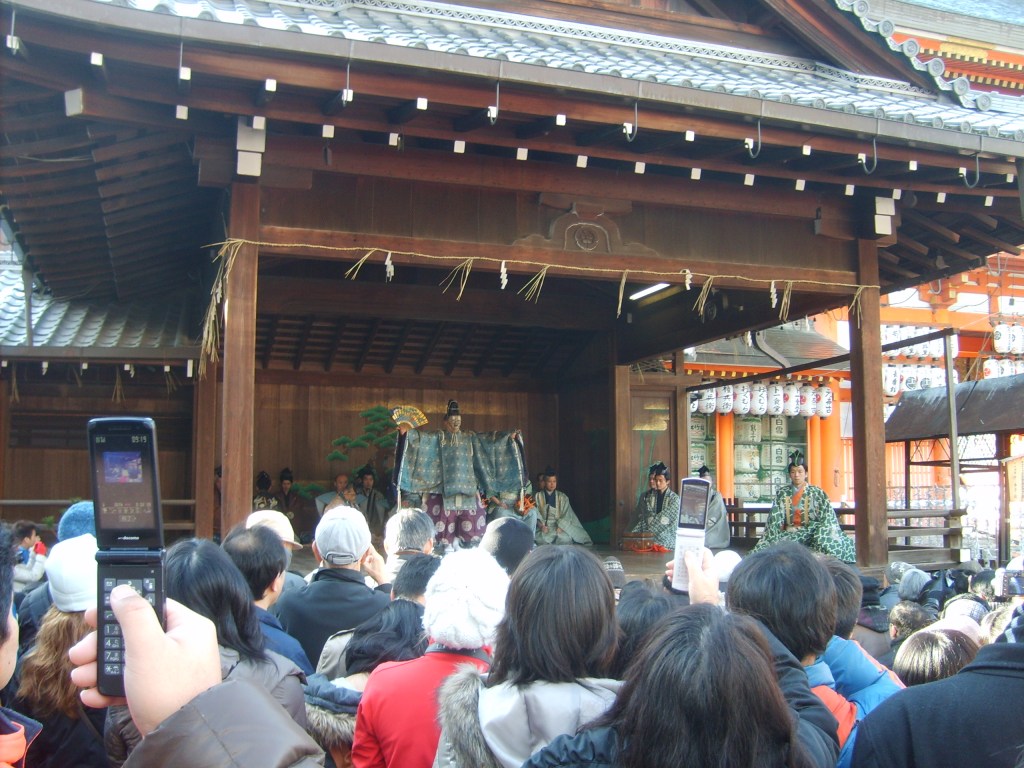
Okina – Kongo Hisanori (Yasaka-jinja, Kyoto)

Two years ago I attended the performance of Okina performed by the Iemoto Kongo Hisanori at Yasaka-jinja in Kyoto. I think it was January 3rd and I was observing chorus members sitting in the back of the outdoor stage, dressed in traditional clothes… and I was wondering how many Uniqlo heat-tech  garments or kairo heating patches they were actually wearing.

War dances in translation

Today I helped Udaka Norishige one of my teacher’s sons, with a Noh workshop at Iori Machiya in Kyoto. I don’t know much about the background of the workshop itself, as I only came upon request of Norishige-sensei, and my only duty was that of interpreting. The group of 18 people who participated to the workshop was mostly composed of Israeli and British citizens. Some of the Israeli participants were actually members of the Cameri Theatre of Tel Aviv, where director Ninagawa Yukio is currently working on an adaptation of the Trojan Women with a mixed Israeli-Palestinian-Japanese cast. 

At the end of the workshop, which was very well received by the enthusiastic participants (we were flooded with questions!) Udaka Michishige danced a shimai, while Norishige-sensei and I sang as a small chorus. The piece was Yashima, which I also recently performed in Matsuyama.

Yashima ô-kassen (八島大合戦, The Battle of Yashima) by Hayashi-ya Shôgorô

The Noh Yashima (second category, warrior plays) tells the story of the homonymous battle that took place in the late 12th century at Yashima Island, (present Takamatsu City, Kagawa Prefecture). Yashima is one of the most important battles of the Genpei War between the rival Minamoto and Heike clans. In Yashima the ghost of General Minamoto no Yoshitsune appears in front of a travelling monk and re-enacts various phases of the battle. Although the play Yashima is one of the three kachi-shura or ‘winning Noh’ (the other two being Tamura and Ebira), the tone of the play is far from being celebratory of the Minamoto victory. Death and killing is on both sides and as the chorus describes how, end of the battle, warriors scatter away like seagulls, while the ghost of Yoshitsune disappears in white foam, as the wind sweeps the desolate battlefield.

I wanted to write more in this post but I think I have actually said enough. Today I did my best.

Yashima island (image from the Samurai Archives)

Pictures from the Udaka Men-No-Kai Noh mask exhibition

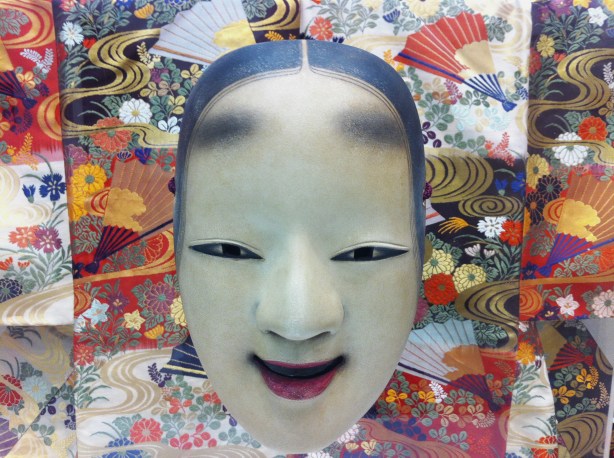
On Wednesday 28th 2012 I visited the 14th Udaka Michishige Men-No-Kai Noh mask exhibition at the Kyoto Prefectural Center for Arts and Culture. The exhibition featured over 30 masks both by Udaka Michishige and by his students. Udaka Michishige is not only a high-profile actor of the Kongo School of Noh, designated Important Cultural Asset by the Japanese government in 1991, but also a superb Noh mask carver. A number of his masks have been approved by the Iemoto Kongo Hisanori, and are now regularly used on stage. I should point out here how normally Noh mask carvers are not professional actors: they conduct their activity independently. Many Noh masks are not even considered to be for stage purpose, but for decorative purpose in private houses, offices, hotel lobbies, etc. I am not saying this in  a derogatory way: some of these are very beautiful indeed… except that they are not suitable for stage use. Here is where Udaka Michishige is special: as an actor with extensive experience of mask use on stage he understands what distinguishes a beautiful work of art from the most important expressive tool of the Noh actor on stage, and implements this knowledge in his mask carving activities. Udaka Michishige teaches Noh mask carving in Kyoto, Nagoya, Matsuyama, and Tokyo: if you are interested in masks and would like to observe a carving session, please check the Men-No-Kai website for contact details.

Among the masks displayed during the 3 day exhibition were among Udaka-sensei’s finest pieces – here are some pictures I took with my iPhone (sorry for the bad quality…) – I will post more soon!

IMG_1626 1
Magojiro
IMG_1627
Shintai (with picture from “Matsuyama Tengu”)
IMG_1628 1
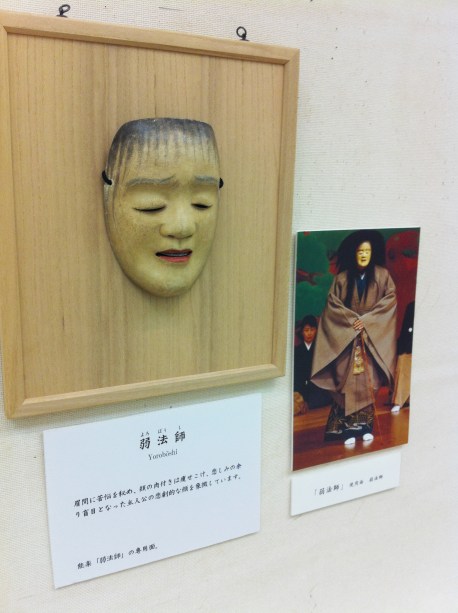
Yoroboshi (with a picture from the homonymous play)
IMG_1629 1
Yoroboshi
IMG_1630
Jya (with a picture from “Dojo-ji” koshiki variation
IMG_1623 1
Some of Udaka Michishige’s masks

A Noh Journey

20121201-112346.jpg

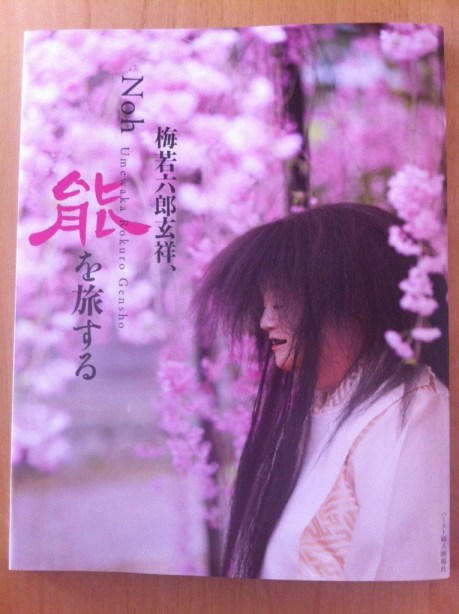
Nō wo tabi suru is a collection of pictures and articles previously published in the magazine Fujin gahō. The pictures portray Noh actor Umewaka Rokurō Genshō wearing costumes and masks of various characters from various Noh plays against the background of the places where the stories of the plays actually take place, for example the Goddess Benzaiten on the shore of Chikubushima Island on the Biwa lake for the play Chikubushima, or Rokujō no Miyasudokoro walking the characteristic paths among bamboo thickets in Arashiyama, Kyoto, for the play Nonomiya.

This is an interesting book as it tries to visualise Noh character in real places, which is one of the beauties of Noh. I think it was Komparu Kunio who in his book Noh Theatre: Principles and Perspectives listed among the points of interest of Noh the possibility to learn about Japanese geography and to travel without moving, qualities that in Japan are characteristic of classic poetry. The pictures are truly beautiful and do an excellent service to the wonderful mask and costumes which I believe belong to the Umewaka Rokurō family.

20121201-115504

In my view the most striking shot is that of the character of the mother in the play Sumidagawa. I think the picture conveys the sense of estrangement the mother who travelled from Kyoto to Tokyo seeking for her lost child, must have felt. At the same time it reminds me that so many of the beautiful sceneries described in Noh are not that beautiful anymore..

The book closes with a chapter on the local food that Genshō and his companions had the chance to taste on their journey… a typically Japanese note that reminds me of the upper-class elderly woman which represent the target of this kind of publication. Sob.

Hosei University Noh Research Institute – 60th Anniversary Symposium

On November 18th I attended the 60th Anniversary symposium, organised by Hosei University’s Nogami Memorial Noh Research Institute. As Prof. Yamanaka Reiko explained in her introduction, the symposium was the latest of six decennial events that mark the growing progress and outstanding research results of the Research Centre. This year’s symposium was entitled ‘Noh no shosa wo kangaeru‘ (‘reflections on the shosa of Noh). Shosa literally means behaviour or comportment, but it is generally used in the performing arts to indicate ‘movement’. As Yokomichi Mario has described in volume IV of the Iwanami Shoten lectures series on Nogaku, in Noh shosa refers both to the dance and to the mimetic aspects of Noh movement.

The symposium opened with a talk by Ondrej Hýbl, a student of Okura-ryu Kyogen actor Shigeyama Shime, who introduced the activities of the Kyogen company he founded in Prague. Hýbl has been involved in Kyogen training in Kyoto as he studied at Osaka University. The achievements of his Czech Kyogen group are truly amazing! (check out this video of the Kyogen Kuchimane). During his speech Hýbl emphasised the need to discuss ways of opening the teaching of Noh and Kyogen outside Japan. I will talk more about this towards the end of the post.

The second talk was given by Kōno Yoshinori, a famous swordsmaster, who talk about changes in the swordsmanship techniques in relation to body parts such as thighs and lower back, which are also fundamental in Noh movement. You can see more about Kōno-sensei on YouTube.

The third talk was given by Nakatsuka Yukiko, who demonstrated the work in progress of a team of researchers she is part on 3D digitalisation and reconstruction of Noh movement. The team has produced a software they call ‘composer’, basically a sequencer drawing on a database of Noh kata acquired with motion capture techniques, that can be mounted in sequences and adjusted in time and speed, in order to suit various kinds of chants. With the Noh composer it is possible to reproduce Noh dance just by knowing which kata are executed, without the need of an actor. One of the main purposes of such technology is to record movements of Noh actors today so that they can be studied in detail in the future, something that cannot be done by simply noting kata in words. Though this kind of technology is moving its first steps, sometimes with rough-looking results, I am sure they will reach a very high level soon. 20 years ago we played Tetris, now we have Call of Duty.

Then followed two conversations. The first was between Noh actor Kanze Tetsunojō and Prof. Yamanaka, touching various aspects of the transmission of Noh movement. Despite his wide experience, it seems to me that Tetsunojō-sensei still is very much grounded in the traditional environment in which he grew up. By his own admission he has little idea of how to help the spreading of Noh outside Japan, a topic I was hoping to hear more on from his perspective. The second conversation, between Kabuki actor Nakamura Kyōzō and Prof. Kodama Ryūichi, discussed Kabuki movements in various styles, also comparing Noh with Kabuki.

A general discussion closed the symposium. I am very happy to have participated to the event, which was brilliantly conducted by Prof. Yamanaka Reiko. While Noh is imprisoned in literature courses outside Japan, it was very refreshing to attend a conference entirely dedicated to movement. I am convinced that Noh should always be taught as performance everywhere it is introduced. It is the only way to save it from the commonplace image of old and boring theatre. However, the wealth of performance theory available in the English language is unavailable in Japan, where traditional performing arts still reside in an academic field isolated from theatre studies. Will post more about this topic as soon as an important publication I have contributed to comes out in print.

As for the dissemination of Noh abroad, Hýbl-san pointed out a crucial aspect of Nogaku: both Kyogen and Noh are arts where perfection is valued, not creativity. This made me think of how Noh actors are more like sportsmen than artists: they spend their lives training on fixed models, largely ignoring all that does not belong to this world. While non-traditional artists draw inspiration from various sources, often deepening the knowledge of other arts (cinema, literature, painting) or even travelling and living abroad, 99% of Noh actors live in isolation from the world.  Obviously when they are confronted with questions such as ‘how do you spread Noh abroad’ the answer is something like: “well, I don’t know… Noh is like this, take it or leave it”. From their perspective there does not seem to be a need of exploring outside its ‘traditional’ boundaries. Where this attitude will lead, I am not sure. What I am sure, though, is that 90% of the audience who attended the symposium on a Sunday afternoon was over 60 years old, which means that in some 30 years they are likely to be all dead. Will they have passed their interest for Noh down to their grandsons by that time? If not, I wonder who will still go to the Noh theatre, except for me and a few others I know (if we are still around). Edward Shils wrote that when tradition becomes useless, it dies. Will it survive in computer generated animations? I hope not.

What I am more and more realising while I am in Japan, is that if foreigners want to learn Noh, they should not expect Japanese institutions to offer ways of doing it. We non-Japanese who have an interest in Noh should get together and do our best to discuss ways of transmitting Noh abroad. As Hýbl pointed out, Nogaku is taught and learnt by imitation, not through books. It is then necessary to find a way for Noh and Kyogen masters to frequently travel or to live for longer periods outside Japan, or for foreigners to live for longer periods in Japan, where they could learn the art and then be able to transmit it to the ‘outside world’. Thanks to the efforts of the International Noh Institute, I feel I am on the right track. I look forward to discussing again about this very important topic with Ondrej Hýbl, Prof. Yamanaka, and the other scholars who took part of the symposium.

PS: speaking of anniversaries, this is my 100th post! : )