This year’s summer kenkyukai will take place at Otsu dentogeino kaikan, a Noh theatre next to Miidera, on the Biwa lake. I will perform the maibayashi of the Noh
Kiyotsune, will serve in the chorus of the Noh Yashima and Ama, and finally play the taiko drum for the chu-no-mai dance from the Noh Shojo. This is my third attempt at taiko chu-no-mai and I feel I have improved a lot, though I still make mistakes. I realised that improving means being more and more aware of what the other instruments do, rather of how well you play your part. This form of music is collective, after all. Again I can see here an ethical value in an aesthetic context: an excess of concentration on one’s own role results in the lowering of the overall aesthetic result. Obviously this does apply to all forms of music, but for some odd reason I only realised it now…
Author: Diego Pellecchia
Kanze Hisao – short biography

I found this nice, short biography of Kanze Hisao (観世寿夫) curated by the Minato-ku library website. It’s short and nice, and contains information that is normally difficult to find on the internet, so I thought I would share it here. Oddly there is no Wikipedia entry for Kanze Hisao in English (there is one on his brother Hideo).
I have read a number of Hisao’s essays (available only in Japanese) which I found enlightening both from the perspective of the scholar and of the actor. His level of analysis and clarity of expression are impressive. Hisao died one year before I was born but I know of some commercial DVDs of his performances. I would really like to hear how his voice sounds like.
Seiza
I still have not quite understood to what extent working on the floor is good for the body. If one were only to be sitting in seiza that would not be a problem as it actually helps you keeping your back straight. But what about moving, bending, reaching for objects and all the other usual movements we do in a workplace? I find that working on the floor forces my back into painful and not always useful postures. I must admit I have some problems with my lower back, which gets easily tired, and I wonder whether seiza will eventually help me correcting my posture or actually increase the stress on my lower back…
Isuzu Yamada dies
Actress Yamada Isuzu (5 February 1917 – 9 July 2012) dies at 95. Several international newspapers have reported this sad news. I do not know much about her work with other directors, but I have got to know her very well for her role in Kurosawa’s Throne of Blood, which was the topic of my baccalaureate thesis, and my first introduction to the world of Noh theatre. In Throne of Blood (based on Shakespeare’s Macbeth) Yamada was Asaji, Washizu’s diabolical wife.

The mastery of Akira Kurosawa transformed Yamada into a Noh mask in the famous delirium scene where Asaji/Lady Macbeth tries to wash invisible blood stains from the hands that plotted the murder of Lord Kuniharu.
The news has bounced on many international newspapers, such as the Japan Times, the Washington Post, and the Guardian. In this report by ANN news (which even describes what she decided to wear before for cremation) it is reported that Yamada preferred not to have flower vases with showy decorations: the funeral took place in an atmosphere of sobriety that characterised her personality.
Tradition: the usual refrain

Memorising utai: yowagin and tsuyogin
There are two main types of chant in Noh theatre: tsuyogin or ‘strong’, ‘dynamic’ chant and yowagin, or ‘weak’, ‘melodic’ style. As the name suggests, the first is powerful and energetic, while the second is melodic. Tsuyogin emphasises rhythm, while yowagin emphasises melody. In Yashima, the play I am memorising at the moment, tsuyogin is used to describe battle scenes, while yowagin is used to render more poetic descriptions. While yowagin consists of a melody, tsuyogin basically centres on a single tone, pitching up as the phrase progresses, which is then embellished by a number of glides. In my experience, tsuyogin is the hardest type of chant to master.
To the difficulty of chanting well, another problem adds up: that of memorisation. Yowagin melodic chant gives a lot of cues because it follows a recognisable melody. Since we are children we have been taught how to turn sentences or lists of names into little songs in order to memorise better. Same with yowagin. However tsugyogin relies almost entirely on rhythm, and its embellishments do not always follow a predictable pattern. Hence memorisation cannot be helped by melodic cues. In addition, tsuyogin is often chanted fast, as in the narration of a lively action scene.
I don’t know whether this applies to all Noh practitioners, but I find the difference in the effort I have to put in memorising astonishing.
Yashima
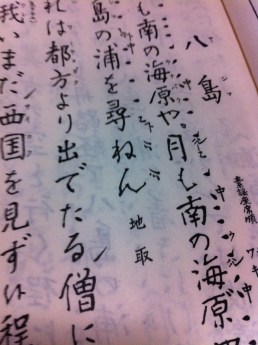
This is going to be my next memory effort. The next hayashi kenkyukai is coming up mid-August, and I am slated to be in the jiutai (chorus) for the Noh Yashima, among other things. I will post more about the kenkyukai (what it is, how it works) in the following posts.
On the ethical beauty of age
A clip from my other blog
Art Project Hōnōmai – ‘Yuki’
Iori is a beautiful Kyoto machiya (traditional guesthouse), offering traditional art courses and art-related activities. In this clip Noh actor Udaka Tatsushige (son of my teacher, Udaka Michishige) is performing the shimai from the Noh Yuki (‘Snow’), a play that is exclusive to the Kongō school repertoire. In the Noh Yuki, a priest on his way to the Tennō-ji temple is caught in a snowstorm when he encounters a mysterious woman, who in reality is the spirit of snow. After reading a sutra, the woman dances as she disappears in a whirlwind of snow. I saw this Noh performed by Ogamo Rebecca Teele in the recital to which I participated June 2010. It is a very refined, delicate Noh, where all sounds and movements seem to be softened by the snow. Even the typical stomps of certain Noh dances are performed so that the feet softly touch the floor, producing no sound.
アートプロジェクト2012『奉納舞』Collaborate with Art and Noh Drama
“Kyoto Kyo-Machiya Stay Arts Project –Art and Noh Drama Collaboration-”
Iori Co. also offers a unique designed program for experiencing the traditional culture of Japan.
For cerebrating the first Project, there was Noh Drama performing collaborating with four Artists’ works of Art.
「京都・京町家ステイ・アートプロジェクト」参加作家によるコラボレーション奉納舞
京都で伝統文化体験を提供する庵。事務所に併設された稽古舞台には、プロジェクトの記念すべき第1回参加作家4名が、それぞれの作品を共鳴させた特別しつらいがなされ、金剛流シテ方 宇高竜成さんが、「雪」を舞った。
Kiyotsune
 I am spending a couple of weeks in my hometown, Brescia, Italy, where I return quite often not only to visit my family and friends, but also to train with Monique Arnaud, the Noh teacher that first introduced me to Noh theatre. Arnaud is a shihan, a Noh instructor licensed by the iemoto of our stylistic school, the Kongō School of Noh. Arnaud, who is originally French, has spent most of her life abroad, first in China, then Japan, then Italy, where she currently resides, working as opera choreographer, and teaching theatre directing at IUAV University of Venice.
These days I am working on the maibayashi from the Noh Kiyotsune (清経). Maibayashi is one of the various canonical ways of performing excerpts of a Noh play, such as shimai (short dance with the accompaniment of a small chorus) or rengin (seated chant of a section of a play). Maibayashi (舞囃子) is a word composed by the characters for ‘dance’ (舞 mai) and ‘Noh instruments’ (囃子 hayashi). Unlike shimai, the maibayashi features the accompaniment of chorus and of the Noh orchestra, and is usually longer than an average shimai, often featuring an instrumental dance between two sections of the play. Kiyotsune is a play from the second category (Warrior plays) and tells the story of Taira no Kiyotsune (平 清経) a general of the Heike clan appearing in the Heike Monogatari epic who drowned himself at Yanagi-ga-ura (present Kitakyūshū) after realising the unavoidable defeat of his army, chased by the Genji clan. Just before committing suicide, Kiyotsune cuts his hair and gives them to his retainer Awazu no Saburo, instructing him to present it to his wife as a keepsake. The Noh opens with Saburo returning to Kyoto, where Kiyotsune’s wife awaits for the return of her husband. Once Saburo tells her about her husband, the wife is shocked and laments how Kiyotsune failed to keep the promise to reunite with her, and refuses the gift. Still in tears, she goes to sleep, where Kiyotsune visits her in dreams. In the second half of the play the ghost of Kiyotsune, in full warrior attire, appears, and discusses with the wife. This is a most interesting section, with Kiyotsune blaming the wife for having refused his gift, while the wife blames him for the selfish act of committing suicide. Blaming each other in what seems like a domestic fight, the couple realises how their condition is similar, both suffering from loss and longing, as this world and the other world are made of the same substance. Kiyotsune then recounts his last days, and, in the final dance, he mimes how he now suffers in hell, where rain is like arrows pouring from the sky, mountains are like iron castles, and enemy warriors advance inesorably like flags of clouds. As it often happens in Noh, it is thanks to the power of the narration of one’s own story (as in a psychoanalysis session) that the characters come to realise the inconsistence of their pain, and manage to get rid of the attachments that prevent them to reach enlightenment. In this case, Kiyotsune reaches enlightenment not only thanks to the nenbutsu prayer he recites before jumping into the water, but also because he comes to terms with his wife. In a way, it is not only the dissatisfaction with his own death, but also the resentment that his wife feels for him that cause his suffering.

I have already performed the maibayashi from the Noh Kochō (胡蝶) a couple of years ago, which contains a standard chu-no-mai medium tempo instrumental dance. However, in Kiyotsune there is no dance between the kuse and kiri sections, but a short exchange between husband and wife, before the kiri closing section where Kiyotsune recounts his torments in the hell of the ashura, the defeated warriors who remain attached to this world and cannot reach enlightenment are destined to suffer. This section is characterised by the guntai martial style, in which the kamae basic stance is performed in han-mi style, slightly lateral instead of frontal. This stance is typical of martial arts, and basically aims at avoiding to offer the front of the body to the opponent, while at the same time presenting the arm that would hold a sword or shield. As maibayashi are not in costume, this dance is performed with two fans – one is open and represents the shield, the other the sword. Handling two fans at the same time is not easy, though the greatest difficulty of the martial stile consists in performing jumps and other more acrobatic movements while maintaining the stability and solidity typical of Noh dance. As a ‘caucasian’ I also find that my legs are longer that the average east-asian: in order to take a good posture I have to bend my knees much more than the usual, which in the case of a warrior is already a lot! This puts much stress on knees and thighs, and naturally leads me to reflect on the extent to which Noh is a form of art tailored around a specific body type (male Japanese), and might not immediately fit other bodies. What is the future of the Noh bodies?
 The Noh Diaries