 I spotted this beautiful, Alphonse Mucha-inspired poster promoting the Todai (Tokyo University) Kanze students and alumni performance (December 21st, Kita Nogakudo, Tokyo). The image portrays the goddess of Mount Kazuraki appearing in the Noh Kazuraki 葛城. Not being able to use stage pictures of professional actors, university clubs usually draw their own posters, which I often find more interesting than the professional ones. As in the play, the goddess here appears bound with vines and ashamed to show her face, points that were used creatively by the artist who drew this, fitting perfectly in the deco-like graphic concept of the poster. Well done!
General
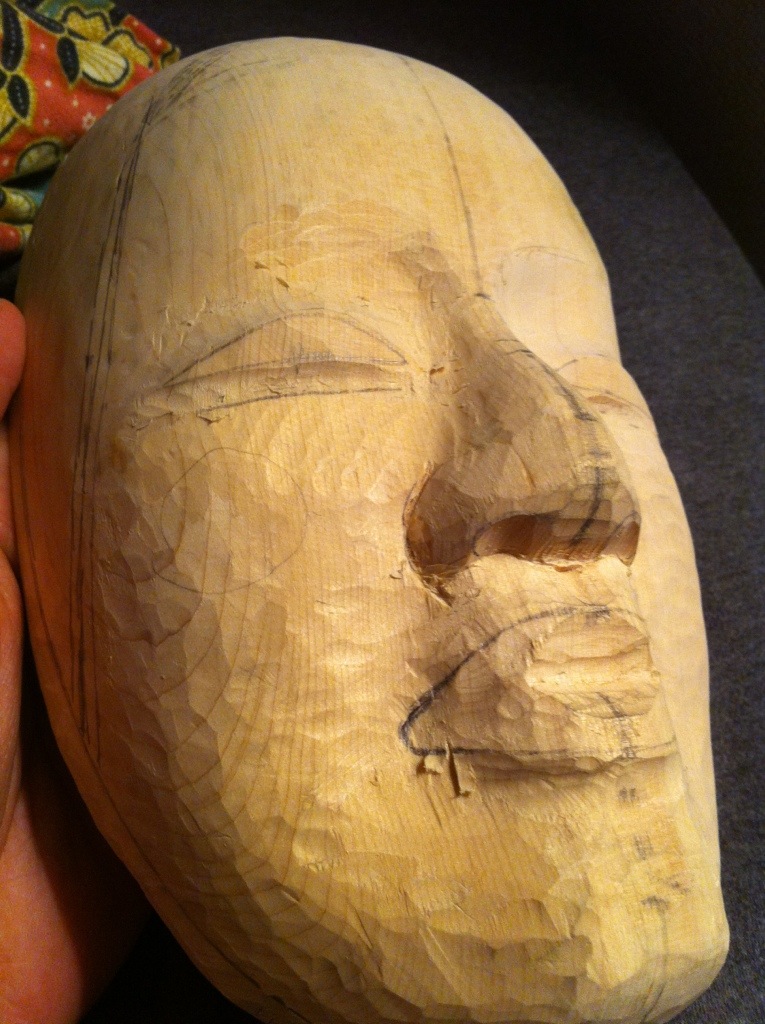
New mask
After chūjō, the mask I used for Kiyotsune in June 2013, Hea-Kyoung is working on a new mask. Can you tell kind it is?
Dengaku to Sarugaku
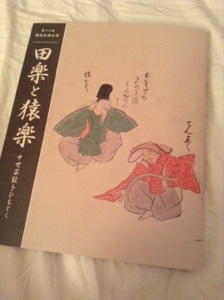 Yesterday I went to see Dengaku to Sarugaku at the National Bunraku Theatre in Osaka. Two groups, the Nachi Dengaku Hozonkai (Nachi, Wakayama pref.) and the Nara Tsuhiko Jinja Okina-mai Hozonkai (Nara) preserve ancient traditions that are thought to predate the performing art we call Noh today. Dengaku (literally ‘field entertainment’, where ‘field’ refers to ‘rice paddy’) is a form of performance where musicians playing taiko and sasara (a kind of wood clapper) dance in symmetrical patterns, at the accompaniment of extremely simple and repetitive musical patterns. Movements mime sowing the fields, evidence of its original purpose of propitiating good crops. Sarugaku (debate is open on the literal meaning of this word) is the old appellation of what we now call Noh. On this occasion the Tsuhiko-jinja troupe performed Okina-mai, a predecessor of the contemporary Okina performed by Noh actors. I won’t get into the discussion on the ‘authenticity’ of such dances – forgive the superficiality of this post.
What can I say about the performance… I took extensive notes. Mostly because I was very bored. As I was looking around, noticing how many people around me were dozing off, I thought of Peter Brook’s ‘rough theatre’ misplaced in a ‘serious’ situation, and of Rustom Bharucha’s talk of ritual performance as something that cannot be detached from its original context. Technically speaking performances such as those I attended today require to be performed at a shrine, on a lawn, in the presence of many people surrounding the performers, chatting, taking pictures, eating, sleeping, moving around.. a ‘rough’ setting. I think that one of the reasons behind the reiteration of simple dance and music sequences is the need to offer a performance that can be ‘followed’ even if distracted or interrupted, something very different from a theatre hall performance, where the audience is sitting, forced to stare at the stage, as we were today.
Moreover, yesterday’s performers were amateurs, whose lack of technique is all the more evident on a ‘proscenium arch stage’. As I wrote on my notes, religious performance contains values transcending the aesthetic: when it’s placed on a theatre stage it loses all true ritualism. All that is left is art, and art requires technique, not belief.
‘Cremona’ rope
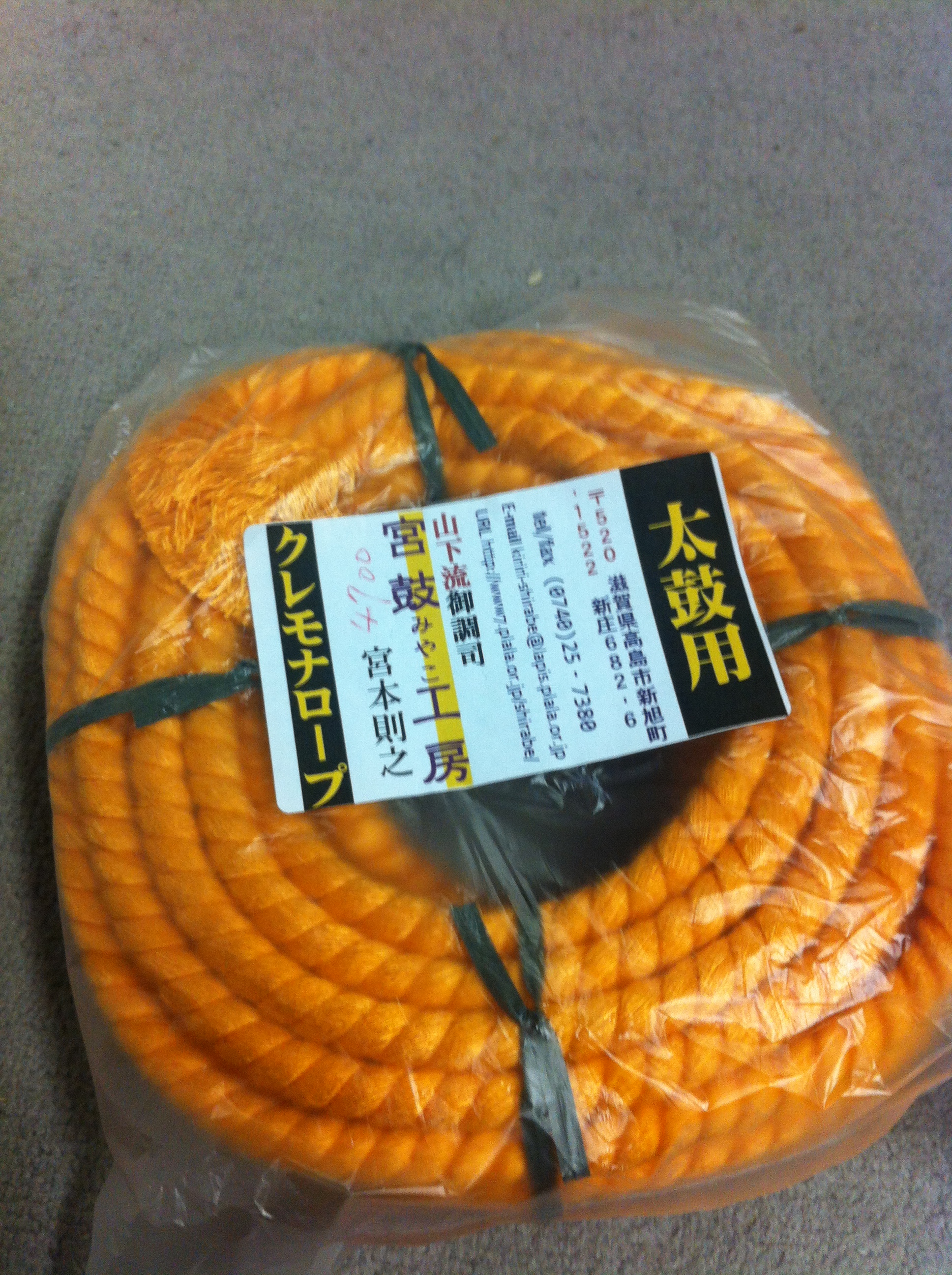
This is the kind of rope we use to tie up the two skins of a taiko stick drum. My teacher recently got this in order to replace the one on his taiko in Kyoto, which started to fray despite numerous applications of tsubaki abura (camelia oil). The label says, on the right, 太鼓用 (for taiko) and on the left クレモナロープ (Kuremona rope)… Cremona?
Cremona is a beautiful Italian city in Lombardy, famous for its violin-making tradition and the cathedral, just an hour drive away from my hometown, Brescia. I was wondering what kind of connection the city might have with Japanese taiko… I started fantasizing of XVI century missionaries from Cremona visiting Japan and transmitting the ancient rope-making tradition from Cremona.

A quick Wikipedia check demolished my fantasies: first of searching for ‘Cremona rope’ does not even bring up results other from Japanese pages, which points toward the label as being a Japanese invention. Second, Cremona rope is far from being traditional: it is a mix of vinyl and polyester fibers. Third, Cremona rope is made only by Japanese producer Kuraray – spelled クレラ (KURERA) in katakana. クレ is rendered KU-RE in alphabet, which can be rendered as CU-RE (kɾe) by Italian readers. KU-RE is the way Japanese spell KRE or CRE sounds, adding the [u] sound between K and RE.
Long story short: KUREMONA is not Cremona [kɾeˈmoːna] but a pun with KURE from Kuraray and something else which I don’t even know. Blah.
Bye.
Adrenaline
I was listening to this radio show about extreme sports… Among the various neurotransmitters rushing whenever we are exposed to danger is adrenaline. Adrenalin rush affects our body in various ways – among these, it helps fixation of memories. Experiencing danger triggers adrenalin release, making such experience extraordinary and unforgettable. This seems to have a pedagogic purpose: our body learns how to act efficiently even when we have no time to think. This is beyond instinct; rather, it is an unconsciously acquired skill.

I often think that Noh offers many situations of danger, which can be both ‘artistic’ (in Noh there is very little room for improvisation, hence the condition of constant ‘alert’) or physical (i. e. the danger of falling of stage). Performing Kiyotsune last week provided the chance to feel adrenalin rush on various occasions. Other situations of danger, giving rise to heightened senses, are okeiko (lessons, in the traditional arts) especially when my teacher is not in a particularly good mood (or when he is). As I progress on the way of Noh my training becomes stricter, and I noticed that my teacher tends to put more pressure on me when he teaches me, often interrupting my movements to briskly correct, hammering on the same gesture, expecting repeated correct executions before moving to the next step, etc. These are not straightforwardly ‘perilous’ situations, but they still retain a certain degree of danger, as failure to live up to a certain standard will result in my teacher’s disappointment. Exams are dangerous. In other words, strict, tough training, sometimes even involving physical contact of sorts, can effect our brain positively, inasmuch it helps ingraining the teaching in the body. The following step is learning how to manage the rush effectively as it happens.
In conclusion I wanted to add that adrenaline is released in dangerous situations along with another hormon, dopamine, a chemical whose effect we common describe as ‘pleasure’. I will let you draw your own conclusions on this…
– Diego
Mt. Fuji
Udaka Michishige sees the Noh world as Mt. Fuji, which recently gained the World Heritage Status by UNESCO.
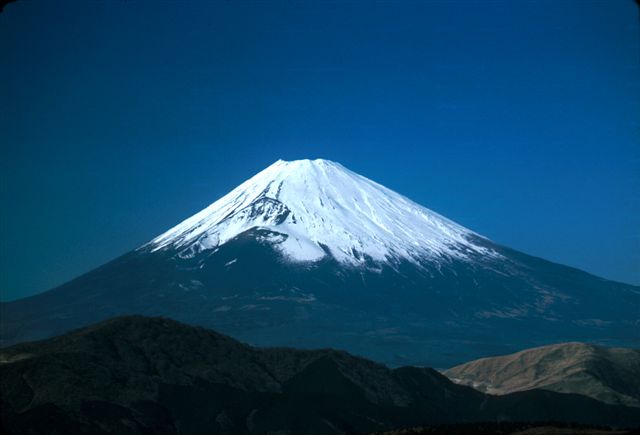
At the bottom is the general public, those who see Noh occasionally, who have a interest in it and respect its tradition.
Above them are Noh theatre-goers, for whom Noh is more than just an occasional pastime. Among them are Noh amateurs, who support actors attending many performances, and who in turn study Noh and contribute to its diffusion.
Then are hayashi musicians, waki actors, and kyogen actors. Their art provides the foundation for all Noh performance.
Above them, close to the top, are shite actors, whose training is complete in all aspects of Noh performance. They, more than anyone else, have the responsibility for the transmission of Noh tradition.
At the top are costumes and masks. Udaka-sensei symbolically values these ‘objects’ above ‘people’. He did not elaborate much on this proposition. I can think of various reasons why, but I am sure of none, so I would rather not over-interpret this. Certainly masks have been considered not simply as man-made performance tools, but as receptacles of higher energies. It might be possible to interpret this both from a spiritual-religious and an anthropological perspective, of course.
Above the top are clouds, sky, stars, even more mysterious and wondrous than Mt. Fuji itself. That is yugen, the indescribable beauty, profound abyss, or fathomless universe of Noh.

After Kiyotsune

I would like to thank all those who came to see my performance of Kiyotsune on June 29th 2013 at the Kongo Noh Theatre in Kyoto, as well as those who supported from a distance but who could not make it to Japan.
It is hard to describe my feelings now that this pivotal event in my personal life and in the history of the International Noh Institute is over. The night before the performance I was preparing my bag with all the necessary clothing and accessory, including dōgi padded undergarment and eri collars, and felt like packing the night before leaving for a long trip. Or maybe Kiyotsune himself was packing his bag, about to take his leave from my room, and from my teacher’s okeikoba, where we lived together during the year of preparation that preceded the performance. Although in Noh there isn’t the same kind of psychological research on the character that you would have in other performance methods, I have become accustomed to live with Kiyotsune… but now Kiyotsune has left, only to live again through someone else’s body. Anyhow, I should not think of it as something belonging to an isolated past, because past things shape our present, and future, too.
Today I was asked by a friend how I felt after the performance. I realised that a Noh performance is like a marriage ceremony. It is a very important event, to which family and friend partake, celebrating a vow of faithfulness and dedication. But the ceremony only lasts one day. What really counts is all the effort behind and before it, and the new path ahead.
Kei’un-kai, INI Gala Recital 2013 *full programme*
June 29~30 (Saturday and Sunday), 2013
Kongo Nohgakudo, Karasuma Ichijo-sagaru, Kamigyo-ku, Kyoto 602-0912
Tel: 075 -441-7222
Please join us at the Kongo Nohgakudo for an opportunity to experience Noh in a variety of forms: shimai, dance excerpts; Maibayashi, dance excerpts with the accompaniment of the Noh ensemble of instruments as well as the chorus; Rengin, concert style performance of a Noh excerpt performed by students in formal kimono and hakama; and 3 fully costumed Noh performances each day.
• Descriptions of the content of each piece will be available in programs provided in English, French, German and Italian.
• The recital is free of charge and open to all. We look forward to seeing you at the Nohgakudo.
Day I Featuring International Noh Institute Students
June 29th (Saturday)
(from about 11.00am)
仕舞 Shimai dance excerpts in formal wear performed to the accompaniment of a small chorus.
舞囃子 Maibayashi excerpt to the accompaniment of the Noh ensemble and chorus:
「胡 蝶」KOCHO ‘The Butterfly’ shite: Cristina Picelli.
Bangai-Shimai Dances by professional Noh performers (UDAKA Tatsushige and UDAKA Norishige):
「加 茂」KAMO
「玉之段」TAMA-NO-DAN
(from about 12:00, noon)
Noh:『清経』KIYOTSUNE Shite: Diego Pellecchia Tsure: Monique Arnaud.
(about 1:20 p.m.)
Rengin concert-style recitation of an excerpt from a Noh.
Bangai-Shimai (performed by UDAKA Michishige):
「鉄 輪」KANAWA
(from about 2:00 p.m.)
Noh:『小鍛冶』 KOKAJI ‘The Swordsmith’ Shite: SOMYO Tadasuke
(from about 3:20 p.m.)
Shimai, dance excerpts
(from about 4:00 p.m.)
Noh: 『猩 々』SHOJO Shite: HIRASAWA Yumiko
Day II Featuring Keiun-kai Students
June 30th (Sunday)
Rengin concert-style recitation of an excerpt from a Noh
(from about 11:20 p.m.)
Shimai
(about 11:40 p.m.)
Noh: 『羽 衣・盤渉』HAGOROMO Banshiki ‘The Robe of Feathers’ Shite: ITOH Yuki
Maibayashi excerpt with the accompaniment of the Noh ensemble:
「融」TORU
(about 1:00 p.m.)
Shimai
Rengin concert style recitation of an excerpt from a Noh.
Bangai Shimai(performed by UDAKA Michishige):
「藤 戸」FUJITO
(from about 2:00 p.m.)
Noh: 『黒塚・白頭』KUROZUKA ‘The Black Mound’ Hakutoh Shite: KUROTAKE Sadato
(from about 3:10 p.m.)
Maibayashi excerpt with the accompaniment of the Noh ensemble:
「松 風」MATSUKAZE
Shimai
(from about 4:00 p.m.)
Noh: 『猩 々』SHOJO Shite: NAGAO Atsushi
*Feel free to come and go quietly as you please during the recital.
*Be sure your cell phone is set on silent or manner mode.
*You may take pictures, but the use of flash is strictly prohibited.
*Please enjoy the tea and sweets provided.
Thank you readers!
The Kyoto Takigi Noh 2013 is now over. It’s been a very interesting 2-day event, and the audience has been able to enjoy various nuances of the multifarious world of Noh performance. What I was particularly surprised with this time was the amount of people who were able to attend the performance because they found information through my blog. Writing online can be a rather solitary activity and I often wonder who are those people reading, whose presence is signalled by numbers and colours in the blog stats map. It was nice to meet some of them this past weekend at Heian Jingu! I feel all the more motivated to write on this blog and to help people come closer to the world of Noh! Thank you!
Diego
Awake

 The Noh Diaries