Kyoto Takigi Noh 2013: Oe-yama

KYOTO TAKIGI NOH

(Fire-lit performance)

Heian-jingu Shrine, Kyoto

1, 2 JUNE 2013

I strongly recommend those in Japan on June 1, 2 to come and attend the Heian Jingu Takigi Noh fire-lit performances in Kyoto. It is a unique chance to see full performances both by Kanze and Kongo master-actors, in the context of the evocative Heian-jingu shinto shrine. Performances begin at 5:30 (doors open at 4:30 and I  encourage you to come before this time –  seating is on a first come, first served basis) and end at around 8:45. Tickets are between 4,000 and 2,700 yen depending on the type. The INI International Noh Institute will have a stand with free information, translation and synopses in English – I will be there in person! ^_^ Do not hesitate to contact me if you are planning to come! See below for more info.

—- UPDATE :  advance tickets are now sold out!

2 JUNE 2013 Noh: OE-YAMA

Mae-shite: UDAKA Michishige

大江山 OE-YAMA

Synopsis (from P.G. O’Neill’s A Guide to Noh)

Yorimitsu and his companions, disguising themselves as yamabushi priests, set off at the command of the Emperor to find and kill a demon known as Shuten-doji. Guided to his dwelling on Oe-yama by a woman who has been captured and made to work for him, they beg a night’s lodging there. Shuten-doji is alarmed that his hiding-place is has been discovered, but because of a promise he has made never to lift his hand against priests, he feels bound to receive them hospitably. They drink together, but later that night when he has taken on his true form as a demon, he is surprised in his sleep and eventually killed by his enemies.

64-Takigi-noh_omote

64 Takigi-noh_ura

← Back

Thank you for your response. ✨

Japanese Punk and Italian Noh

On the plane from Helsinki to Osaka I was sitting next to this Japanese punk guy, Keiji (I initially thought he introduced himself as “Cage” until I saw his FB page). We had an interesting conversation on the Italian HC punk scene, of which Keiji is an expert. Bands like Negazione and The Wretched re-emerged from my memory, reminding me of the days when I used to listen to stuff like The Exploited, U.K. Subs, Anti-Nowhere League, etc. Keiji has blonde hair and a lot of piercings, so I showed him the hole left by the piercing I had in my lower lip. I was curious to know what kind of life a Japanese punk lives, as I thought it would differ much from a punk in any of the European countries I visited. He explained that Japanese punks wash themselves more often in comparison to European punks. I asked him how he came in touch with punk and why he liked it. He found the latter question quite difficult to answer.

At this point the conversation paused for a moment, I leaned back on my seat and thought I would take the chance to do some of the reading I planned to do before I left Italy. So I took out a copy of the Noh magazine Hana moyo from my bag and started reading. Keiji freaked out. He could not believe the guy sitting next to him, who was talking about HC punk a few moments ago, was now reading a Noh theatre magazine. I explained to him that I don’t listen to this kind of music now, and that I find Noh much more hard-core than punk. This is when the average Japanese tells you about how they only saw Noh on a school trip and that they found it boring. So he did, and then he asked me a couple more questions about how I came in touch with Noh and why I liked it. Funnily, I gave the same kind of awkward answer Keiji did regarding punk. We looked at each other for a brief but intense moment. Then we shook hands.

Traditional Japanese theatre trading cards (Italian set)

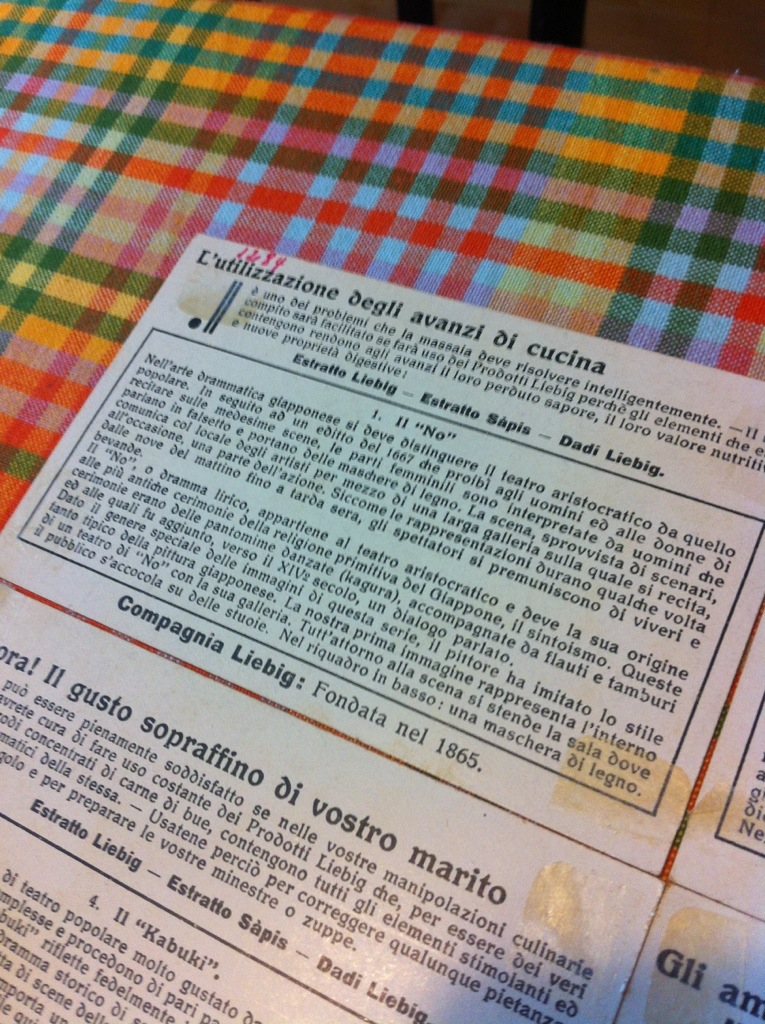
During a brief stop in Italy some time ago I purchased on Ebay this set of six 1960s (I think) trading cards by the famous meat extract company, Liebig. The six cards introduce different Japanese performance traditions (Noh, Kabuki, Bunraku), along with recipes and cooking suggestions. Most cards show kabuki-like scenes (rather generic, I think) and Noh-like masks, grotesquely drawn by an amateurish hand – take a look at the ja 蛇 mask (top-right), looking like some kind of deformed alien with antennas sticking out.

This set of cards adds up to my collection of Italian japonisme goods (Japonisme and all its aesthetic paraphernalia did not end at the same time in all Western countries). I wonder whether there is an English version of the same set…

20130507-183340.jpgThe best part is actually the back of the card. For example the pictured below introduces to Noh (in the box) and explains how to properly re-utilise kitchen leftovers.

20130507-183403.jpg

Notes on translation

20130427-064215.jpgI’m on an airplane, working on my translation of Kiyotsune into Italian. The beauty of the poetry is too much to take and I cannot stop the tears rolling down my face. I do my best not to be too self-indulgent, but… It sometimes happen at okeiko, too, and I think I saw my teacher also crying when we were rehearsing the ji-utai for Tomoe.
Anyways, I just wanted to jot down a brief thought, perhaps a truism. I feel lucky not being a Japanese native speaker because otherwise I would not be able to enjoy bringing Kiyotsune into my native language. All this work of searching, decoding, reflecting, writing, re-writing, changing, making mistakes, correcting them, modelling, adapting…. Translating… What a delight. What a moment of deep transformation and union with the character. Translation can’t be betrayal as long as one accepts that in this life everything is transformed. One thing is thinking it, another is feeling it.

Kiyotsune’s face #2

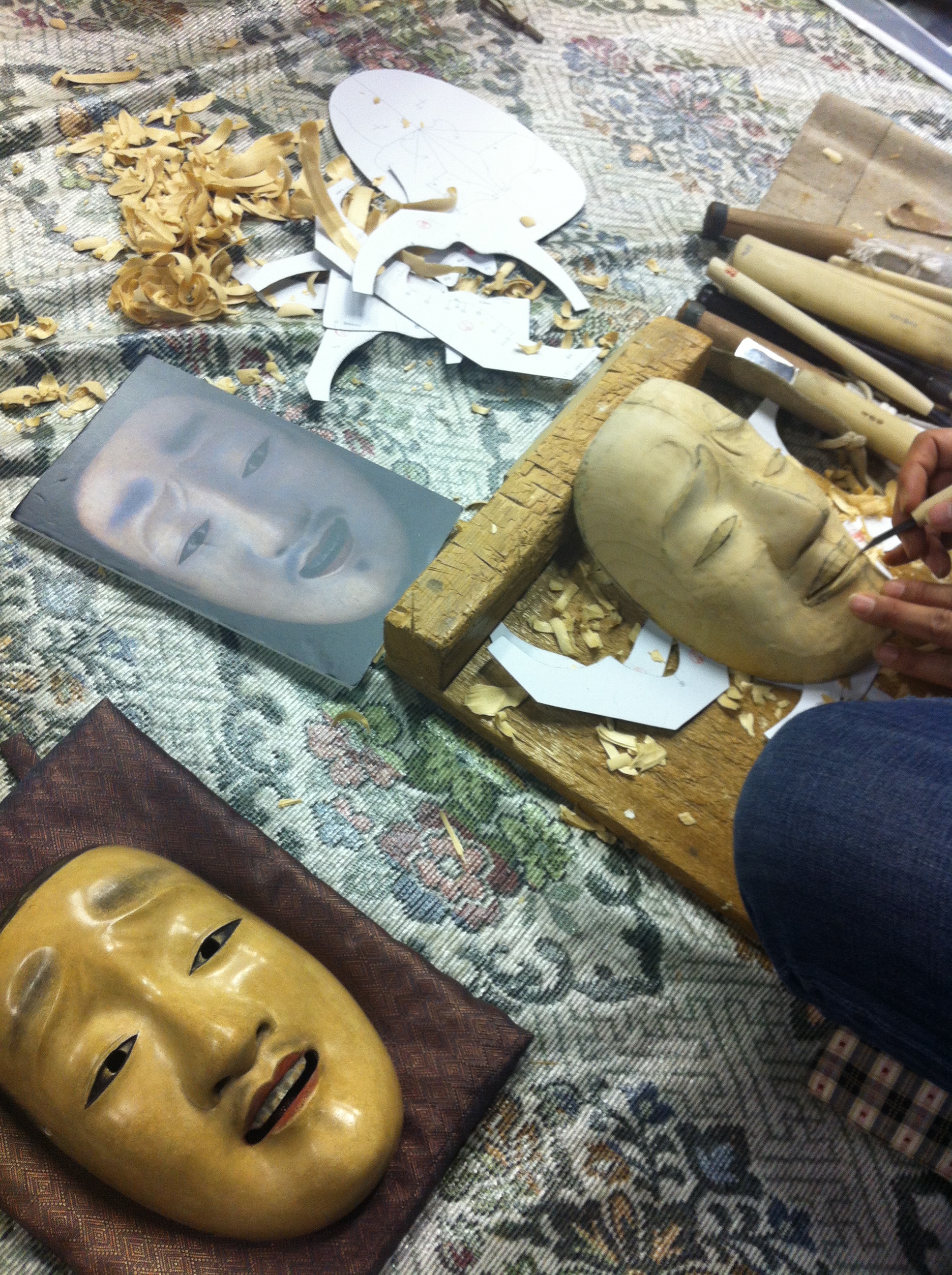
The mouth is now open. Kiyotsune is getting ready to tell his story.

In this picture you see Hea-Kyoung carving the chūjō mask I will use for Kiyotsune. At the bottom left is one of Udaka-sensei’s chūjō which is used as a model. A the top of the picture you can see paper shapes used to check the progress of specific portions of the mask.

IMG_2430

In the picture below you can clearly see the mouth just after being opened. ‘Frowning’ eyebrow marks are also deeper now.

IMG_2431

Thoughts and pictures from the Noh workshop at HUB Kyoto

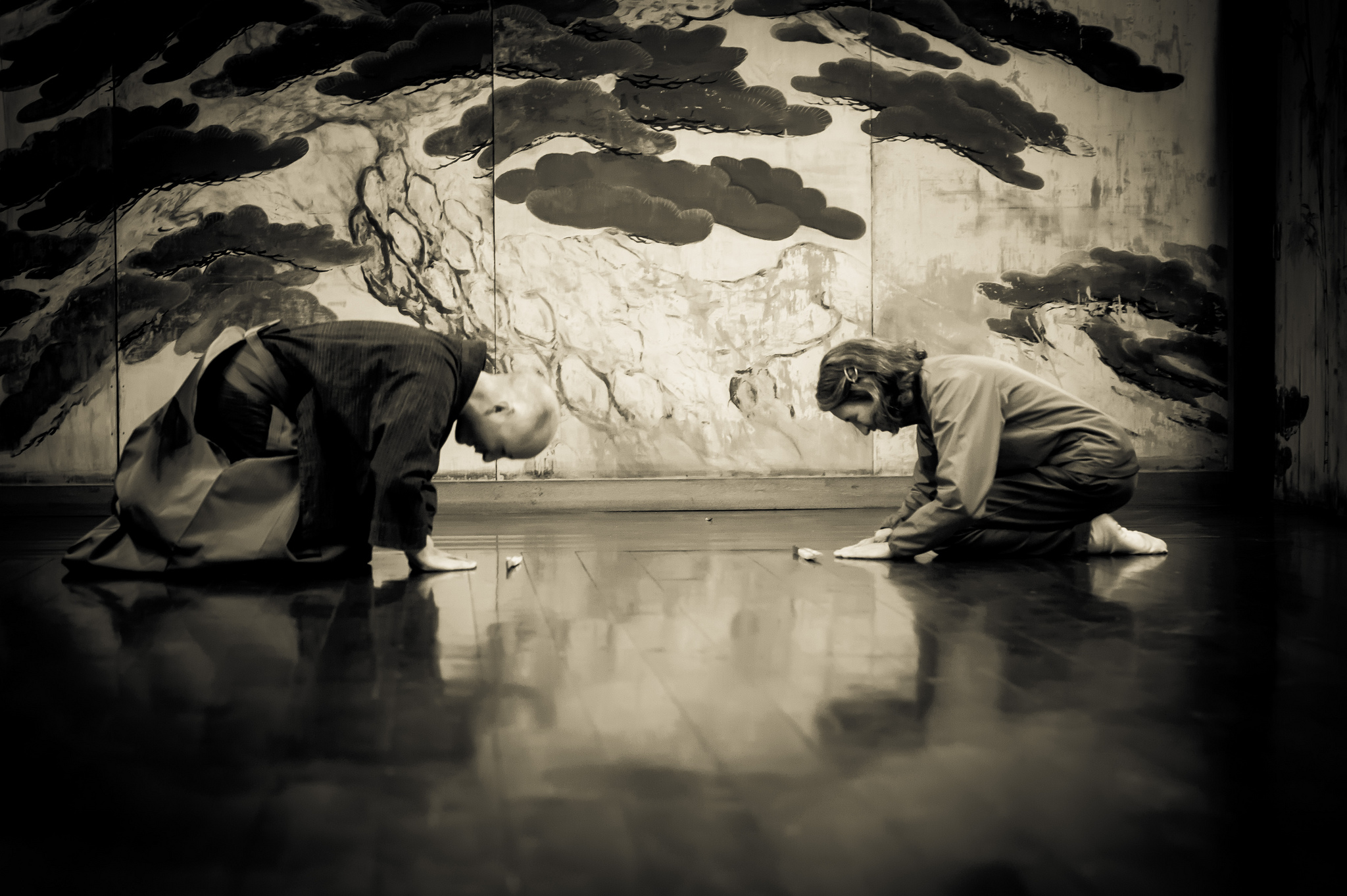
On Sunday 21st April I led a Noh theatre workshop for foreigners at the HUB Kyoto, Kyohakuin. It’s been a wonderful experience and a great chance to meet foreigners who share an interest in Noh and who are willing to try their best with Noh utai chant and shimai dance. Kyohakuin is an ex-school featuring a Noh stage which was not used for several decades. Recently the kagami-ita backdrop pine tree has been restored by Kim Hea-Kyoung and Ichimiya Keiko, and the participants of this workshop as well as myself had the privilege of dancing the shimai Oimatsu (‘Aged Pine’) in front of the renovated pine tree for the first time.

Diego and Carol Begert – ‘arigato gozaimashita’

Teaching absolute beginners is a very instructing experience for the teacher, too. Teaching a full, albeit brief, dance to people who never even walked the suriashi sliding step is very challenging, yet I find fascinating how all participants identify dance elements differently and focus on various parts of the dance according to their own decoding tools and processes.

Photographer Stéphane Barbery joined us and took the awesome picture you see on this post. Stéphane has a long-term project on Japanese traditional arts, and has photographed a number of Noh professionals so far. You can check his work on his Flickr account here.

THANKS to Lucinda Cowing and Eri Suzuki of the HUB Kyoto for helping organise and promote the event: I very much enjoyed this workshop and I am looking forward to the next one!

Julien de Vries
Izumi Texidor
Diego Pellecchia
With Hea-Kyoung's ko-omote
With Hea-Kyoung’s ko-omote

Kiyotsune’s face

I consider myself a very ‘lucky’ (in the commonsense meaning of the term) person in many ways. Among these, one of my favourite is having a partner who carves Noh masks. Not only it is interesting to share a passion with someone who has a  different insight from yours, but also it is wonderful to be working towards the same goal, in this case my first Noh, Kiyotsune. Hea-Kyoung has been working on this Chūjō (中将) under the supervision of Udaka-sensei. This is a rather standard version of Chūjō (the name of a military rank, sometimes translated as lieutenant or captain – if you know more let me know), used for roles of young warriors of the Heike clan, or for roles of aristocrats, as in the Noh Tōru. I will talk about this mask more in future post – for now here are a couple of pictures of how Kiyotsune’s face is coming into being.

IMG_2297
Chujo, Noh mask by Kim Hea-Kyoung
IMG_2301
Chujo, Noh mask by Kim Hea-Kyoung
IMG_2298
Chujo, Noh mask by Kim Hea-Kyoung

Noh workshop at HUB Kyoto

On Sunday 21st April the INI International Noh Institute will hold a Noh workshop at the HUB Kyoto, Kyohakuin (see below for details & directions).

Noh Workshop info

NOH THEATRE WORKSHOP

INI Encounters with Noh Series

at HUB Kyoto

21 April, 14:00-17:15


Noh drama, Japanese traditional theatre of masks, music and abstract and mimetic movement, is the world’s oldest masked performance tradition. It has been performed uninterrupted for over six hundred years, and in 2001 was designated an Intangible World Heritage by UNESCO. Noh portrays a world where the boundaries of past, present, and future blur and our consciousness of memory, the moment, and anticipation of what is to come unite. In this singular environment, the spirits of elegant ladies and fierce warriors, gods and goddesses, flowering plants and demons appear and share nostalgic memories of their desires and attachments.

In the INI Encounters with Noh Workshop at HUB Kyoto, participants will learn the basic principles of Noh theatre in the tradition of the Kongō School. This includes basic meditation in preparation for training, physical/vocal warm up exercises, chant and dance movements through the study of a short dance excerpt.

No previous knowledge of Noh is required. The workshop will be conducted in English.

The workshop will be led by Dr. Diego Pellecchia, Noh scholar, student of Udaka Michishige, and active member of the International Noh Institute.

Students are kindly asked to bring comfortable clothes and socks (preferably white)

Participation fee: ¥5,000

Concessions (students): ¥2,500

Observation fee: ¥1000

This workshop is restricted to 10 places. Please book by e-mailing hubkyoto@gmail.com

About the INI – International Noh Institute

The International Noh Institute was founded in 1984 in response to the urging of foreigners studying with UDAKA Michishige as members of his student group and participants of intensive courses. Since then, UDAKA Michishige has taught students from various disciplines, including actors, dancers, psychologists and scholars, from thirteen countries through INI programs.

Access

HUB Kyoto, Kyohakuin, 682 Shokokuji monzen-mae,

Kamigoryomae-agaru, Karasuma-dori, Kamigyo-ku, Kyoto

TEL: 075-417-0115

Nearest station: Kuramaguchi on the Karasuma Subway Line.

Walk 3 minutes south (towards Doshisha University, Imadegawa-dori) on the east side of Karasuma-dori. Kyohakuin is between a tobacco shop and koban police box.