is the theme of this year’s UDAKA Michishige Men-no-KaiNoh mask exhibition. The 14th edition of the exhibition will feature works of Master-Actor UDAKA Michishige, possibly the only Noh actor who is also a professional mask carver, as well as several masks carved by his students. the exhibition will open tomorrow Tuesday 27th November and close on Thursday 28th November. Wednesday at 13:30 it will be possible to attend a talk by UDAKA Michishige and a Noh costuming demonstration. See below for more details and access information.
UDAKA Michishige’s work as Noh mask carver has been collected in various picture books, among which The Secrets of Noh Masks published by Kodansha International.
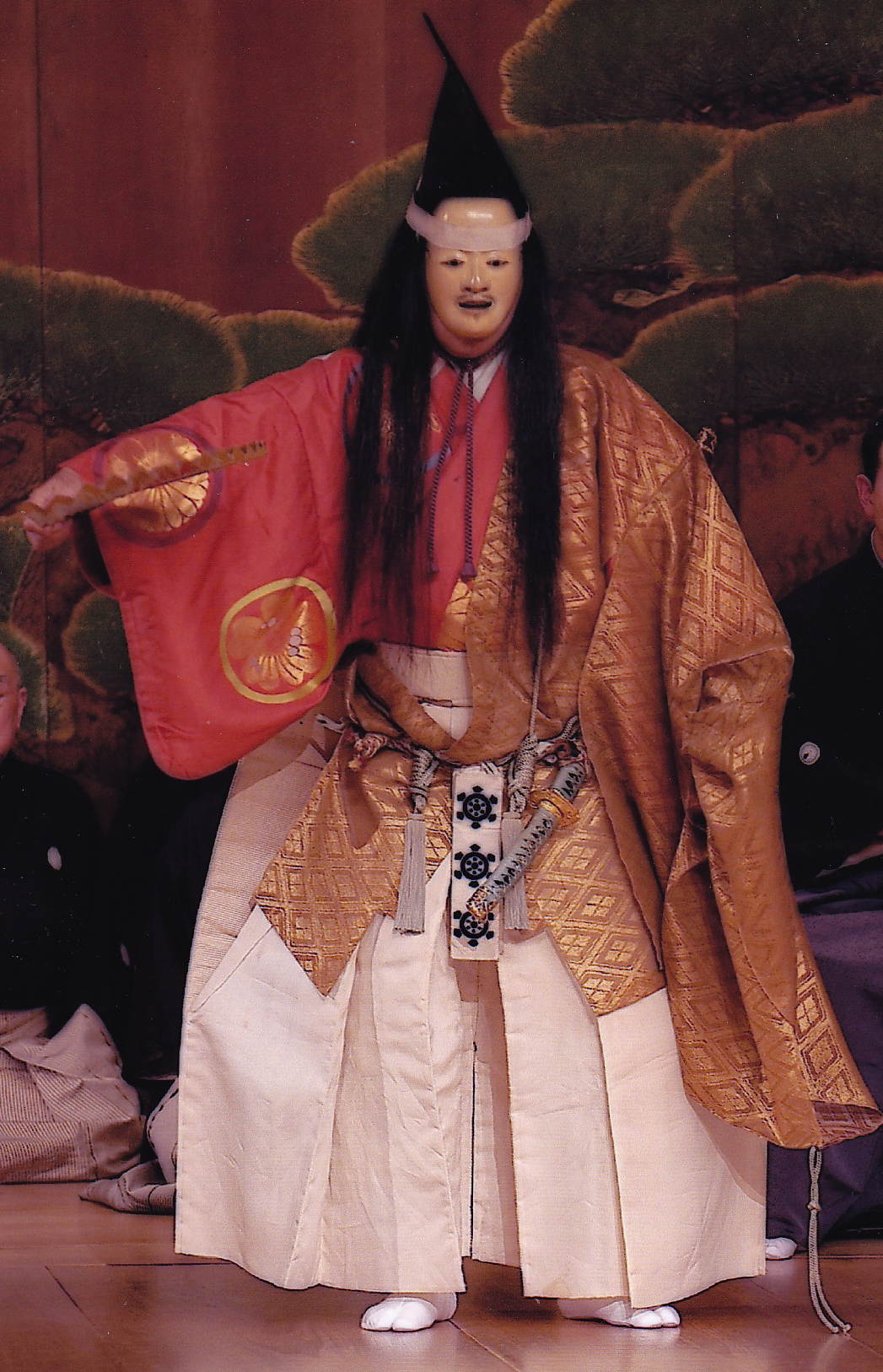
Noh: Michimori. Mask: Chujo, by UDAKA Michishige. Photograph by HARADA Shichikan
The 14th UDAKA Michishige Men-no-Kai Mask Exhibition
At the Kyoto Prefectural Center for Arts and Culture 2nd Floor
Kawaramachi Hironokoji-sagaru, Kamigyo-ku (across from the Prefectural Hospital)
10:00 a.m.~6:00 p.m. (5:30 p.m. on the 28th)
28th (Wednesday)1:30 p.m. Talk and Costuming Demonstration by UDAKA Michishige
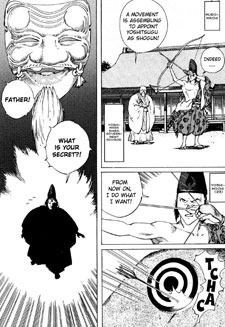
An image from ‘Ikkyū’, by Sakaguchi Hisashi (Kodansha)
On October 23 2012 the twelfth edition of MANABU, a seminar for Italian researchers hosted by the ISEAS (Italian School of East Asian Studies) took place. The event, which I had the pleasure to organise, was hold in Italian so here are some notes in English for those who could not attend. The meeting brought together scholars from various research fields: Matteo Casari (Bologna) is an anthropologist, Katja Centonze (Tokyo) specialises in contemporary dance/performance, Monique Arnaud (Venice) is a Noh instructor and theatre director, and myself. Silvio Vita, director of ISEAS, has been a wonderful host, facilitating the discussion and organising post-meeting events.
Matteo Casari (University of Bologna) introduced the topic of Noh and Manga, looking at Noh-inspired manga such as Hana yori mo hana no gotoku and Ikkyū (which, I learnt, is surprisingly translated in Italian) and to manga-inspired Noh, such as Umewaka Rokurō’s Kurenai Tennyo. Katja Centonze described the work of dancer/musician/choreographer Alessio Silvestrin and his collaboration with Noh practitioner Tsumura Reijirō, presenting clips of Kakekotoba, Monique Arnaud talked about her directing work in Venice, showing clips of her most recent production Silent Moving, taking place in the interiors of the magnificent Palazzo Ducale, Venice, implementing techniques borrowed from Japanese traditions such as bunraku in a modern ‘Theatre du Complicite’ style. My presentation introduced the issue of limiting the study of Noh to Japanese literature departments. I suggested that, in order to prevent Noh to become a museum piece, it should be also studied as performance in theatre departments, just like Shakespeare or Aeschylus are.
After the conference we went to my teacher, Udaka Michishige’s okeikoba in order to observe the training session. Since Arnaud and I are both students of Udaka-sensei, we were called on stage for our okeiko. This was not my intention as I thought we would go with the purpose of introducing our guests, but it is difficult to say ‘no’ to your teacher…
We enjoyed the day, especially the rare chance to discuss with members from different backgrounds, and we concluded the day agreeing on the intention of creating another similar event (in English) in the not-so-far future.
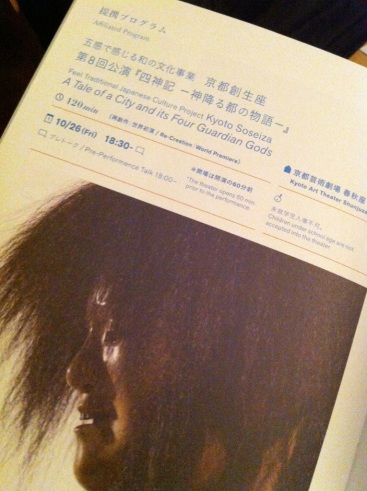
Last Friday I went to see A Tale of a City and its Four Guardian Gods, a Soseiza production that closed the Kyoto Experiment, performing arts festival 2012. The performance featured Kabuki and Noh actors interacting on stage. The venue was the Shunju-za, a full-fledged Kabuki theatre built within Kyoto Zōkei University. Before the staging of the play some of us who applied were taken to a backstage tour of the theatre. All I can say is: ‘holy cow!’ The theatre is unbelievable, and features a mawari butai rotating stage with two rectangular modules that can be lowered and raised independently, wiring for fly-over action, and of course a hanamichi. Japanese universities certainly do not lack funding for this kind of enterprise.
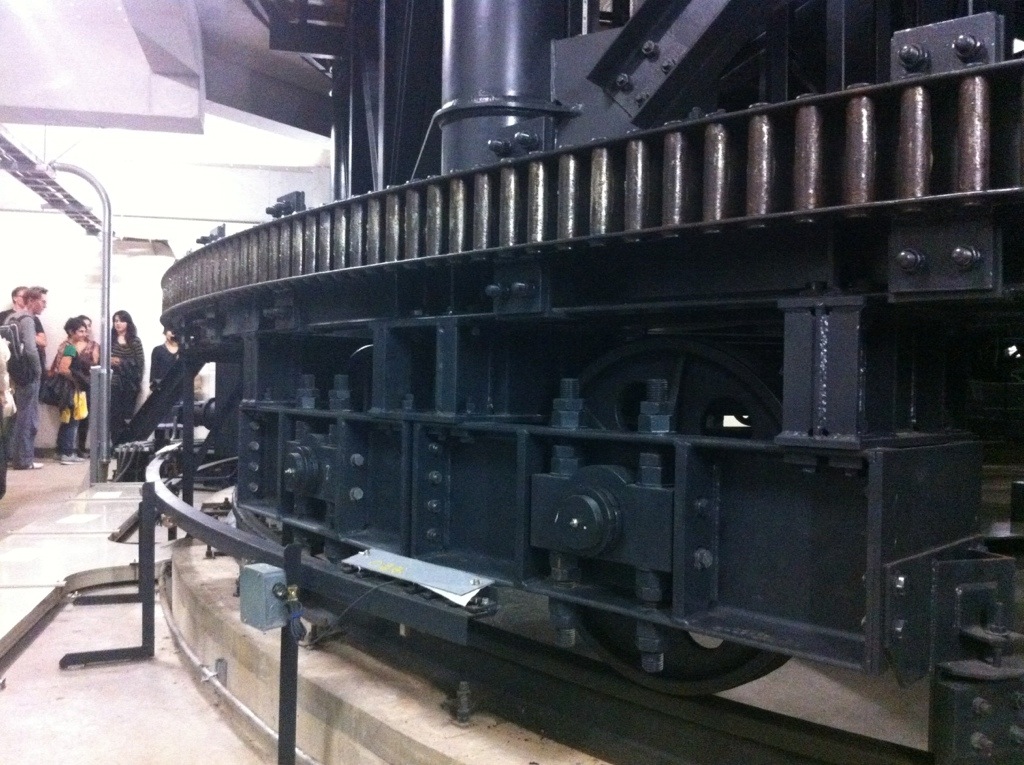
The massive cog that moves the rotating stage
All this beauty is used for all sorts of performances, from classical plays to more experimental stuff such as what I saw on Friday. I must say I was not impressed by the play. To put it bluntly, having Noh and Kabuki sharing the same space seems to be detrimental to both. Kabuki ends up looking like a children panto, while the Noh bits are deadly boring. One of the issues with the Noh actors, who interpreted rather dynamic characters (a warrior and a tiger) was that on such a large space Noh movements lose all intensity. I have seen Noh performed in wide spaces and I keep on feeling that Noh needs the cubical space produced by the ‘orthodox’ Noh stage. Wide spaces flatten the movements, and do not offer a sufficiently tight framing for the intense but minimal Noh gestures.
One thing that bugged my about the performance was the paradox of having different styles on stage without a real attempt at dialogue, except for the fact that… they were both on the same stage, and maybe for a couple of musical moments where the Noh orchestra (sitting on the left) ‘dialogued’ with the Kabuki orchestra (sitting on the right) – they actually played the same tune. This is so typical of the Japanese traditional arts. Fragmentation. Together, but apart. The result was actors who want to talk to each other, but can speak (or want to speak) only their native language, and in the end do not seem to really understand each other.
Those nerds who know videogames might get this: the performance looked like one of those beat’em’up video games, in which a sumo wrestler fights with a muay-thai boxer – it just looks unnatural.
Anyway, it was worth going and I hope I look forward to future Soseiza works that would more baldly experiment with a deeper interaction of their arts.
This post is about a research seminar that I have organised in Kyoto, coming up in a few days. This is probably my first post in Italian, so I just wanted to warn my readers. I will report about the event (in English) towards the end of the month so stay tuned ^^
La tradizione oggi: uno sguardo interdisciplinare sul teatro giapponese
Seminario della serie ‘MANABU’, Giornate di studio dei dottorandi, borsisti e ricercatori italiani in Giappone
La giornata riunisce quattro ricercatori con formazione e interessi diversi (antropologia, studi giapponesi, studi teatrali, regia), e si propone di investigare la relazione fra tradizione e modernità nel teatro giapponese da un ampio spettro di prospettive (letterarie, critiche e pratiche). Gli interventi spazieranno dall’adattamento Nō dei manga al rapporto fra corpo e tecnologia, dall’insegnamento in ambito interculturale alla storiografia del teatro. A una presentazione del ricco panorama della ricerca sul teatro giapponese oggi, seguirà una discussione nella quale i partecipanti confronteranno teorie ed esperienze, incoraggiando un produttivo scambio di approcci che possa gettare le basi per ulteriori iniziative in futuro.
11:00-11:10 Introduzione
11:10-11:30 Matteo Casari (Università di Bologna) Il Nō e il Manga, un primo sguardo 11:30-11:50 Katja Centonze (Universität Trier) L’Erma Bifronte: Eclettismo nelle arti performative del Giappone che guarda alla tradizione e alla contemporaneità 11:50-12:10 Monique Arnaud (Università IUAV di Venezia) La regia come dimensione nascosta 12:10-12:30 Diego Pellecchia (Scuola Italiana di Studi sull’Asia Orientale) I confini della tradizione: Educazione al teatro giapponese oggi
Per informazioni:
ISEAS Scuola Italiana di Studi sull’Asia Orientale (ISEAS)
Tel 075-751-8132
Fax 075-751-8221
E-mail iseas@iseas-kyoto.org
Iori is a beautiful Kyoto machiya (traditional guesthouse), offering traditional art courses and art-related activities. In this clip Noh actor Udaka Tatsushige (son of my teacher, Udaka Michishige) is performing the shimai from the Noh Yuki (‘Snow’), a play that is exclusive to the Kongō school repertoire. In the Noh Yuki, a priest on his way to the Tennō-ji temple is caught in a snowstorm when he encounters a mysterious woman, who in reality is the spirit of snow. After reading a sutra, the woman dances as she disappears in a whirlwind of snow. I saw this Noh performed by Ogamo Rebecca Teele in the recital to which I participated June 2010. It is a very refined, delicate Noh, where all sounds and movements seem to be softened by the snow. Even the typical stomps of certain Noh dances are performed so that the feet softly touch the floor, producing no sound.
アートプロジェクト2012『奉納舞』Collaborate with Art and Noh Drama
“Kyoto Kyo-Machiya Stay Arts Project –Art and Noh Drama Collaboration-”
Iori Co. also offers a unique designed program for experiencing the traditional culture of Japan.
For cerebrating the first Project, there was Noh Drama performing collaborating with four Artists’ works of Art.
The other day I’ve been to this place in Kyoto where you
can eat all sorts of grilled food. Apart from the smoke and the
smell of barbecue that will oblige you to wash everything you wore
on that day, the food is pretty good and the staff nice and
friendly. I had scallop, squid and pumpkin – all grilled with real
wood fire. You have a choice of having whatever you order grilled
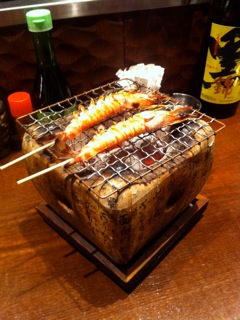
by the chef or to grill it yourself on small bracers with burning
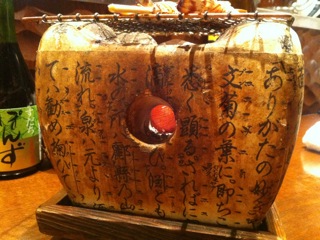
embers inside. This is where the
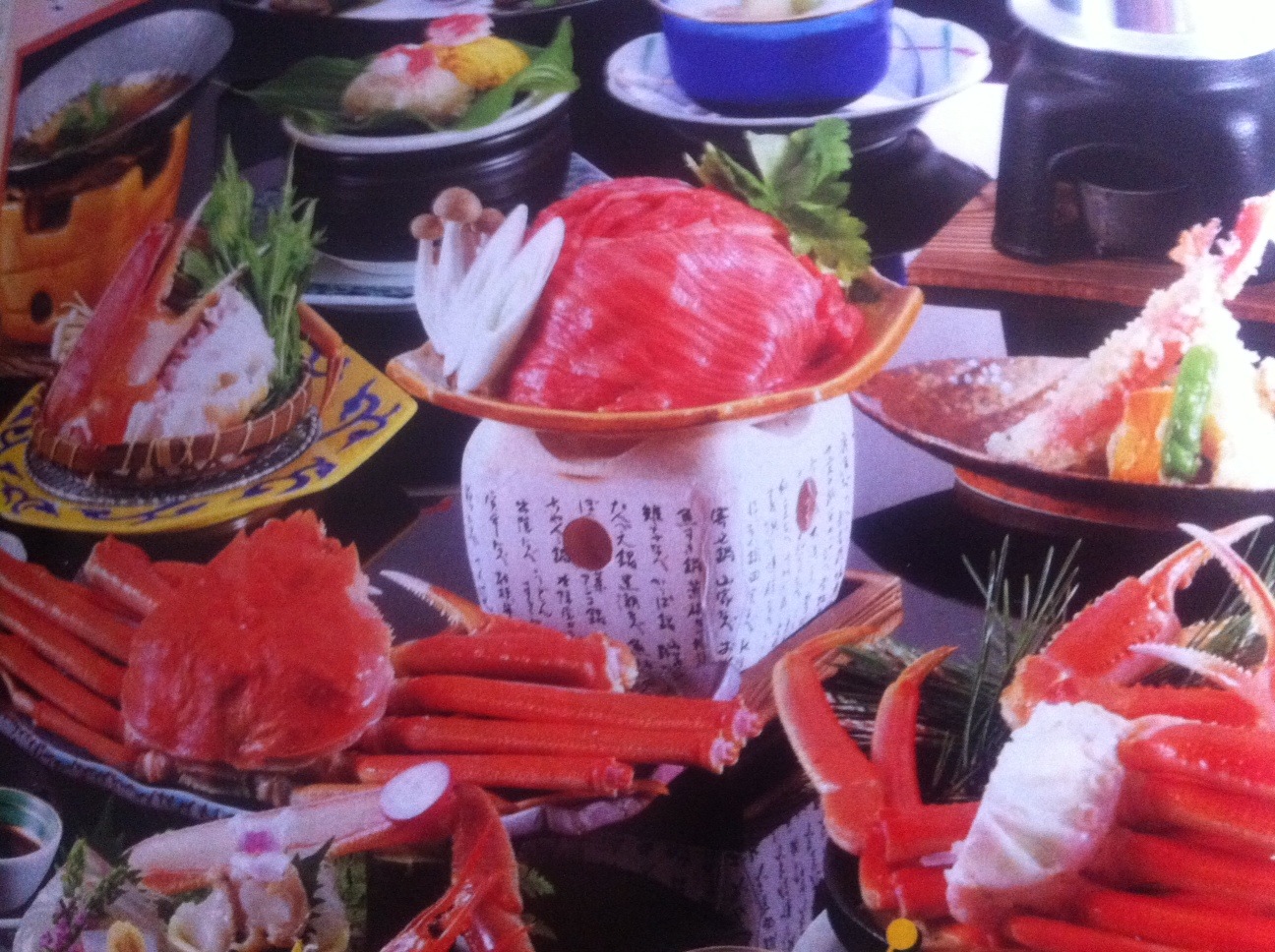
surprise came. The bracers are decorated with paper taken from Noh utaibon (謡本), or Noh chant libretti. Mine had Makurajido (枕慈童, aka 菊慈童) on. I was lucky
enough to be given an utai I already practiced, which was easy to
recognise. However, I realised
it is common practice to use paper from various traditional books
(with printed handwriting) on bracers. This is from the
advertisement of one of the many restaurants specialised in crab.
I find this custom rather interesting,
although a bit inappropriate, maybe.
This year I am spending my first new year period (お正月) in Kyoto. Although the temperatures seemed to be slightly higher than London (recently hit by a blizzard that seriously threatened my departure by having Heathrow and Gatwick shut for a few days), I reached Kyoto once the weather changed here too. We had rain, cold winds, snow and all that comes with the rigours of winter.
One of the most interesting events so far has been the New Year’s performance of Okina at Yasaka-Jinja in Kyoto on January 3rd (the shite was the Kongoh iemoto, Kongoh Hisanori). The New Year is probably the most important festivity of the year in Japan, and people use to pay their visit Shinto shrines (but actually Buddhist temples, too) for what is called 初詣, or ‘first pilgrimage’. Okina is a special performance that does not belong to the 5 ‘regular’ categories, but it is considered a sort of primal performance, although several critics see it as a form of ‘invented tradition’ part of the programme of national resurrection that began during the mid/late Meiji period. Despite philological speculation (with which I anyway concur), I have to admit Okina possesses an ancestral charm to which I unwillingly fall victim… as we say in Italian: ‘l’importante e’ crederci!’