New essay: Leoni che folleggiano fra le peonie in fiore

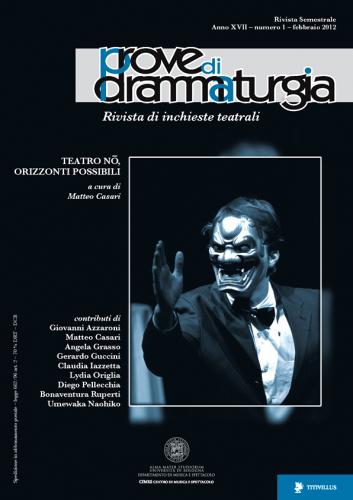
COPERTINA-Prove-1_2012.jpg.mediumThe new issue of the Journal Prove di Drammaturgia, entirely dedicated to Noh theatre, features my article on the first Noh theatre performance in the West in Venice 1954. The journal is available here. The journal is entirely in Italian, though I am currently working on an English version of the essay.

Prove di Drammaturgia n.1/2012

anno: 2012
numero: 1/2012
ISSN: 1592-6680
data di pubblicazione: febbraio 2012

TEATRO NŌ, ORIZZONTI POSSIBILI
a cura di Matteo Casari

EDITORIALE
  A partire dal Teatro nō: una dinamica a doppio binario
TEATRO NŌ, UNA TRADIZIONE CONTEMPORANEA
Atti del convegno 
(Bologna, Salone Marescotti, 10 novembre 2011)
Umewaka Naohiko, La fisicità nel prendere un caffè
Umewaka Naohiko, Passeggiata in casa: appunti di un attore nō sul confine tra il mondo interiore ed il mondo esteriore
Matteo Casari, Il nuovo nō: continuità di discontinuità
Bonaventura Ruperti, La creazione di nuovi nō in epoca moderna. Il fascino inesauribile di un’arte
Claudia Iazzetta, Il nō, l’arte dell’incontro
Giovanni Azzaroni, La tradizione resistente. Conservazione o innovazione: qui sta il problema
Lydia Origlia, Yukio Mishima e l’incantevole mondo del nō
Diego Pellecchia, “Leoni che folleggiano fra le peonie in fiore”: spettacoli di teatro nō al XIII Festival Internazionale ‘Biennale’ di Venezia (1954)
IL RISTORANTE ITALIANO
Umewaka Naohiko, Il ristorante italiano. Lo spettacolo più bello del mondo
Angela Grasso, Teatro nō. Polarità a confronto. Recensione dello spettacolo “Il ristorante italiano”

March 11/Sunday Great East Japan Earthquake Memorial Service and Prayer for Rebuilding at Soji-ji, (Soto-zen Daihonzan)

A memorial service and votive performances in celebration of renewal
and reconstruction
will be held at Sojo-ji in Tsurumi Ward, Yokohama.
Schedule of events:
11:30  Memorial Service
12:00  Offering of a Taiko drum performance by 108 volunteers and flower arrangement offering
12:30  Chanting of the Kannon 10 Great Prayers
12:45  Noh:  SHAKKYO Sange-no-shiki”  Shite (White Lion) : UDAKA Michishige, Tsure (First and Second Red Lions): Tatsushige and Norishige
13:30  Special Lecture
14:46  Silent prayer as the temple bell is rung to mark the time of the earthquake

実盛表

Admission:  free of charge
For information in Japanese call the Daihonzan Sojo-ji information
office: 045・581・6021
Access: click here for a map in Japanese

‘Honourable guests’ and the promotion of Japanese performing arts

This is the worst of the off-topics of a Noh specialist, but… as I am preparing a Kabuki class for my 2nd year drama school students, I was browsing YouTube searching for interesting videos that might show the ‘behind-the-scenes’ of a Kabuki production. I bumped into the video below, a Kirin Beer commercial featuring Ichikawa Danjuro XII (thank you Matt for the identification) posing as Kamakura Gongoro from the play Shibaraku. So far nothing special – Kabuki actors often feature commercials for famous brands of tea, beer, etc. What caught my attention, though, comes towards the end of the commercial, when Danjuro is portrayed as having a refreshing beer after the performance, surrounded by a group of foreigners in tuxedos, who listen in amusement to his stage tales.

It is not uncommon to see foreigners featuring Japanese commercials, sometimes playing comic character, most often portraying cast-types of various Western ethnicities (a while ago I saw this ‘Italian’ whose nose really pierced the screen). However, this scene in the Kirin commercial somehow reminded me of the imagery of the ‘honourable guests’, Western visitors – diplomats and academics – that during the Meiji period attended Noh performances, and of whom the Noh establishment took much pride. In those days, Kabuki was considered popular and vulgar, hence unsuitable to entertain the high-ranking foreign guests. Of course, things have now changed, and despite a certain look of disdain from the world of Noh, Kabuki is by all means considered one of the treasure of Japanese traditional culture, and is often promoted internationally. Mukashi mo ima mo, the Japanese tradition takes advantage of the foreign eye on it in order to improve its self-image, and this seems to have been quite clear to the writer of the Kirin commercial, who carefully devised the script so that Danjuro would be the star not only of an indigenous product, but of an art of international value. And so is Kirin.

Everyone’s on Facebook

Ok this might be slightly off-topic but it’s not (read to find out why).

It sounds pretty obvious to say that ‘everyone’s on Facebook nowadays’. What is less obvious is to notice how Facebook’s standards flattens the way people can interact with each other. While this might not be particularly shocking if taken within the boundaries of a singular cultural area, things change when the protagonists of this new form of digital sociality belong to different backgrounds.

Japan had social networking before we got it: it’s called Mixi and, like all things Japanese, it’s a closed, invitation-only network. Normally you cannot get a Mixi account unless you have a Japanese mobile email address. How so? Well, simply because you cannot buy a Japanese mobile phone unless you are registered with a long-stay visa in Japan = no phones for tourists. The only option you have is knowing someone who is already registered to Mixi (i.e. a Japanese resident, an exchange student or someone on a working visa). This is just one of the many signs of the ‘fear of the alien’ that is so much rooted into Japanese culture (huge discussion of this in Japanese sociology – I’m not going there now) and that is now expressed in the digital universe, too.

However, things are changing. Twitter has now taken over Japan (check out the numbers) – because Japanese language can express longer concepts with fewer signs, because it is more discreet with fewer pictures/info on profile, and because it is more discrete, with no ‘circles’ but preference of direct crosstalk.

So what about Facebook? It has been a year or so since I started to see my Japanese friends’ profiles appearing on FB. In the beginning it was mostly people who did a year abroad, who could speak a second language (mostly English) or who had any sort of friendship or relationship with non-Japanese people. However, there has been a recent significant increase in full-Japanese FB pages: the network of my Japanese friends has now reached the same magnitude of my non-Japanese group. What has struck me recently is not only how I can now communicate with Japanese friends in Japan (and the peculiarity thereof) but also how I can (or I should say ‘I could’) see their pictures, likes, conversations, and other private information from which I was naturally precluded in the past years.

Facebook mixes everything: students with teachers, bosses with co-workers, masters and pupils. While it is normal to see people such as musicians, actors and dancers on Facebook, one can now see the profile of Noh performers. Of course, you need to be friends with them before you can actually access the profile, but still it is not too improbable to have your request accepted if you have signs of belonging to the Japanese traditional arts showing on your profile. What’s so special about this? To put it simply, Noh is not like Kabuki and other arts that are based on the cult of the individual performer. Kabuki actors have their names and faces on posters hanging everywhere, they feature TV dramas, commercials etc. Articles talk about them, and people know their faces. Noh is nothing like this. Actors wear masks, they don’t come back on stage to take applauses, and most of all their faces are unknown to the general public. There is an aura of mystery enveloping them, which has to do with the semi-sacrality of their art, but also with the secrecy that surrounds their practice. Or so it was until Noh started to be popularised by new media, and most of all through the digital tools such as the Internet.

I’m not judging which is best here: I just felt the urge to collect this datum as I think it is a sign of the times. As Prof. Nishino Haruo has pointed out, the increasing use of information material on Noh is demolishing its fundamental component of secrecy and mystery that has contributed to its success and survival for centuries. This is the next stage: not only the art, but also the artist. Next to my elementary school friend I have the face of a renowned Noh actor to whom I usually bow – now how’s that?
Sakura. Tribute to Japan

It is difficult to find words to illustrate what was meant to describe the indescribable.

This is Sakura. A Tribute to Japan: an Italian project by Gio’ Fronti,  directed by Alessandra Pescetta, and starring Monique Arnaud, a short film dedicated to the victims (dead and alive) of the Fukushima disaster. Arnaud, director of the International Noh Institute branch of Milan is the only Noh shihan (licensed instructor) to be currently active in Europe as teacher and performer. Her dance in the video is inspired by Noh movements, and she wears a costume realised by disassembling 10 paper tracksuits that recall those worn in contaminated areas, and by sewing them together into a Noh-inspired costume. The voice (in Japanese, subbed in Italian) describes the dreadful coming of the tsunami, when the clouds fell into the ocean, and the sky was left empty. But with the wind comes the beauty of cherry blossoms… Please click on the picture below to watch the video on Vimeo (I could not embed).

Sakura. Tribute To Japan from videodrome-XL on Vimeo.

Resource: National Archives of Japan

Awesome! Thanks to tnguyen3729 for the heads-up! Now I know what to do this lazy Christmas Sunday!

tnguyen3729's avatarWhat can I do with a B.A. in Japanese Studies?

Interested in archives or history? Check out the digital collection available through the National Archives of Japan!

About

The National Archives of Japan (NAJ) Digital Archive provides access to digitized images of preserved historical records. Users can search for the descriptions and view the digitized images of the records within their collection.

Contents

There are 1.23 million volumes (approximately 6.12 million images) divided into two major categories within the NAJ: The Government Records and the Cabinet Library and Important Cultural Properties.

The Government Records and the cabinet library contains description of about 750,000 volumes which were transferred from the ministries and agencies of the government of Japan. There are 480,000 volumes of both Japanese and Chinese books offered. Records are continually added to the collection including records related to the Constitution of Japan, reformation of the administration after World War II, etc.

Important Cultural Properties provides over 1,400 digitized…

View original post 559 more words

Noh pop songs

Just a quick link to report something I bumped into: three songs by Kyūko and Aina, based on the themes of three Noh plays: Teika, Ominameshi and Shōjō. As the authors specify in the description of the video, they have only been inspired by the content of the plays, and freely developed the lyrics on their own.

Despite the production of the songs, vaguely reminding some tacky period drama soundtrack, I actually find the experiment interesting, and I am honestly impressed by the huge leap the authors have taken by transforming something like Noh, often understood as old and venerable, into something so easy-listening: the characters of the three plays must be so alive in the imagination of Kyūko and Aina. The video also includes a link to an internet shop where it is possible to purchase postcards with bunnies in Noh costumes…